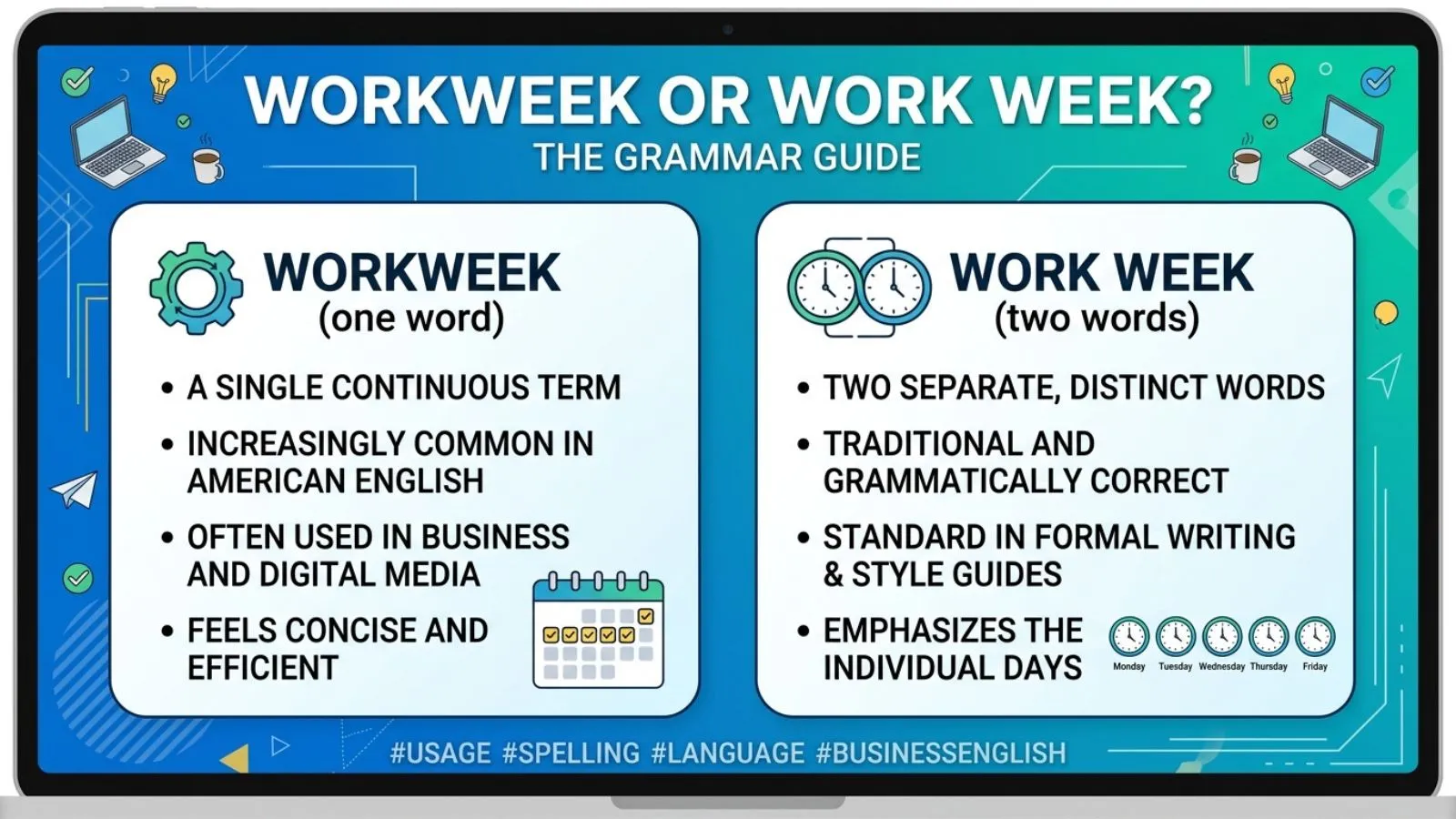
Hey, I want to share something that happened to me recently about Workweek or Work Week.
I was chatting with a friend when I suddenly saw this term pop up, and honestly, I had no clue what it meant at first.
I kept wondering, “Am I missing something here?” It was a bit confusing, and I didn’t want to respond the wrong way.
But when it comes to describing your working days, should you write “workweek” as one word or “work week” as two?
So, I decided to look into Workweek or Work Week and figure out its meaning and context.
After understanding it, I realized how important it is to know these terms to avoid awkward situations in conversations.
I handled it by learning the proper meaning and responding confidently, and now I feel ready whenever I see Workweek or Work Week again in chats, emails, or social media.
Workweek or Work Week – Quick Answer
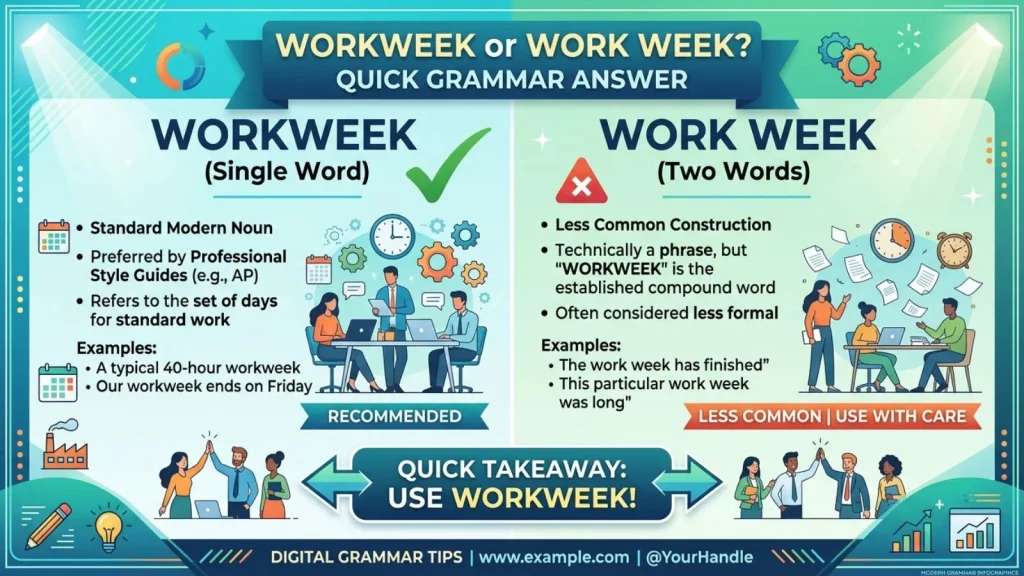
Both spellings are correct. The one you should use depends on where you are and who you’re writing for.
- “Workweek” (one word) is standard in American English. Example: “Our workweek runs Monday through Friday.”
- “Work week” (two words) is more common in British and Commonwealth English. Example: “Her work week starts on Sunday in some regions.”
- “Work-week” (hyphenated) appears occasionally but is the least common form today.
If you’re writing for a US audience, use “workweek.” If you’re writing for a UK, Australian, or Canadian audience, “work week” is safer. For global or mixed audiences, pick one spelling and stay consistent throughout your document.
The Origin of Workweek
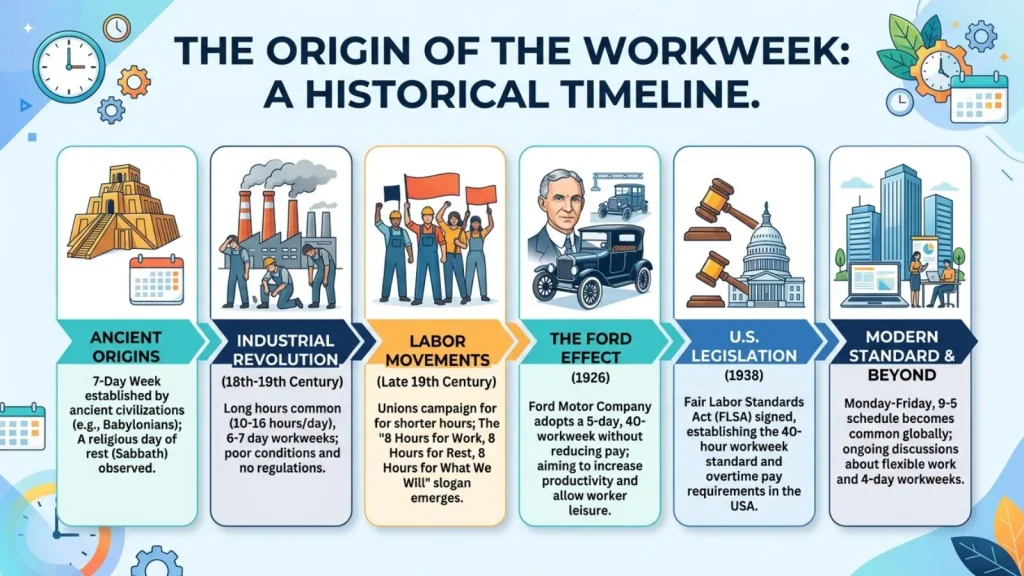
The word combines two simple English terms: “work” and “week.” Together, they describe the block of days set aside for paid labor, as opposed to the weekend.
The concept became formalized in the early 20th century. Before that, many people worked six or even seven days. The idea of a fixed “workweek” grew alongside labor reforms. In the 1920s and 1930s, businesses and governments began setting standard limits on working days and hours. The five-day, 40-hour workweek became common in the United States by the mid-1900s, largely following changes made by major employers and later supported by labor laws.
As the term spread through business and legal writing, it started merging into a single word in American usage. This mirrors a common pattern in English: two-word phrases that get used often tend to compress over time. “Weekend” followed the same path. It used to be written “week end” before becoming one word.
British English held onto the two-word spacing longer, which is why “work week” still feels more natural in UK writing today.
British English vs American English Spelling
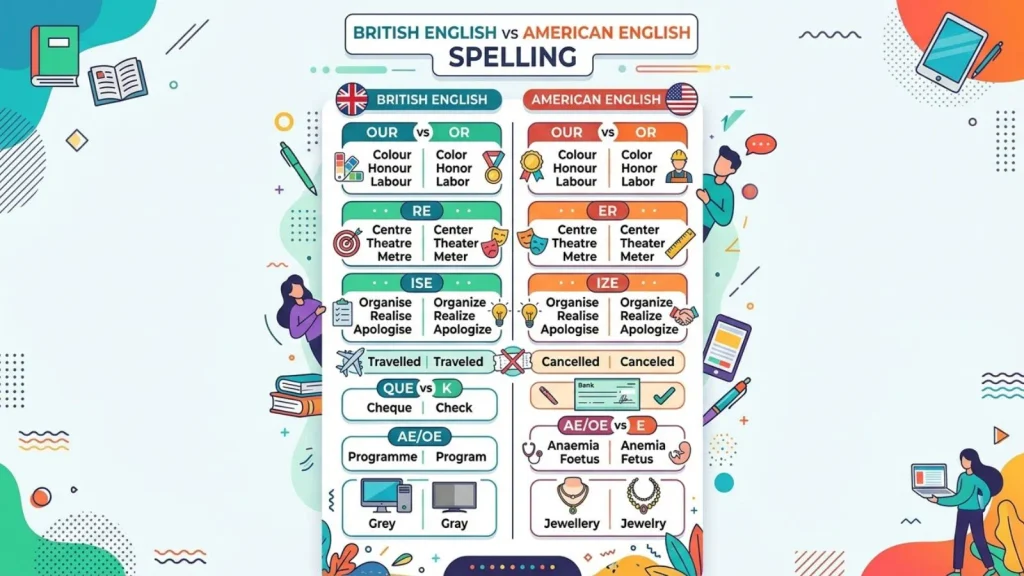
Spelling differences between American and British English aren’t random. They follow patterns you can learn once and apply everywhere.
American English tends to close up compound words faster. British English tends to keep words separated or hyphenated for longer. You see this same pattern in other word pairs, not just “workweek.”
| Word Type | American English | British English |
| Work + week | workweek | work week |
| Week + end | weekend | weekend |
| Health + care | healthcare | health care |
| Data + base | database | data base (older usage) |
| e-mail (older usage) |
Note that “weekend” merged in both dialects long ago, showing that these patterns aren’t fixed rules. They shift over decades based on common usage. “Workweek” is still mid-shift, which is exactly why the confusion exists today.
Which Spelling Should Use Workweek or Work Week ?
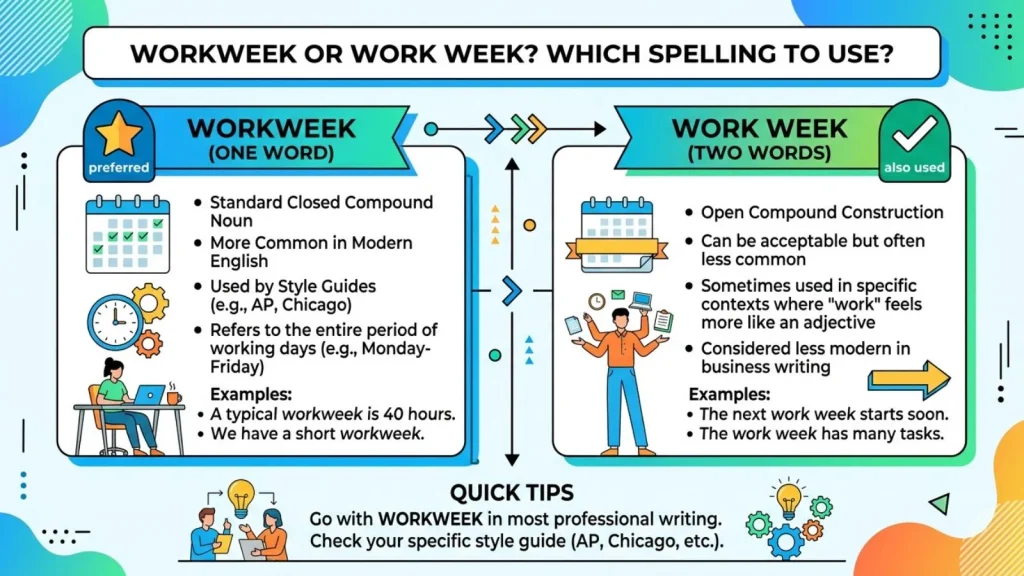
Your choice depends on your audience, not personal preference.
Writing for a US audience: Use “workweek.” It’s the standard form in American style guides, business writing, and HR documents.
Writing for a UK, Australian, or Commonwealth audience: Use “work week.” It matches local convention and reads naturally to that audience.
Writing for a global or mixed audience: Pick one spelling and use it consistently. Consistency matters more than which version you choose. Switching between “workweek” and “work week” in the same document looks careless, even though both are technically correct.
Writing for SEO or content marketing: Check what your target audience searches for. US-based search traffic favors “workweek.” UK-based traffic favors “work week.” If you’re targeting both, you can naturally include both spellings across your content to capture search traffic from each group.
Common Mistakes with Workweek
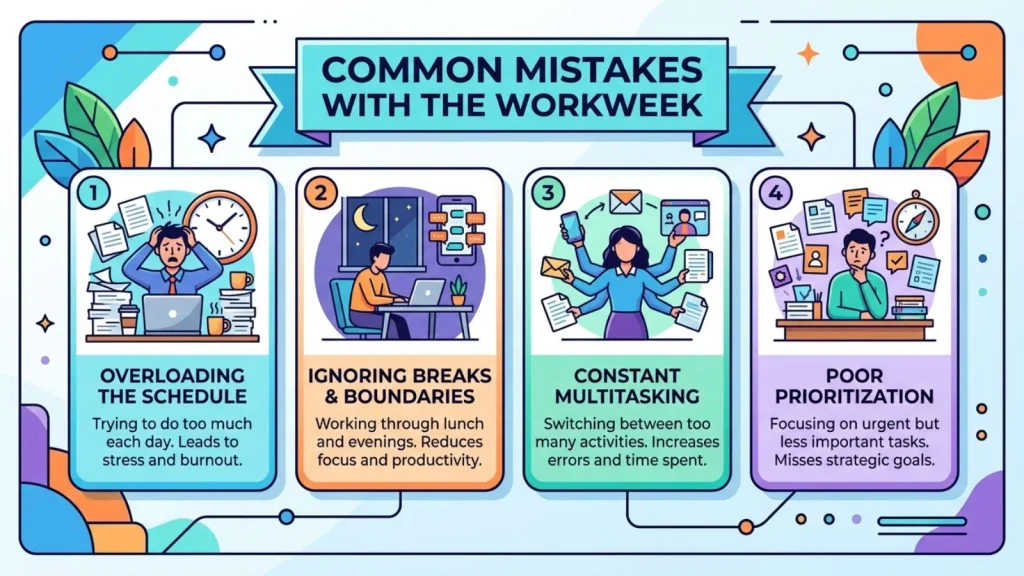
Even careful writers slip up on this word. Here are the most frequent errors.
Mistake 1: Mixing spellings in one document Wrong: “Our workweek is five days. The work week starts Monday.” Fix: Pick one spelling and use it throughout.
Mistake 2: Adding an unnecessary hyphen “Work-week” isn’t wrong, but it’s outdated and rarely used in modern writing. Stick to “workweek” or “work week” instead.
Mistake 3: Confusing it with “working week” “Working week” is another valid British phrase, but it’s a different construction. Don’t blend it with “workweek” mid-sentence.
Mistake 4: Wrong plural form Correct: “Two workweeks remain before the deadline.” Incorrect: “Two work weeks remain” is grammatically fine, but stay consistent with your chosen spelling style.
Mistake 5: Capitalizing it unnecessarily “Workweek” is a common noun. Don’t capitalize it unless it starts a sentence or appears in a title.
Workweek in Everyday Examples
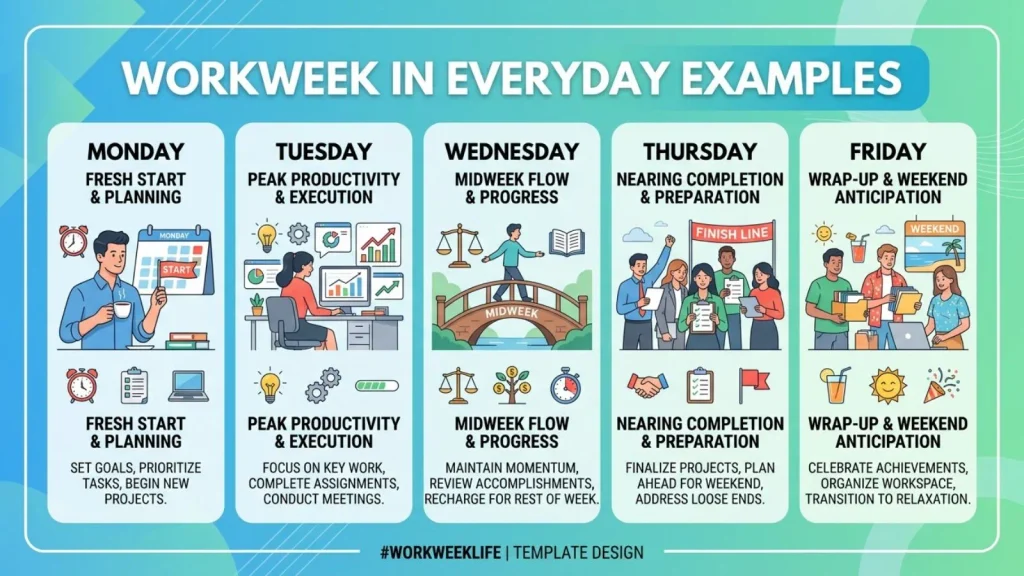
Seeing the word in real contexts makes the spelling choice easier to remember.
In emails: “Just a reminder that our workweek ends early on Fridays this summer.”
News articles: “Several companies are testing a four-day workweek to improve employee wellbeing.”
In social media posts: “Survived another workweek. Weekend, I’m ready for you.”
In formal business writing: “Employees are expected to complete 40 hours within the standard workweek, as outlined in the employee handbook.”
In UK-style writing: “The work week in most UK offices runs Monday to Friday, with some flexibility for remote staff.”
Notice how the tone stays professional in formal writing and casual in social posts. The spelling doesn’t change with tone. It changes with audience and region.
Workweek – Google Trends & Usage Data
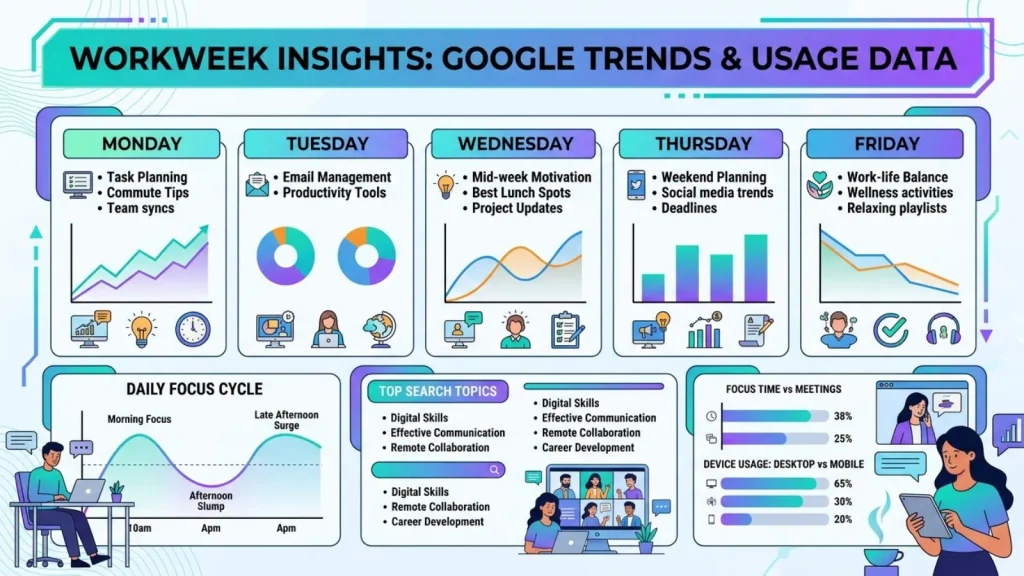
Search behavior confirms the regional pattern discussed earlier. “Workweek” consistently shows higher search volume in the United States, appearing often in business, HR, and productivity content. “Work week” trends higher in the UK, Australia, and other Commonwealth countries, often appearing in news coverage and workplace policy discussions.
Globally, “workweek” tends to lead in raw search volume, largely because of the size of the US market and the popularity of American business media. However, “work week” remains steady in international English-speaking regions and shows up frequently in discussions about labor laws, remote work policies, and the four-day workweek movement.
Context also shapes which spelling appears. Corporate and tech content tends to favor “workweek,” while government, legal, and traditional news sources outside the US lean toward “work week.” If you’re creating content for search visibility, understanding your target region’s habits helps you choose the version most likely to match what your audience actually types.
Keyword Variations Comparison
| Variation | Region | Common Use Case |
| Workweek | United States | Business, HR, tech content |
| Work week | UK, Australia, Canada | News, government, general writing |
| Work-week | Rare, older texts | Legacy documents, older style guides |
| Working week | UK primarily | Labor policy, formal British English |
FAQs
Is “workweek” one word or two?
Both forms exist. “Workweek” (one word) is standard in American English. “Work week” (two words) is standard in British English.
Which spelling is grammatically correct?
Neither is incorrect. Correctness depends on regional convention and audience, not strict grammar rules.
Should I hyphenate “work-week”?
No. Hyphenation is outdated and rarely used today. Choose “workweek” or “work week” instead.
What is the plural of workweek?
The plural is “workweeks” (one word) or “work weeks” (two words), matching whichever spelling you use throughout your writing.
Does Microsoft Word or Google Docs prefer one spelling?
Most US-based spell checkers default to “workweek.” UK-localized settings often accept “work week” without flagging it.
Is “working week” the same as “workweek”?
It’s closely related but a separate phrase. “Working week” is common in British English and refers to the same concept, but it’s not interchangeable mid-sentence with “workweek.”
Which spelling should I use for a resume or job application?
Match the spelling convention of the country you’re applying in. Use “workweek” for US employers and “work week” for UK or Commonwealth employers.
Does Google penalize content for using both spellings?
No, but inconsistency can hurt readability and look unprofessional. For SEO purposes, using both spellings naturally across a piece can help capture search traffic from different regions.
Conclusion
“Workweek” and “work week” are both correct. The real difference comes down to region and audience, not grammar rules.
American English favors the single-word “workweek.” British and Commonwealth English favor the two-word “work week.” A hyphenated “work-week” still appears occasionally but has fallen out of common use.
The key takeaway is consistency. Once you choose a spelling based on your audience, stick with it throughout your document.
Mixing spellings in the same piece of writing looks careless, even though both versions are technically valid.
If you’re writing for US readers, go with “workweek.” If you’re writing for UK, Australian, or Canadian readers, use “work week.”
For global content, choose one version and apply it consistently, or use both intentionally if you’re optimizing for search visibility across regions.
Now that you understand the origin, the regional split, and the common mistakes, you can write with confidence. No more hesitating over spell check. No more second-guessing which version looks right.

Here’s a concise 2-line author bio suitable for Simifind.com:
James Dashner is an American bestselling author best known for The Maze Runner series and other popular young-adult fiction.
On Simifind.com, he shares clear, engaging insights and helpful content for readers interested in books, writing, and popular literature.




1 thought on “Workweek or Work Week: Examples, Rules, and Meaning (for 2026)”