Hey, I want to share something that happened to me recently about Proving or Prooving.
When two spellings look almost identical, knowing which one is correct can save you from an embarrassing writing mistake.
I was chatting with a friend when I suddenly saw this term pop up, and honestly, I had no clue what it meant at first.
I kept wondering, “Am I missing something here?” It was a bit confusing, and I didn’t want to respond the wrong way.
So, I decided to look into Proving or Prooving and figure out its meaning and context.
After understanding it, I realized how important it is to know these terms to avoid awkward situations in conversations.
I handled it by learning the proper spelling and usage, and now I feel ready whenever I see Proving or Prooving again in chats, writing, or social media.
Proving or Prooving – Quick Answer
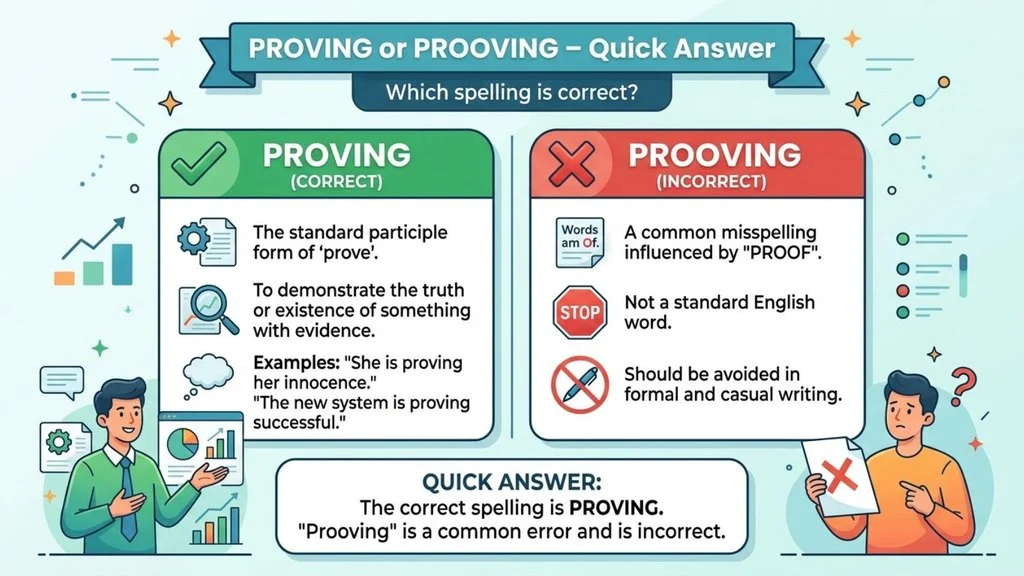
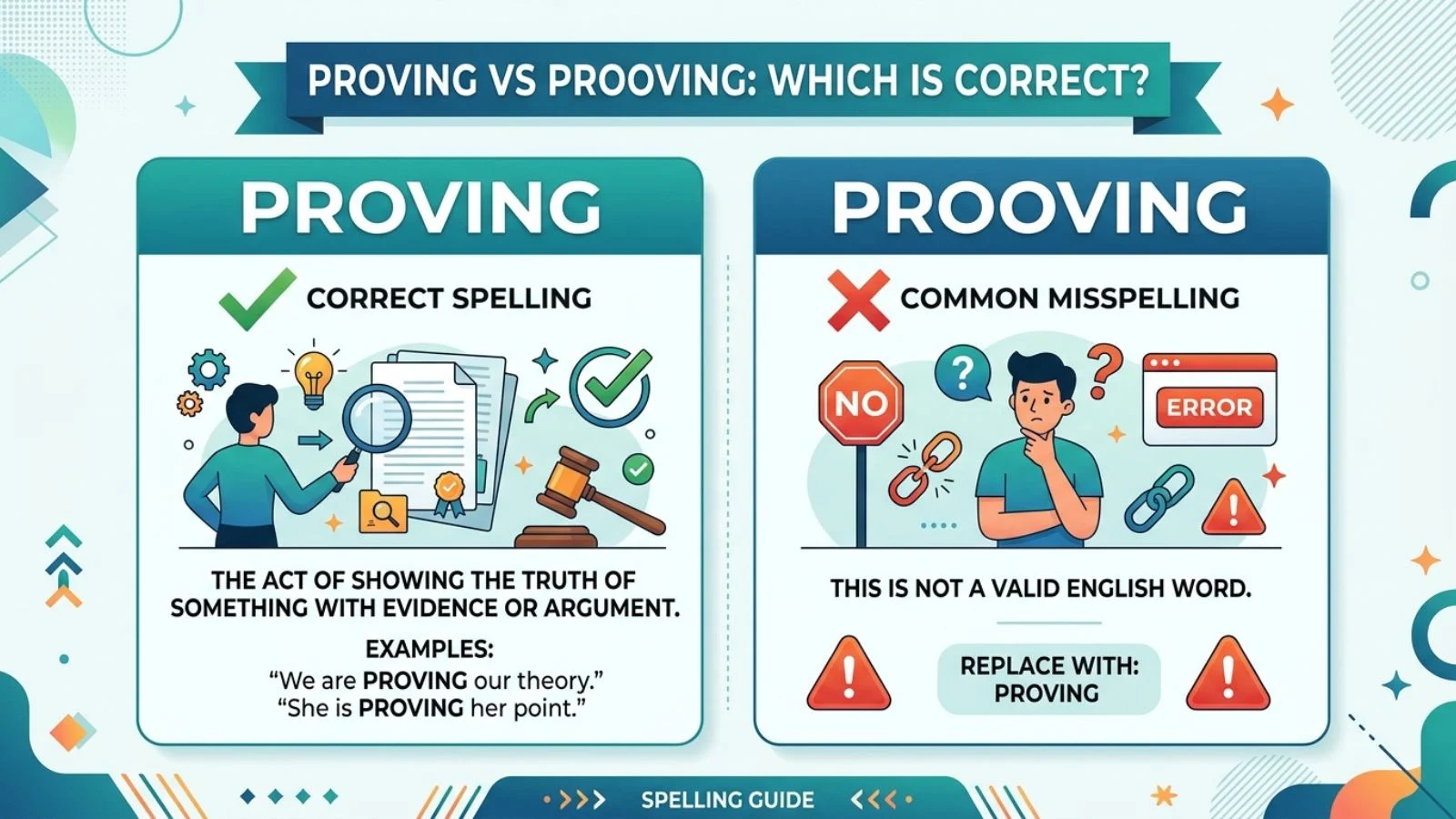
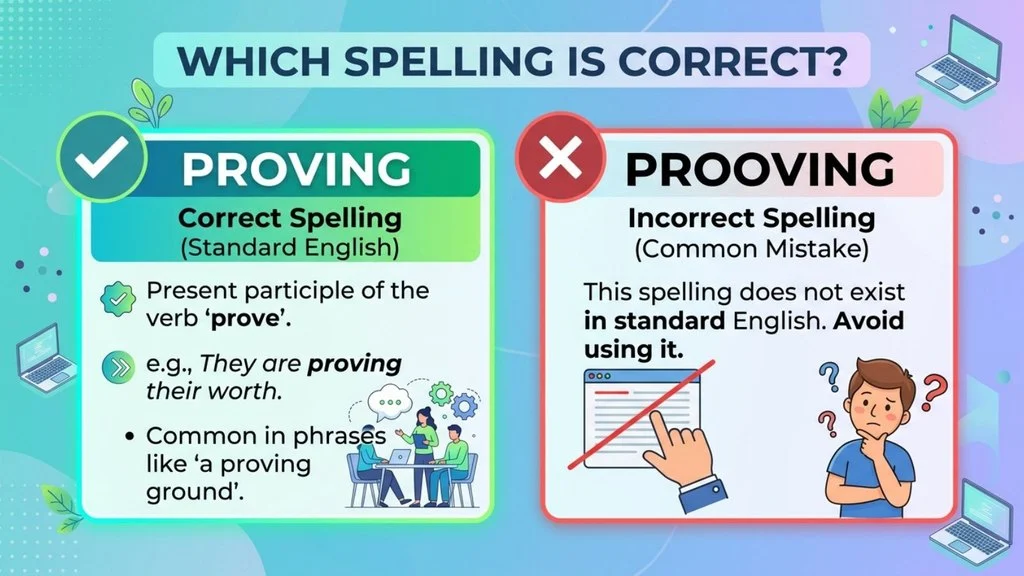
The correct spelling is proving. “Prooving” is not a word in any standard English dictionary, in either American or British English.
- ✅ She is proving her theory with new data.
- ❌ She is prooving her theory with new data.
“Proving” comes from the verb “prove.” When you add “-ing” to “prove,” you drop the silent “e” at the end. This follows a standard English spelling rule used in hundreds of other words.
- prove → proving
- move → moving
- love → loving
- believe → believing
“Prooving” adds an extra “o,” which does not belong. It is a spelling mistake, not a regional variation or alternate form.
The Origin of Proving

The word “prove” comes from the Old French word “prover,” which itself came from the Latin word “probare.” “Probare” meant to test, judge, or approve something. Over centuries, the word moved into Middle English as “proven” or “preven,” eventually settling into the modern spelling “prove.”
The “-ing” form, “proving,” follows a spelling pattern that goes back to Old English grammar rules. When a verb ends in a silent “e,” English typically drops that “e” before adding a vowel suffix like “-ing.” This keeps pronunciation consistent and avoids awkward double vowels.
So why do people write “prooving”? A few reasons explain it:
- Phonetic spelling: The word “prove” rhymes with “move” and “groove,” words that do contain a double “o.” This creates a pattern in the brain that does not actually apply to “prove.”
- Typing speed: Fast typing and small keyboards increase typo rates, especially with repeated letters.
- Non-native speakers: English learners often apply logical spelling rules from other languages, which do not always match English’s irregular patterns.
- Autocorrect gaps: Some autocorrect tools miss less common typos, letting “prooving” slip through unflagged.
None of these reasons make “prooving” correct. It remains a misspelling across every English-speaking region.
British English vs American English Spelling
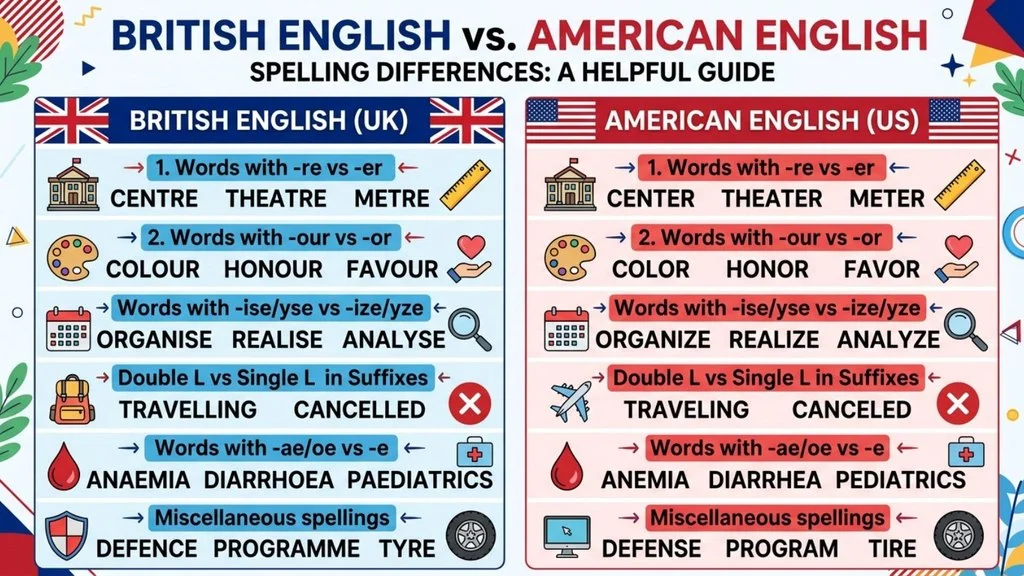
Many English words do change spelling between British and American English. Think “colour” vs “color,” or “organise” vs “organize.” This leads some people to assume “proving” might have a regional alternate too. It does not.
Both British and American English use the exact same spelling: proving. There is no British version that uses double “o.”
| Spelling | British English | American English | Correct? |
| Proving | ✅ Used | ✅ Used | Yes |
| Prooving | ❌ Not used | ❌ Not used | No |
| Prooven | ❌ Not used | ❌ Not used | No |
| Proven | ✅ Used (adjective/past participle) | ✅ Used (adjective/past participle) | Yes |
| Proved | ✅ Used (past tense) | ✅ Used (past tense, more common) | Yes |
Note that “proven” and “proved” are both correct as past tense or adjective forms, and usage varies slightly by region. But “prooving” and “prooven” are wrong everywhere.
Which Spelling Should Use Proving or Prooving ?
Since “proving” is universal, the real question is not which region to write for. It is simply making sure you spell the word correctly no matter your audience.
- US writers: Use “proving.” For past tense, “proved” is more common in American English.
- UK and Commonwealth writers (Canada, Australia, India, etc.): Use “proving.” Both “proved” and “proven” appear as past tense forms, with “proven” often used as an adjective (“a proven method”).
- Global and business writing: Stick with “proving” for the present participle in all cases. It is the only standard option and works everywhere without exception.
- Academic and formal writing: Always use “proving.” Spellcheck tools and style guides like APA, MLA, and Chicago all recognize only this spelling.
There is no scenario, dialect, or context where “prooving” becomes acceptable.
Common Mistakes with Proving
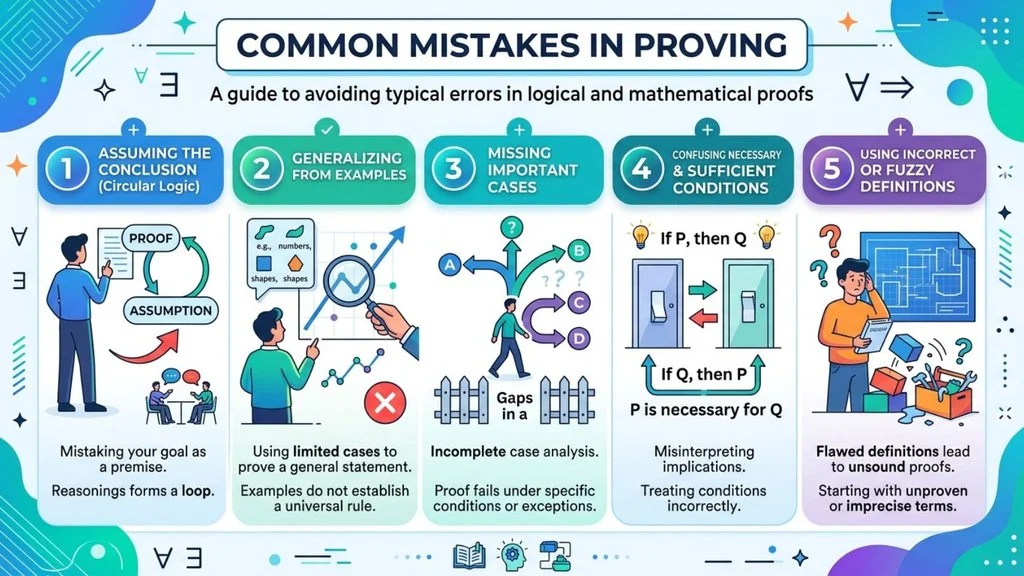
Here are the most frequent errors people make with this word, and how to fix them.
- Mistake: “I am prooving that this works.” Fix: “I am proving that this works.”
- Mistake: “The results are prooving my hypothesis.” Fix: “The results are proving my hypothesis.”
- Mistake: Confusing “proving” with “prooving” in bread baking terms. Bakers use “proofing” (letting dough rise), not “prooving.” Fix: “The dough needs 30 minutes of proofing” (baking) vs “The evidence is proving the case” (general use).
- Mistake: Writing “prooven” instead of “proven.” Fix: “This method is a proven success,” not “a prooven success.”
- Mistake: Relying on autocorrect without double-checking. Fix: Manually review documents, since some tools miss this specific typo.
Proving in Everyday Examples
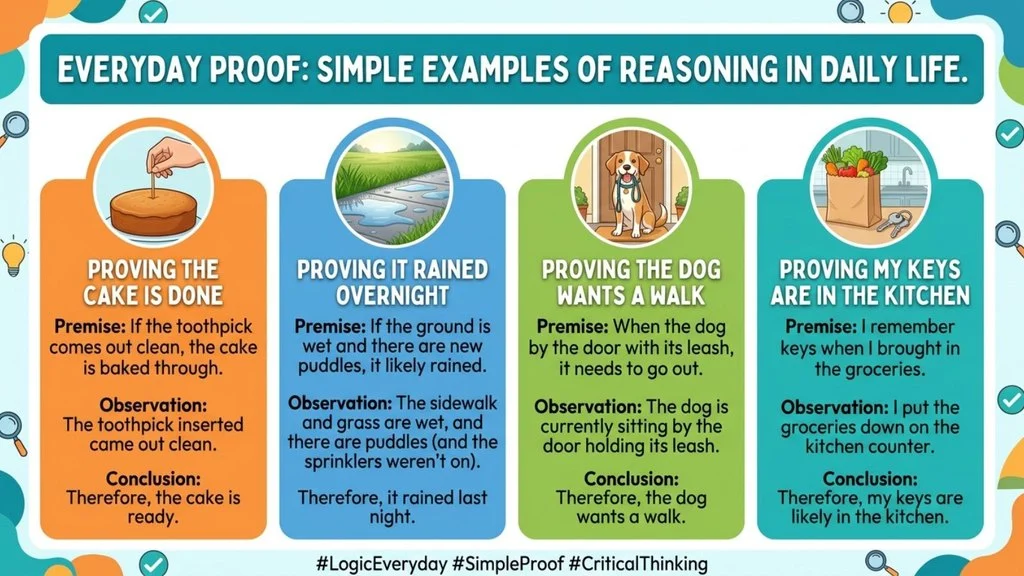
Seeing the word in real contexts helps the correct spelling stick.
In emails: “Attached is the data proving our Q3 growth.”
In news headlines: “New Study Proving Link Between Sleep and Memory Published Today”
Social media posts: “Nothing feels better than proving people wrong. 💪 #hustle”
In formal writing and reports: “The following section presents evidence proving the effectiveness of the proposed method.”
In casual conversation: “He’s always trying to prove he’s right, even when he’s not.”
Proving – Google Trends & Usage Data

Search data shows that “proving” is searched far more often than “prooving,” confirming it as the standard and widely recognized spelling. However, “prooving” still generates meaningful search volume, largely from people typing the misspelling by mistake and looking to confirm or correct it.
Interest in the correct spelling tends to spike around:
- Academic seasons, when students write essays and research papers
- News cycles involving legal or scientific “proof” stories
- Workplace reporting periods, such as quarterly business reviews
English-speaking countries, including the US, UK, Canada, Australia, and India, all show consistent search interest in the correct spelling, with occasional misspelling searches from all regions equally. This confirms the error is a general typing mistake rather than a regional dialect difference.
Keyword Variation Comparison
| Variation | Correct? | Common Use |
| Proving | ✅ Yes | Present participle of “prove” |
| Prooving | ❌ No | Common misspelling |
| Proven | ✅ Yes | Adjective / past participle |
| Prooven | ❌ No | Common misspelling |
| Proved | ✅ Yes | Past tense |
| Prove | ✅ Yes | Base verb form |
FAQs
1. Is “prooving” ever correct in any dialect of English?
No. “Prooving” is not recognized in American, British, Australian, Canadian, or any other standard English dialect. It is always a misspelling.
2. Why does “prove” not become “prooving” like “groove” becomes “grooving”?
“Groove” already has a double “o” in its base spelling. “Prove” does not. The “-ing” rule simply drops the silent “e” and keeps the rest of the word unchanged.
3. What is the difference between “proving” and “proofing”?
“Proving” relates to the verb “prove,” meaning to show something is true. “Proofing” is a separate word often used in baking (letting dough rise) or editing (checking for errors, as in “proofreading”).
4. Should I write “proven” or “proved” as the past tense of “prove”?
Both are correct. “Proved” is more common in American English as the simple past tense. “Proven” is often used as an adjective, as in “a proven strategy,” and appears more often as past tense in British English.
5. Does spellcheck always catch “prooving”?
Most modern spellcheck tools catch it, but not all autocorrect systems flag every instance, especially in fast typing or informal apps. Always proofread important documents manually.
6. Is “prooving” a regional slang term?
No. It is not slang, dialect, or informal accepted usage. It is simply an incorrect spelling of “proving.”
7. How can I remember the correct spelling permanently?
Remember the rule: drop the silent “e” in “prove” before adding “-ing.” Compare it to similar words like “move” → “moving” and “love” → “loving.” The pattern is consistent across all three.
Conclusion
The correct spelling is always proving, never “prooving.” This holds true across American English, British English, and every other major English dialect.
The confusion usually comes from phonetic guessing, fast typing, or mixing up “proving” with unrelated words like “proofing” or “groove.”
Remember the simple rule behind it: English drops the silent “e” in “prove” before adding “-ing,” the same pattern used in “move,” “love,” and “believe.”
There is no regional version, formal exception, or informal shortcut that makes “prooving” acceptable.
Whether you are writing a business report, a school essay, a news article, or a quick text message, stick with “proving.”
It is the only correct choice, recognized by every dictionary and style guide in the English language.
When in doubt, picture the base word “prove” and simply add “-ing,” dropping that final “e.” This small habit will keep your writing accurate and professional every time.

Here’s a concise 2-line author bio suitable for Simifind.com:
James Dashner is an American bestselling author best known for The Maze Runner series and other popular young-adult fiction.
On Simifind.com, he shares clear, engaging insights and helpful content for readers interested in books, writing, and popular literature.