Have you ever written “site” when you actually meant “sight”? You’re not alone—these two words sound alike but have completely different meanings.
Hey, I want to share something that happened to me recently about Site or Sight.
I was chatting with a friend when I suddenly saw one of these terms pop up, and honestly, I had no clue which word was correct at first.
I kept wondering, “Am I missing something here?” It was a bit confusing, and I didn’t want to respond the wrong way.
So, I decided to look into Site or Sight and figure out their meanings and contexts.
After understanding the difference, I realized how important it is to know these words to avoid awkward situations in conversations and writing.
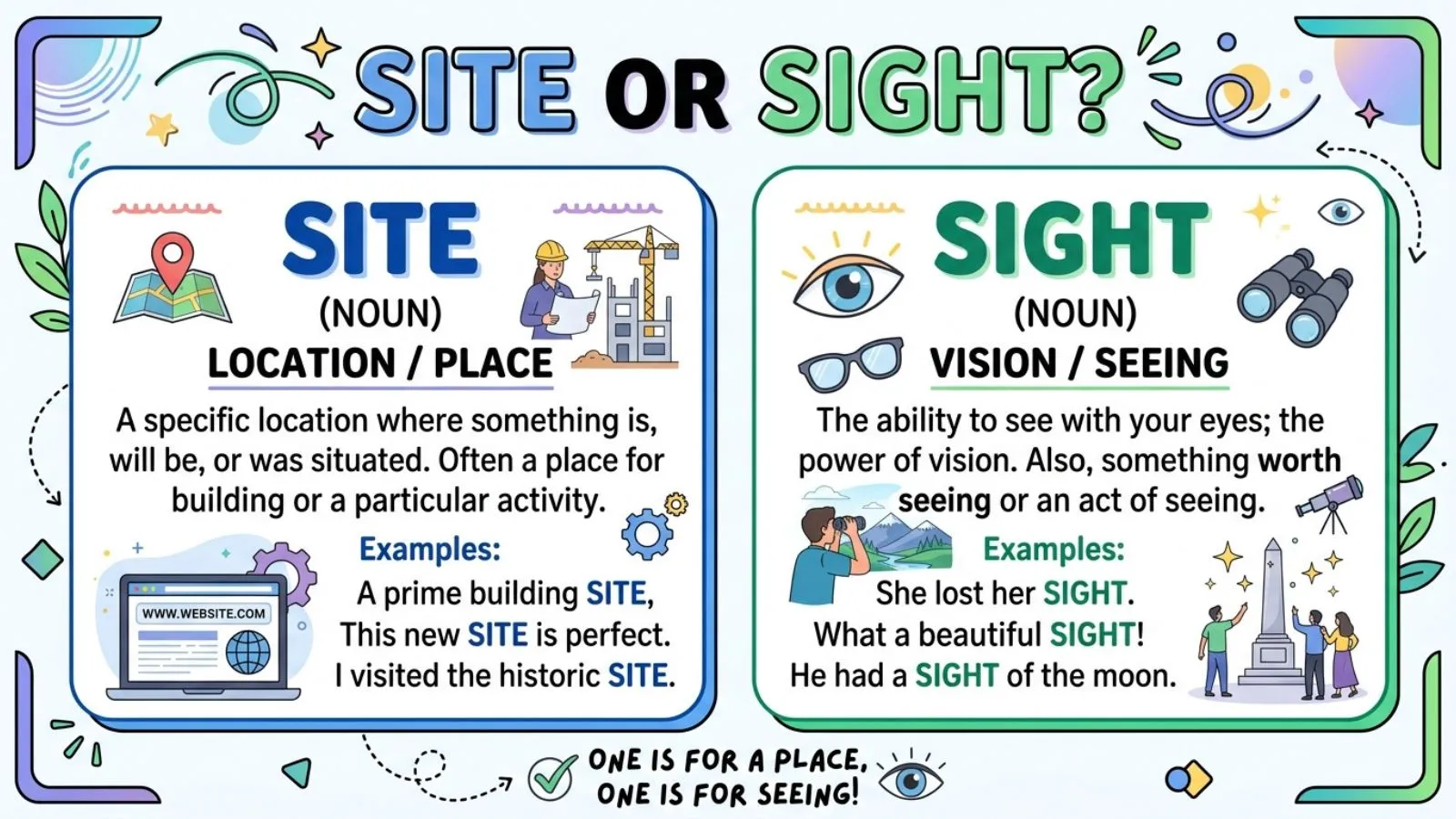
I learned that site usually refers to a place or location, while sight relates to seeing or something you can see.
I handled the confusion by learning the proper usage of both words, and now I feel confident whenever I see site or sight in chats, social media, or everyday writing.
Site or Sight – Quick Answer
Here is the short version:
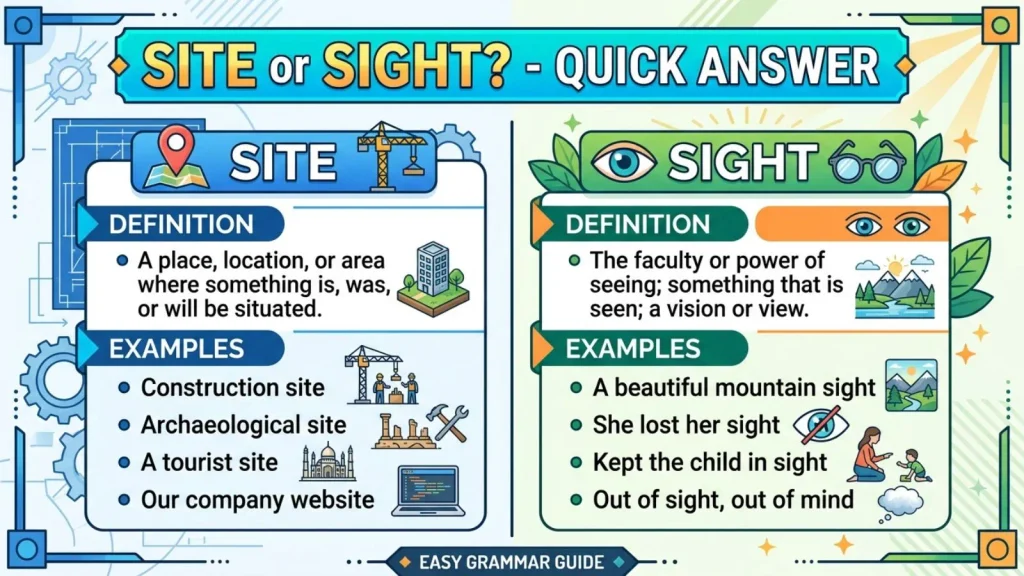
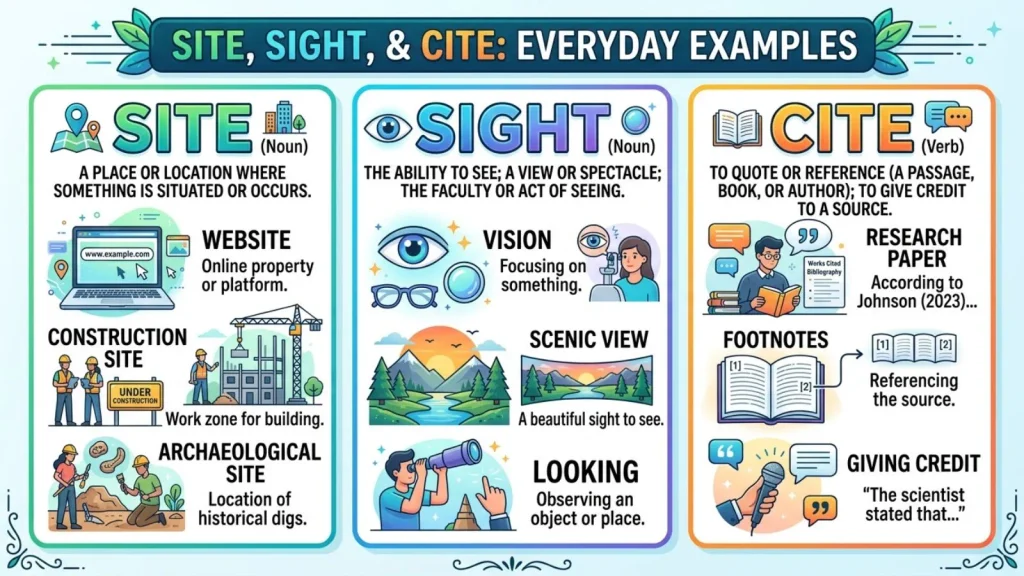
- Site (noun) means a location or place, especially a website or a physical location like a construction site.
- Sight (noun/verb) relates to vision — the ability to see, or something worth seeing.
- Cite (verb) means to quote or reference a source.
Examples:
- “The construction site is closed on weekends.” (a place)
- “The mountain view was a beautiful sight.” (something seen)
- “Please cite your sources in the report.” (to reference)
If you remember only one thing: site = place, sight = seeing, cite = source.
The Origin of Site, Sight, and Cite
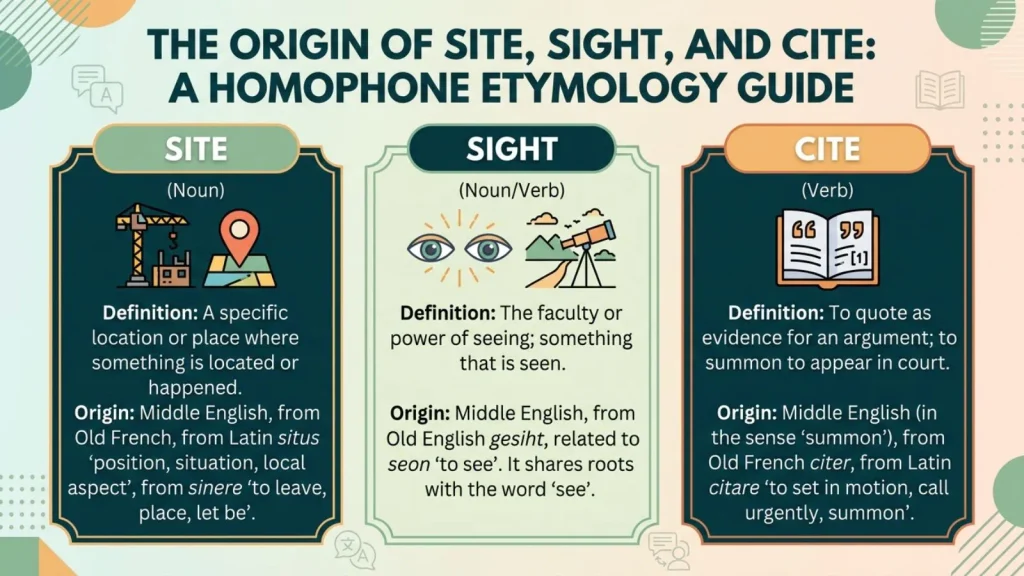
These three words did not start as the same word that later split apart. They come from entirely different roots, and that is exactly why they are spelled so differently today.
- Site comes from the Latin word situs, meaning “position” or “location.” It entered English through French in the 1400s and has always referred to a place.
- Sight comes from Old English sihth or gesiht, related to the verb “see.” It is one of the oldest words in this group, tied to vision and perception for over a thousand years.
- Cite comes from the Latin citare, meaning “to summon” or “to call.” It entered English in the 1300s through legal and academic use, where summoning a source or reference was the core idea.
The confusion exists purely because English absorbed words from multiple languages (Old English, Latin, French) that happened to end up sounding alike. Spelling differences are not a style choice here — they reflect three separate word histories.
British English vs American English Spelling
Unlike true British-versus-American spelling pairs (such as “colour” vs “color”), site, sight, and cite are not regional variants of one word. Every English-speaking country uses the same three spellings for the same three meanings. The comparison that actually matters is meaning, not geography.
| Word | Part of Speech | Meaning | Example Sentence |
| Site | Noun | A location or place | “They chose a new site for the office.” |
| Sight | Noun / Verb | Vision; something seen | “Losing her sight was hard.” / “I sighted land.” |
| Cite | Verb | To quote or reference | “She cited three studies.” |
There is no US/UK spelling split for these words. American and British writers use “site,” “sight,” and “cite” the exact same way.
Which Word Should Use Site or Sight ?
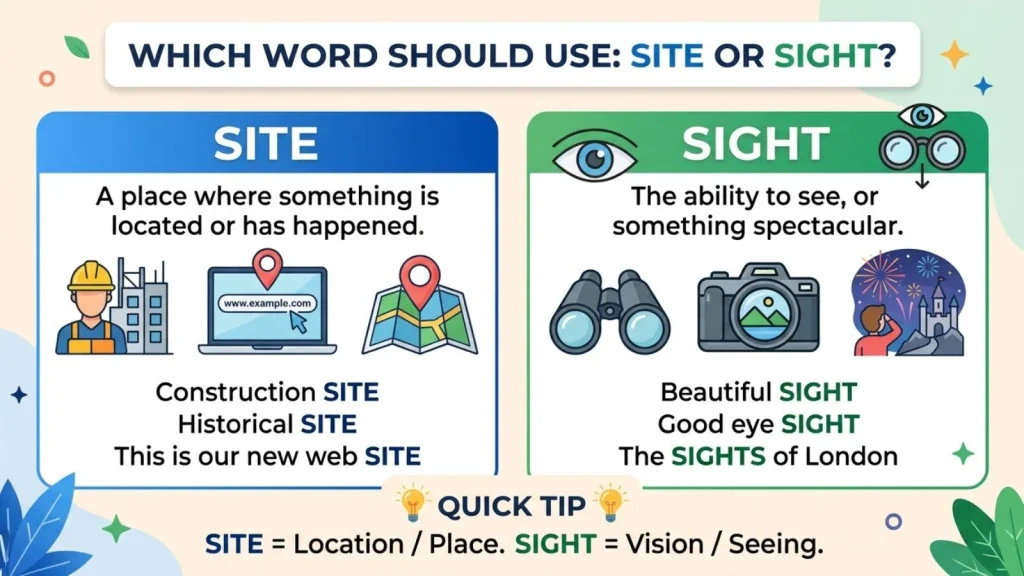
Since this is not a regional spelling issue, the real question is: which word matches your meaning?
- Writing about a website, app, or physical location? Use site. (“Visit our site,” “the building site.”)
- Writing about vision, viewing, or something impressive to look at? Use sight. (“A sight to behold,” “poor eyesight.”)
- Writing an essay, report, or academic paper and referencing a source? Use cite. (“Cite your references in APA format.”)
- Global audiences (US, UK, Commonwealth, or anywhere else): The advice is identical everywhere. There is no regional variation to worry about — just match the word to the meaning.
Common Mistakes with Site, Sight, and Cite
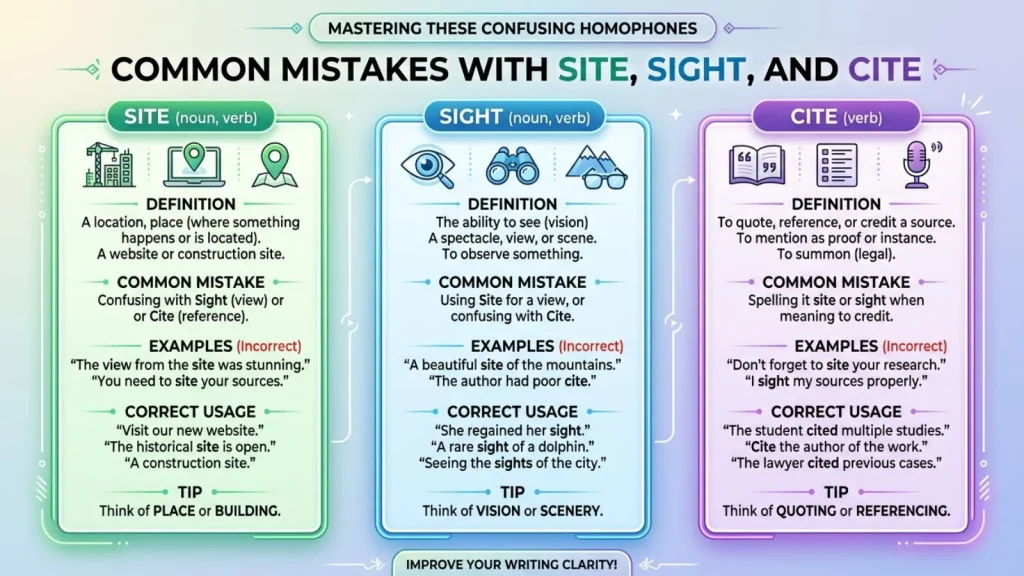
Here are the errors people make most often, with corrections:
- Wrong: “Check out my web sight.” Right: “Check out my web site.” (A website is a location, so it takes “site.”)
- Wrong: “The Grand Canyon is a beautiful site.” Right: “The Grand Canyon is a beautiful sight.” (Something seen and admired takes “sight.”)
- Wrong: “Please site your sources.” Right: “Please cite your sources.” (Referencing a source takes “cite.”)
- Wrong: “I finally sighted the new office location.” (used loosely to mean “located”) Right: “I finally found the site for the new office.” (“Sighted” means spotted with your eyes, not chosen as a location.)
- Wrong: “That’s a citing I’ll never forget.” (confusing “sighting” with “citing”) Right: “That’s a sighting I’ll never forget.” (A rare bird sighting is something seen.)
Site, Sight, and Cite in Everyday Examples
In emails: “Attached is the link to our company site. Let me know if the sight lines in the new office layout work for you.”
In news headlines: “Rare Comet Sighting Draws Crowds” — here “sighting” refers to viewing an event. “Construction Site Halted After Inspection” — here “site” refers to a location.
On social media: “Just visited the most breathtaking sight in Iceland 😍” (something seen) “Link to my new site in bio!” (a website)
In formal or academic writing: “According to the source cited above, the site was selected based on soil quality.” (both “cited” and “site” used correctly in one sentence)
Site or Sight – Search and Usage Data
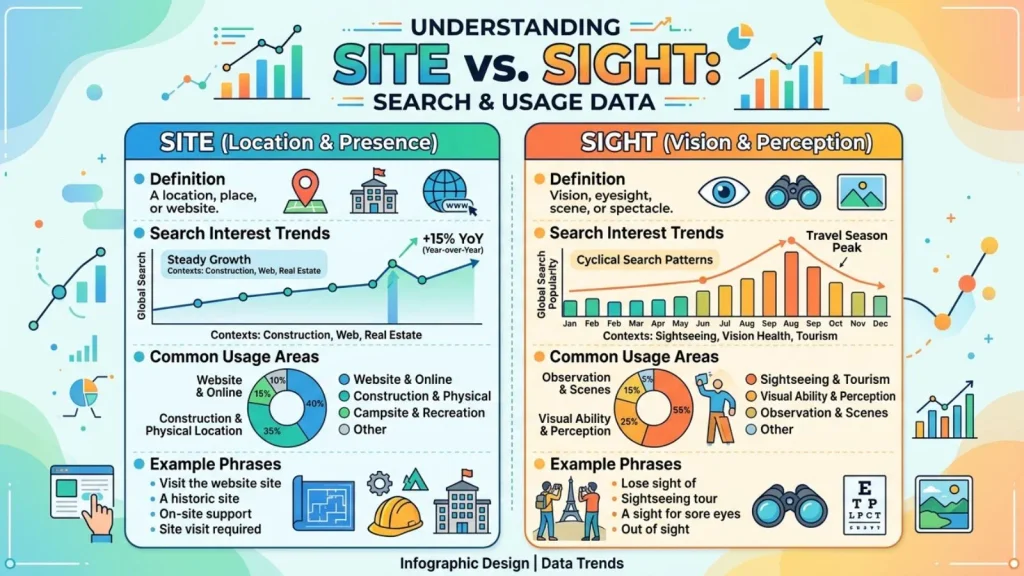
Search interest in “site or sight” spikes consistently because both words are common in everyday writing, but only one fits any given sentence. Data patterns show:
- “Site” dominates in tech, business, and web-related searches (e.g., “construction site,” “website vs site”).
- “Sight” appears more in travel, health, and descriptive writing (e.g., “loss of sight,” “tourist sight”).
- “Cite” is searched heavily by students and academic writers, especially around essay and citation deadlines.
Interest in this confusion is fairly consistent across English-speaking countries, since — as covered above — this is a meaning-based mix-up rather than a regional spelling difference.
Keyword Variation Comparison
| Search Term | Typical Searcher | Common Context |
| Site or sight | General writers | Website vs. viewing confusion |
| Sight or site | Same query, reversed | Same intent |
| Cite or site | Students, researchers | Referencing vs. location |
| Sight vs cite | Rare, but occurs | Usually a typo-driven search |
FAQs
1. Is it “web site” or “web sight”?
It is “website” (one word, or “web site” as two words in older style). Never “web sight” — a website is a location, not something you see with your eyes.
2. What is the difference between site and sight?
“Site” is a place or location. “Sight” relates to vision — either the ability to see or something worth looking at.
3. How do I remember the difference between site and cite?
Think: “Cite” has a “C” like “Copy” or “Confirm a source.” “Site” relates to a location, like a consiteruction… actually, simpler: “site” rhymes with “spot,” and both are about place.
4. Is “sighting” the same as “citing”
No. “Sighting” means spotting something with your eyes (a bird sighting). “Citing” means referencing a source (citing a study).
5. Do British and American English spell these words differently?
No. “Site,” “sight,” and “cite” are spelled the same way in both British and American English. This is not a regional spelling variant like “colour” vs. “color.”
6. Which word do I use for eyesight problems?
Use “sight.” Example: “Her sight worsened with age.”
7. Can “site” ever mean something you see?
No. “Site” always refers to a location or place, never to vision or viewing.
Conclusion
The “site or sight” confusion is common because these words sound identical but mean completely different things. Unlike true British-versus-American spelling differences, this is not a regional issue — it is a matter of matching the right word to the right meaning, no matter where you live.
Remember the simple breakdown: site means a place, sight relates to seeing, and cite means to reference a source. Use “site” for websites and locations, “sight” for vision and viewable scenes, and “cite” for quoting sources in academic or formal writing.
Spell-checkers will not catch this mistake, since all three are valid words. The only reliable fix is knowing the meaning behind each one. With the quick answer, examples, and FAQs in this guide, you now have a fast way to check yourself every time you write — whether it’s a casual email, a social media post, or a formal report.

Here’s a concise 2-line author bio suitable for Simifind.com:
James Dashner is an American bestselling author best known for The Maze Runner series and other popular young-adult fiction.
On Simifind.com, he shares clear, engaging insights and helpful content for readers interested in books, writing, and popular literature.