Have you ever wondered whether ribosomes are found in prokaryotic or eukaryotic cells?
Ribosomes are tiny cell structures that play a major role in life. They make proteins, which help cells grow, repair damage, and carry out important tasks.
However, students often get confused about whether ribosomes belong to prokaryotic cells, eukaryotic cells, or both.
The simple answer is that ribosomes are found in both prokaryotic and eukaryotic cells.
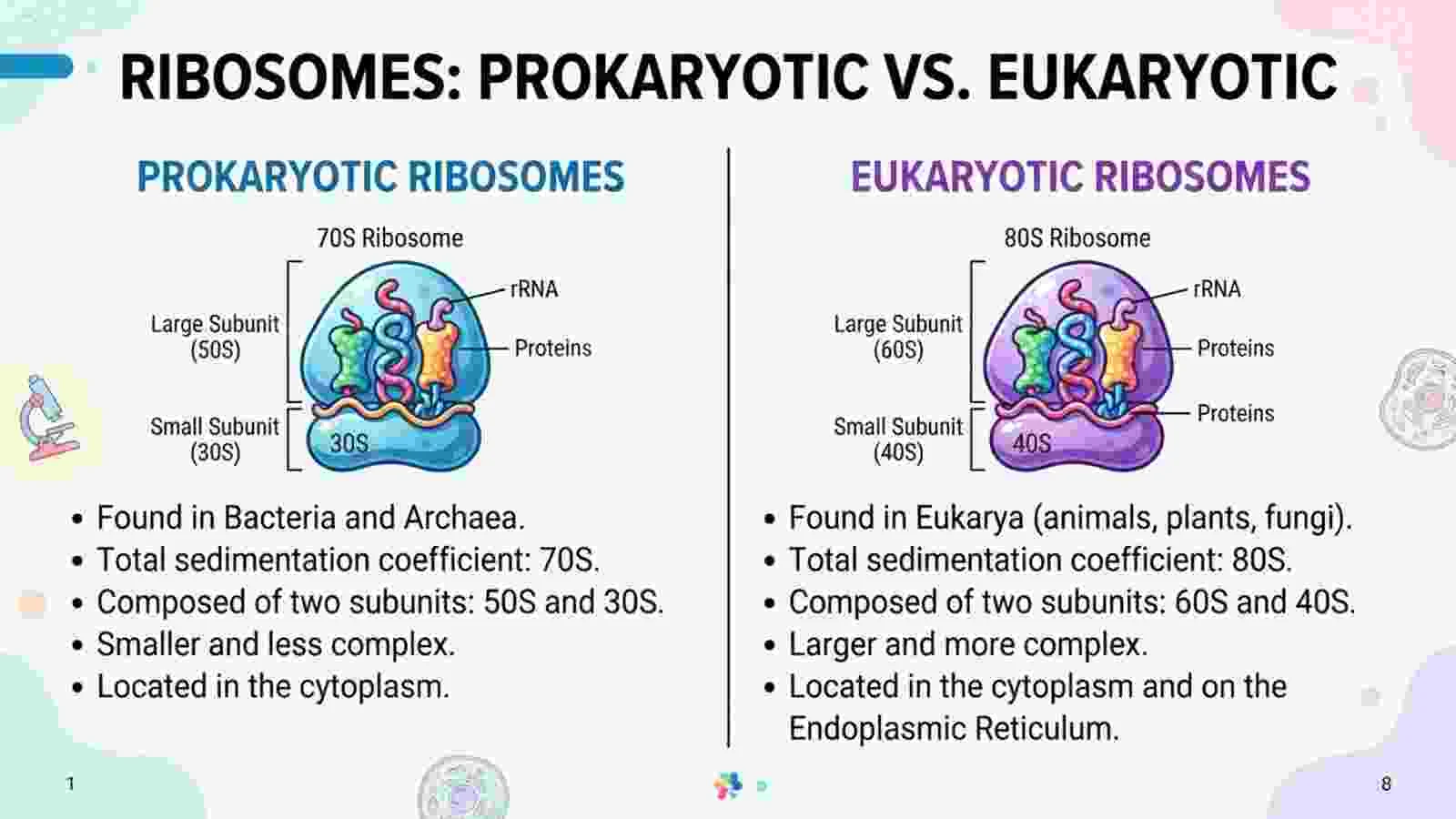
However, their sizes and structures are different. Prokaryotic cells usually have 70S ribosomes, while eukaryotic cells have 80S ribosomes in their cytoplasm.
This topic is common in biology classes, school exams, and science tests. People search for it to understand cell structures, protein synthesis, and the differences between the two types of cells.
In this guide, we will explain where ribosomes are found, how they work, and what makes prokaryotic and eukaryotic ribosomes different. You will also learn simple examples and useful facts to remember.
Ribosomes Prokaryotic or Eukaryotic – Quick Answer
Ribosomes are found in both prokaryotic and eukaryotic cells. They make proteins by reading genetic instructions carried by messenger RNA (mRNA).
The main difference is their size:
- Prokaryotic ribosomes: 70S, made of 50S and 30S subunits.
- Eukaryotic ribosomes: 80S, made of 60S and 40S subunits.
For example, bacteria are prokaryotes and have 70S ribosomes. Animal and plant cells are eukaryotes and have 80S ribosomes in their cytoplasm.
One important fact is that mitochondria and chloroplasts also contain ribosomes. These ribosomes are similar to those found in bacteria.
The Origin of Ribosomes
The word ribosome comes from the terms ribonucleic acid (RNA) and the Greek word soma, meaning body.
Ribosomes were studied as scientists learned more about how cells make proteins. They became known as important structures involved in protein production.
Ribosomes are made mainly of two things:
- Ribosomal RNA (rRNA).
- Ribosomal proteins.
Every ribosome has two subunits. These subunits work together to join amino acids and form proteins.
Ribosomes do not have a surrounding membrane. This makes them different from many other cell structures, such as the nucleus and mitochondria.
Prokaryotic Ribosomes vs Eukaryotic Ribosomes
Prokaryotic and eukaryotic cells both need proteins to survive. However, their ribosomes have different sizes and structures.
| Feature | Prokaryotic Ribosomes | Eukaryotic Ribosomes |
| Size | 70S | 80S |
| Large subunit | 50S | 60S |
| Small subunit | 30S | 40S |
| Location | Cytoplasm | Cytoplasm and rough ER |
| Found in | Bacteria and Archaea | Animals, plants, fungi, and protists |
| Structure | Smaller | Larger |
| Main function | Protein synthesis | Protein synthesis |
1. Prokaryotic Ribosomes
Prokaryotic ribosomes are smaller structures found in prokaryotic cells. They are usually 70S ribosomes.
They have two parts:
- 50S large subunit.
- 30S small subunit.
These ribosomes float freely in the cytoplasm. They help bacteria and other prokaryotes make the proteins they need.
2. Eukaryotic Ribosomes
Eukaryotic ribosomes are larger than prokaryotic ribosomes. we are usually 80S ribosomes.
They have two parts:
- 60S large subunit.
- 40S small subunit.
They are found freely in the cytoplasm or attached to the rough endoplasmic reticulum (rough ER).
Free ribosomes mainly make proteins used inside the cell. Ribosomes attached to the rough ER make proteins that may enter membranes or leave the cell.
Important: The S in 70S and 80S stands for Svedberg units. It measures fast particles settle during centrifugation. Values cannot be added directly, which is why 50S + 30S equals 70S, not 80S.
Which Ribosomes Are Found in Prokaryotic and Eukaryotic Cells?
The answer depends on the type of cell.
Prokaryotic cells: Bacteria and Archaea have 70S ribosomes in their cytoplasm.
Eukaryotic cells: Animal, plant, fungal, and protist cells have 80S ribosomes in their cytoplasm.
There is one important exception to remember. Mitochondria and chloroplasts contain ribosomes that are generally smaller and more similar to prokaryotic ribosomes.
This is linked to the endosymbiotic theory, which explains how these organelles may have developed from ancient bacteria.
Therefore, it is correct to say that both prokaryotic and eukaryotic cells contain ribosomes, but their ribosomes are not exactly the same.
Common Mistakes About Ribosomes
Students often make a few mistakes when learning about ribosomes. Here are some common errors and their correct answers.
Mistake 1: Ribosomes are found only in prokaryotic cells.
Correction: Ribosomes are present in both prokaryotic and eukaryotic cells.
Mistake 2: All ribosomes are 80S.
Correction: Prokaryotic ribosomes are usually 70S, while eukaryotic cytoplasmic ribosomes are 80S.
Mistake 3: Ribosomes have a membrane.
Correction: Ribosomes do not have a surrounding membrane.
Mistake 4: Ribosomes only exist in the cytoplasm.
Correction: Ribosomes can also be attached to the rough ER in eukaryotic cells. Mitochondria and chloroplasts have their own ribosomes.
Mistake 5: Ribosomes produce energy.
Correction: Ribosomes make proteins. Mitochondria play a major role in cellular energy production.
Ribosomes in Everyday Examples
Ribosomes are important in many living things. They help cells produce the proteins needed for growth, repair, and survival.
Here are some simple examples:
- In bacteria: Ribosomes make proteins that help bacteria grow and survive.
- In humans: Ribosomes make proteins needed for muscles, skin, enzymes, and other body functions.
- In plants: Ribosomes help produce proteins needed for growth and photosynthesis.
- In animals: Ribosomes make proteins that support normal cell activities.
- In mitochondria: Ribosomes help make some proteins needed for mitochondrial function.
In biology textbooks, ribosomes are often shown as small dots inside cells. In scientific writing, they are described as the main sites of protein synthesis.
On social media and in study notes, students may use simple terms such as 70S ribosomes, 80S ribosomes, and protein-making structures to explain their function.
Ribosomes – Google Trends and Usage Data

The keyword ribosomes prokaryotic or eukaryotic relates mainly to biology education and cell biology.
People may search for this topic when studying:
- Cell biology and cell structures.
- Differences between prokaryotic and eukaryotic cells.
- Ribosome structure and function.
- Protein synthesis.
- Biology homework and exam questions.
- 70S and 80S ribosomes.
Search interest can vary by country, school examination periods, and university study schedules.
Related searches include prokaryotic ribosomes, eukaryotic ribosomes, 70S vs 80S ribosomes, and ribosome function.
Google Trends uses relative search interest rather than exact search volume. A verified country ranking or popularity score should not be claimed without checking the selected keyword and date range in live Trends data.
Comparison Table: Prokaryotic and Eukaryotic Ribosomes
| Ribosome Feature | Prokaryotic | Eukaryotic |
| Overall size | 70S | 80S |
| Large subunit | 50S | 60S |
| Small subunit | 30S | 40S |
| Cytoplasmic location | Yes | Yes |
| Protein synthesis | Yes | Yes |
| Membrane-bound | No | No |
| Free in cytoplasm | Yes | Yes |
| Attached to rough ER | No | Yes |
| Example | Bacteria | Animal cells |
FAQs About Ribosomes
1. Are ribosomes prokaryotic or eukaryotic?
Ribosomes are found in both prokaryotic and eukaryotic cells. However, their sizes and structures are different.
2. Are ribosomes 70S or 80S?
Prokaryotic ribosomes are usually 70S, while eukaryotic cytoplasmic ribosomes are 80S.
3. Do prokaryotic cells have ribosomes?
Yes. Prokaryotic cells have 70S ribosomes that help them produce proteins.
4. Do eukaryotic cells have ribosomes?
Yes. Eukaryotic cells have 80S ribosomes in their cytoplasm. They may also have ribosomes attached to the rough ER.
5. Why are ribosomes important?
Ribosomes are important because they make proteins. These proteins help cells grow, repair themselves, and perform essential functions.
6. Are ribosomes found in plant and animal cells?
Yes. Both plant and animal cells are eukaryotic cells and contain 80S ribosomes in their cytoplasm.
7. Do mitochondria have ribosomes?
Yes. Mitochondria contain their own ribosomes. These are generally more similar to bacterial ribosomes than to the 80S ribosomes in the eukaryotic cytoplasm.
Conclusion
Ribosomes are important structures found in both prokaryotic and eukaryotic cells. Their main job is to make proteins, which help living things grow, repair cells, and perform daily functions.
The biggest difference is their size. Prokaryotic cells usually have 70S ribosomes, while eukaryotic cells have 80S ribosomes in their cytoplasm. The 70S ribosome contains 50S and 30S subunits, while the 80S ribosome contains 60S and 40S subunits.
Remember that ribosomes do not have a surrounding membrane. They can float freely in the cytoplasm, and eukaryotic ribosomes can also attach to the rough endoplasmic reticulum. Mitochondria and chloroplasts have their own ribosomes as well.
If you are preparing for a biology test, remember one simple rule: both cell types have ribosomes, but their main cytoplasmic ribosomes have different sizes.
This fact will help you understand cell biology and answer related exam questions with confidence.

Here’s a concise 2-line author bio suitable for Simifind.com:
James Dashner is an American bestselling author best known for The Maze Runner series and other popular young-adult fiction.
On Simifind.com, he shares clear, engaging insights and helpful content for readers interested in books, writing, and popular literature.







