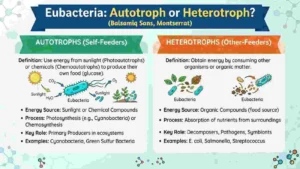
When studying bacteria, one common question is whether Eubacteria are autotrophs or heterotrophs.
The answer may seem simple, but there is an important detail that many students miss. Eubacteria can be both!
Some eubacteria make their own food using sunlight or chemical energy. Others get food from plants, animals, dead matter, or other living things.
This difference helps us understand how bacteria survive and how they affect the environment.
Students often search for this topic because they want to understand bacterial nutrition, prepare for biology exams, or complete school assignments.
They may also be confused by the terms autotroph and heterotroph.
In this guide, we will explain both types in simple words. You will learn how eubacteria get energy, discover common examples, and understand the differences between autotrophic and heterotrophic bacteria. We will also explore their roles in nature and answer common questions.
Eubacteria Autotroph or Heterotroph – Quick Answer
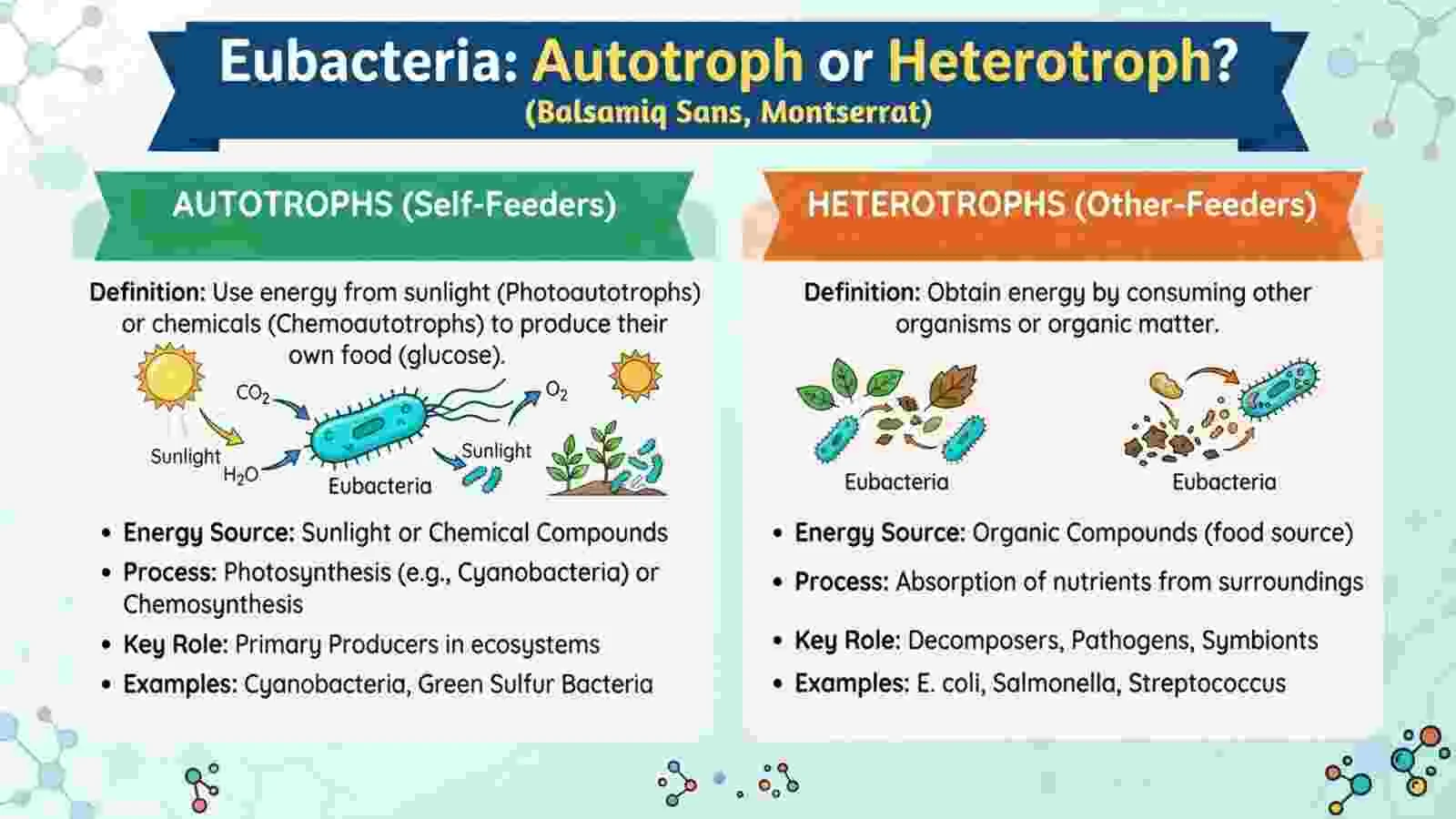
Eubacteria can be both autotrophs and heterotrophs. Their method of getting food depends on the type of bacteria.
- Autotrophic eubacteria: Make their own food using sunlight or chemical energy.
- Heterotrophic eubacteria: Get food from other organisms or organic matter.
For example, cyanobacteria are photosynthetic autotrophs. They use sunlight to make food. Many bacteria that break down dead plants and animals are heterotrophs.
Therefore, not all eubacteria follow the same feeding method. Their nutrition depends on their species and environment.
What Are Eubacteria?
Eubacteria are also called true bacteria. They are tiny, single-celled organisms found in soil, water, air, and living bodies.
They are prokaryotes. This means they do not have a true nucleus or other membrane-bound organelles.
Eubacteria have different shapes, such as:
- Cocci: Round-shaped bacteria.
- Bacilli: Rod-shaped bacteria.
- Spirilla: Spiral-shaped bacteria.
Some eubacteria are helpful. Others can cause diseases. They also play an important role in breaking down waste and recycling nutrients.
Autotrophic Eubacteria: How Do They Make Food?
Autotrophic eubacteria make their own food from simple inorganic substances. They use energy from sunlight or chemical reactions.
There are two main types.
1. Photoautotrophic Bacteria
Photoautotrophic bacteria use sunlight to make food. They take in carbon dioxide and use light energy to produce organic compounds.
Example: Cyanobacteria
Cyanobacteria are common in water and moist environments. They use photosynthesis to make food and release oxygen.
2. Chemoautotrophic Bacteria
Chemoautotrophic bacteria use energy from chemical reactions instead of sunlight.
They get energy by changing substances such as ammonia, nitrites, sulfur, or iron compounds.
Examples:
- Nitrosomonas
- Nitrobacter
- Sulfur-oxidizing bacteria
These bacteria help recycle nutrients and support healthy soil ecosystems.
Heterotrophic Eubacteria: How Do They Get Food?
Heterotrophic eubacteria cannot make all their food from inorganic substances. They depend on organic matter produced by other organisms.
They get nutrients from different sources.
1. Saprophytic Bacteria
These bacteria feed on dead plants, animals, and other organic materials.
They break down dead matter and return nutrients to the environment.
2. Parasitic Bacteria
Parasitic bacteria get nutrients from living hosts. Some can cause diseases in humans, animals, and plants.
Examples include certain strains of Salmonella and Mycobacterium tuberculosis.
3. Symbiotic Bacteria
Some bacteria live with other organisms and provide benefits to their partners.
For example, Rhizobium bacteria live in the root nodules of legume plants. They help convert atmospheric nitrogen into forms plants can use.
Autotrophic vs Heterotrophic Eubacteria: Key Differences
| Feature | Autotrophic Eubacteria | Heterotrophic Eubacteria |
| Food source | Make their own food | Get food from organic matter |
| Energy source | Sunlight or chemicals | Organic compounds |
| Carbon source | Usually carbon dioxide | Organic carbon |
| Main types | Photoautotrophs and chemoautotrophs | Saprophytes, parasites, and symbionts |
| Examples | Cyanobacteria, Nitrosomonas | Salmonella, Rhizobium |
| Main role | Produce organic food | Consume and break down organic matter |
Why Are Eubacteria Important in Nature?
Eubacteria play many important roles in the environment.
- Nutrient recycling: They break down dead matter and return nutrients to soil.
- Nitrogen fixation: Some bacteria help plants get usable nitrogen.
- Oxygen production: Cyanobacteria release oxygen through photosynthesis.
- Digestion: Helpful bacteria support digestion in humans and animals.
- Food production: Some bacteria help make yogurt and cheese.
- Disease control: Understanding harmful bacteria helps scientists prevent infections.
These roles show why both autotrophic and heterotrophic bacteria are important for life on Earth.
Eubacteria – Classification and Usage Data
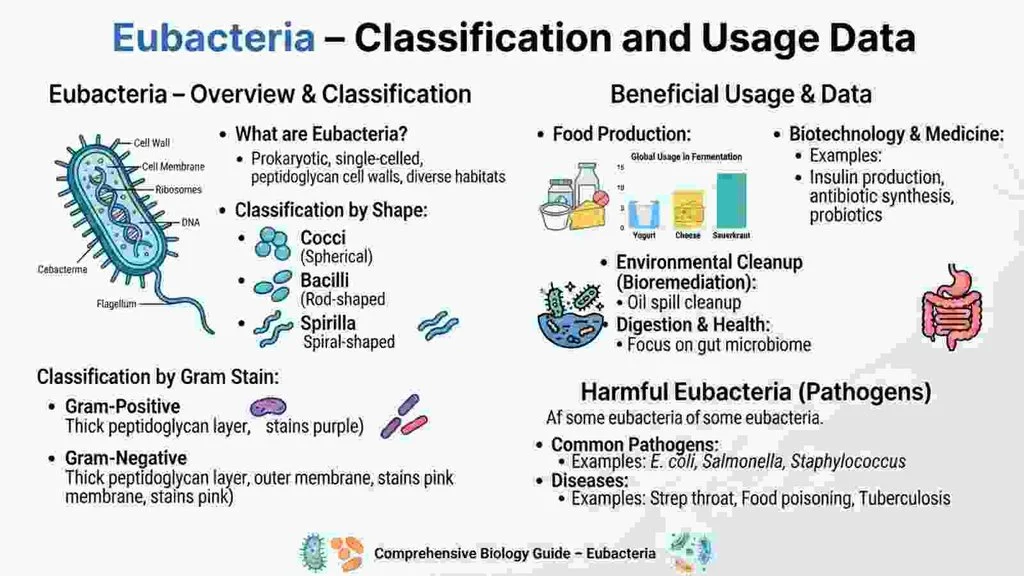
Eubacteria are commonly studied in biology because they show different ways of obtaining nutrition.
Their classification by nutrition depends on how they get carbon and energy.
| Type | Nutrition Method | Example |
| Photoautotroph | Uses sunlight | Cyanobacteria |
| Chemoautotroph | Uses chemical energy | Nitrosomonas |
| Photoheterotroph | Uses light but needs organic carbon | Some purple non-sulfur bacteria |
| Chemoheterotroph | Gets energy and carbon from organic compounds | Salmonella |
Important: Photoheterotrophs and chemoheterotrophs are also found among bacteria. This shows that bacterial nutrition has more than two simple categories.
Search Interest and Google Trends
Searches for terms such as Eubacteria autotroph or heterotroph, bacterial nutrition, and autotrophic bacteria examples are linked to biology education.
Students commonly search for these terms when preparing for:
- School biology exams.
- High school science assignments.
- College biology courses.
- Microbiology lessons.
- Biology multiple-choice questions.
Google Trends data can change over time and by country. Exact country rankings or search volumes should be checked directly rather than assumed.
Common Mistakes About Eubacteria Nutrition
Students often make these mistakes when learning about bacterial nutrition.
Mistake 1: All eubacteria are heterotrophs.
Correction: Eubacteria include both autotrophic and heterotrophic species.
Mistake 2: All autotrophic bacteria use sunlight.
Correction: Some use chemical energy to make food.
Mistake 3: Cyanobacteria are heterotrophs.
Correction: Cyanobacteria are mainly photoautotrophic.
Mistake 4: All heterotrophic bacteria cause diseases.
Correction: Many are harmless or helpful. Some recycle nutrients and support digestion.
Mistake 5: Eubacteria and archaebacteria are the same.
Correction: They are different groups of prokaryotic organisms.
Frequently Asked Questions (FAQs)
1. Are eubacteria autotrophs or heterotrophs?
Eubacteria can be both autotrophs and heterotrophs. Some make their own food, while others get nutrients from organic matter.
2. Is E. coli an autotroph or heterotroph?
Escherichia coli (E. coli) is a heterotrophic bacterium. It gets energy and nutrients from organic substances.
3. Are cyanobacteria autotrophs?
Yes. Cyanobacteria are photoautotrophs. They use sunlight to make food through photosynthesis.
4. Can eubacteria make their own food?
Yes. Autotrophic eubacteria can make their own food using sunlight or chemical energy.
5. What are examples of heterotrophic eubacteria?
Examples include E. coli, Salmonella, and many decomposer bacteria.
6. What are examples of autotrophic eubacteria?
Cyanobacteria, Nitrosomonas, and Nitrobacter are examples of autotrophic bacteria.
7. Why are eubacteria important?
Eubacteria help recycle nutrients, produce oxygen, support digestion, improve soil health, and maintain ecological balance.
Conclusion
Eubacteria can be both autotrophs and heterotrophs. Their nutrition depends on how they get energy and carbon to survive.
Autotrophic bacteria make their own food using sunlight or chemical energy. Cyanobacteria and Nitrosomonas are common examples.
Heterotrophic bacteria get nutrients from organic materials, dead organisms, or living hosts. Some help break down waste, support digestion, and improve soil health. Others can cause diseases.
The main point to remember is that not all eubacteria have the same feeding method. Some produce their own food, while others depend on organic matter.
If you are preparing for a biology exam, remember this simple fact: eubacteria include both autotrophic and heterotrophic organisms. Understanding their feeding methods will help you answer questions about bacterial nutrition, classification, and their role in nature.

Mary Roach is an American science writer and bestselling author known for making unusual and complex scientific topics engaging, accessible, and humorous. Her books include Stiff, Packing for Mars, Gulp, and Fuzz.
Author at Simifind.com, sharing clear, informative content designed to help readers understand interesting topics and everyday questions.