Have you ever wondered if HCl is a strong or weak acid?
This is a common question in chemistry, especially for students learning about acids, bases, and chemical reactions.
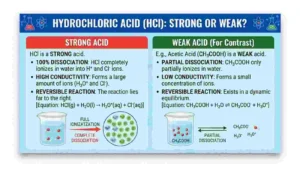
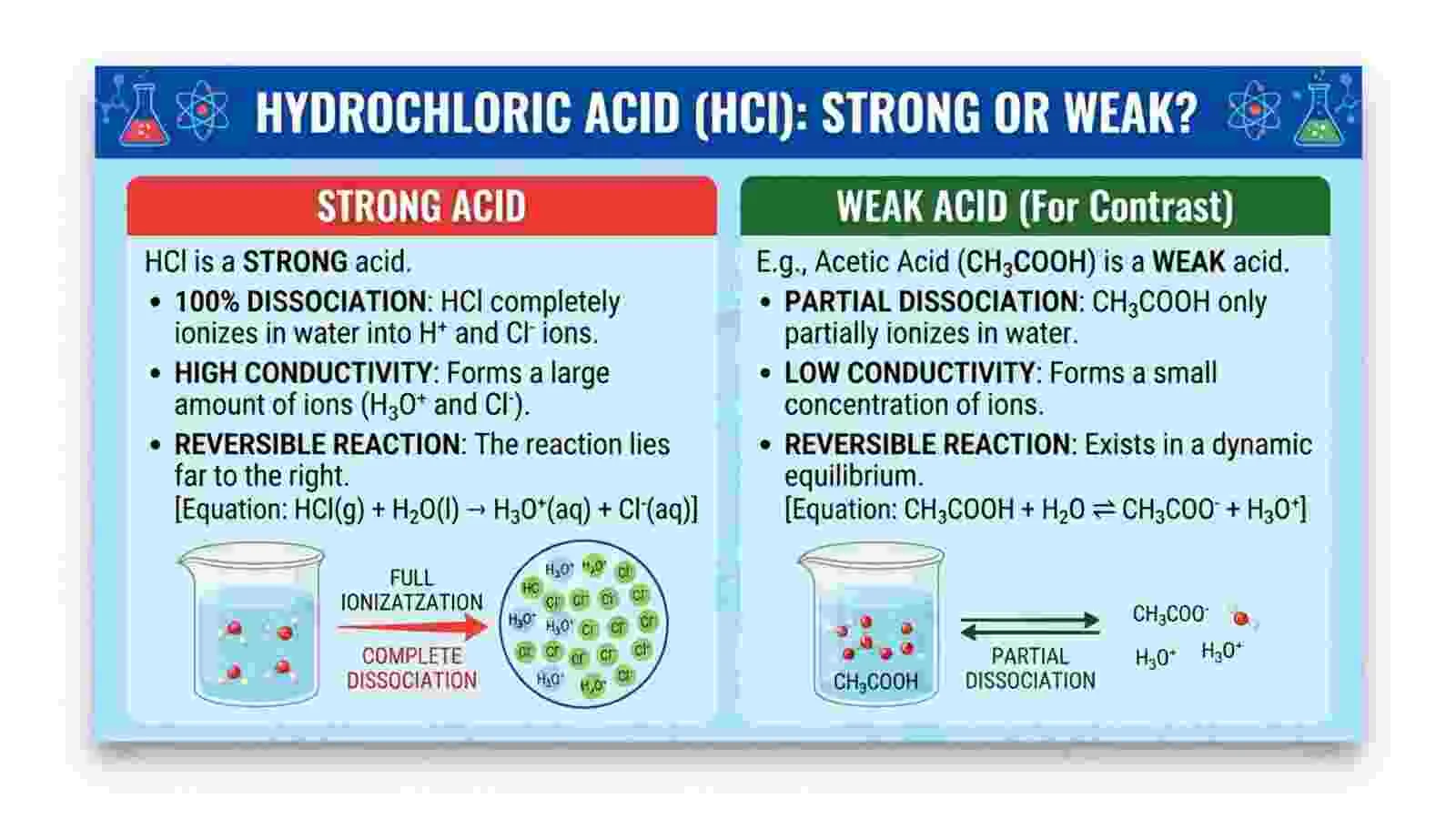
The answer is simple: HCl (hydrochloric acid) is a strong acid. It breaks apart almost fully in water and releases hydrogen ions (H⁺).
This makes it very different from weak acids, which only break apart in part.
Many students search for “HCl strong or weak” because they want to understand acid strength, chemical bonding, and ionization.
Some also confuse acid strength with acid concentration. These are not the same. A strong acid can be dilute or concentrated, depending on how much acid is mixed with water.
In this guide, you will learn why HCl is a strong acid, how it behaves in water, and how it compares with weak acids.
You will also find simple examples, common mistakes, and answers to key chemistry questions.
HCl Strong or Weak – Quick Answer
HCl is a strong acid because it ionizes almost 100% in water. It releases hydrogen ions and chloride ions when dissolved in water.
The chemical reaction is:
HCl+H2OH3O++Cl-
This means hydrochloric acid gives its proton to water. It forms hydronium ions (H₃O⁺) and chloride ions (Cl⁻).
Examples of strong acids include:
- Hydrochloric acid (HCl)
- Sulfuric acid (H₂SO₄)
- Nitric acid (HNO₃)
- Hydrobromic acid (HBr)
- Hydroiodic acid (HI)
A weak acid, such as acetic acid, only ionizes partly in water.
The Origin of HCl
HCl is the chemical formula for hydrogen chloride. It contains one hydrogen atom and one chlorine atom.
The name hydrochloric acid is used when hydrogen chloride gas dissolves in water. In this form, it acts as an acid.
The word acid comes from the Latin word acidus, which means sour. The term hydrochloric acid refers to its hydrogen and chlorine components.
Hydrochloric acid has been used in laboratories and industries for many years. It is also found naturally in the human stomach, where it helps break down food.
British English vs American English Spelling
The spelling of hydrochloric acid does not change between British and American English. Both use the same chemical name and formula.
| Feature | British English | American English |
| Chemical formula | HCl | HCl |
| Chemical name | Hydrochloric acid | Hydrochloric acid |
| Acid classification | Strong acid | Strong acid |
| Scientific spelling | Ionisation | Ionization |
| Common term | Acid strength | Acid strength |
The main difference is in some scientific words, such as ionisation and ionization. The chemical formula HCl stays the same worldwide.
Which Spelling Should You Use?
The correct spelling depends on your audience and writing style.
- US audience: Use American spelling, such as ionization.
- UK audience: Use British spelling, such as ionisation.
- Global audience: Use clear scientific terms and the standard formula HCl.
For chemistry exams, always follow the spelling style used by your school, college, or examination board.
Remember that HCl is a strong acid in both British and American chemistry textbooks.
Common Mistakes with HCl Strong or Weak
Students often make a few mistakes when learning about hydrochloric acid.
Here are some common errors and their corrections:
| Common mistake | Correct explanation |
| HCl is a weak acid. | HCl is a strong acid. |
| Strong acid means concentrated acid. | Strength and concentration are different. |
| HCl does not ionize in water. | HCl ionizes almost completely in water. |
| HCl and H₂O are the same. | They are different chemical substances. |
| All acids are strong. | Some acids are weak. |
| HCl releases chloride ions only. | It forms hydronium and chloride ions in water. |
The most important point is that acid strength depends on ionization, not just concentration.
HCl in Everyday Examples
Hydrochloric acid has many uses in daily life, science, and industry.
1. In the human stomach
Our stomach makes hydrochloric acid. It helps break down food and supports digestion.
2. In laboratories
Scientists use HCl in experiments to study acids, bases, and chemical reactions.
3. In industries
HCl is used to clean metal surfaces and remove unwanted deposits.
4. In chemistry classes
Students use HCl to learn about strong acids, pH values, and neutralization reactions.
5. In formal scientific writing
A chemistry report may state: “Hydrochloric acid is a strong acid that ionizes almost completely in water.”
Never handle concentrated hydrochloric acid without proper safety equipment. It can cause serious burns.
HCl Strong or Weak – Google Trends & Usage Data
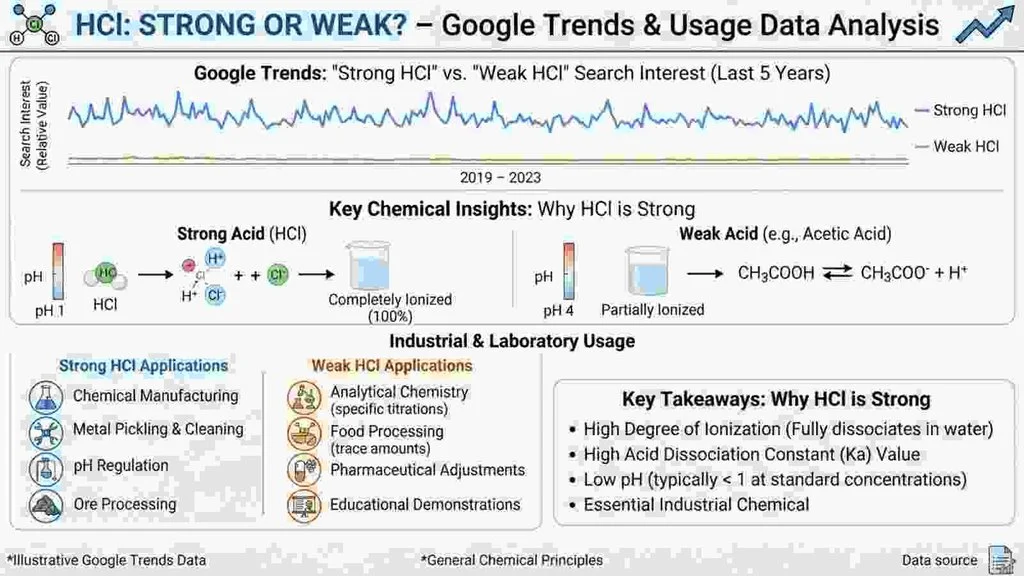
The keyword “HCl strong or weak” is mainly searched by students, teachers, and people studying chemistry.
Search interest may vary by country and school examination periods. However, exact popularity rankings require current keyword research data.
| Search context | User interest |
| United States | Chemistry homework and science exams |
| United Kingdom | Acid strength and ionization |
| India | School chemistry and competitive exams |
| Pakistan | Chemistry concepts and board exams |
| Canada | Acid-base reactions and science studies |
| Australia | Chemical properties and acid classification |
Related searches include:
- Is HCl a strong acid?
- Why is hydrochloric acid strong?
- HCl ionization in water
- HCl pH value
- HCl strong or weak electrolyte
- Difference between strong and weak acids
These related terms help explain the main topic and answer different types of chemistry questions.
Comparison Table: Strong Acids vs Weak Acids
| Feature | Strong acids | Weak acids |
| Ionization | Almost complete | Partial |
| Ion production | High at equal concentration | Lower at equal concentration |
| Electrical conductivity | Generally high | Generally lower |
| Examples | HCl, HNO₃, HBr | CH₃COOH, HF |
| Reaction with water | Nearly complete | Reversible equilibrium |
HCl belongs to the strong acid group because it ionizes almost completely in water.
FAQs About HCl Strong or Weak
1. Is HCl a strong or weak acid?
HCl is a strong acid because it ionizes almost completely in water.
2. Why is HCl called a strong acid?
It is called a strong acid because it transfers its hydrogen ion to water very easily.
3. Is HCl stronger than acetic acid?
Yes. HCl is much stronger than acetic acid because HCl ionizes almost completely, while acetic acid ionizes only partly.
4. Is HCl a strong electrolyte?
Yes. HCl is a strong electrolyte in water because it produces many ions.
5. Is concentrated HCl always a strong acid?
HCl is strong even when dilute. Concentration describes how much HCl is present in a solution.
6. What happens when HCl dissolves in water?
It transfers a proton to water and forms hydronium ions (H₃O⁺) and chloride ions (Cl⁻).
7. Is HCl a strong acid in all conditions?
HCl is classified as a strong acid in aqueous solutions. Its behavior can differ in other solvents.
Conclusion
HCl is a strong acid because it ionizes almost completely when dissolved in water.
It forms hydronium ions and chloride ions, which explains its strong acidic behavior. This makes it different from weak acids like acetic acid, which only ionize partly.
One important thing to remember is that acid strength and acid concentration are not the same.
HCl remains a strong acid even when it is diluted with water. Its strength depends on how easily it gives away a proton, not simply on how much acid is present.
Whether you study chemistry in the United States, United Kingdom, Pakistan, or another country, the chemical formula and classification remain the same.
Learning this simple concept can help you understand pH, electrolytes, acid-base reactions, and other chemistry topics.
For exams, remember this simple rule: HCl = Strong Acid. This is the key fact you need to answer questions about hydrochloric acid with confidence.

Here’s a concise 2-line author bio suitable for Simifind.com:
James Dashner is an American bestselling author best known for The Maze Runner series and other popular young-adult fiction.
On Simifind.com, he shares clear, engaging insights and helpful content for readers interested in books, writing, and popular literature.