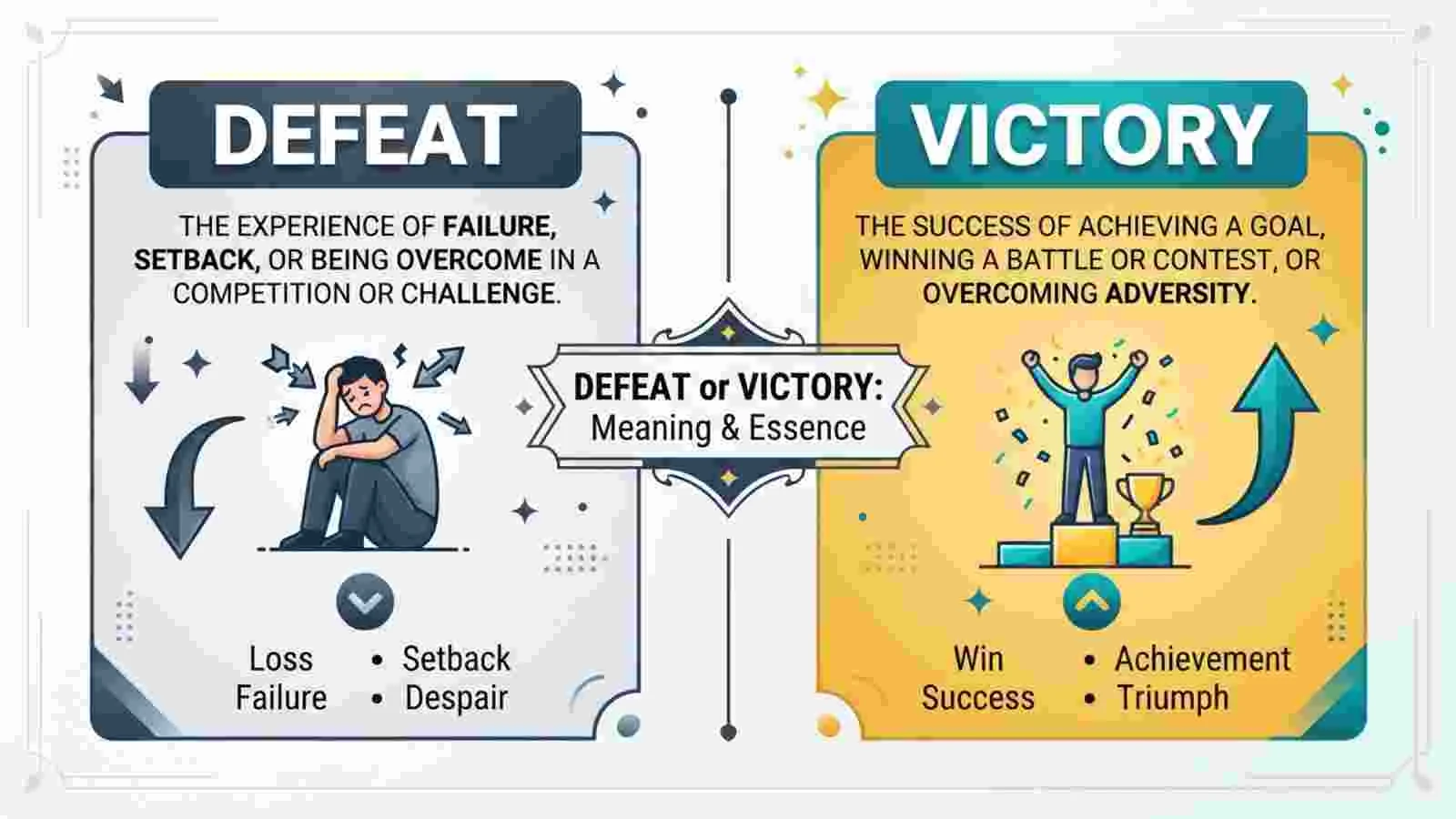
Life is full of challenges, choices, and outcomes. Sometimes we win, and sometimes we lose. But how do we describe these moments?
Should we use defeat or victory?
Both words have strong meanings, but they describe opposite results. Victory means winning a battle, game, or difficult situation. Defeat means losing or failing to reach a goal.
People search for “defeat or victory” to understand the difference between these words, learn their correct usage, and find examples for everyday communication.
These terms are common in sports, history, politics, news, education, and personal life. They also appear in famous quotes, speeches, and motivational messages.
Although defeat and victory are not spelling variations, they are often compared because they represent opposite outcomes.
Understanding their meanings helps you choose the right word in the right situation. In this guide, we will explore their definitions, origins, usage, common mistakes, and examples to help you use both words with confidence.
Defeat or Victory – Quick Answer
Defeat means losing a contest, battle, competition, or struggle. Victory means winning or achieving success.
Both words are nouns, but they can also be used in different grammatical forms.
Examples:
- Defeat: Our team faced defeat in the final match.
- Victory: Our team celebrated victory after the final match.
- Defeat: The army suffered a major defeat.
- Victory: The players achieved a historic victory.
The main difference is simple: defeat represents losing, while victory represents winning.
The Origin of Defeat or Victory
The words defeat and victory have different historical roots.
Defeat comes from Old French defait, related to the verb defaire, meaning to undo or destroy. It entered English during the Middle Ages. Over time, its meaning developed to describe losing a battle or competition.
Victory comes from Latin victoria, meaning winning or triumph. It entered English through Old French and Latin influences. The word has been used for centuries to describe success in battles, contests, and personal struggles.
These words developed separately because they describe opposite human experiences.
British English vs American English Spelling
There is no British and American spelling difference between defeat and victory. Both countries use the same spellings.
However, their related words and expressions may appear in different writing styles.
| Word or Expression | British English | American English |
| Defeat | Defeat | Defeat |
| Victory | Victory | Victory |
| Defeated | Defeated | Defeated |
| Victorious | Victorious | Victorious |
| Defeating | Defeating | Defeating |
| Victory celebration | Victory celebration | Victory celebration |
Examples:
- British English: The team achieved a great victory.
- American English: The team achieved a great victory.
- British English: The country suffered a major defeat.
- American English: The country suffered a major defeat.
Both forms are correct in the UK and USA.
Which Spelling Should You Use?
Choosing between defeat and victory depends on the meaning you want to express, not your location.
For American English: Use defeat when describing a loss and victory when describing a win.
For British English: Follow the same spelling and meaning. There is no regional spelling change.
For Commonwealth countries: Countries such as Pakistan, India, Australia, and Canada also use both standard spellings.
For global writing: Use these words according to the result you want to describe. They are understood worldwide.
For SEO articles, academic writing, news reports, and professional communication, both words are suitable.
Common Mistakes with Defeat or Victory
Writers sometimes confuse these words or use them in the wrong context.
Here are common mistakes and their corrections:
| Incorrect Usage | Correct Usage | Explanation |
| We celebrated our defeat. | We celebrated our victory. | Victory means winning. |
| The team won a defeat. | The team suffered a defeat. | Defeat means losing. |
| He was victory in the match. | He was victorious in the match. | Victorious is an adjective. |
| They achieved defeat. | They suffered defeat. | Use suffered for a loss. |
| Our defeat was successful. | Our victory was successful. | Victory describes success. |
Helpful tip: Remember that victory is connected with winning, while defeat is connected with losing.
Defeat or Victory in Everyday Examples
Both words are used in daily conversations, professional writing, news reports, and social media.
1. In Emails
- We are pleased to announce our victory in the competition.
- Despite the defeat, we appreciate everyone’s hard work.
2. In News Reports
- The national team secured a historic victory.
- The government faced a major defeat in parliament.
3. On Social Media
- Every defeat teaches a lesson.
- Victory comes to those who never give up.
- A small victory can create a big change.
4. In Formal Writing
- The historical defeat changed the course of the war.
- The victory marked an important moment in national history.
5. In Everyday Conversations
- Nobody likes defeat, but everyone can learn from it.
- Victory feels better after hard work.
- A defeat today can lead to victory tomorrow.
Defeat or Victory – Google Trends & Usage Data
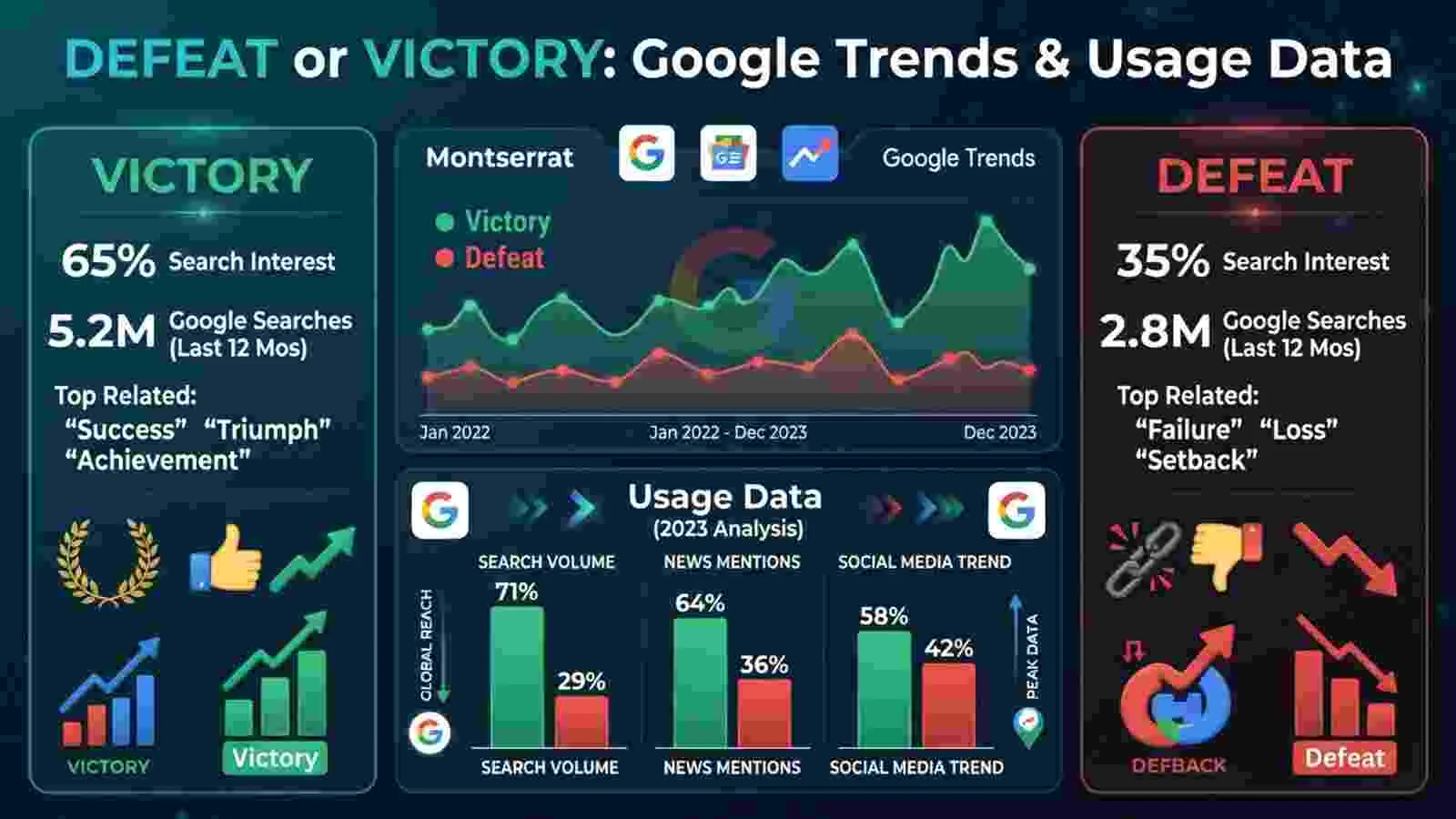
Defeat and victory are widely used English words across the world. Their search interest often changes according to sports events, political developments, historical discussions, and major competitions.
However, they are not exact keyword alternatives because people search for them with different intentions.
Victory searches often relate to:
- Sports wins and championship results.
- Victory quotes and motivational messages.
- Historical victories and national celebrations.
- Personal success and achievements.
Defeat searches often relate to:
- Sports losses and match results.
- Military and historical events.
- Political defeats and election outcomes.
- Motivational lessons about failure.
Comparison Table: Defeat vs Victory
| Feature | Defeat | Victory |
| Meaning | Losing | Winning |
| Word type | Noun and verb | Noun |
| Related adjective | Defeated | Victorious |
| Main feeling | Disappointment | Happiness |
| Sports context | Losing a match | Winning a match |
| Historical context | Losing a war | Winning a war |
| Example | A painful defeat | A great victory |
Country-based usage: Both words are understood in the USA, UK, Canada, Australia, Pakistan, and India. Exact country rankings and search volumes require current Google Trends or keyword research data, so no unsupported figures are provided here.
FAQs About Defeat or Victory
1. What is the difference between defeat and victory?
Defeat means losing a competition or struggle, while victory means winning or achieving success.
2. Is defeat the opposite of victory?
Yes. Defeat and victory are opposites. Defeat describes losing, while victory describes winning.
3. Is victory a noun or an adjective?
Victory is a noun. The adjective form is victorious.
4. What is the adjective form of defeat?
The adjective form is defeated. For example, the defeated team left the field.
5. Can defeat lead to victory?
Yes. A defeat can teach valuable lessons, improve skills, and help someone achieve future success.
6. Are defeat and victory spelled differently in British and American English?
No. Both British and American English use the same spelling for defeat and victory.
7. Which word is better for motivational writing?
Both words work well. Victory highlights success, while defeat can show learning, courage, and personal growth.
Conclusion
Understanding defeat or victory is important for clear English communication.
Although these words describe opposite outcomes, both play an important role in everyday language.
Defeat means losing a match, battle, competition, or struggle. Victory means winning or reaching a desired goal.
The most important point is that neither word has a different British or American spelling.
Both are written and understood in the same way across English-speaking countries.
You should choose the word that matches the situation. Use defeat when discussing a loss and victory when describing a win.
These words are useful in academic essays, professional emails, news articles, social media posts, and everyday conversations.
They also help express important life lessons. A defeat does not always mean the end, and a victory does not always mean the journey is over.
Both experiences can teach us valuable lessons. By understanding their meanings and examples, you can use defeat and victory correctly and confidently in your writing.

Here’s a concise 2-line author bio suitable for Simifind.com:
James Dashner is an American bestselling author best known for The Maze Runner series and other popular young-adult fiction.
On Simifind.com, he shares clear, engaging insights and helpful content for readers interested in books, writing, and popular literature.







