Have you ever wondered why some molecules mix with water while others do not?
The answer often depends on whether a molecule is polar or nonpolar. One common chemistry question is whether SF2 is polar or nonpolar.
Students often search for this topic because they want to understand its molecular shape, bond polarity, Lewis structure, and electron arrangement.
SF2 is the chemical formula for sulfur difluoride. It contains one sulfur atom and two fluorine atoms.
Both fluorine atoms attract electrons strongly, which creates polar bonds. However, bond polarity alone does not decide the polarity of the whole molecule. The molecular shape also matters.
In this guide, you will learn why SF2 is polar, how its Lewis structure works, and how its bent shape affects the molecule.
We will also explain its electronegativity, dipole moment, and VSEPR theory in simple words. By the end, you will understand the difference between polar bonds and a polar molecule.
SF2 Polar or Nonpolar – Quick Answer
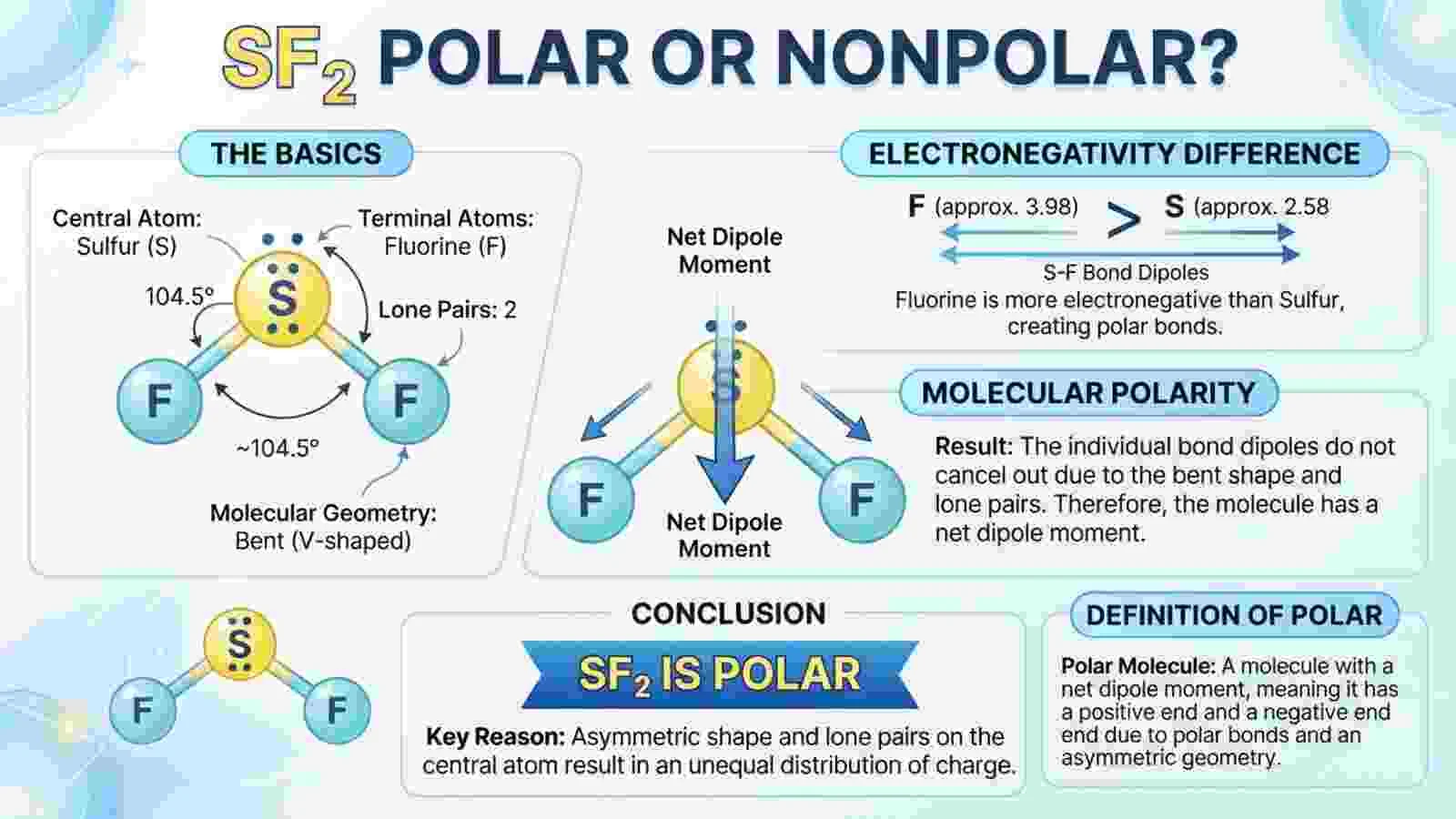
SF2 is a polar molecule. Its shape is bent, so the bond dipoles do not cancel each other.
Here are the main facts:
- Chemical formula: SF2
- Full name: Sulfur difluoride
- Central atom: Sulfur
- Molecular shape: Bent (V-shaped)
- Bond type: Polar covalent
- Molecular polarity: Polar
- Electron geometry: Tetrahedral
The sulfur-fluorine bonds are polar because fluorine attracts shared electrons more strongly than sulfur.
Since SF2 has a bent shape, the two bond dipoles point in different directions. They do not cancel out. This creates a net dipole moment.
The Origin of SF2 – Chemical Structure and History
SF2 stands for sulfur difluoride. Its name comes from its two main elements: sulfur (S) and fluorine (F).
The prefix di- means two. Therefore, sulfur difluoride contains one sulfur atom and two fluorine atoms.
Sulfur belongs to Group 16 of the periodic table. Fluorine belongs to Group 17. Sulfur has six valence electrons, while each fluorine atom has seven.
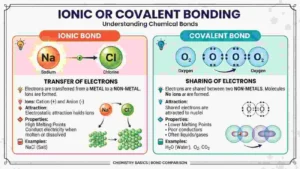
These atoms share electrons to form two covalent bonds.
Lewis Structure of SF2
The Lewis structure shows how atoms share electrons and how lone pairs are arranged.
- Sulfur is the central atom.
- Two fluorine atoms form single bonds with sulfur.
- Sulfur has two lone pairs.
- Each fluorine atom has three lone pairs.
This arrangement gives sulfur four electron regions: two bonding pairs and two lone pairs.
Why Is SF2 Bent?
According to VSEPR theory, electron pairs repel each other.
The two lone pairs on sulfur push the bonding pairs closer together. This creates a bent molecular shape.
The bond angle is approximately 98 degrees.
This bent shape is the main reason SF2 is polar.
British English vs American English Spelling
The chemical formula SF2 does not have British and American spelling variations.
Both British English and American English use the same formula and chemical name.
| Feature | British English | American English |
| Chemical formula | SF2 | SF2 |
| Chemical name | Sulfur difluoride | Sulfur difluoride |
| Molecular shape | Bent | Bent |
| Bond type | Polar covalent | Polar covalent |
| Molecular polarity | Polar | Polar |
Sulfur vs Sulphur
There is one spelling difference worth knowing:
- Sulfur: Standard spelling in American English and the internationally preferred scientific spelling.
- Sulphur: Traditional British English spelling.
Both words refer to the same chemical element.
Which Spelling Should You Use?
Your choice depends on your audience and writing purpose.
- US audience: Use sulfur difluoride.
- UK audience: Sulphur may appear in general British English, but sulfur is standard in modern scientific writing.
- Global audience: Use sulfur difluoride for scientific accuracy and consistency.
For chemistry assignments, research papers, and educational articles, use SF2 (sulfur difluoride).
The chemical formula remains the same worldwide.
Common Mistakes with SF2 Polar or Nonpolar
Students often make mistakes when deciding whether SF2 is polar or nonpolar.
Here are some common errors and their corrections.
| Common mistake | Correct explanation |
| SF2 is nonpolar because it has two fluorine atoms. | Its bent shape makes it polar. |
| SF2 has a linear shape. | SF2 has a bent shape. |
| Sulfur has no lone pairs. | Sulfur has two lone pairs. |
| All covalent bonds are nonpolar. | SF2 has polar covalent bonds. |
| Bond polarity and molecular polarity are the same. | Molecular shape also affects polarity. |
| SF2 has a trigonal planar shape. | Its molecular geometry is bent. |
Remember: A molecule can have polar bonds and a net dipole moment. Its shape decides whether the bond dipoles cancel.
SF2 in Everyday Examples – Understanding Molecular Polarity
The concept of SF2 polarity helps students understand how molecules behave.
Although sulfur difluoride is not a common household chemical, its structure provides a useful example of molecular polarity.
1. Chemistry Class
Students use SF2 to learn about Lewis structures, VSEPR theory, and molecular geometry.
2. Science Exams
Questions about SF2 often appear in chemistry tests. Students must identify its shape and explain why it is polar.
3. Online Learning
Science websites and social media posts often compare SF2 with other molecules, such as CO2, H2O, and BF3.
4. Formal Scientific Writing
In chemistry reports, SF2 is a useful example of a molecule with polar bonds and a bent molecular shape.
5. Understanding Water Polarity
Water (H2O) also has a bent shape and is polar. Comparing H2O with SF2 helps students understand how molecular geometry affects polarity.
SF2 Polar or Nonpolar – Google Trends and Usage Data
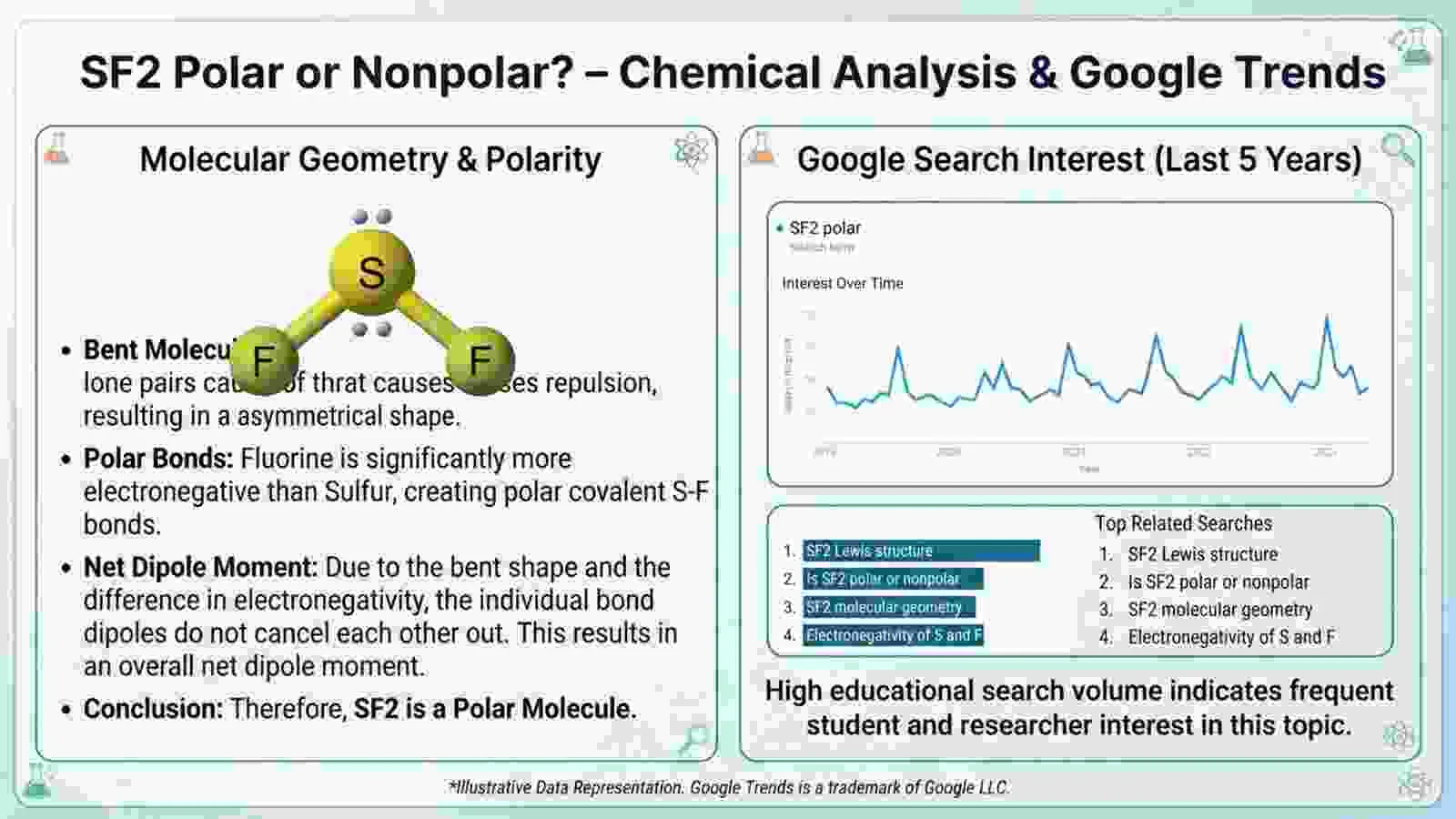
The keyword SF2 polar or nonpolar belongs to the educational chemistry niche.
Students often search for this phrase when studying molecular polarity, Lewis structures, and VSEPR theory.
Search interest may come from:
- United States: High school and college chemistry students.
- United Kingdom: Students learning chemical bonding and molecular shapes.
- Canada: Learners studying electronegativity and molecular geometry.
- Australia: Students preparing for chemistry assessments.
- Pakistan and India: Students preparing for school, college, and competitive examinations.
Related search terms include:
- Is SF2 polar or nonpolar?
- SF2 molecular geometry
- SF2 Lewis structure
- SF2 bond angle
- SF2 dipole moment
- Sulfur difluoride polarity
- SF2 electron geometry
Note: These are likely search contexts and related keyword ideas, not verified Google Trends rankings or search-volume figures.
SF2 Polar vs Nonpolar – Comparison Table
The following table compares SF2 with other common molecules.
| Molecule | Shape | Polarity |
| SF2 | Bent | Polar |
| H2O | Bent | Polar |
| CO2 | Linear | Nonpolar |
| BF3 | Trigonal planar | Nonpolar |
| NH3 | Trigonal pyramidal | Polar |
| CH4 | Tetrahedral | Nonpolar |
| SO2 | Bent | Polar |
This comparison shows that molecular shape plays an important role in determining polarity.
FAQs About SF2 Polar or Nonpolar
1. Is SF2 polar or nonpolar?
SF2 is polar because it has a bent molecular shape. Its bond dipoles do not cancel each other.
2. Why is SF2 a polar molecule?
SF2 is polar because fluorine attracts electrons more strongly than sulfur. Its bent shape creates an uneven charge distribution.
3. What is the molecular geometry of SF2?
SF2 has a bent or V-shaped molecular geometry because sulfur has two bonding pairs and two lone pairs.
4. What is the electron geometry of SF2?
The electron geometry of SF2 is tetrahedral because it has four electron regions around the central sulfur atom.
5. How many lone pairs are present in SF2?
Sulfur has two lone pairs, and each fluorine atom has three lone pairs.
6. Are SF2 bonds polar?
Yes. Both sulfur-fluorine bonds are polar covalent because fluorine has a higher electronegativity than sulfur.
7. Does SF2 have a dipole moment?
Yes. SF2 has a net dipole moment because its two bond dipoles do not cancel due to its bent shape.
Conclusion
Understanding whether SF2 is polar or nonpolar becomes easy when you study its Lewis structure and molecular geometry.
SF2 is a polar molecule because it has two polar sulfur-fluorine bonds and a bent molecular shape.
Sulfur is the central atom and has two bonding pairs and two lone pairs. According to VSEPR theory, these four electron regions create a tetrahedral electron geometry.
However, the molecular geometry is bent because lone pairs are not counted as atoms when naming the molecular shape.
The two sulfur-fluorine bond dipoles do not cancel each other. As a result, SF2 has a net dipole moment.
Remember these three important points: SF2 has polar covalent bonds, a bent molecular shape, and an overall polar nature.
If you are preparing for a chemistry exam, learn how molecular shape affects bond dipoles. This simple rule will help you solve many other polarity questions with confidence.

Mary Roach is an American science writer and bestselling author known for making unusual and complex scientific topics engaging, accessible, and humorous. Her books include Stiff, Packing for Mars, Gulp, and Fuzz.
Author at Simifind.com, sharing clear, informative content designed to help readers understand interesting topics and everyday questions.