Have you ever wondered whether SiF4 is polar or nonpolar?
This is a common question in chemistry. Many students find it hard to understand because silicon-fluorine bonds are polar. So, does that make the whole SiF4 molecule polar too?
The answer depends on its molecular shape and the direction of its bond dipoles. SiF4 is also known as silicon tetrafluoride.
It contains one silicon atom and four fluorine atoms. Fluorine attracts electrons more strongly than silicon. This creates polar Si-F bonds.
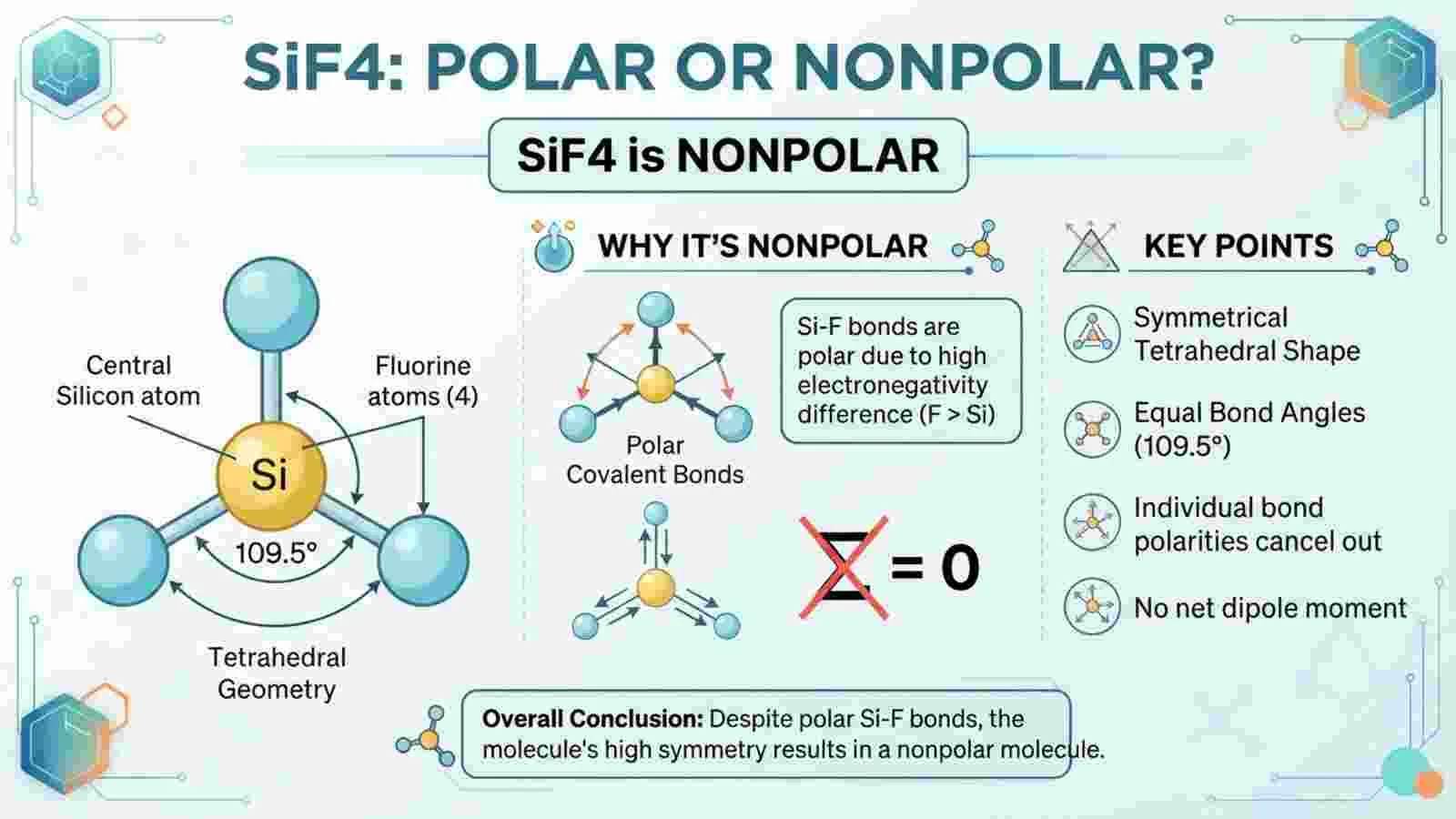
However, the shape of a molecule also matters. SiF4 has a symmetrical tetrahedral structure.
Its four bond dipoles point in different directions and cancel each other out. As a result, the molecule has no net dipole moment.
In this guide, you will learn whether SiF4 is polar or nonpolar, how its Lewis structure works, why its bond dipoles cancel, and how molecular geometry affects polarity.
These simple explanations will help you understand the chemistry behind this molecule.
SiF4 Polar or Nonpolar – Quick Answer
SiF4 is a nonpolar molecule.
Although its silicon-fluorine (Si-F) bonds are polar, its symmetrical tetrahedral shape causes all four bond dipole moments to cancel.
Here are the main facts:
- Chemical formula: SiF4
- Chemical name: Silicon tetrafluoride
- Central atom: Silicon (Si)
- Surrounding atoms: Four fluorine (F) atoms
- Molecular geometry: Tetrahedral
- Bond type: Polar covalent
- Molecular polarity: Nonpolar
- Net dipole moment: Zero
For example, water (H2O) is polar because its bent shape does not allow its bond dipoles to cancel. SiF4 has a symmetrical shape, so its dipoles cancel.
What Is SiF4? Chemical Structure and Origin
SiF4 stands for silicon tetrafluoride. It is a chemical compound made of one silicon atom and four fluorine atoms.
The name comes from two parts:
- Silicon: The central element in the compound.
- Tetrafluoride: “Tetra” means four, while “fluoride” refers to fluorine.
Silicon has four valence electrons. Each fluorine atom has seven valence electrons. Silicon shares one electron pair with each of the four fluorine atoms.
This creates four single covalent bonds.
Silicon tetrafluoride is a colorless gas under normal room conditions. It is also known for its tetrahedral molecular structure.
SiF4 Lewis Structure
The Lewis structure helps explain how atoms share electrons in a molecule.
To draw the SiF4 Lewis structure, follow these steps:
- Count the valence electrons. Silicon has 4, and four fluorine atoms have 28. The total is 32 valence electrons.
- Place silicon in the center.
- Connect four fluorine atoms to silicon using single bonds.
- Give each fluorine atom three lone pairs.
- Check the electron count and octets.
Silicon forms four single bonds. Each fluorine completes its octet with three lone pairs.
The central silicon atom has no lone pairs.
This structure gives SiF4 a symmetrical arrangement.
Molecular Geometry of SiF4
SiF4 has a tetrahedral molecular geometry.
In this shape, the central silicon atom sits in the middle, while four fluorine atoms surround it.
The bond angle is approximately 109.5 degrees.
The tetrahedral shape is important because it creates symmetry. Each Si-F bond has the same strength and arrangement.
According to VSEPR theory, four bonding regions around the central silicon atom repel one another. They move as far apart as possible, creating a tetrahedral shape.
This arrangement helps explain why SiF4 is nonpolar.
Why Is SiF4 Nonpolar?
SiF4 is nonpolar because its four polar bonds are arranged symmetrically.
Fluorine is more electronegative than silicon. Therefore, each Si-F bond has an unequal sharing of electrons.
This creates four bond dipoles.
However, these dipoles point toward the four fluorine atoms in different directions. Because the molecule has a symmetrical tetrahedral shape, the dipoles cancel each other.
As a result:
- Individual Si-F bonds are polar.
- The molecular shape is symmetrical.
- The four bond dipoles cancel.
- The total dipole moment is zero.
Therefore, SiF4 is a nonpolar molecule.
Remember: Polar bonds do not always create a polar molecule. Molecular geometry plays a major role in determining overall polarity.
Is the Si-F Bond Polar or Nonpolar?
The Si-F bond is polar covalent.
This happens because silicon and fluorine have different electronegativity values.
Fluorine attracts shared electrons more strongly than silicon. As a result, fluorine gets a partial negative charge (δ−), while silicon gets a partial positive charge (δ+).
| Property | Si-F Bond |
| Bond type | Polar covalent |
| Electronegativity difference | About 2.1 |
| Electron attraction | Toward fluorine |
| Silicon charge | Partial positive |
| Fluorine charge | Partial negative |
| Bond dipole | Present |
Even though each bond is polar, the complete SiF4 molecule is nonpolar.
SiF4 vs Other Molecular Polarity Examples
Comparing SiF4 with other molecules makes molecular polarity easier to understand.
| Molecule | Molecular Shape | Bond Polarity | Overall Polarity |
| SiF4 | Tetrahedral | Polar | Nonpolar |
| CF4 | Tetrahedral | Polar | Nonpolar |
| CH4 | Tetrahedral | Nearly nonpolar | Nonpolar |
| H2O | Bent | Polar | Polar |
| NH3 | Trigonal pyramidal | Polar | Polar |
| CO2 | Linear | Polar | Nonpolar |
| SF4 | Seesaw | Polar | Polar |
The key difference is molecular geometry. Symmetrical molecules often have cancelling bond dipoles, while asymmetrical molecules may have a net dipole moment.
Common Mistakes About SiF4 Polarity
Students often make a few mistakes when studying molecular polarity.
Mistake 1: Thinking polar bonds always create polar molecules.
Correction: The whole molecular shape determines whether bond dipoles cancel.
Mistake 2: Calling SiF4 a polar molecule because fluorine is highly electronegative.
Correction: Fluorine creates polar bonds, but the tetrahedral structure makes the molecule nonpolar.
Mistake 3: Confusing molecular geometry with electron geometry.
Correction: SiF4 has four bonding regions and no lone pairs on silicon. Both its electron geometry and molecular geometry are tetrahedral.
Mistake 4: Forgetting the bond angle.
Correction: The ideal tetrahedral bond angle is approximately 109.5 degrees.
Mistake 5: Confusing bond polarity with molecular polarity.
Correction: A polar bond and a nonpolar molecule can exist together.
SiF4 in Everyday Chemistry and Science
SiF4 is not a common household chemical, but it has uses in industrial and scientific settings.
It is important in areas such as:
- Semiconductor manufacturing: It is used in some processes involving silicon-containing materials.
- Chemical research: Scientists study its bonding and molecular structure.
- Industrial chemistry: It is involved in certain processes that use fluorine-containing compounds.
- Chemistry education: It is a useful example for teaching molecular geometry and polarity.
Its molecular structure also helps students understand why bond polarity and molecular polarity are different.
SiF4 is toxic and reacts with moisture to produce dangerous substances, including hydrogen fluoride. It must be handled under proper industrial safety controls.
SiF4 – Google Trends and Search Interest
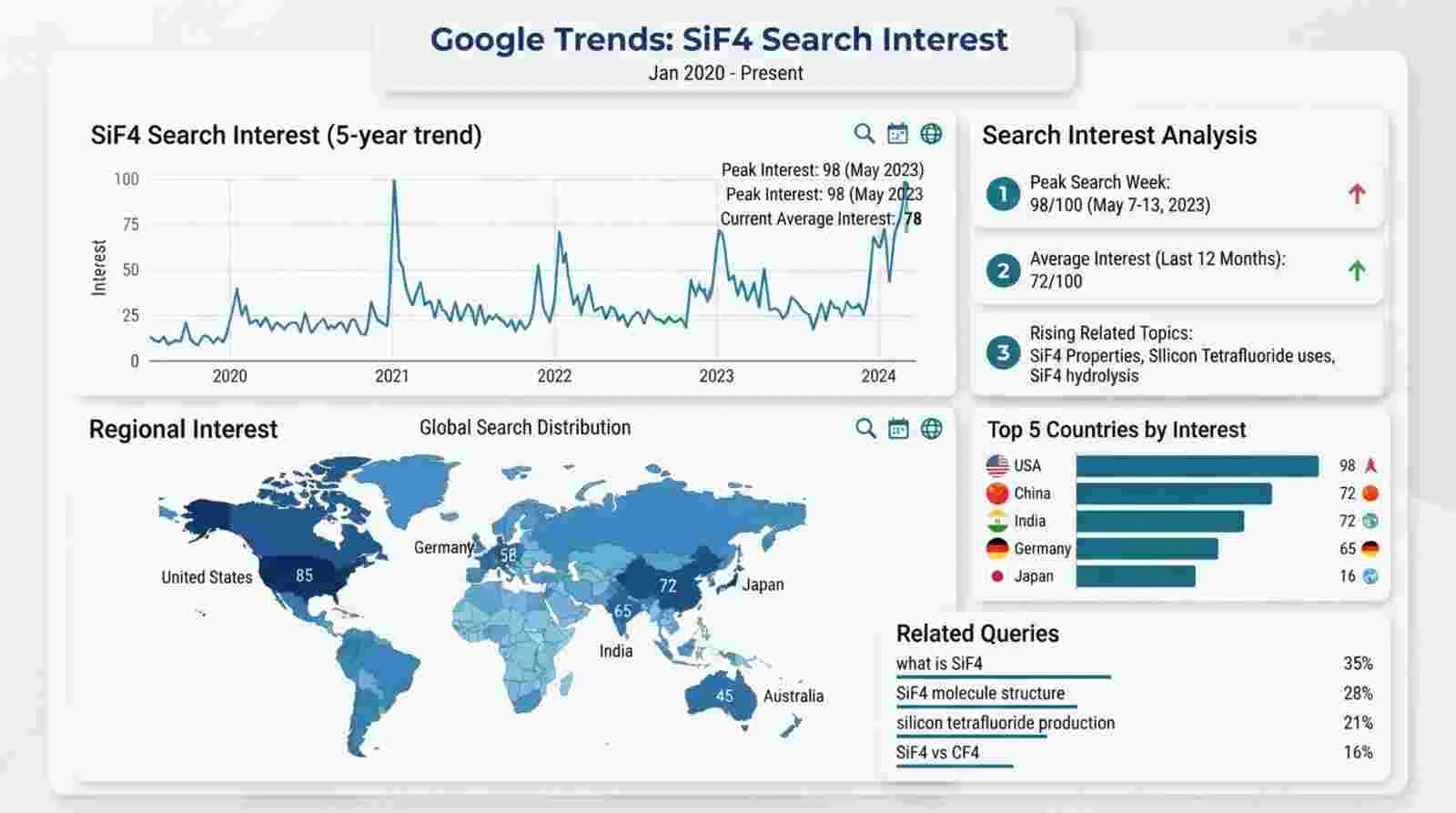
People search for SiF4 polar or nonpolar mainly to understand molecular polarity, chemistry homework, and exam questions.
Common search variations include:
- Is SiF4 polar or nonpolar?
- Why is SiF4 nonpolar?
- SiF4 molecular geometry
- SiF4 Lewis structure
- SiF4 bond angle
- Is the Si-F bond polar?
- SiF4 dipole moment
- Silicon tetrafluoride polarity
- SiF4 tetrahedral structure
- SiF4 electronegativity difference
Students in the United States, the United Kingdom, Canada, Australia, and other English-speaking countries may encounter this topic in high school and college chemistry courses.
Exact country rankings and search volumes require live Google Trends or keyword research data. No verified numerical popularity figures are available here.
FAQs About SiF4 Polar or Nonpolar
1. Is SiF4 polar or nonpolar?
SiF4 is nonpolar because its symmetrical tetrahedral structure causes the four Si-F bond dipoles to cancel.
2. Why is SiF4 nonpolar even though its bonds are polar?
Each Si-F bond is polar, but the four bond dipoles cancel because of the symmetrical tetrahedral shape.
3. What is the molecular geometry of SiF4?
SiF4 has a tetrahedral molecular geometry with an ideal bond angle of approximately 109.5 degrees.
4. Is the Si-F bond polar?
Yes. The Si-F bond is polar covalent because fluorine attracts shared electrons more strongly than silicon.
5. Does SiF4 have a net dipole moment?
No. Its four bond dipoles cancel, giving the molecule a net dipole moment of zero.
6. How many lone pairs are present on the central silicon atom in SiF4?
The central silicon atom has zero lone pairs and four bonding pairs.
7. What is the hybridization of silicon in SiF4?
In the traditional introductory chemistry model, silicon is described as sp3 hybridized, which is associated with its tetrahedral geometry.
Conclusion
SiF4 is a nonpolar molecule with four polar silicon-fluorine bonds. Its overall polarity depends on its molecular geometry, not just the electronegativity of its atoms.
The molecule has a symmetrical tetrahedral shape. Its four Si-F bonds point in different directions, and their dipole moments cancel each other. This gives SiF4 a net dipole moment of zero.
Its Lewis structure also makes this easy to understand. Silicon sits in the center and forms four single bonds with fluorine atoms. There are no lone pairs on the central silicon atom. The bond angle is about 109.5 degrees.
The most important lesson is that polar bonds do not always make a polar molecule. You must consider both bond polarity and molecular shape before deciding whether a compound is polar or nonpolar.
For chemistry students, SiF4 is a useful example of how molecular symmetry affects polarity. Remember its tetrahedral shape and cancelling dipoles, and you can answer this question with confidence.

Here’s a concise 2-line author bio suitable for Simifind.com:
James Dashner is an American bestselling author best known for The Maze Runner series and other popular young-adult fiction.
On Simifind.com, he shares clear, engaging insights and helpful content for readers interested in books, writing, and popular literature.







