Have you ever wondered whether to write email or e-mail?
You may see both spellings in emails, books, websites, and business documents. This can make it hard to know which one is correct.
The good news is that both forms are correct. They have the same meaning and refer to messages sent through the internet.
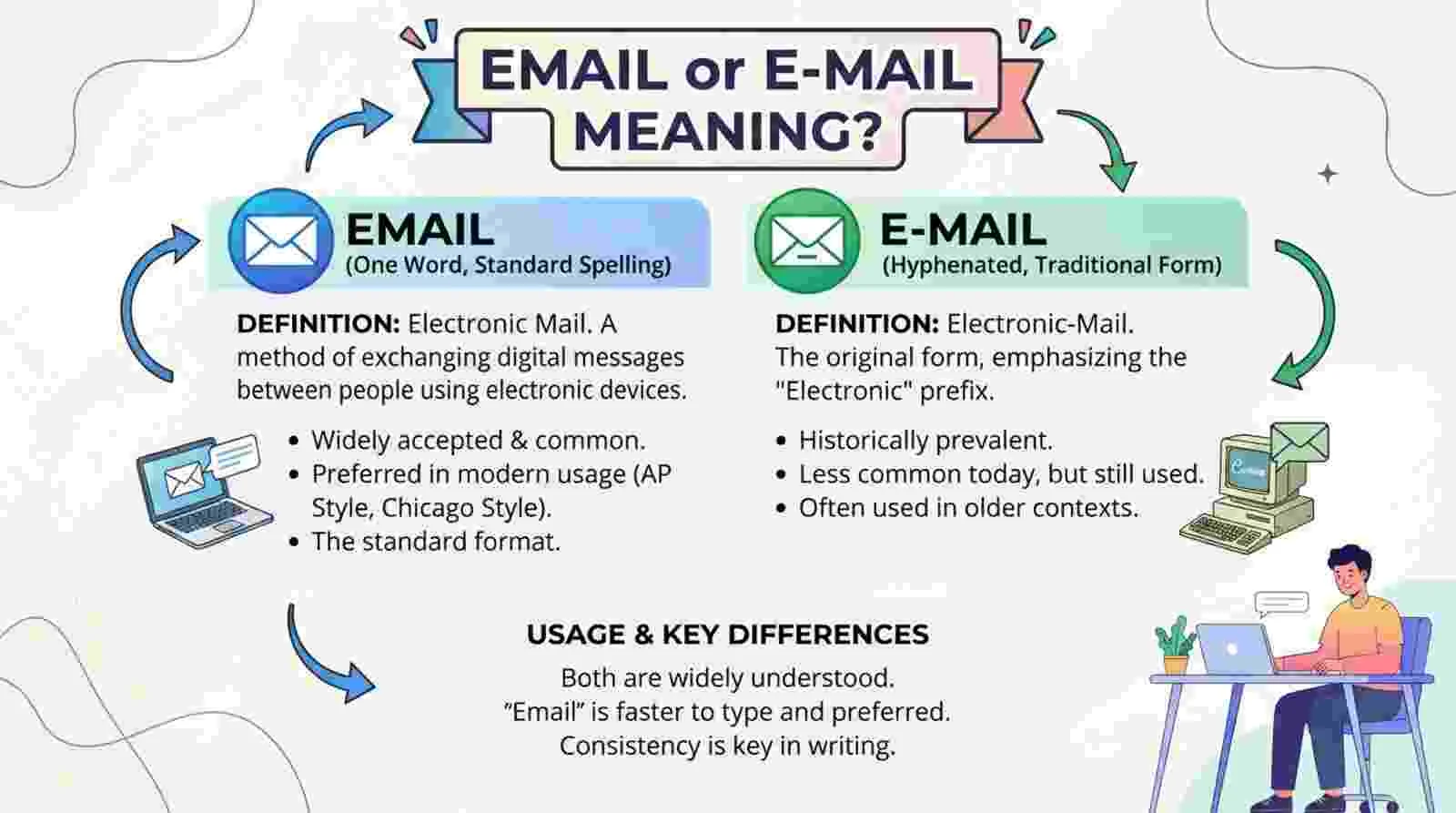
The main difference is how people write the word. Email is the modern and more common spelling. E-mail is the older form, which uses a hyphen.
Many people still use it, especially in older documents and traditional writing styles.
People often search for this spelling because they want to write clearly and avoid grammar mistakes. They may also wonder whether American and British English follow different rules.
In this guide, you will learn the meaning, origin, spelling differences, and correct usage of email and e-mail.
You will also find simple examples to help you choose the right form for school, work, and daily communication.
Email or E-Mail – Quick Answer
Both email and e-mail are correct spellings. They have the same meaning, but email is now the preferred form in most modern writing.
- Email: I sent you an email yesterday.
- E-mail: Please check your e-mail for the details.
The word email means a digital message sent from one computer or device to another through the internet.
| Spelling | Correct? | Usage |
| Yes | Modern and widely preferred | |
| Yes | Older and traditional | |
| E mail | No | Incorrect standard spelling |
Quick tip: Use email in modern writing unless your workplace or style guide requires e-mail.
The Origin of Email and E-Mail
The word email comes from the phrase electronic mail. It describes messages sent through electronic devices instead of traditional paper letters.
Electronic mail became popular as computer networks developed. Early users needed a short and simple word to describe this new way of sending messages.
The spelling e-mail appeared first. The letter “e” stood for electronic, while the hyphen joined it to the word mail.
Over time, people began writing it as email. This change followed a common pattern in English. Many words that once used hyphens later became single words.
For example:
- E-mail became email.
- E-commerce is also written as ecommerce in some contexts.
- E-book is often written as ebook.
Today, email is the more common spelling in websites, apps, newspapers, and business communication.
British English vs American English Spelling
There is no major spelling difference between British and American English when using email or e-mail.
Both countries accept both forms. However, modern writing in both regions tends to favor email.
| Feature | American English | British English |
| Modern spelling | ||
| Traditional spelling | ||
| Meaning | Electronic message | Electronic message |
| Common usage | ||
| Formal writing |
American English
American writers commonly use email in business documents, websites, and daily messages.
Example: I received an email from my manager.
British English
British writers also prefer email in modern communication.
Example: She sent me an email about the meeting.
Important: Neither spelling belongs to only one country. The choice is mainly about writing style and personal preference.
Which Spelling Should You Use?
Choosing between email and e-mail depends on your audience and writing purpose.
1. For American Readers
Use email when writing for American readers. It is common in offices, schools, websites, and online communication.
2. For British and Commonwealth Readers
Use email for modern British, Australian, Canadian, and other Commonwealth audiences. It is widely understood and accepted.
3. For Global Audiences
Email is the safest choice for international communication. It is simple, familiar, and widely used around the world.
4. For Academic and Formal Writing
Follow your university, publisher, or organization’s style guide. Some older style guides may still prefer e-mail.
5. For Websites and SEO
Use email in website content, headings, and SEO articles. It is the more common modern spelling and matches everyday search language.
Common Mistakes with Email or E-Mail
Writers sometimes make small mistakes when using these words. Here are some common errors and their corrections.
| Incorrect or Less Preferred | Correct Form | Explanation |
| E mail | Do not leave out the hyphen in the traditional form | |
| Both are accepted, but email is modern | ||
| Email’s (for plural) | Emails | No apostrophe is needed |
| Send me an e mail | Send me an email | Use the standard spelling |
| Email addresss | Email address | Avoid extra letters |
| I email him yesterday | I emailed him yesterday | Use the past tense |
Mistake 1: Writing E Mail
The form e mail is not standard. Use email or e-mail instead.
Mistake 2: Confusing Email and Emails
Email can be a noun or a verb. Emails is the plural noun.
Examples:
- I received an email.
- I received three emails.
Mistake 3: Using an Apostrophe for Plurals
Do not write email’s when you mean more than one message.
Correct: I checked all my emails.
Mistake 4: Changing Spellings in One Article
Avoid switching between email and e-mail without a reason. Choose one form and use it consistently.
Email or E-Mail in Everyday Examples
Both spellings have the same meaning. Here are examples from different situations.
1. In Business Emails
- Please send me an email with the report.
- I received your e-mail this morning.
2. In News Articles
- The company announced its new email service.
- The office received hundreds of e-mails from customers.
3. On Social Media
- Check your email for the latest update.
- I sent you an e-mail. Please reply soon.
4. In Formal Writing
- Please contact us by email.
- All applications must be sent through email.
5. In Daily Conversation
- Did you get my email?
- I will send you an email tonight.
These examples show that both forms work in everyday English. However, email is the simpler and more widely preferred choice.
Email or E-Mail – Google Trends and Usage Data
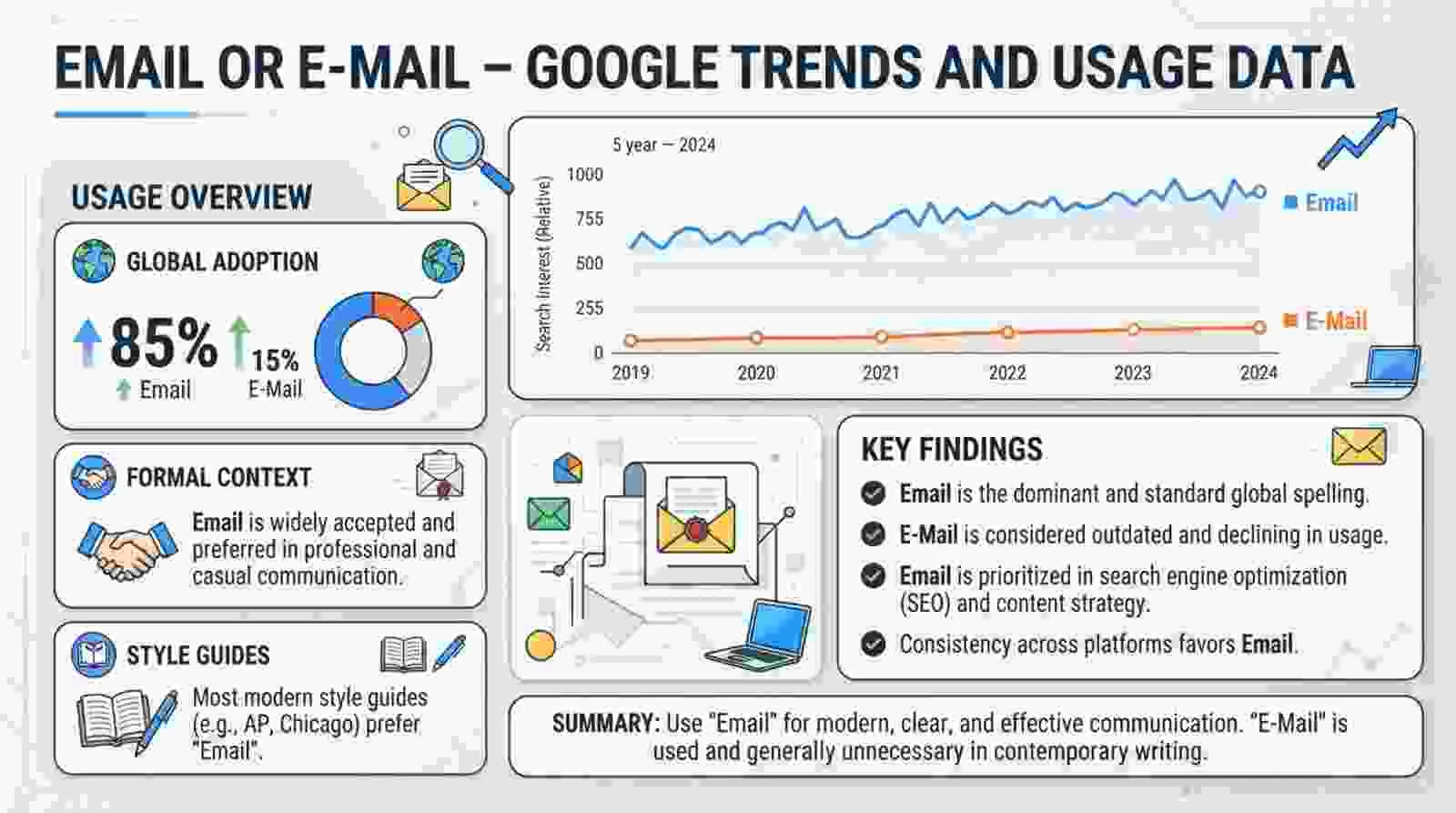
The popularity of email and e-mail has changed over time. The single-word form has become more common as digital communication has grown.
Email is widely used in:
- American English websites and business writing.
- British English newspapers and online publications.
- Australian and Canadian digital communication.
- International business and education.
- Social media and technology platforms.
E-mail is still found in older books, traditional documents, and some established style guides.
Which Keyword Is More Popular?
| Keyword | General Usage Trend | Best Context |
| More common | Modern writing and SEO | |
| Less common | Traditional writing | |
| Electronic mail | Formal and technical | Academic explanations |
Google Trends can help compare search interest for email and e-mail across countries and time periods.
However, search interest is not the same as the number of times a word appears in writing. Exact popularity rankings can change based on the country and selected date range.
For SEO purposes, email is the better primary keyword. You can also mention e-mail naturally in your article to cover readers who search for the hyphenated form.
Email vs E-Mail: Comparison Table
Here is a quick comparison of both spellings.
| Comparison | ||
| Meaning | Electronic mail | Electronic mail |
| Spelling | One word | Hyphenated |
| Correctness | Correct | Correct |
| Origin | Modern form | Older form |
| Popularity | Higher | Lower |
| American usage | Common | Accepted |
| British usage | Common | Accepted |
| SEO choice | Preferred | Secondary |
| Formal usage | Accepted | Accepted |
Frequently Asked Questions (FAQs)
1. Is email or e-mail correct?
Both email and e-mail are correct. However, email is the more common spelling in modern English.
2. Is email one word or two words?
Email is written as one word. E-mail is also correct, but it uses a hyphen. E mail without a hyphen is not standard.
3. Do Americans write email or e-mail?
Americans generally prefer email in modern writing. However, e-mail is also accepted.
4. Do British people use email or e-mail?
British writers use both forms, but email is now widely preferred in modern communication.
5. Is e-mail outdated?
E-mail is not incorrect or completely outdated. However, email is more common in modern websites, business writing, and everyday communication.
6. Should I use email or e-mail in formal writing?
Use email unless your organization, university, or style guide specifically requires e-mail.
7. What is the plural of email?
The plural of email is emails. For example, “I received five emails today.”
Conclusion
Choosing between email or e-mail is easy once you understand their meaning and history.
Both spellings are correct, and both refer to electronic messages sent through the internet.
The main difference is their style. E-mail is the older spelling, while email is the modern form.
Today, most writers prefer email because it is simple, clear, and widely recognized.
It is suitable for business communication, school assignments, websites, social media, and professional documents. American and British English both accept this spelling.
If you write for an international audience, email is the best choice. It is also a strong option for SEO content because it matches common modern usage.
However, if your organization follows a style guide that requires e-mail, you should follow that rule.
The most important thing is to stay consistent. Choose one spelling and use it throughout your article or document.
This small step will make your writing look clean, professional, and easy to read.

Mary Roach is an American science writer and bestselling author known for making unusual and complex scientific topics engaging, accessible, and humorous. Her books include Stiff, Packing for Mars, Gulp, and Fuzz.
Author at Simifind.com, sharing clear, informative content designed to help readers understand interesting topics and everyday questions.







