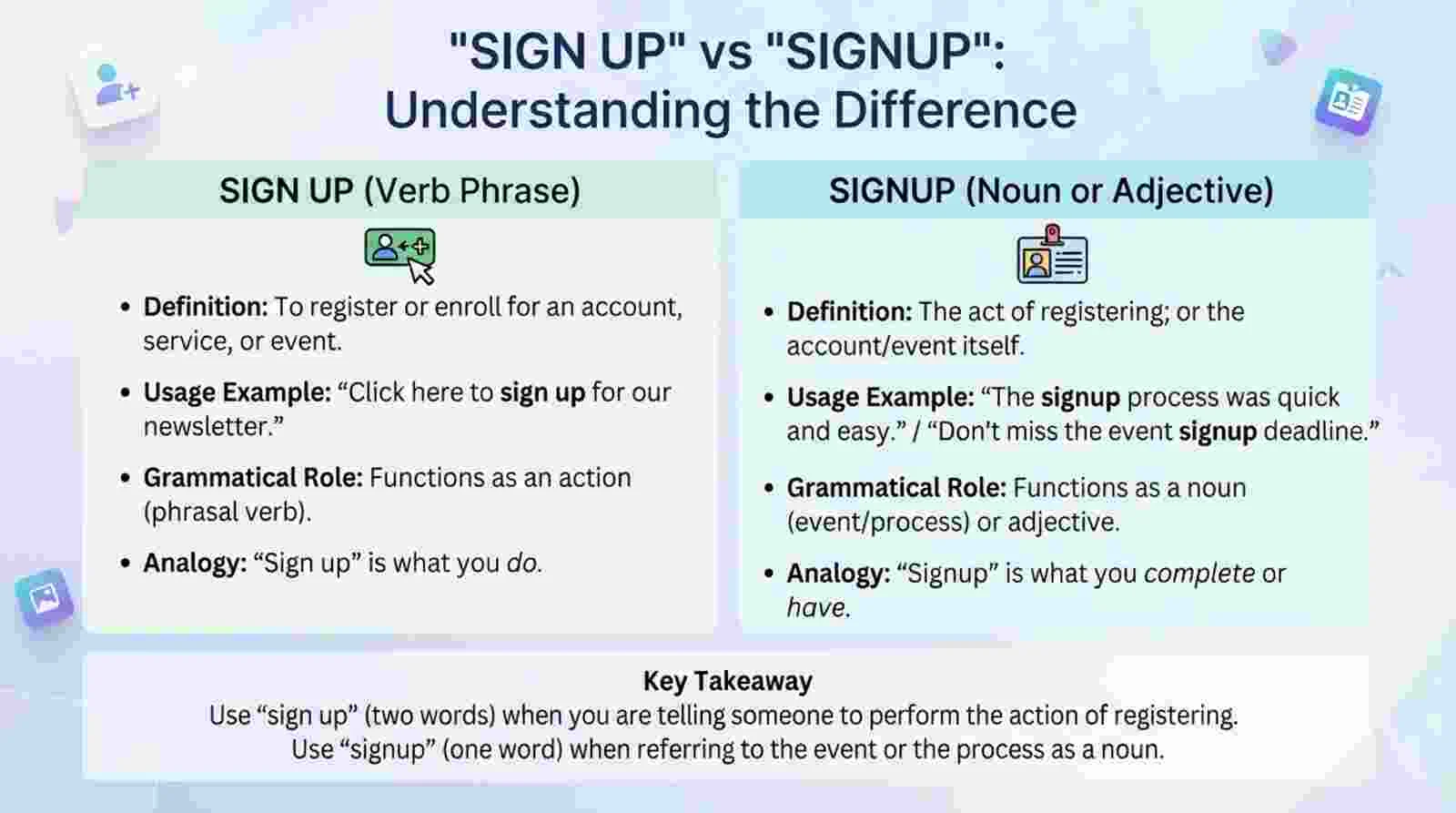
Sign up (two words) is the verb — “Please sign up here.” Sign-up (hyphenated) is the noun or adjective — “the sign-up form”, “a quick sign-up”. Signup (one word) is also used as a noun in American English, but sign-up is the safer spelling.
Have you ever wondered whether to write sign up or signup when creating an account, joining a website, or registering for an online service?
You are not alone. Many people search for this phrase because both forms look correct, but they have different uses in English.
The main difference is simple. Sign up is a verb that means to register or join something.
Signup is a noun or adjective that refers to the registration process, form, or activity.
For example, you can sign up for a newsletter, but you may need to complete a signup form.
This spelling question matters in emails, websites, business writing, social media, and everyday conversations.
Using the correct form makes your writing clear and professional. Both American and British English use these forms, although style and context can affect how they appear.
In this guide, you will learn when to use sign up and signup, explore their origins, compare their meanings, and see simple examples.
You will also learn common mistakes and which form is best for your audience.
Sign Up or Signup – Quick Answer
Sign up is the correct form when you use it as a verb. Signup is the correct form when you use it as a noun or adjective.
Both forms are correct, but they do not have the same grammatical role.
Examples:
- Sign up (verb): I want to sign up for an online course.
- Signup (noun): The signup was quick and easy.
- Signup (adjective): Please complete the signup form.
Remember this simple rule:
- Use sign up when someone takes action to register.
- Use signup when talking about the registration process, form, or event.
The Origin of Sign Up and Signup
The phrase sign up comes from the word sign. Historically, people signed their names on lists to show that they wanted to join an activity, group, or service.
The word sign comes from the Latin word signum, which means a mark or sign. Over time, signing a name became a way to show agreement, confirm identity, or register for something.
The word up adds the idea of joining or becoming part of something.
As English developed, the two words became common in phrases such as:
- Sign up for a class.
- Sign up for a service.
- Sign up for a membership.
Later, signup became common as a single word when used as a noun or adjective.
For example, websites began using terms such as signup form, signup page, and signup process.
This change reflects a common English pattern. Phrasal verbs often become single-word nouns over time.
British English vs American English Spelling
There is no major spelling difference between British and American English when using sign up and signup.
Both varieties use the same basic grammar rule. The difference depends on the role of the word in a sentence, not the country.
| Word form | American English | British English | Usage |
| Sign up | Sign up | Sign up | Verb |
| Signup | Signup | Signup | Noun |
| Signup form | Signup form | Signup form | Adjective |
| Sign-up | Sign-up | Sign-up | Alternative noun/adjective |
| Signed up | Signed up | Signed up | Past tense |
Examples in American English:
- I want to sign up for this website.
- The signup process takes two minutes.
- Complete the signup form today.
Examples in British English:
- You can sign up for the course online.
- The signup process is simple.
- Please complete the signup form.
The hyphenated form sign-up is also widely used, especially in British English and some formal or editorial styles.
However, consistency is more important than choosing a regional spelling.
Which Spelling Should You Use?
Your choice depends on your sentence, audience, and writing purpose. The good news is that the basic rule works in both American and British English.
For American English
If your audience is in the United States, use:
- Sign up for the newsletter.
- Create a signup page.
- Complete the signup form.
These forms are common in websites, apps, business emails, and digital marketing.
For British English and Commonwealth Countries
British English follows the same grammatical distinction. You may also see the hyphenated form sign-up in formal writing.
Examples:
- Sign up for our training course.
- Read the sign-up instructions.
- Complete the sign-up form.
For Global English
If you write for an international audience, keep your spelling simple and consistent.
Use sign up as a verb and signup as a noun or adjective. These forms are easy to understand across different English-speaking countries.
Common Mistakes with Sign Up or Signup
Many writers confuse these two forms because they sound the same. However, their grammatical uses are different.
Here are some common mistakes to avoid.
1. Using Signup as a Verb
Incorrect: I want to signup for the course.
Correct: I want to sign up for the course.
Use two words when describing the action of joining or registering.
2. Using Sign Up as a Noun
Incorrect: The sign up was very easy.
Better: The signup was very easy.
You can also write that the sign-up was very easy if your preferred style guide allows the hyphenated form.
3. Writing Signup Form Incorrectly
Incorrect: Please complete the sign up form.
Correct: Please complete the signup form.
The word signup describes the type of form.
4. Confusing Sign Up with Sign In
These phrases have different meanings.
- Sign up means creating a new account.
- Sign in means accessing an existing account.
5. Forgetting the Past Tense
Incorrect: She signup yesterday.
Correct: She signed up yesterday.
Always use signed up when talking about a completed registration in the past.
Sign Up or Signup in Everyday Examples
Both forms appear in daily communication. You can find them in emails, news articles, social media posts, and professional documents.
1. In Emails
Emails often use sign up when inviting people to join a service or event.
Examples:
- Please sign up for our weekly newsletter.
- You can sign up using the link below.
- The signup process is now open.
2. In News and Articles
News websites may use these words when discussing registration, memberships, or online services.
Examples:
- Users can sign up for the new digital service.
- The company introduced a faster signup process.
- Online signup numbers increased this month.
3. On Social Media
Social media posts often use sign up to encourage people to join an event, group, or platform.
Examples:
- Sign up today and join our community!
- Don’t miss the chance to sign up for our free event.
- Our new signup page is now available.
4. In Formal Writing
Professional documents use both forms according to their grammatical purpose.
Examples:
- Employees must sign up for the training session.
- The signup process requires a valid email address.
- Please review the signup instructions before registering.
Sign Up or Signup – Google Trends and Usage Data
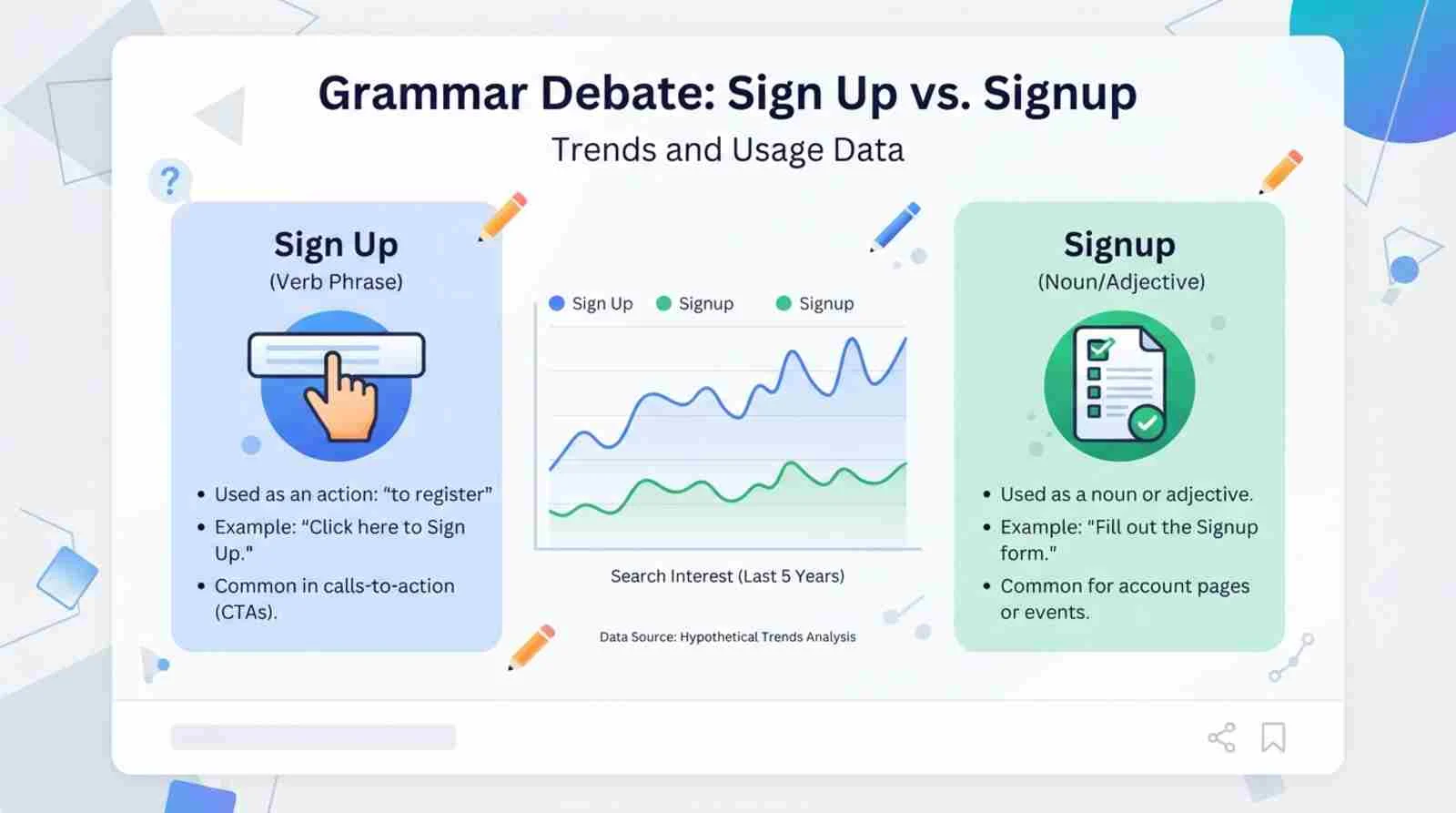
Both sign up and signup are widely used in online searches. However, they attract different search intentions.
People searching for sign up often want to register for a website, service, newsletter, or event. It is also common in instructions and calls to action.
People searching for signup may be looking for a registration form, account creation page, or information about the signup process.
Their popularity also depends on the topic.
| Search term | Common search intent | Typical context |
| Sign up | Registration action | Websites and apps |
| Signup | Registration process | Online services |
| Signup form | Find a registration form | Business websites |
| Sign up online | Register online | Courses and services |
| Free sign up | Join without payment | Membership platforms |
| Signup page | Create or access a registration page | Digital marketing |
Popularity by country
The terms are used in the United States, United Kingdom, Canada, Australia, and other English-speaking regions.
There is no reliable basis here for claiming that one spelling has a higher search volume in a particular country. Google Trends comparisons can help measure relative interest, but exact rankings depend on the selected time range, region, and search category.
For SEO, use the form that matches the user’s search intent. Include natural variations such as sign up, signup form, and signup process without repeating keywords unnecessarily.
Sign Up vs Signup: Comparison Table
Here is a quick comparison to help you remember the difference.
| Feature | Sign Up | Signup |
| Spelling | Two words | One word |
| Grammar | Verb | Noun/adjective |
| Meaning | To register or join | Registration process or form |
| Example | Sign up today | Signup form |
| Use | Describes an action | Describes a thing |
| Correctness | Correct | Correct |
| British English | Used | Used |
| American English | Used | Used |
Frequently Asked Questions (FAQs)
1. Is it sign up or signup?
Both are correct. Use sign up as a verb and signup as a noun or adjective. For example, sign up for a course and complete the signup form.
2. Is signup one word or two?
Signup is one word when used as a noun or adjective. Sign up is two words when used as a verb.
3. Is sign-up with a hyphen correct?
Yes. Sign-up is also accepted as a noun or adjective in many writing styles. For example, you can write sign-up form or sign-up process.
4. Is signup correct in American English?
Yes. American English uses signup as a noun or adjective and sign up as a verb.
5. Is sign up correct in British English?
Yes. British English follows the same basic rule. The hyphenated form sign-up is also common.
6. Should I write signup form or sign up form?
Signup form is a widely accepted choice. Sign-up form is also correct in many style guides. Avoid sign up form when using the phrase as a noun modifier.
7. What is the difference between sign up and sign in?
Sign up means creating a new account or joining a service. Sign in means accessing an account that you already have.
8. What does sign up mean?
Sign up means to register or join something — to create a new account or enroll for a service or event. Example: “Please sign up for our newsletter.”
9. How do you spell sign up?
Sign up is spelled S-I-G-N U-P — two words when it is a verb (“Please sign up here”). As a noun or adjective, write signup (one word) or sign-up (hyphenated): “Complete the signup form.”
Conclusion
Choosing between sign up or signup is easy once you understand their grammatical roles. Both spellings are correct, but they are not interchangeable in every sentence.
Use sign up when describing an action. For example, you can sign up for a newsletter, join a course, or register for an online service.
Use signup when talking about the registration process, form, or page. For example, you can complete a signup form or visit a signup page.
You may also see sign-up with a hyphen. This form is accepted in many writing styles, especially when used as a noun or adjective. American and British English both follow the same basic distinction.
For professional writing, website content, emails, and SEO articles, focus on grammar and consistency.
Remembering one simple rule will help you avoid mistakes: sign up is an action, while signup is a thing. Use the right form, and your writing will remain clear, natural, and easy to understand.

Mary Roach is an American science writer and bestselling author known for making unusual and complex scientific topics engaging, accessible, and humorous. Her books include Stiff, Packing for Mars, Gulp, and Fuzz.
Author at Simifind.com, sharing clear, informative content designed to help readers understand interesting topics and everyday questions.







