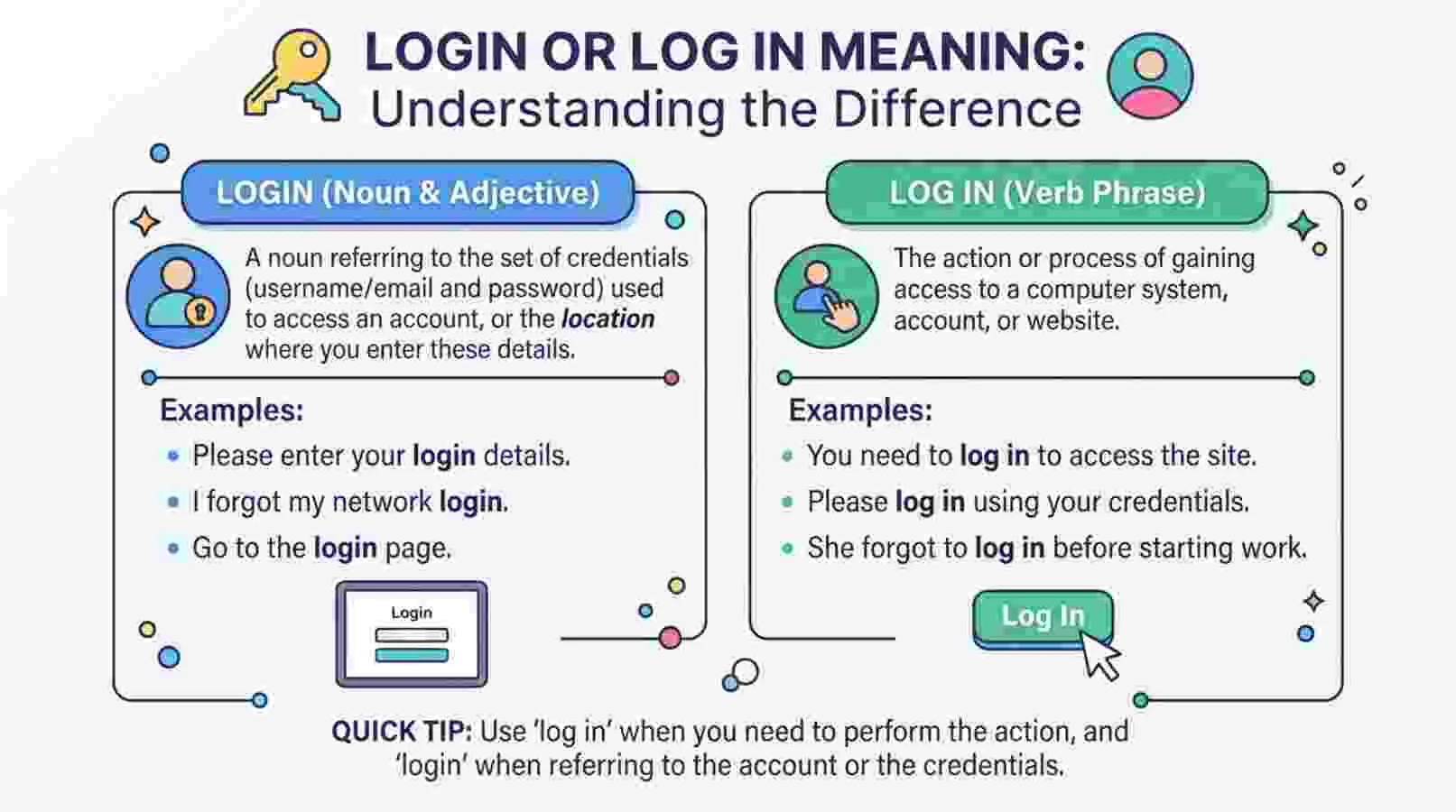
Log in (two words) is the verb — ‘Please log in to your account.’ Login (one word) is the noun or adjective — ‘the login page’, ‘your login details’. Use log in for the action and login for the thing or page.
Have you ever wondered whether you should write login or log in when accessing a website, app, or online account?
You may see both forms on websites, emails, social media, and computer screens. They look almost the same, but they have different roles in a sentence.
The good news is that both login and log in are correct English forms. The difference is simple.
Login is a noun or adjective, while log in is a verb.
Knowing when to use each form can help you write clear emails, create professional website content, and avoid common grammar mistakes.
Many people search for this keyword because they want to know which spelling is correct in everyday writing.
They may also wonder whether American and British English follow different rules.
In this guide, you will learn the meaning, origin, grammar rules, spelling differences, and practical examples of login and log in.
You will also discover which form works best in professional and everyday communication.
Login or Log In – Quick Answer
Both login and log in are correct, but they have different grammatical uses.
- Login: Use it as a noun or adjective.
- Log in: Use it as a verb to describe entering an online account or computer system.
Examples of Login
- I forgot my login details.
- The login page is not working.
- Please check your login information.
Examples of Log In
- I need to log in to my account.
- Please log in before starting the lesson.
- You must log in to view your results.
Easy rule: If you are describing an action, write “log in.” If you are naming a page, process, or set of details, write “login.”
The Origin of Login and Log In
The terms login and log in come from the history of computers and communication systems.
The word “log” has a much older history. It was used to describe written records of events, activities, and journeys. Over time, people began using the word in different fields, including business, science, and technology.
When computers became more common, users needed a way to enter computer systems and record their activities. The phrase “log in” became associated with entering a computer network or account.
The noun login later developed as a single word. It describes the process of entering a system or the information needed to access an account.
Today, both forms are widely used in digital communication.
Why Are There Two Spellings?
English often uses separate words for actions and combined words for nouns or adjectives.
For example:
- Log in: The action of entering an account.
- Login: The process or details used to access an account.
This pattern helps readers understand the role of a word in a sentence.
British English vs American English Spelling
There is no major spelling difference between American and British English when using login and log in.
Both English varieties follow the same basic grammar rule. The choice depends on how the word is used, not where the writer lives.
| Usage | American English | British English |
| Noun | Login | Login |
| Verb | Log in | Log in |
| Adjective | Login | Login |
| Past tense | Logged in | Logged in |
| Present participle | Logging in | Logging in |
| Negative verb | Do not log in | Do not log in |
American English Examples
- Enter your login details.
- I need to log in to my email.
- The login page is unavailable.
British English Examples
- Please enter your login information.
- You must log in to your account.
- The login screen is not working.
As you can see, the spelling remains the same in both varieties.
The main difference is not regional. It is grammatical.
Which Spelling Should You Use?
Your choice depends on the meaning of your sentence and the audience you are writing for.
For American Readers
If you write for an American audience, follow standard American English grammar.
Use login when referring to account details, a login page, or an access process.
Use log in when telling someone to enter an account.
Examples:
- Check your login details.
- Log in to your account to continue.
For British and Commonwealth Readers
British English and Commonwealth English, including Australian and Canadian English, use the same distinction.
Examples:
- Your login information is incorrect.
- Please log in before accessing the website.
For Global English
If your content targets an international audience, use both forms correctly.
This rule works well for:
- Website content
- Online learning platforms
- Business emails
- Mobile applications
- Customer support messages
- Technical instructions
Professional advice: Do not choose between login and log in based on location. Choose based on grammar.
Common Mistakes with Login and Log In
Many writers confuse these two forms because they sound similar. However, using the wrong form can make a sentence look incorrect.
Here are some common mistakes and their corrections.
1. Using Login as a Verb
Incorrect: I need to login to my account.
Correct: I need to log in to my account.
Why? “Log in” describes an action, so it should be written as two words.
2. Using Log In as a Noun
Incorrect: I forgot my log in details.
Correct: I forgot my login details.
Why? “Login” is a noun that describes the information needed to access an account.
3. Confusing Login Page and Log In Page
Preferred: Login page.
A login page is a page where users enter their account information. Here, login works as an adjective.
4. Writing Login Instead of Logged In
Incorrect: I have login to my account.
Correct: I have logged in to my account.
Why? The correct past participle is “logged in.”
5. Confusing Log In With Sign In
Both expressions can describe entering an online account.
Examples:
- Log in to your account.
- Sign in to your account.
Both are correct. However, follow the wording used by the website or application for consistency.
Login and Log In in Everyday Examples
Understanding these words becomes easier when you see them in real situations.
1. In Emails
Professional emails often use both forms.
Examples:
- Please use your login details to access the company portal.
- You must log in before the meeting begins.
- Your login information has been updated.
2. In News and Articles
News websites use login as a noun when discussing online access.
Examples:
- The website introduced a new login system.
- Users must log in to read premium articles.
- The company improved its login security.
3. On Social Media
Social media platforms use these terms when helping users access their accounts.
Examples:
- I cannot log in to my Instagram account.
- My login details are incorrect.
- Please log in to continue using the app.
4. In Formal Writing
Business documents and technical instructions need clear grammar.
Examples:
- Employees must log in using their official accounts.
- Each employee receives separate login credentials.
- The login process requires two-step verification.
5. In Website Buttons and Applications
You may see both forms on websites and mobile applications.
Examples:
- Login Page
- Login Details
- Log In Now
- Please Log In
- Login Required
The exact wording may vary depending on the website’s design and style guide.
Login or Log In – Google Trends and Usage Data
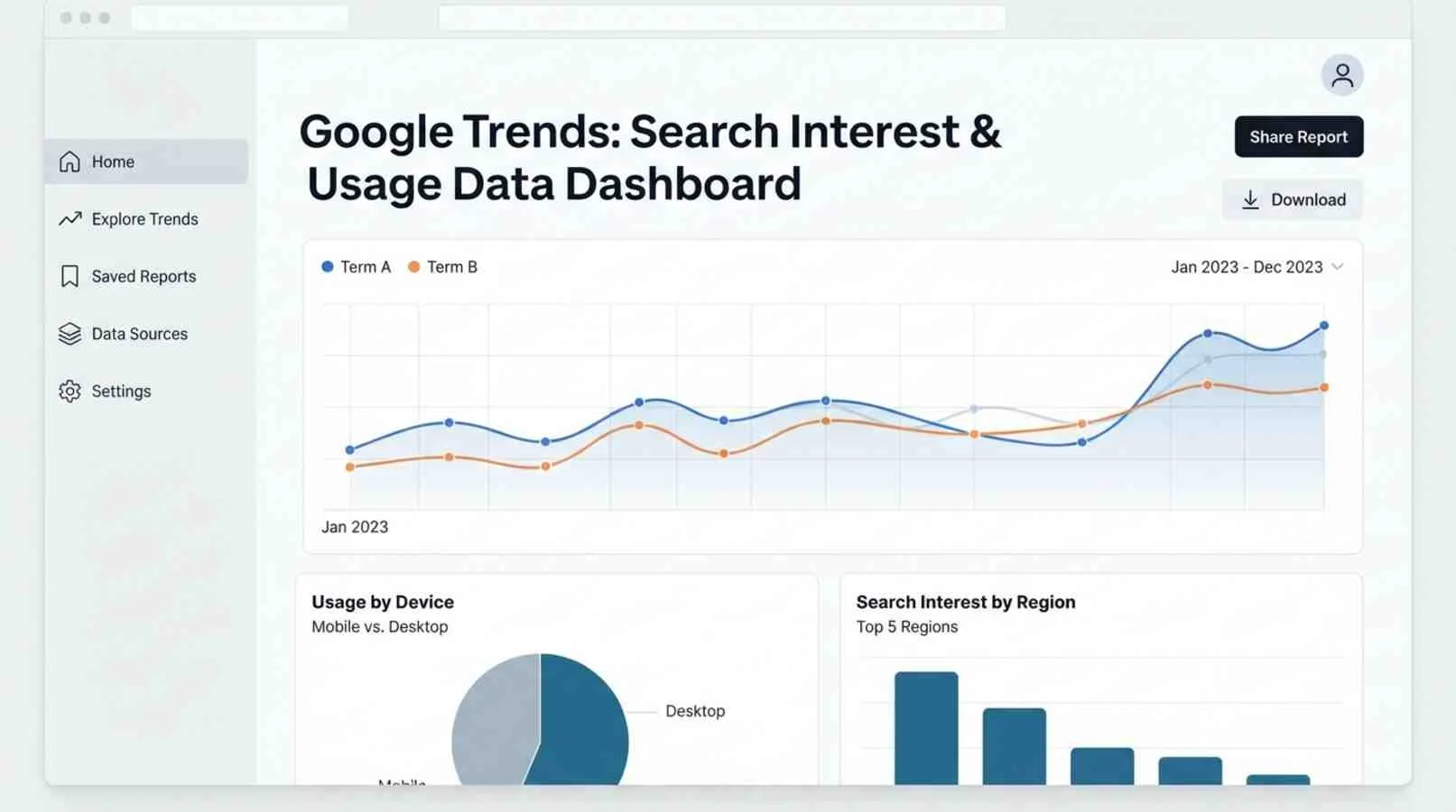
The search terms login and log in are both relevant to internet users, website owners, students, and digital businesses.
People search for these phrases when they need help accessing accounts, understanding English grammar, or writing website instructions.
Which Term Is More Popular?
The popularity of each term depends on the search intent.
- Login: Often appears in searches about account access, login pages, credentials, and website features.
- Log in: Often appears in searches about performing an action, accessing an account, and checking grammar.
Both terms are widely used in digital content.
Popularity by Country
English-speaking countries and countries with large English-language internet audiences commonly use both expressions.
| Country | Common Usage |
| United States | Login and log in |
| United Kingdom | Login and log in |
| Canada | Login and log in |
| Australia | Login and log in |
| India | Login and log in |
| Pakistan | Login and log in |
How to Check Google Trends
Google Trends can help compare search interest for both phrases.
To check their popularity:
- Visit Google Trends.
- Search for “login.”
- Add “log in” as a comparison term.
- Select your target country.
- Choose your preferred time range.
- Compare the search interest graph.
Important: Google Trends shows relative search interest, not exact search volume. No fixed ranking or search-volume figure should be assumed without checking live data.
For SEO writers, both phrases can be useful. Use the main keyword naturally in your title, introduction, headings, and relevant examples. Include related terms such as login page, login details, account access, sign in, and log in to your account where they fit naturally.
Login vs Log In – Comparison Table
Here is a quick comparison to help you remember the difference.
| Feature | Login | Log In |
| Word type | Noun or adjective | Verb |
| Word structure | One word | Two words |
| Main meaning | Access process or details | Enter an account |
| Example | Login page | Log in now |
| Correct phrase | Login details | Log in to your account |
| Past tense | Not applicable | Logged in |
| British English | Correct | Correct |
| American English | Correct | Correct |
The easiest way to remember the difference is to look at the job the word performs in a sentence.
Frequently Asked Questions (FAQs)
1. Is it login or log in?
Both are correct. Use “login” as a noun or adjective and “log in” as a verb.
2. Is login one word or two words?
“Login” is one word when used as a noun or adjective. For example, “login page” and “login details.”
3. Is log in one word or two?
“Log in” is two words when used as a verb. For example, “I need to log in to my account.”
4. Is login correct in American English?
Yes. American English uses “login” as a noun or adjective and “log in” as a verb.
5. Is login correct in British English?
Yes. British English follows the same spelling and grammar rules. Both forms are correct when used in the right context.
6. Should I write login page or log in page?
“Login page” is the preferred form. Here, login describes the type of page, so it works as an adjective.
7. Is it log in or sign in?
Both are correct. They describe the action of entering an online account. Many websites use them in the same way.
8. What does log in mean?
Log in means to enter an online account or computer system with your username and password, as in ‘Please log in to your account.’
9. What does login mean?
Login is a noun or adjective. As a noun, it means the details used to access an account — your username and password — as in ‘your login details’, or the page where you enter them, as in ‘the login page’.
10. What is the past tense of log in?
Logged in — ‘I have logged in to my account.’ Do not write ‘I have login to my account’.
Conclusion:
Choosing between login or log in is easy when you understand their grammatical roles. Both forms are correct, but they are not interchangeable in every sentence.
Use login when talking about a noun or adjective. For example, you can write “login details,” “login page,” or “login system.”
Use log in when describing the action of entering a website, application, or online account. For example, “Please log in to continue.”
Remember that American and British English follow the same rule. You do not need to change the spelling based on your audience or location.
For students, bloggers, website owners, and professional writers, this small grammar rule can make a big difference. It helps your writing look clear, natural, and professional.
The simplest rule to remember is this: Login is a thing, while log in is an action. Follow this rule, and you will know which form to use in almost every situation.

Here’s a concise 2-line author bio suitable for Simifind.com:
James Dashner is an American bestselling author best known for The Maze Runner series and other popular young-adult fiction.
On Simifind.com, he shares clear, engaging insights and helpful content for readers interested in books, writing, and popular literature.







