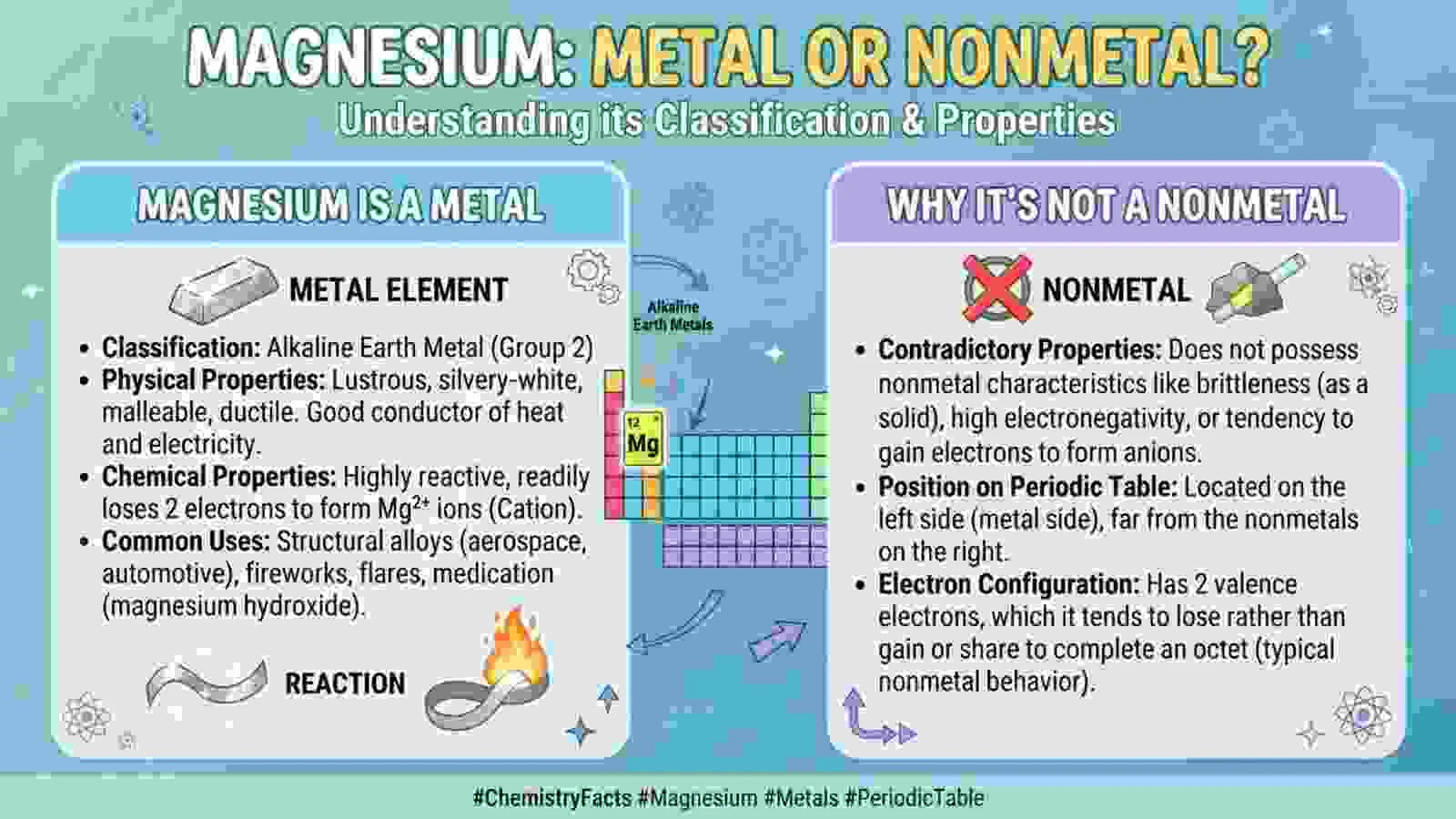
When studying chemistry, it is common to ask whether an element is a metal or a nonmetal.
One question students often search for is magnesium metal or nonmetal.
The answer is important because magnesium has several special properties that make it useful in science, industry, and daily life.
Magnesium is a chemical element found in the periodic table. It is known for its light weight, silvery-white appearance, and ability to burn with a bright white flame.
These features make it useful in products such as car parts, aircraft materials, fireworks, and electronic devices.
Some students confuse magnesium with nonmetals because it reacts with oxygen and other elements. However, chemical reactions do not change its basic classification.
Magnesium has the properties of a metal and belongs to a special family called alkaline earth metals.
In this guide, you will learn why magnesium is a metal, where its name comes from, how it behaves, and how to identify it correctly.
You will also find simple examples, common mistakes, and answers to popular chemistry questions.
Magnesium Metal or Nonmetal – Quick Answer
Magnesium is a metal, not a nonmetal. It is a silvery-white chemical element with the symbol Mg and atomic number 12.
It belongs to Group 2 of the periodic table. This group is known as the alkaline earth metals.
Here are some basic facts about magnesium:
- Chemical symbol: Mg
- Atomic number: 12
- Element category: Metal
- Periodic table group: Group 2
- Period: 3
- Atomic mass: About 24.305 u
- Appearance: Silvery-white
- Electron configuration: [Ne] 3s²
Magnesium is a good example of a lightweight metal. It can lose two electrons during chemical reactions and form a positive ion called Mg²⁺.
The Origin of Magnesium
The name magnesium comes from Magnesia, a region in ancient Greece. This region was known for minerals containing magnesium compounds.
The element’s history is linked to early scientific studies of minerals and chemical substances.
In 1755, Scottish scientist Joseph Black studied magnesia and helped distinguish magnesium compounds from other substances.
Later, in 1808, British chemist Humphry Davy produced magnesium in an impure form through electrochemical methods. French chemist Antoine Bussy later prepared metallic magnesium in a more usable form in 1831.
Today, magnesium is recognized as an important chemical element. Its name, symbol, and properties are used worldwide.
Unlike words that have different British and American spellings, magnesium has the same spelling in both forms of English.
British English vs American English Spelling
There is no spelling difference between British and American English for magnesium.
Both countries use the same spelling, chemical symbol, and scientific classification.
However, some related scientific terms may have different spellings in British and American English.
| Term | British English | American English |
| Magnesium | Magnesium | Magnesium |
| Aluminium | Aluminium | Aluminum |
| Sulphur | Sulphur | Sulfur |
| Oxidation | Oxidation | Oxidation |
| Colour | Colour | Color |
| Chemical | Chemical | Chemical |
Magnesium remains unchanged in both English systems. Students, teachers, and scientists can use this spelling in academic papers, school assignments, and professional reports.
Is Magnesium Spelled Differently in the UK and USA?
No. Magnesium is spelled exactly the same in the United Kingdom, the United States, Canada, Australia, and other English-speaking countries.
Its chemical symbol is also always Mg.
Which Classification Should You Use?
When writing about magnesium, always classify it as a metal.
Your audience or location does not change its chemical properties.
Here is how to use the correct classification:
- For US students: Write that magnesium is an alkaline earth metal.
- For UK students: Use the same scientific classification.
- For Commonwealth countries: Magnesium is also classified as a metal.
- For international readers: Use the standard scientific name and symbol, Mg.
If you are preparing a chemistry assignment, remember that magnesium belongs to Group 2 of the periodic table.
Do not describe it as a nonmetal or metalloid. Its electron arrangement and physical properties clearly place it in the metal category.
Common Mistakes About Magnesium
Students sometimes make mistakes when learning about magnesium and its chemical properties.
Here are some common errors and their corrections.
1. Calling magnesium a nonmetal
Incorrect: Magnesium is a nonmetal.
Correct: Magnesium is a metal because it has metallic properties and belongs to Group 2.
2. Confusing magnesium with magnesium oxide
Magnesium (Mg) is a metal. Magnesium oxide (MgO) is a compound formed when magnesium reacts with oxygen.
3. Confusing magnesium with calcium
Both elements are metals. Magnesium and calcium belong to Group 2 of the periodic table.
4. Thinking all lightweight elements are nonmetals
This is incorrect. Magnesium is a lightweight metal, even though it has a low density compared with many other metals.
5. Confusing chemical reactions with element classification
Magnesium reacts with oxygen, acids, and other substances. These reactions do not make it a nonmetal.
Magnesium Metal or Nonmetal in Everyday Examples
Magnesium is used in many industries because it is lightweight and has useful chemical properties.
Here are some examples of how to describe it in everyday writing.
In school assignments:
“Magnesium is a lightweight metal that belongs to Group 2 of the periodic table.”
In science reports:
“Magnesium reacts with oxygen to form magnesium oxide.”
In news articles:
“Magnesium alloys are used in different industries because they help reduce the weight of products.”
On social media:
“Did you know magnesium burns with a bright white flame? It is a metal, not a nonmetal!”
In formal writing:
“Magnesium is an alkaline earth metal with the atomic number 12 and the chemical symbol Mg.”
These examples show how to use the correct scientific classification in different situations.
Why Is Magnesium Considered a Metal?
Magnesium is considered a metal because of its electronic structure and physical properties.
It has two electrons in its outermost shell. During many chemical reactions, it loses these electrons and forms Mg²⁺ ions.
Other important metallic properties include:
- It has a shiny, silvery-white appearance when freshly exposed.
- It conducts heat and electricity.
- It can form alloys with other metals.
- It reacts with oxygen to form magnesium oxide.
These features help explain why magnesium is classified as a metal.
Magnesium Metal or Nonmetal – Google Trends and Usage Data
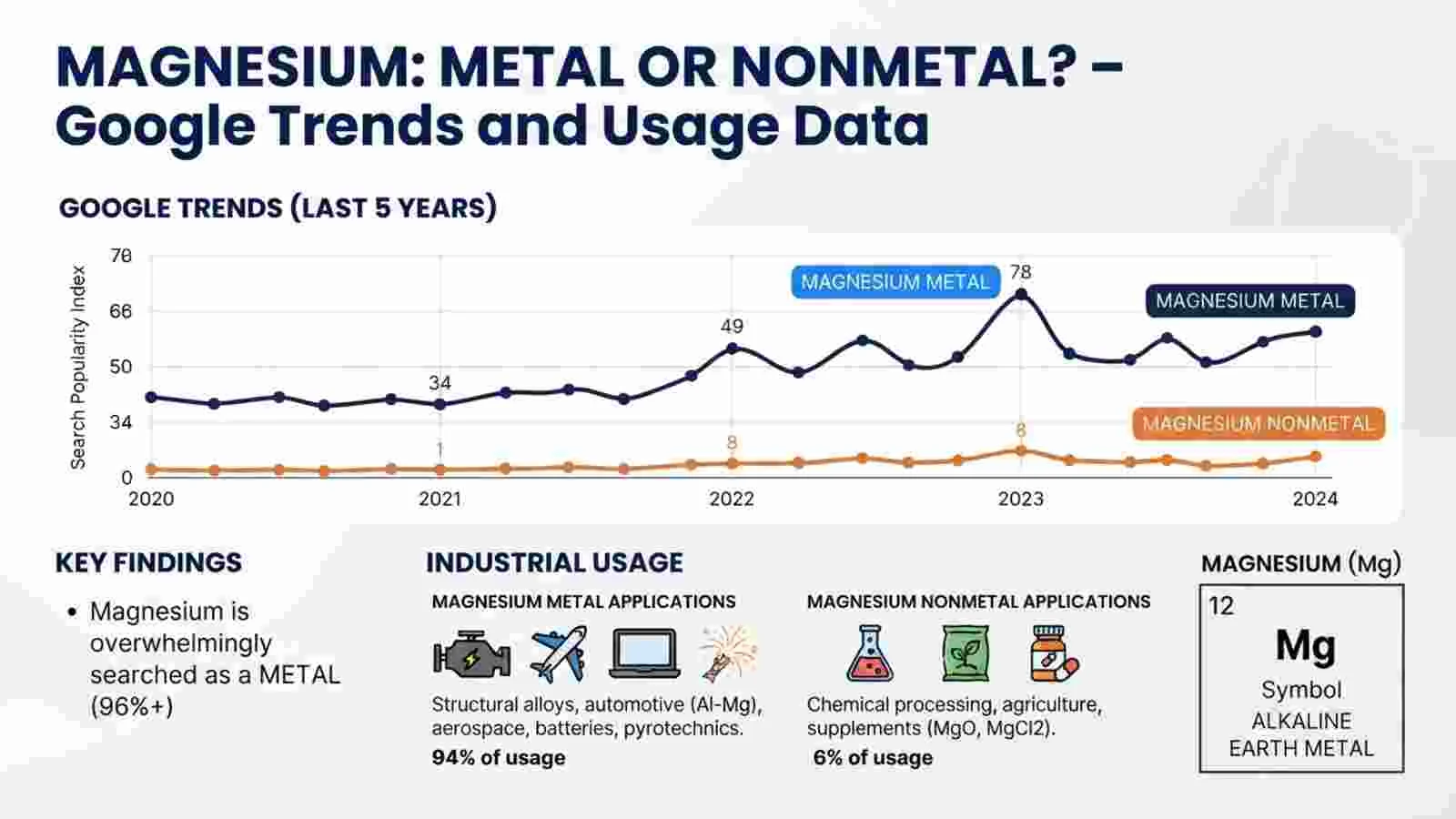
The search phrase “magnesium metal or nonmetal” is mainly connected with educational and scientific questions.
People may search for this topic when preparing chemistry homework, studying the periodic table, or reviewing basic science concepts.
Search interest can vary by country, school term, and examination season. However, exact popularity rankings and search volumes require current Google Trends or keyword research data.
The following table shows the main search contexts rather than verified search-volume rankings.
| Search context | User intent |
| Magnesium metal or nonmetal | Identify its classification |
| Is magnesium a metal? | Find a quick answer |
| Magnesium chemical properties | Understand its behavior |
| Magnesium atomic number | Learn basic element facts |
| Magnesium symbol | Find its chemical symbol |
| Magnesium periodic table | Identify its group and period |
| Magnesium electron configuration | Understand its atomic structure |
For SEO purposes, focus on clear answers, simple scientific explanations, and related educational questions.
Avoid adding unrelated spelling comparisons or repeating the main keyword too often. Natural keyword use makes the article easier to read and more useful.
Comparison Table: Magnesium and Other Elements
The following table compares magnesium with other common elements to make its classification easier to understand.
| Element | Symbol | Atomic Number | Classification |
| Magnesium | Mg | 12 | Metal |
| Calcium | Ca | 20 | Metal |
| Sodium | Na | 11 | Metal |
| Iron | Fe | 26 | Metal |
| Oxygen | O | 8 | Nonmetal |
| Carbon | C | 6 | Nonmetal |
| Sulfur | S | 16 | Nonmetal |
| Silicon | Si | 14 | Metalloid |
This comparison shows that magnesium belongs to the metal category, while oxygen, carbon, and sulfur are nonmetals.
Frequently Asked Questions (FAQs)
1. Is magnesium a metal or nonmetal?
Magnesium is a metal. It belongs to Group 2 of the periodic table and is classified as an alkaline earth metal.
2. Why is magnesium called a metal?
Magnesium is called a metal because it has metallic properties. It conducts electricity, has a shiny appearance, and can lose two outer electrons.
3. What is the chemical symbol of magnesium?
The chemical symbol of magnesium is Mg. Its atomic number is 12.
4. Is magnesium a transition metal?
No. Magnesium is not a transition metal. It belongs to Group 2, which contains the alkaline earth metals.
5. Is magnesium a metalloid?
No. Magnesium is not a metalloid. It is a metal with clear metallic properties.
6. Does magnesium react with oxygen?
Yes. Magnesium reacts with oxygen and produces magnesium oxide (MgO). When magnesium burns, it gives off a bright white light.
7. Where is magnesium found?
Magnesium is found in minerals, seawater, and many natural compounds. It is also present in the Earth’s crust and living organisms.
Conclusion
Understanding whether magnesium is a metal or nonmetal is simple once you know its place in the periodic table.
Magnesium is a metal, not a nonmetal or metalloid. It belongs to Group 2 and is known as an alkaline earth metal.
Its chemical symbol is Mg, and its atomic number is 12. It has a silvery-white appearance, a low density, and the ability to conduct heat and electricity. It also reacts with oxygen to form magnesium oxide.
Magnesium is useful in many areas, including transportation, construction, electronics, and manufacturing. Its lightweight nature makes it valuable for producing strong and lighter materials.
Remember that magnesium has the same spelling in British and American English. There is no spelling variation to worry about when writing about this element.
For students, the most important fact is simple: magnesium is a metal in Group 2 of the periodic table. Keep this fact in mind when studying chemical elements and their classifications.

Here’s a concise 2-line author bio suitable for Simifind.com:
James Dashner is an American bestselling author best known for The Maze Runner series and other popular young-adult fiction.
On Simifind.com, he shares clear, engaging insights and helpful content for readers interested in books, writing, and popular literature.







