Have you ever typed “jersies” only to wonder if “jerseys” is actually the correct spelling?
Hey, I want to share something that happened to me recently about jerseys or jersies.
I was chatting with a friend when I suddenly saw this term pop up, and honestly, I had no clue which spelling was correct at first.
I kept wondering, “Am I missing something here?” It was a bit confusing, and I didn’t want to respond or write the wrong word.
So, I decided to look into jerseys or jersies and figure out the correct spelling, meaning, and context.
After understanding the difference, I realized how important it is to know the right spelling to avoid awkward situations in conversations, messages, and social media posts.
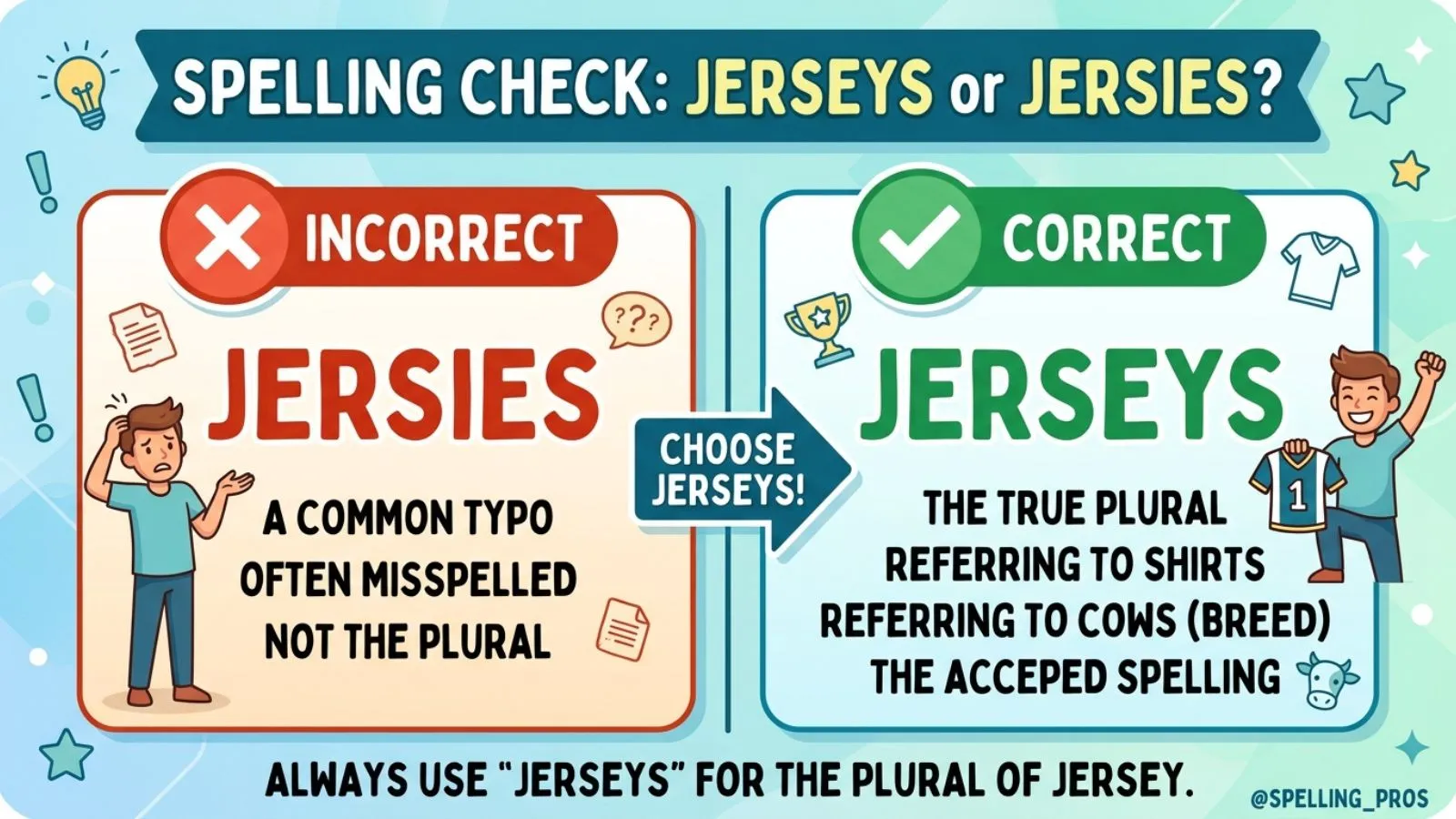
I learned that “jerseys” is the correct standard spelling, while “jersies” is generally a misspelling.
Now, whenever I see jerseys or jersies, I know exactly which form to use and why. A quick understanding of the word helped me communicate more clearly and confidently.
Jersies or Jerseys – Quick Answer
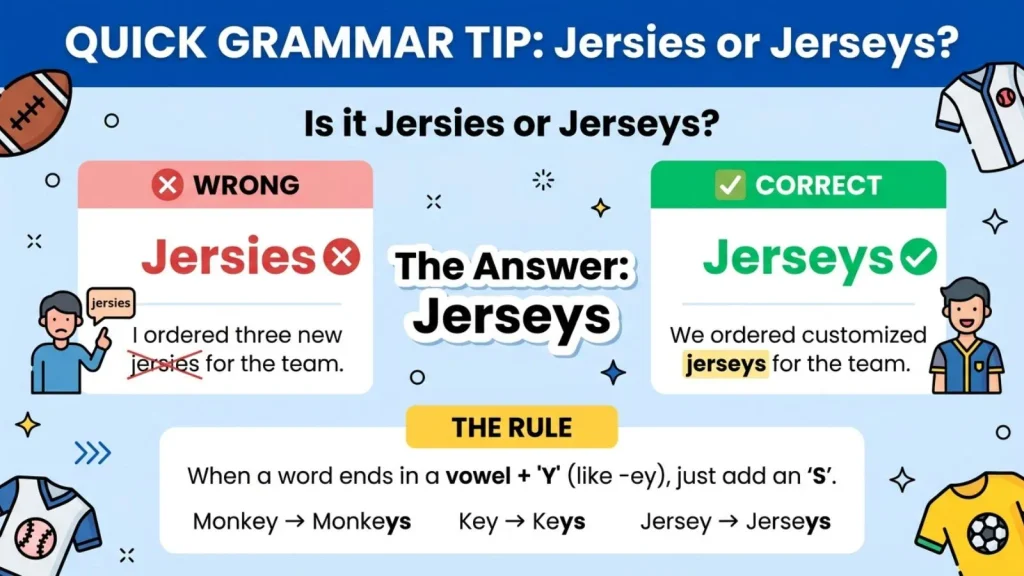
The correct spelling is jerseys. “Jersies” is a common misspelling, not an accepted variant.
- Correct: “The team ordered new jerseys for the season.”
- Incorrect: “The team ordered new jersies for the season.”
- Correct: “She collects vintage football jerseys.”
- Incorrect: “She collects vintage football jersies.”
This isn’t a British-versus-American spelling issue like “color” versus “colour.” Every major English dialect uses “jerseys.” The confusion comes from grammar, not geography.
The Origin of Jerseys

The word “jersey” comes from the Isle of Jersey, a British Crown dependency in the Channel Islands. Local knitters there produced a tightly woven wool fabric that became known simply as “jersey.” By the 1700s, the term referred to the knitted material itself.
Over time, “jersey” expanded to mean:
- A knitted pullover or sweater
- The fabric used in T-shirts and casual clothing
- A sports shirt worn by athletes, showing a team name or number
The spelling confusion traces back to English pluralization rules. Most nouns ending in a consonant plus “y” swap the “y” for “ies” (baby → babies, city → cities). But “jersey” ends in a vowel (“e”) plus “y,” so it follows the regular rule: just add “s.” That single letter difference is where “jersies” goes wrong.
British English vs American English Spelling
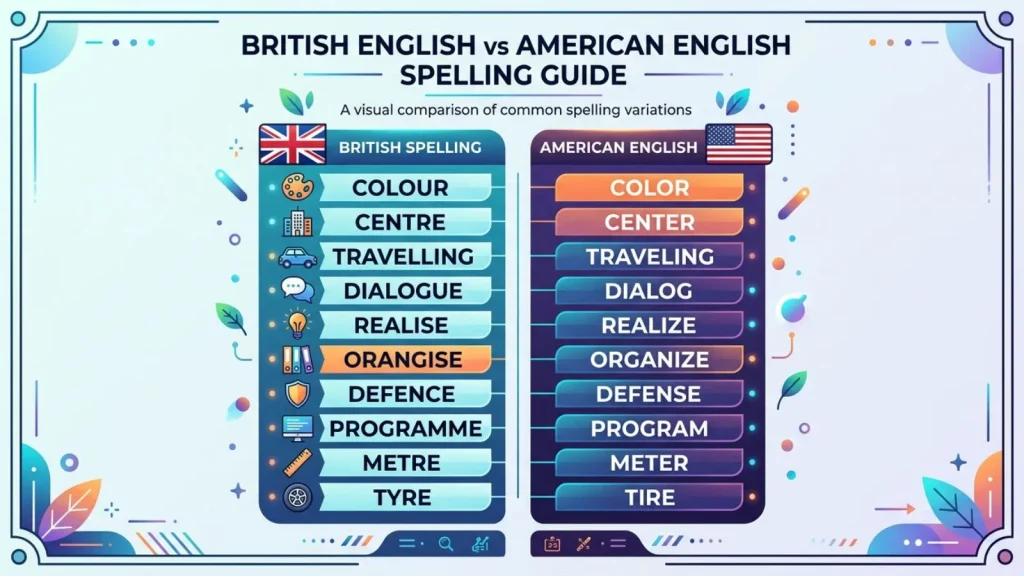
Here’s the part that surprises most people: British and American English don’t disagree on this word. Both use “jerseys.” Compare that to true regional spelling splits, and the difference becomes obvious.
| Word | British English | American English | Jersey Rule Applies? |
| Jersey (plural) | Jerseys | Jerseys | Same in both |
| Colour/Color | Colour | Color | Regional difference |
| Favourite/Favorite | Favourite | Favorite | Regional difference |
| Baby (plural) | Babies | Babies | Consonant + y rule |
| Party (plural) | Parties | Parties | Consonant + y rule |
| Monkey (plural) | Monkeys | Monkeys | Vowel + y rule (like jersey) |
| Valley (plural) | Valleys | Valleys | Vowel + y rule (like jersey) |
Notice the pattern: any word ending in a vowel followed by “y” (jersey, monkey, valley, key) simply adds an “s.” Only consonant-plus-y words switch to “ies.”
Which Spelling Should Use jersies or jerseys ?
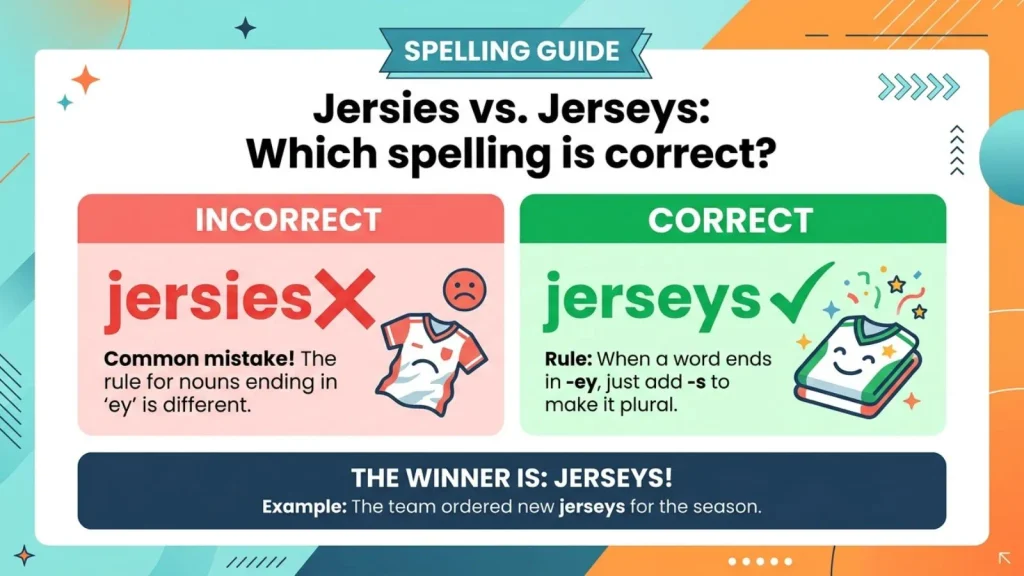
No matter where you’re writing from, the answer is the same.
- United States: Use “jerseys.” This applies in sports writing, retail, and everyday speech.
- United Kingdom and Commonwealth countries: Use “jerseys.” The Isle of Jersey origin doesn’t change the plural form.
- Global and business writing: Use “jerseys” in any formal document, website, or product listing aimed at an international audience.
There is no scenario, dialect, or style guide where “jersies” is the preferred or accepted spelling. If you see it in print, it’s a typo.
Common Mistakes with Jerseys
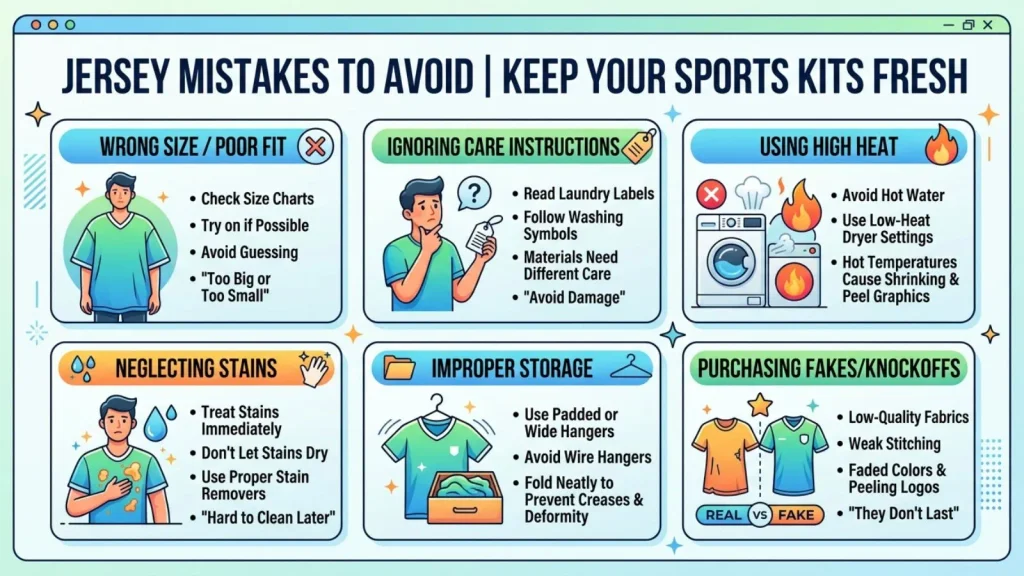
- Mistake: “jersies” — Correction: jerseys
- Mistake: “jersey’s” when meaning plural — Correction: jerseys (the apostrophe form is only for possession, like “the jersey’s color”)
- Mistake: “jerseies” — Correction: jerseys
- Mistake: Applying the “-ies” rule to any vowel-plus-y word — Correction: check whether the letter before “y” is a vowel; if so, just add “s”
- Mistake: Confusing “Jersey” (the U.S. state or Channel Island) with lowercase “jersey” (the garment) — Correction: capitalize only when referring to the place
Jerseys in Everyday Examples
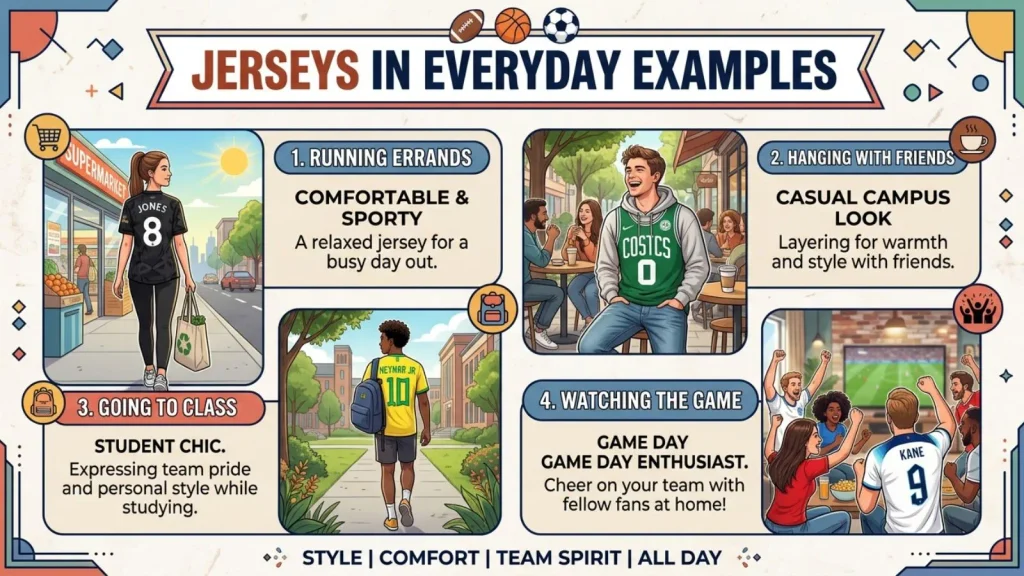
In emails: “Hi team, please confirm your sizes so we can order the new jerseys before Friday.”
In news headlines: “Fans line up overnight for limited-edition jerseys ahead of the championship game.”
Social media captions: “New drop alert 🔥 Retro jerseys are back in stock — link in bio.”
In formal writing: “The manufacturing division reported a 12% increase in jersey fabric orders during the third quarter.”
Across every context, professional, casual, or promotional, “jerseys” is the consistent, correct choice.
Jerseys – Google Trends & Usage Data

Search interest in this topic tends to spike around major sporting events, back-to-school shopping, and new team merchandise releases, when fans and retailers alike search for team gear. The correct spelling, “jerseys,” dominates search volume overwhelmingly, while “jersies” appears mainly as a misspelling that search engines automatically correct.
Interest is highest in countries with strong sports culture, including the United States, United Kingdom, and Australia, largely driven by football (soccer), American football, basketball, and cricket merchandise searches. This confirms the term is used consistently worldwide, with spelling confusion, not regional variation, driving the search volume for “jersies.”
Keyword Variations Comparison Table
| Variation | Correct? | Notes |
| Jerseys | Yes | Standard plural form, used globally |
| Jersies | No | Common misspelling |
| Jerseies | No | Rare misspelling |
| Jersey’s | Conditional | Correct only for possession, not plural |
| Jersies vs Jerseys | Search phrase | Reflects user uncertainty, not two valid options |
FAQs
Is “jersies” ever correct?
No. It’s a misspelling. “Jerseys” is the only correct plural form in all English dialects.
Why do people think “jersies” might be right?
Because many “y”-ending words become “-ies” in plural form, like baby to babies. Jersey doesn’t follow that rule because it ends in a vowel plus “y.”
Is “jerseys” different in British and American English?
No. Both use “jerseys.” This word doesn’t have a regional spelling split like “colour” versus “color.”
What’s the plural of “jersey” as a sweater?
Jerseys, whether you mean a knitted sweater or a sports shirt.
Does “Jersey” the place use the same plural rule?
Yes, though “Jersey” as a place name is usually singular (referring to the Channel Island or the U.S. state) and rarely pluralized.
How can I remember the correct spelling?
Check the letter before the final “y.” If it’s a vowel (like in jersey, monkey, valley), just add “s.” If it’s a consonant (like in baby, city), change “y” to “ies.”
Do spell-checkers catch “jersies” automatically?
Most do, and many browsers and word processors will autocorrect it to “jerseys,” which is part of why the misspelling rarely appears in published writing.
Conclusion
The correct spelling is “jerseys,” full stop. “Jersies” is a misspelling that comes from applying the wrong pluralization rule, not from any regional or dialect difference. Words ending in a vowel plus “y,” like jersey, monkey, and valley, simply add an “s” to form the plural. Words ending in a consonant plus “y,” like baby and city, swap the “y” for “ies.”
Whether you’re writing for a US audience, a UK audience, or a global one, “jerseys” is the only accepted form. There’s no British-versus-American split here, and no context, casual or formal, where “jersies” becomes acceptable.
Next time you’re texting about game day, writing product copy, or drafting a company email about team uniforms, you can spell it with confidence: jerseys. One small rule, one letter, and no more second-guessing.

Mary Roach is an American science writer and bestselling author known for making unusual and complex scientific topics engaging, accessible, and humorous. Her books include Stiff, Packing for Mars, Gulp, and Fuzz.
Author at Simifind.com, sharing clear, informative content designed to help readers understand interesting topics and everyday questions.