When learning geometry, many students get confused about convex or concave shapes. Both terms describe the shape of an object, but they have very different meanings. Knowing the difference can make geometry much easier.
A convex shape curves outward and has no inward dents. A concave shape has at least one part that bends inward. You can see these shapes in everyday objects, such as balls, bowls, mirrors, and windows.
People often search for convex or concave because they want to understand geometry, identify shapes, or learn how curved mirrors work.
These terms are also used in mathematics, science, physics, and optics.
The good news is that you do not need to learn many hard rules to tell them apart. A simple look at the shape can help you understand the difference.
In this guide, you will learn their meanings, key features, examples, common mistakes, and how to use each term correctly.
Convex or Concave – Quick Answer
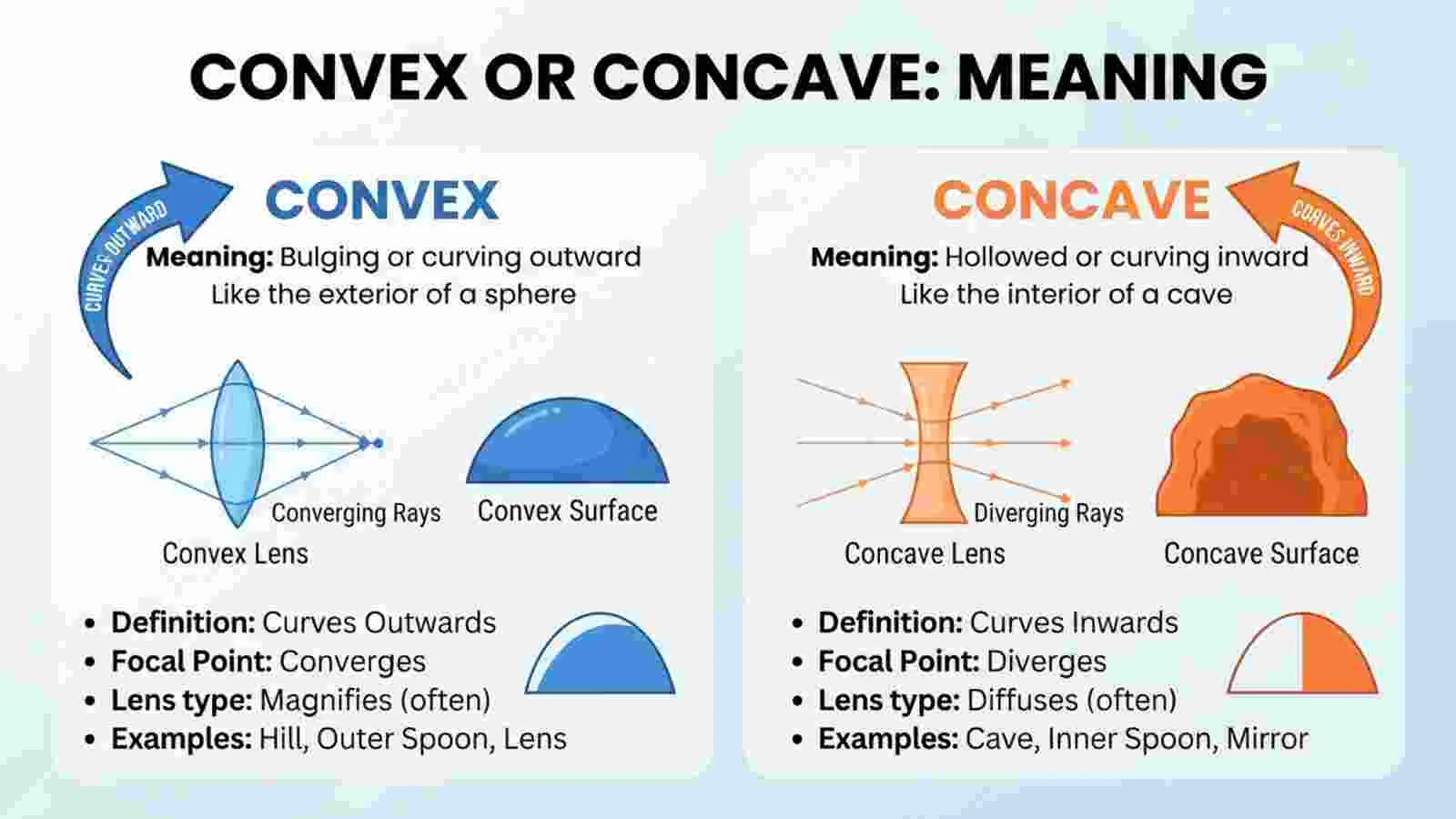
Convex means a shape curves or bulges outward. Concave means a shape has an inward curve or dent.
Here is the easiest way to remember:
- Convex: Curves outward, like the outside of a ball.
- Concave: Curves inward, like the inside of a bowl.
For example, a convex mirror curves outward and gives a wider view. A concave mirror curves inward and can focus light.
Both terms are correct, but they describe different shapes and properties.
The Origin of Convex and Concave
The words convex and concave come from Latin. They have been used for many years in mathematics and science.
- Convex comes from the Latin word convexus, which means vaulted or arched.
- Concave comes from the Latin word concavus, which means hollow or curved inward.
These words describe two opposite types of curves. Over time, they became common terms in geometry, physics, engineering, and optics.
Unlike spelling variations, convex and concave are not British and American versions of the same word. They have separate meanings and spellings in both forms of English.
British English vs American English Spelling
There is no spelling difference between British English and American English for convex or concave. Both countries use the same spelling and meaning.
| Word | British English | American English | Meaning |
| Convex | Convex | Convex | Curves outward |
| Concave | Concave | Concave | Curves inward |
Examples
- British English: A convex lens helps focus light.
- American English: A concave mirror reflects light inward.
- Global English: A convex shape has no inward dents.
You can use both words in academic writing, schoolwork, science reports, and everyday communication without changing their spelling.
Which Term Should You Use?
The correct term depends on the shape or object you want to describe. Think about whether the surface bends outward or inward.
Use Convex When:
- A shape bulges outward.
- A lens spreads light rays apart or brings them together depending on its type (a convex lens converges light).
- A mirror gives a wider field of view.
- A polygon has no inward angles.
Examples include a ball’s outer surface, a convex lens, and a convex polygon.
Use Concave When:
- A shape bends inward.
- A surface looks hollow.
- A mirror can focus light.
- A polygon has at least one inward angle.
Examples include the inside of a bowl, a concave mirror, and a concave polygon.
Professional advice: Use the word that matches the actual shape. Do not use convex and concave as interchangeable terms.
Common Mistakes with Convex or Concave
Many learners mix up these two words. Here are some common mistakes and their corrections.
| Common mistake | Correct explanation |
| Convex means curves inward. | Convex means curves outward. |
| Concave means curves outward. | Concave means curves inward. |
| Both words have the same meaning. | They describe different shapes. |
| Convex and concave have US and UK spellings. | Their spellings are the same in both countries. |
| Every curved shape is convex. | Some curved shapes are concave. |
| A concave mirror gives a wider view. | A convex mirror generally gives a wider field of view. |
How to Remember the Difference
Imagine holding a bowl:
- The outside of the bowl is convex.
- The inside of the bowl is concave.
This simple example can help you remember both terms during exams and daily learning.
Convex or Concave in Everyday Examples
These words are not limited to textbooks. They are used in many areas of life.
1. In emails and schoolwork
- Please identify the convex and concave shapes in this diagram.
- Explain the difference between a convex and a concave lens.
2. In news and science
- Scientists use convex lenses in many optical tools.
- Concave mirrors are used in some scientific instruments.
3. On social media
- What is the easiest way to identify a convex shape?
- Can you explain convex vs. concave with simple examples?
4. In formal writing
- A convex polygon has no interior angle greater than 180 degrees.
- A concave polygon has at least one interior angle greater than 180 degrees.
5. In daily life
- A car’s side-view mirror is usually convex.
- The inside of a spoon can act like a concave mirror.
Convex or Concave – Google Trends and Usage Data
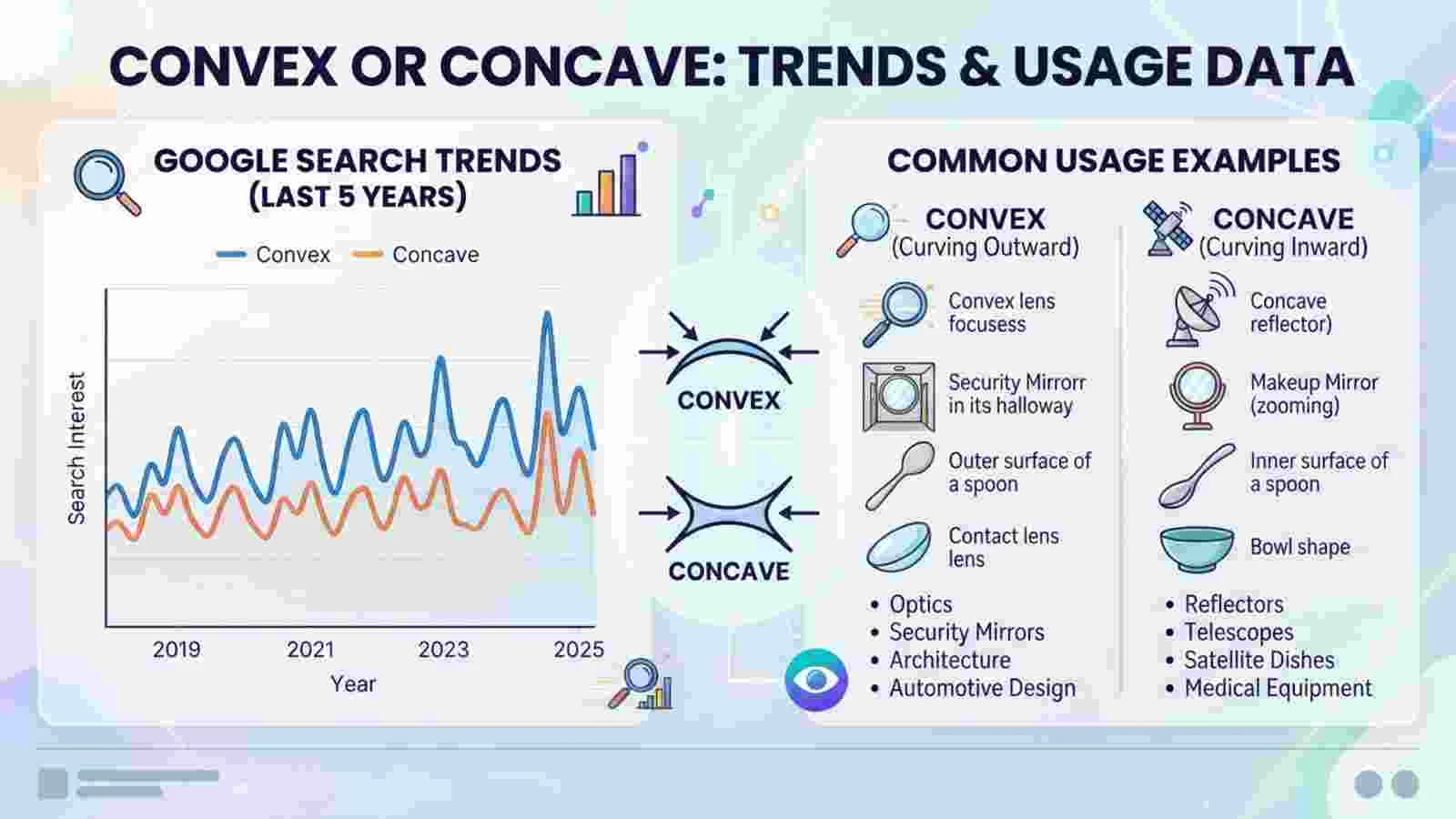
Convex and concave are commonly searched in educational and scientific contexts. People often search for these terms when studying geometry, physics, lenses, mirrors, and mathematical shapes.
Their search interest is linked to several topics:
| Search context | Common search terms |
| Geometry | Convex shape, concave shape |
| Mathematics | Convex polygon, concave polygon |
| Physics | Convex lens, concave lens |
| Optics | Convex mirror, concave mirror |
| Education | Convex vs. concave difference |
| Exams | Convex or concave examples |
Search Interest by Country
Students and learners in countries such as the United States, United Kingdom, India, Canada, and Australia may encounter these terms in school science and mathematics.
However, this is a list of relevant English-speaking search markets, not a verified ranking of Google Trends popularity. Exact country rankings and search volumes require a live Google Trends comparison.
For SEO, it is useful to target specific phrases such as convex vs. concave, convex and concave shapes, and difference between convex and concave mirrors.
Convex vs. Concave – Side-by-Side Comparison
| Feature | Convex | Concave |
| Shape | Bulges outward | Curves inward |
| Appearance | Rounded outward | Hollow inward |
| Polygon | No inward angle | Has an inward angle |
| Mirror | Wider field of view | Can focus light |
| Lens | Converges light | Diverges light |
| Example | Outside of a ball | Inside of a bowl |
| Main idea | Outward curve | Inward curve |
FAQs About Convex or Concave
1. What is the main difference between convex and concave?
Convex shapes curve outward, while concave shapes have an inward curve or dent.
2. Is a ball convex or concave?
The outer surface of a ball is convex because it bulges outward.
3. Is a bowl convex or concave?
The inside of a bowl is concave because it curves inward.
4. Is a convex lens different from a concave lens?
Yes. A convex lens is thicker in the middle and converges light. A concave lens is thinner in the middle and diverges light.
5. Is a car mirror convex or concave?
Most car side-view mirrors are convex because they provide a wider field of view.
6. How can you easily identify a concave shape?
Look for an inward curve or dent. If the shape bends inward, it is concave.
7. Are convex and concave British or American spellings?
No. Both words have the same spelling in British and American English. They are different mathematical and scientific terms.
Conclusion
Understanding convex or concave is easy when you know how each shape looks.
Convex describes a shape that curves outward, while concave describes a shape that bends inward. These terms are important in geometry, mathematics, physics, and science.
Remember the simple bowl example. Its outside is convex, and its inside is concave. You can use this example to identify these shapes in everyday objects.
Both words have the same spelling in British and American English. There is no need to choose one based on your country or writing style. Instead, choose the correct word based on the shape you are describing.
Whether you are studying for an exam, writing a science report, or learning about mirrors and lenses, knowing this difference will help you avoid common mistakes. Practice with real objects and simple drawings to remember both terms with ease.

Here’s a concise 2-line author bio suitable for Simifind.com:
James Dashner is an American bestselling author best known for The Maze Runner series and other popular young-adult fiction.
On Simifind.com, he shares clear, engaging insights and helpful content for readers interested in books, writing, and popular literature.