Dying or dyeing—one tiny letter can completely change the meaning of a sentence!
Hey, I want to share something that happened to me recently about dying or dyeing.
I was chatting with a friend when I suddenly saw this term pop up, and honestly, I had no clue what it meant at first.
I kept wondering, “Am I missing something here?” It was a bit confusing, and I didn’t want to respond the wrong way.
So, I decided to look into dying or dyeing and figure out their meanings and proper contexts.
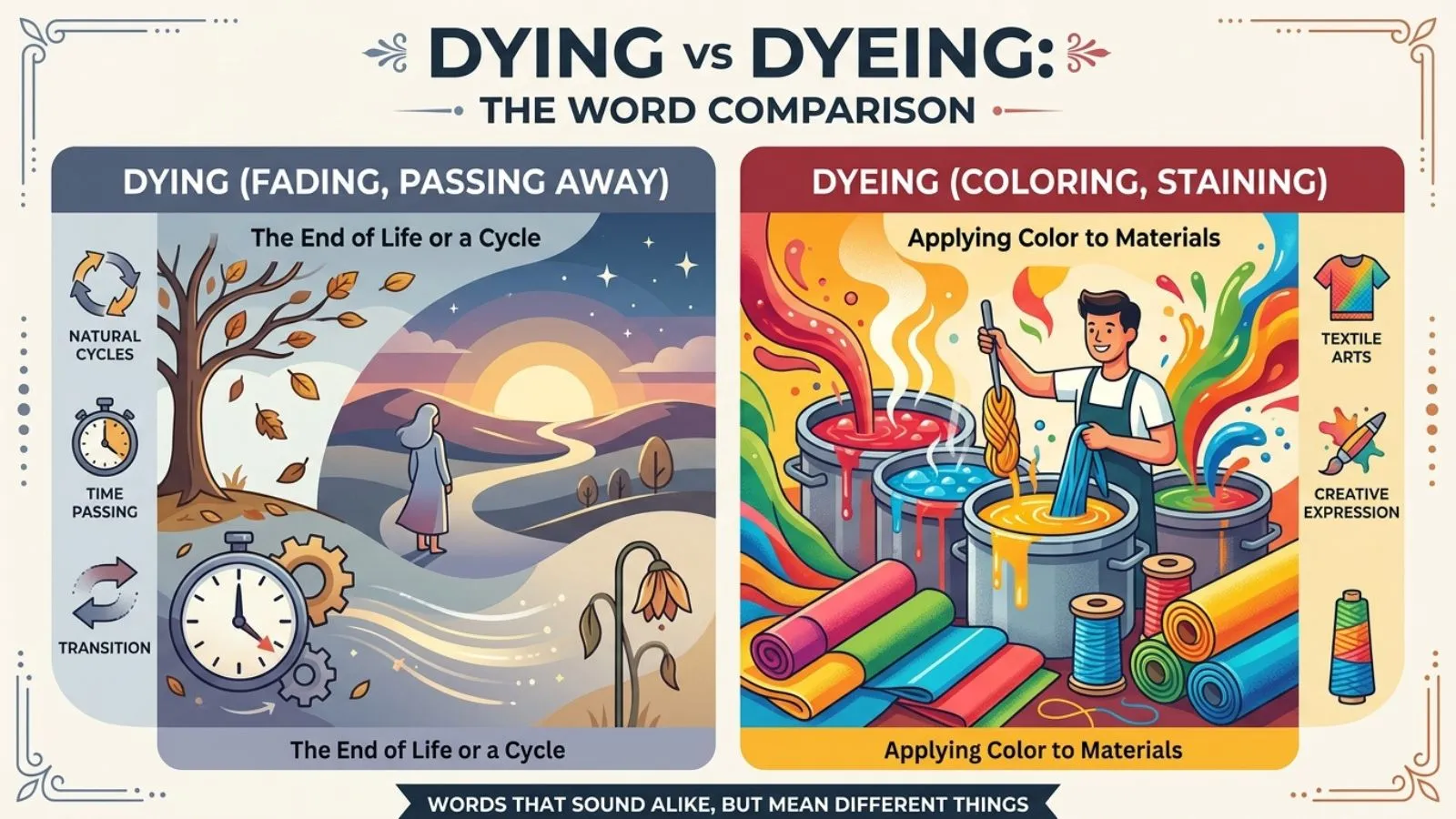
After understanding the difference, I realized how important it is to know these two words because one relates to death, while the other usually means changing the color of something.
Mixing them up can easily create an awkward or even funny situation.
I handled the confusion by learning the proper meanings, spelling, and usage of both words.
Now, whenever I see dying or dyeing in chats, social media, or everyday writing, I feel confident enough to understand exactly what the writer means.
Dying or Dyeing – Quick Answer
Here is the short version:
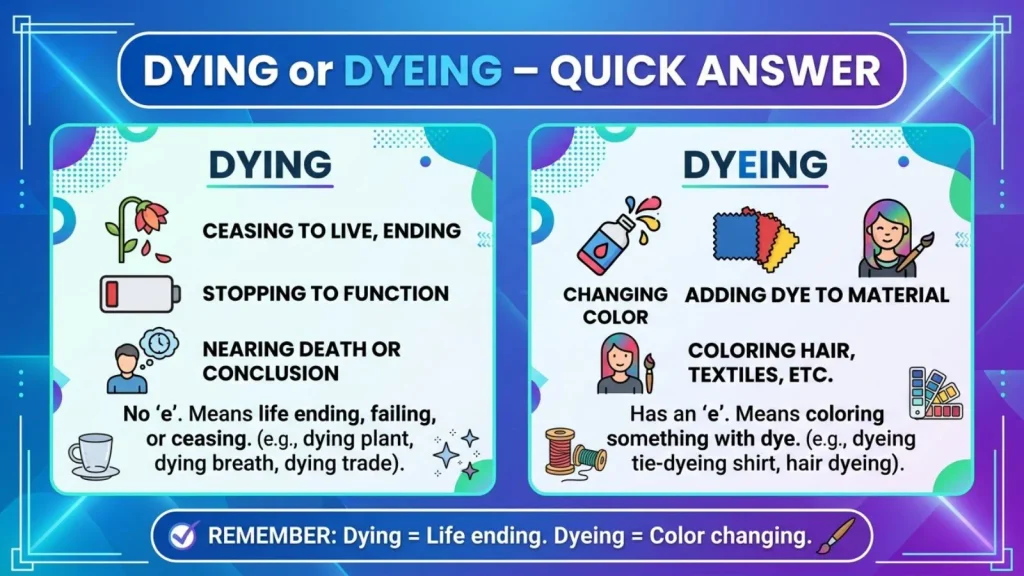
- Dyeing = coloring something (fabric, hair, eggs). It comes from the verb “dye.”
- Dying = the process of death, or losing importance. It comes from the verb “die.”
Examples:
- “She is dyeing the curtains blue.” (coloring)
- “The old man is dying peacefully at home.” (passing away)
- “Interest in fax machines is dying out.” (fading away, not literal death)
The two words are pronounced the same in most cases. Only the spelling and the meaning sets them apart.
The Origin of Dying or Dyeing
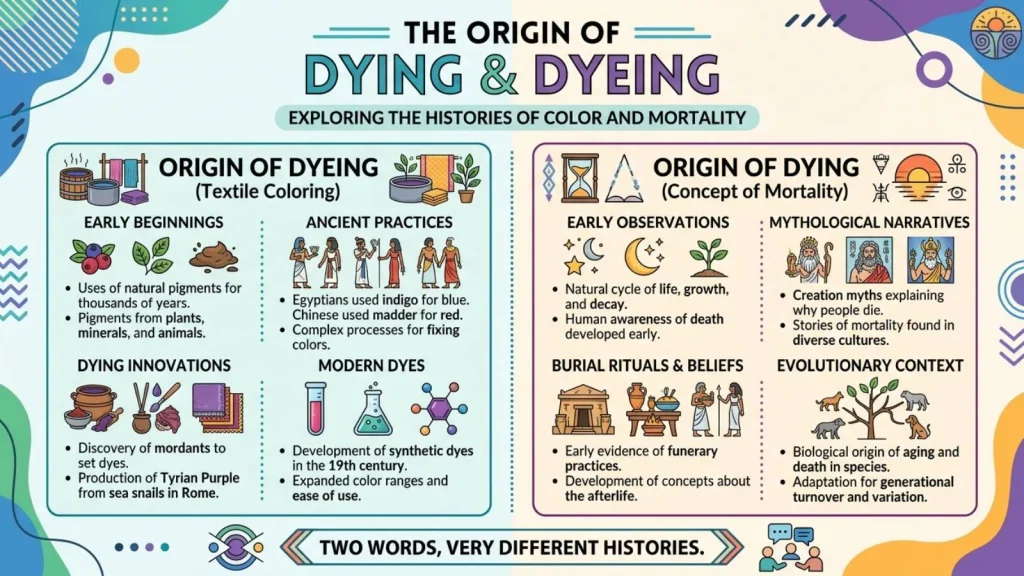
The confusion has a clear cause: English “-ing” spelling rules.
Normally, when a verb ends in a silent “e,” you drop the “e” before adding “-ing.” “Bake” becomes “baking.” “Like” becomes “liking.” Following that rule, “dye” should become “dying.”
But “die” already uses “dying” as its own “-ing” form. If “dye” also became “dying,” readers would have no way to tell the two words apart in writing.
To solve this, English writers and dictionaries settled on an exception. “Dye” keeps its “e” before “-ing,” giving us “dyeing.” This spelling choice dates back centuries, appearing in print by at least the 1700s, as printers and dictionary makers standardized spelling to avoid ambiguity.
So the extra “e” is not a mistake. It is a deliberate fix for a spelling collision. Similar exceptions exist for other short verbs, like “singe” becoming “singeing” (to avoid confusion with “singing”).
British English vs American English Spelling
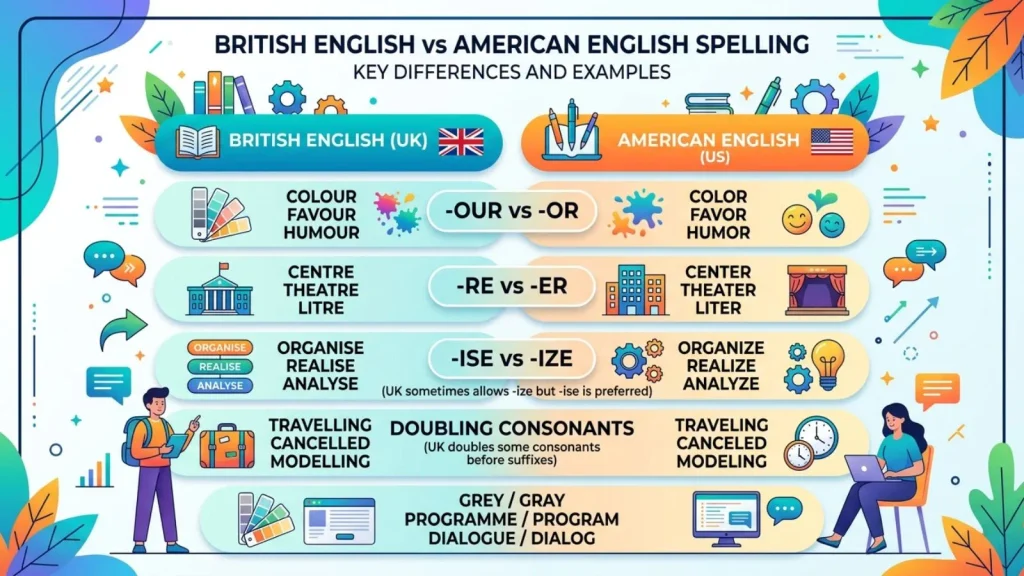
Good news: this is one spelling case where British and American English fully agree. Unlike “colour” vs “color” or “realise” vs “realize,” both varieties of English treat “dyeing” and “dying” the same way.
| Word | Meaning | British English | American English |
| Dye + ing | To color something | Dyeing | Dyeing |
| Die + ing | To stop living | Dying | Dying |
| Related noun | Person or process | Dyer / Dyeing process | Dyer / Dyeing process |
| Past tense | Dyed / Died | Dyed / Died |
The only place spelling might vary is in industry terms. British textile writing sometimes uses “dyeing” in compound terms like “dyeing house,” while American usage favors “dye house.” But the core word itself dyeing vs. dying stays identical worldwide.
Which Spelling Should Use dying or dyeing ?
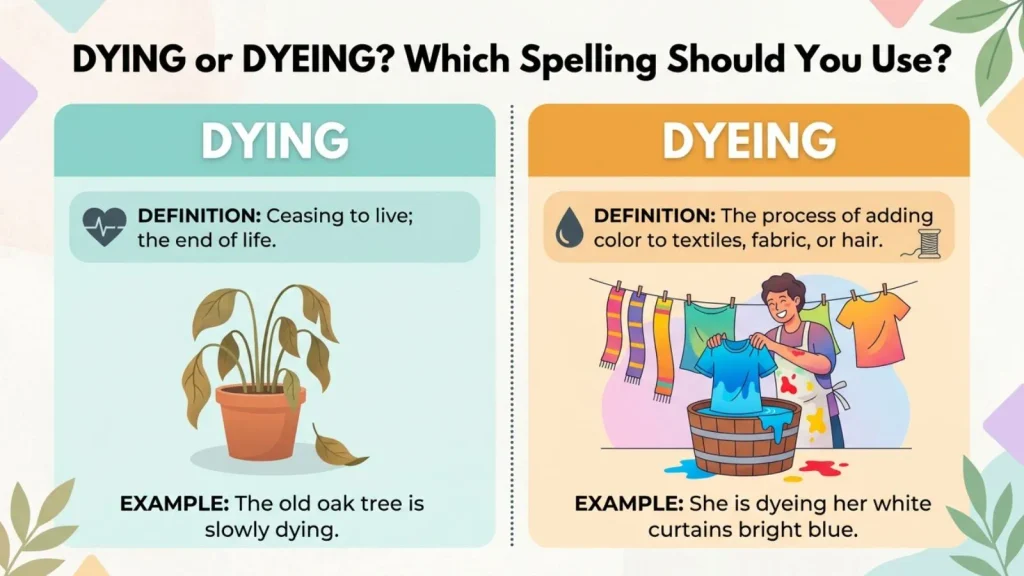
Your choice depends on meaning, not region. Since British and American English agree here, this isn’t a US-vs-UK issue like many other spelling debates. Instead, ask yourself what you mean:
- Talking about color, fabric, hair, or eggs? Use “dyeing.”
- Talking about death, loss of life, or something fading away? Use “dying.”
- Writing for a global audience? Both spellings are understood everywhere English is spoken. Just pick the one that matches your meaning.
- Writing for business or formal documents? Double-check the word in context. Autocorrect tools sometimes suggest the wrong one, especially on mobile keyboards.
There’s no regional debate here only a meaning-based choice.
Common Mistakes with Dying or Dyeing
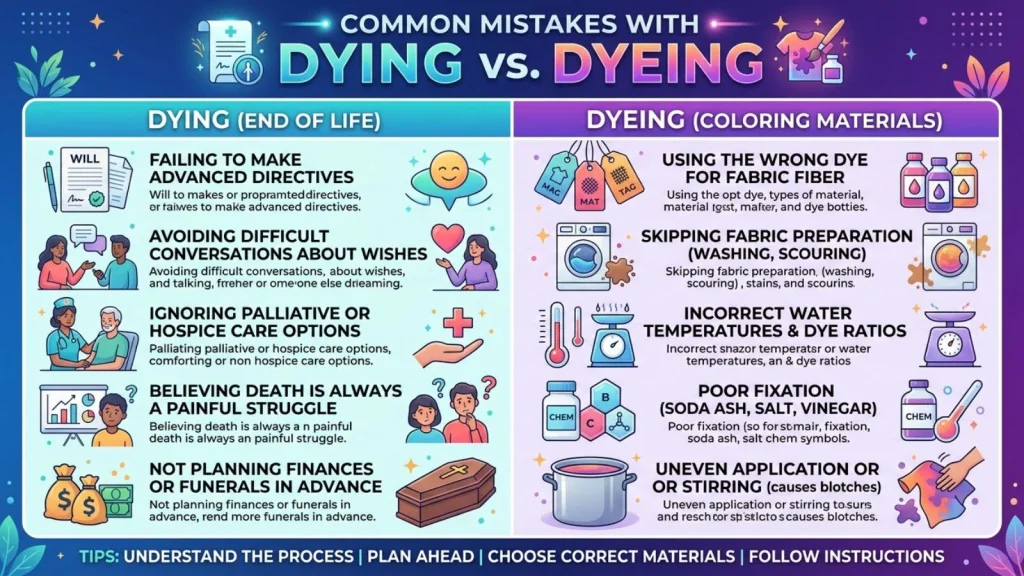
Here are the most frequent errors, and how to fix them:
Mistake 1: “I’m dying my hair red.” Fix: “I’m dyeing my hair red.” (You’re coloring your hair, not passing away.)
Mistake 2: “The fabric is dying in that vat.” Fix: “The fabric is dyeing in that vat.” (Fabric doesn’t die it takes on color.)
Mistake 3: “Easter egg dying kit.” Fix: “Easter egg dyeing kit.” (A common labeling error on product packaging.)
Mistake 4: “The plant is dyeing from lack of water.” Fix: “The plant is dying from lack of water.” (This is literal death, not coloring.)
Mistake 5: Confusing the adjective forms “a dyeing man” instead of “a dying man.” Always check whether you mean color or death before adding the ending.
A simple trick: if you can replace the word with “coloring,” use “dyeing.” If you can replace it with “passing away” or “fading,” use “dying.”
Dying or Dyeing in Everyday Examples
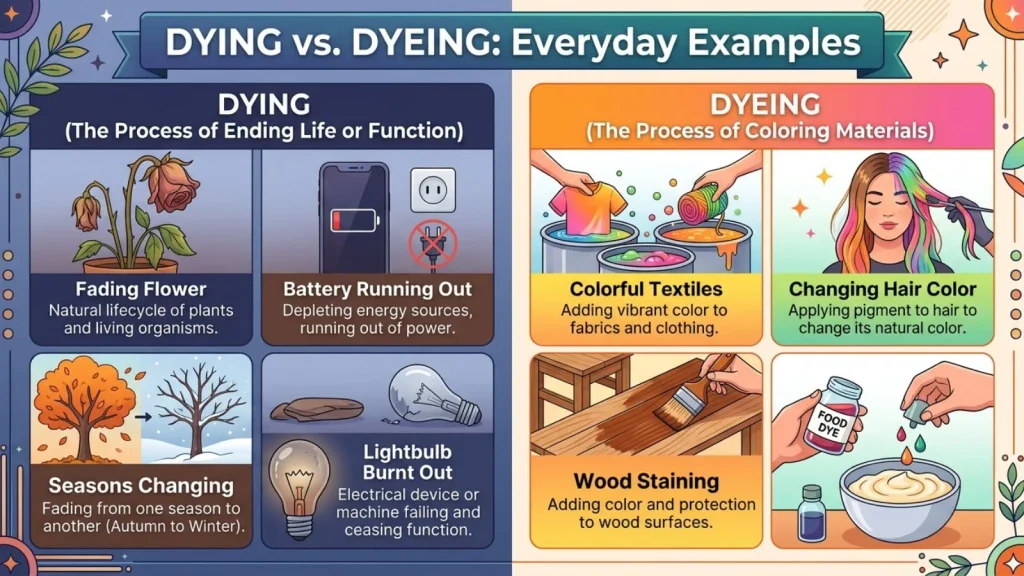
In emails: “Please confirm the fabric dyeing schedule for next week’s order.”
In news headlines: “Local river polluted by illegal dyeing runoff from textile factory.” “Coral reefs are dying at record rates, new study finds.”
On social media: “Just tried DIY tie-dyeing at home and it turned out amazing! 🎨” “RIP to my old phone, it’s finally dying on me 😂”
In formal writing: “The dyeing process for the garment uses natural plant-based pigments.” “The patient’s condition was described as dying, with family gathered at the bedside.”
Each example shows the same pattern: dyeing relates to color and process, dying relates to life, loss, or decline.
Dying or Dyeing – Google Trends & Usage Data
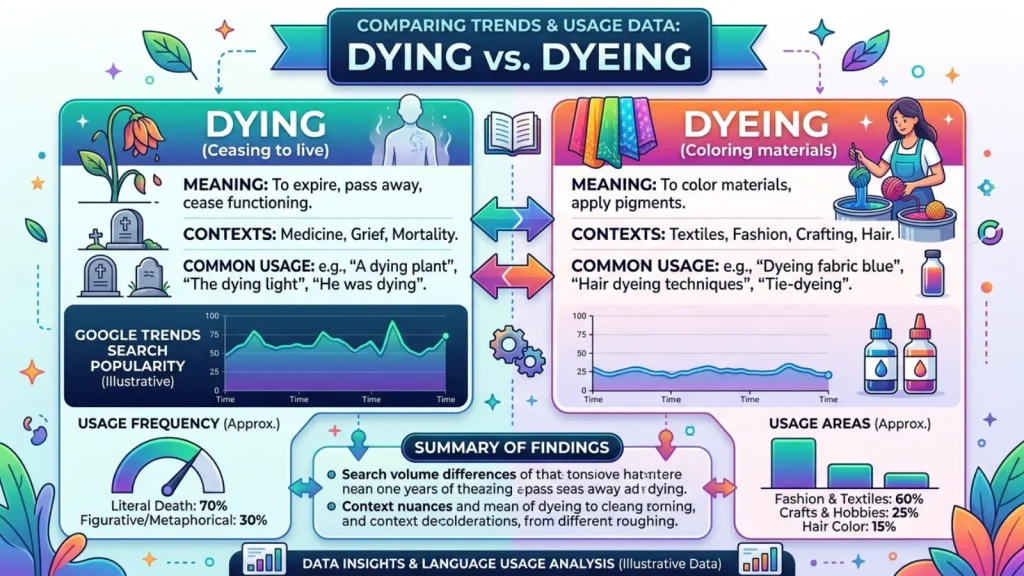
Search interest in both spellings stays high year-round, with some patterns worth noting. Searches for “dyeing” tend to spike around Easter (egg dyeing), during hair-color trend seasons, and alongside DIY and craft content like tie-dye tutorials. Searches for “dying” spike around news events, health topics, and casual expressions like “dying laughing” or “dying to know.”
By region, both American and British English speakers search for the correct spelling at similar rates, confirming this is a universal English spelling challenge rather than a regional one. Many searches also include the phrase “dying or dyeing” directly, showing that people actively look for clarity rather than guessing.
Context matters most: craft, beauty, and fashion content drives “dyeing” searches, while news, health, and casual conversation drive “dying” searches.
Keyword Variations Comparison
| Variation | Correct Meaning | Example Sentence |
| Dyeing | Coloring something | “She is dyeing the shirt purple.” |
| Dying | Losing life / fading | “The tradition is dying out.” |
| Dyed | Past tense of dye | “He dyed his jacket black.” |
| Died | Past tense of die | “The engine died on the highway.” |
| Dyer | Person who dyes | “The dyer mixed a new shade of blue.” |
| Dier | Not a standard word (common typo) | Avoid not recognized in dictionaries |
FAQs
1. Is “dying” ever correct when talking about color?
No. “Dying” always relates to death or fading away. For color, always use “dyeing.”
2. Why does “dye” keep the “e” before “-ing” but other words drop it?
English drops the silent “e” before “-ing” in most verbs, but “dye” is an exception. Keeping the “e” avoids clashing with “dying” from “die.”
3. Do British and American English spell these words differently?
No. Both use “dyeing” for coloring and “dying” for death-related meaning. This is one of the few spelling pairs where the two English varieties agree completely.
4. What is the past tense of “dye” and “die”?
“Dye” becomes “dyed.” “Die” becomes “died.” These two are spelled the same way, so context is key here too.
5. Is there a simple trick to remember the difference?
Yes. Think: “dyeing” keeps the “e” for “extra color.” “Dying” drops the “e” like a life running out.
6. Can “dying” be used in a non-literal sense?
Yes. People say things like “dying to see you” or “dying of laughter” to express strong feeling, not literal death.
7. Is “dyeing” used outside of fabric and hair?
Yes. It applies to eggs, wood, food, paper, and any material that takes on color through a dye process.
Conclusion
The difference between “dying” and “dyeing” comes down to one letter and one meaning. Dyeing means coloring something, like fabric, hair, or eggs. Dying means the end of life, or something fading away. The confusion exists because normal English spelling rules would turn “dye” into “dying” too, so the extra “e” was kept in “dyeing” to avoid a clash with “die.”
Unlike many British-versus-American spelling debates, this one has no regional split. Both sides of the Atlantic and English speakers everywhere use “dyeing” for color and “dying” for death. The only decision you need to make is about meaning, not location.
To avoid mistakes, use the simple mental trick: dyeing keeps its “e” for “extra color,” while dying drops it, just like a life running low. Check your sentence are you talking about a color change or a life event? That answer tells you exactly which spelling to use.
With this guide, you now have the quick answer, the history, and practical examples to use “dying” and “dyeing” correctly every time.

Here’s a concise 2-line author bio suitable for Simifind.com:
James Dashner is an American bestselling author best known for The Maze Runner series and other popular young-adult fiction.
On Simifind.com, he shares clear, engaging insights and helpful content for readers interested in books, writing, and popular literature.