Have you ever wondered whether you should write “feel” or “feal” when expressing an emotion or describing how something seems?
Recently, I was chatting with a friend when I suddenly saw the term “Feel or Feal” pop up, and honestly, I had no clue which spelling was correct at first.
I kept wondering, “Am I missing something here?” It was a bit confusing, and I didn’t want to respond with the wrong word.
So, I decided to look into Feel or Feal and understand its meaning, spelling, and proper context.
After learning the difference, I realized how important it is to know which word is correct, especially when writing messages, posts, or everyday conversations.
I handled the confusion by learning the proper usage and responding confidently, and now I feel ready whenever I come across Feel or Feal again.
Feel or Feal – Quick Answer
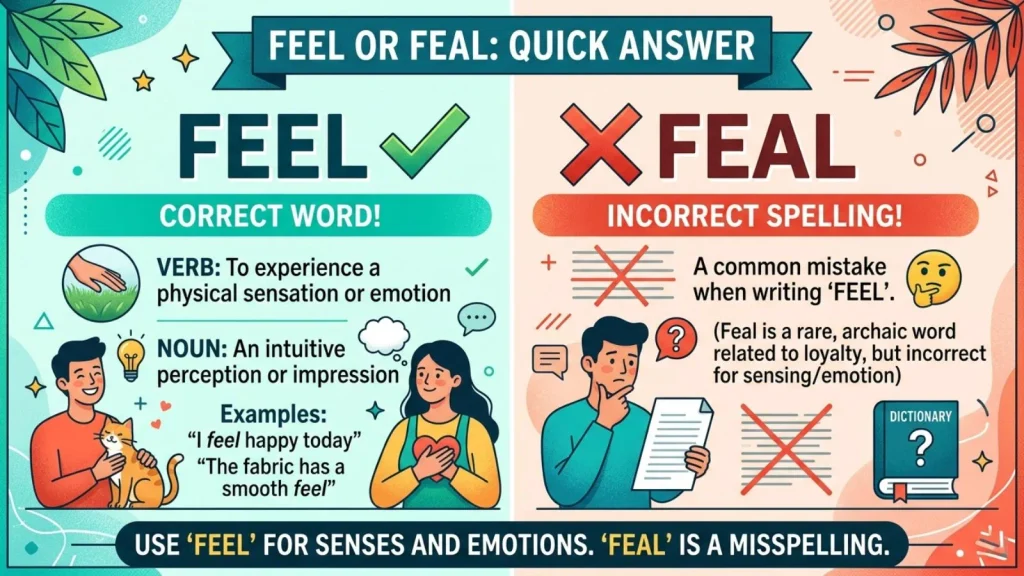
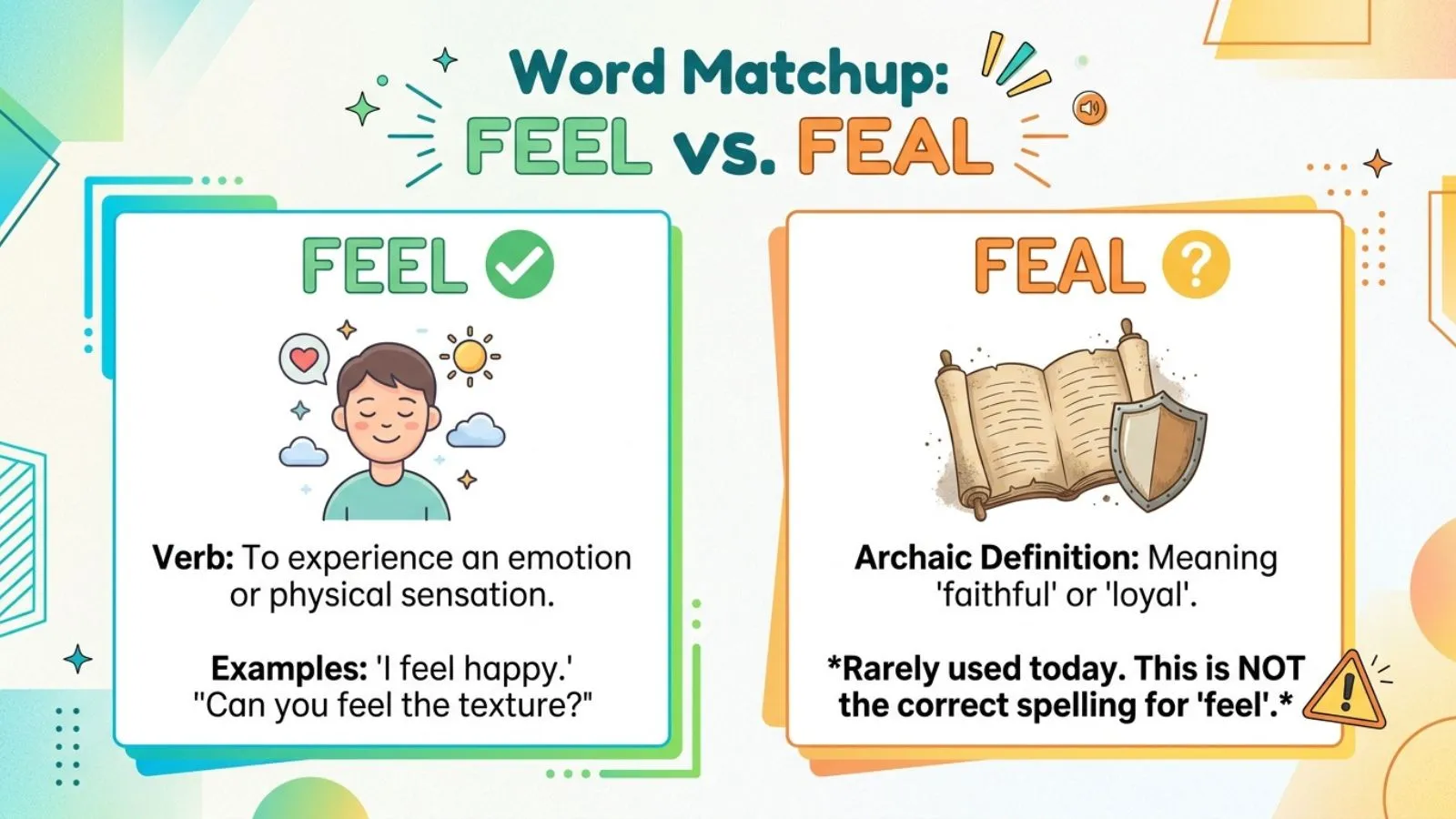
Use “feel.” This is the correct, modern, everyday word.
- Correct: “I feel tired today.”
- Correct: “How do you feel about the plan?”
- Incorrect: “I feal tired today.”
“Feal” is a separate, old word. It means faithful or loyal , not a spelling variant of “feel.” It is barely used in modern writing, except in poetry, fantasy fiction, or historical text.
- “The knight remained feal to his king.” (meaning: loyal)
So if you are writing an email, a text, a report, or anything modern, “feel” is almost certainly what you need.
The Origin of Feel or Feal
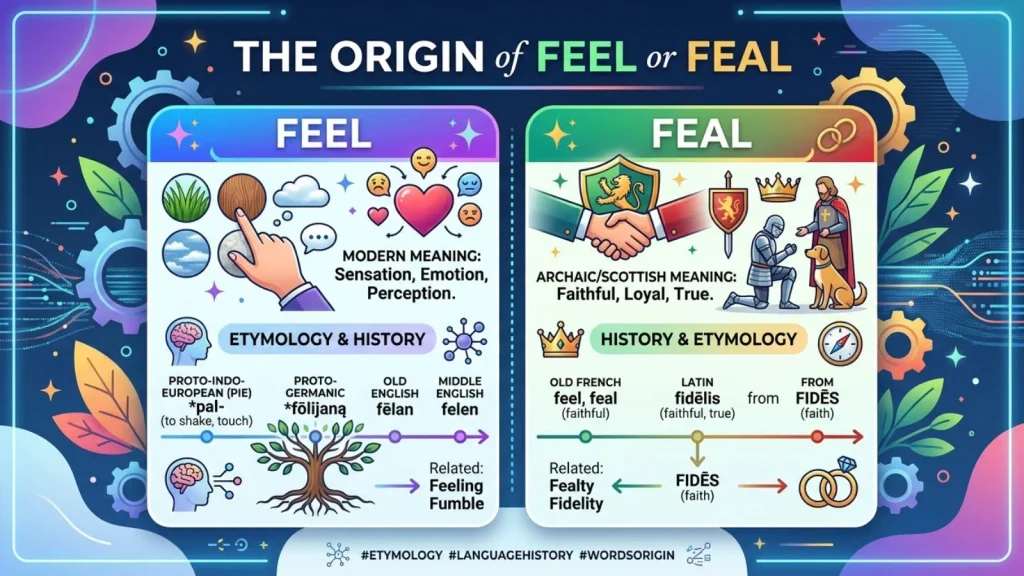
“Feel” comes from Old English fēlan, meaning to touch or sense. It has stayed close to that meaning for over a thousand years. Today we use it for physical sensation (“I feel cold”) and emotion (“I feel happy”).
“Feal” has a completely different root. It comes from Old French feeil, based on Latin fidelis, meaning faithful. It entered English in the 1500s as a formal or poetic word for loyalty. Old dialect writers in parts of England and Scotland also used “feal” as a rough, informal spelling of “feel.” That is one reason the two words get mixed up today.
So the confusion is not really about British versus American spelling. It is about two old words that happen to sound alike. One survived into modern English. The other mostly did not.
British English vs American English Spelling
This is the part that surprises most people: there is no British-versus-American spelling split for this word.
“Feel” is spelled the same way everywhere English is spoken. The UK, the US, Canada, Australia, and every other English-speaking country all use “feel.”
“Feal” is not a regional spelling of “feel.” It is its own old word, and it shows up rarely in any dialect today.
| Region | Standard Spelling | Notes |
| United States | feel | Only correct modern spelling |
| United Kingdom | feel | Only correct modern spelling |
| Canada | feel | Only correct modern spelling |
| Australia | feel | Only correct modern spelling |
| Historical / archaic English | feal | Old word for “loyal”; also an old dialect spelling of “feel” |
Which Spelling Should You Use Feel or Feal ?
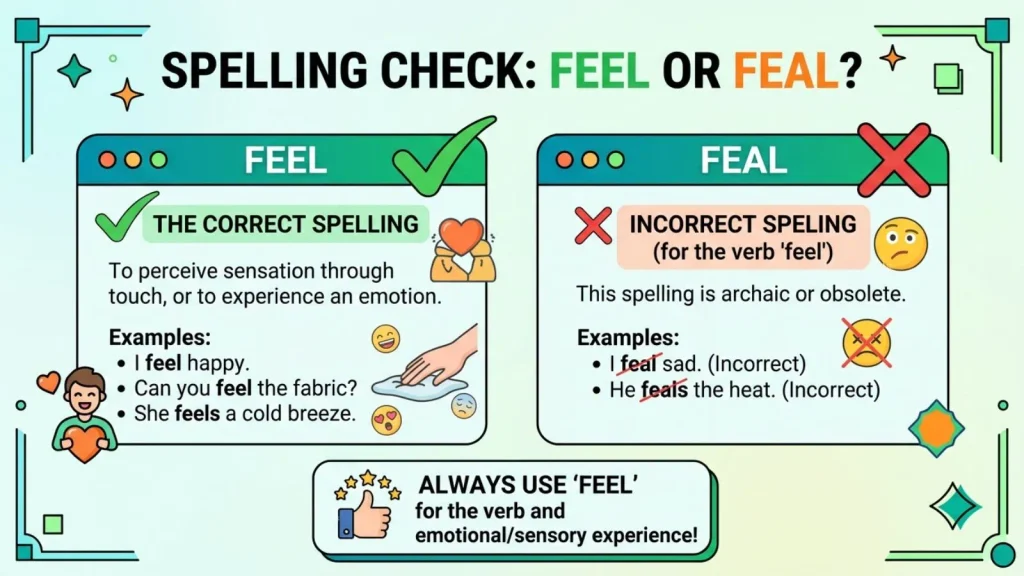
The answer is simple, no matter where you live.
- In the US: Use “feel.” Always.
- In the UK or Commonwealth countries: Use “feel.” Always.
- Writing globally, for business, school, or the web: Use “feel.” It is the only version readers expect.
- Writing fiction, poetry, or historical fantasy: You may use “feal” on purpose, to mean “loyal.” Make sure the context is clear.
If you are unsure, “feel” is the safe, correct, professional choice in 99% of writing.
Common Mistakes with Feel or Feal
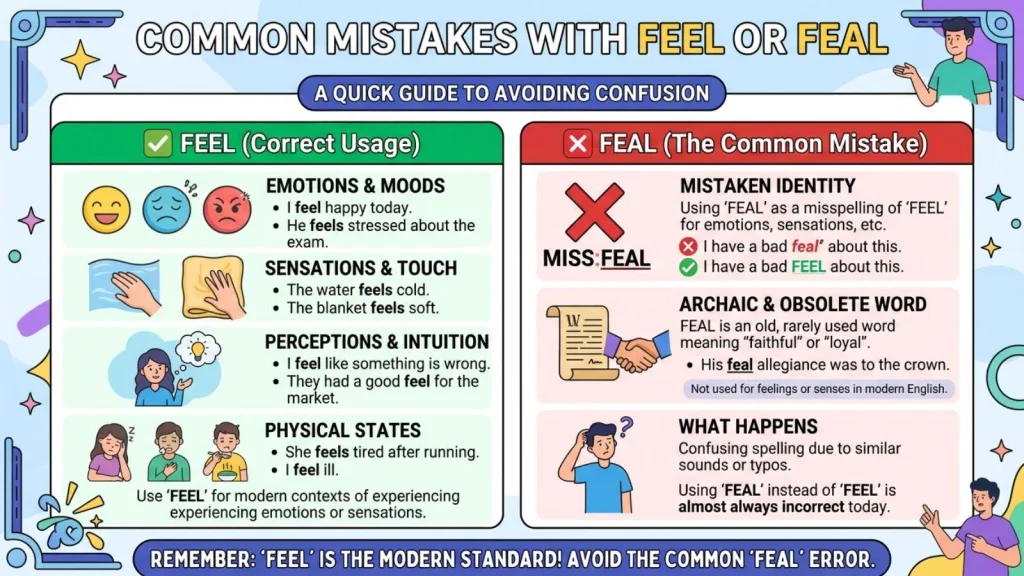
- Typing “feal” by accident. This is the most common issue. Your fingers slip, or you are typing fast, and “feel” becomes “feal.” Spell checkers sometimes miss it because “feal” is a real word.
- Wrong: “I feal like we should talk.”
- Right: “I feel like we should talk.”
- Confusing “feal” with “feel” in meaning. Some writers think “feal” is just an old spelling of “feel,” so they use it that way on purpose. It is not the same word.
- Wrong: “Do you feal okay?”
- Right: “Do you feel okay?”
- Mixing up “feal” with “fear” or “field.” These words share letters and can trip up fast typists.
- Using “feal” in formal writing thinking it sounds fancy. In business or academic writing, this reads as a typo, not a stylistic choice.
Feel or Feal in Everyday Examples
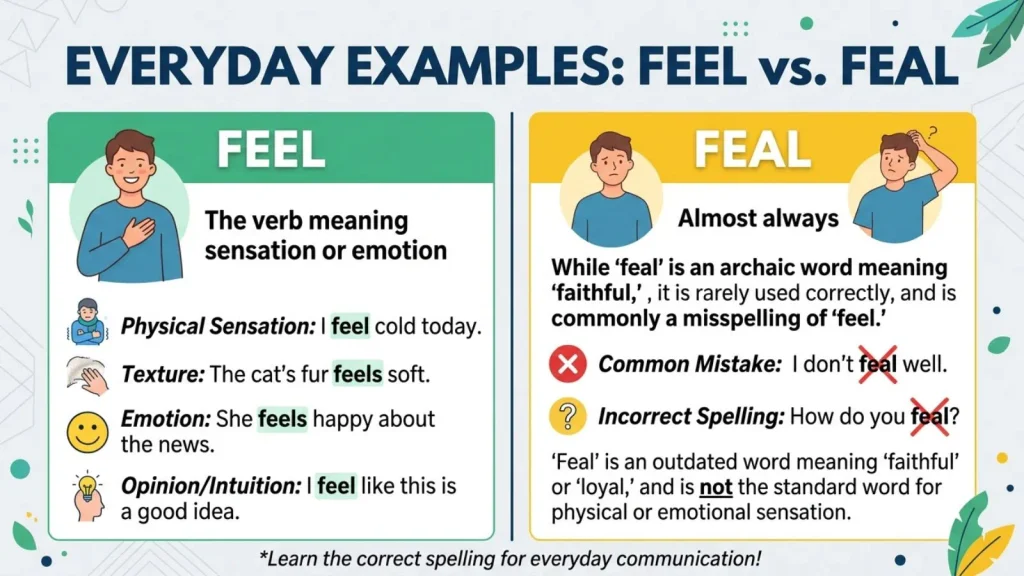
In emails: “I feel we should push the deadline back a week.”
News writing: “Residents say they feel unsafe walking home after dark.”
In social media posts: “Does anyone else feel like Mondays get harder every week?”
In formal writing: “The committee expressed that it did not feel the proposal met current standards.”
“Feal” used correctly (rare, stylistic): “The old servant stayed feal to his master until the end.” (meaning: loyal)
In every normal, modern context, “feel” is the word you want.
Feel or Feal – Search and Usage Data
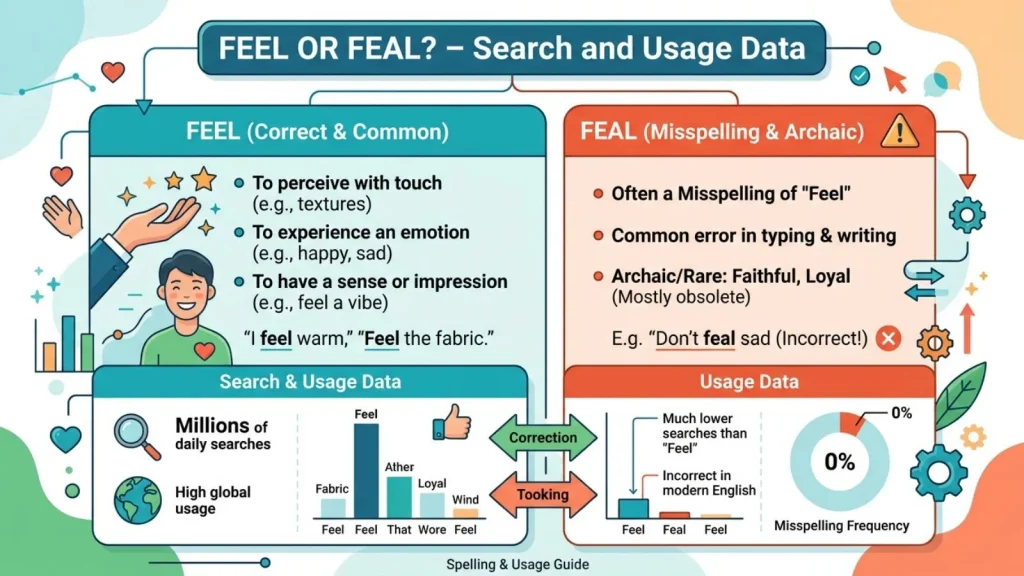
Search interest in “feal” mostly comes from people typing a typo, checking a fantasy novel, or seeing the word in an old text and wondering what it means. Interest is highest among:
- Writers double-checking spelling before publishing
- Students proofreading assignments
- Readers of historical fiction or fantasy who see “feal” used as “loyal”
- People correcting autocorrect or spell-check confusion
Across English-speaking countries, “feel” is used constantly in daily writing, speech, business, and media. “Feal” appears occasionally in creative writing, poetry, and older texts, but almost never in everyday communication.
Keyword Variation Comparison
| Word | Meaning | Common Today? | Correct Use Case |
| Feel | To sense or experience | Yes, very common | Everyday, business, formal writing |
| Feal | Faithful, loyal (archaic) | No, rare | Poetry, fantasy, historical fiction |
| Feel (typo) | Unintentional misspelling as “feal” | N/A | Should always be corrected to “feel” |
FAQs
1. Is “feal” a real word?
Yes. It is an old, archaic English word meaning faithful or loyal. It is rarely used in modern writing.
2. Is “feal” British spelling for “feel”?
No. “Feel” is spelled the same in British and American English. “Feal” is a separate, older word, not a regional spelling.
3. Can I use “feal” instead of “feel”?
No, not in normal writing. They have different meanings. Only use “feal” if you specifically mean “loyal,” usually in creative or historical writing.
4. Why does spell check sometimes miss “feal”?
Because “feal” is a real, dictionary-listed word. Spell checkers do not flag it as an error, even when you meant to type “feel.”
5. What does “feal” mean in old texts or fantasy books?
It usually means faithful, loyal, or devoted, often describing a knight, servant, or subject.
6. How do I stop mistyping “feel” as “feal”?
Slow down when typing, and read your sentence back before sending. Since spell check may not catch it, a quick manual check helps.
7. Is “feal” used in any country as standard spelling today?
No. No country uses “feal” as the standard spelling of “feel.” It survives only in niche, old-fashioned, or poetic use.
Conclusion
The confusion between “feel” and “feal” is common, but the answer is simple. “Feel” is the correct word for everyday writing, no matter where you live or who you are writing for.
It means to sense or experience something, and it has been spelled the same way across British, American, and all other forms of English for centuries.
“Feal” is a real word, but it is archaic. It means faithful or loyal, and it shows up mainly in poetry, fantasy writing, or historical texts. It is not a spelling variant of “feel,” and using it by accident is one of the most common small typos in English.
When in doubt, choose “feel.” It is correct, modern, and understood by every reader, everywhere. Save “feal” for the rare moment you are writing about loyalty in a historical or creative piece, and make sure your reader understands the context.
Now you can write with confidence, and never pause on this word again.

Mary Roach is an American science writer and bestselling author known for making unusual and complex scientific topics engaging, accessible, and humorous. Her books include Stiff, Packing for Mars, Gulp, and Fuzz.
Author at Simifind.com, sharing clear, informative content designed to help readers understand interesting topics and everyday questions.