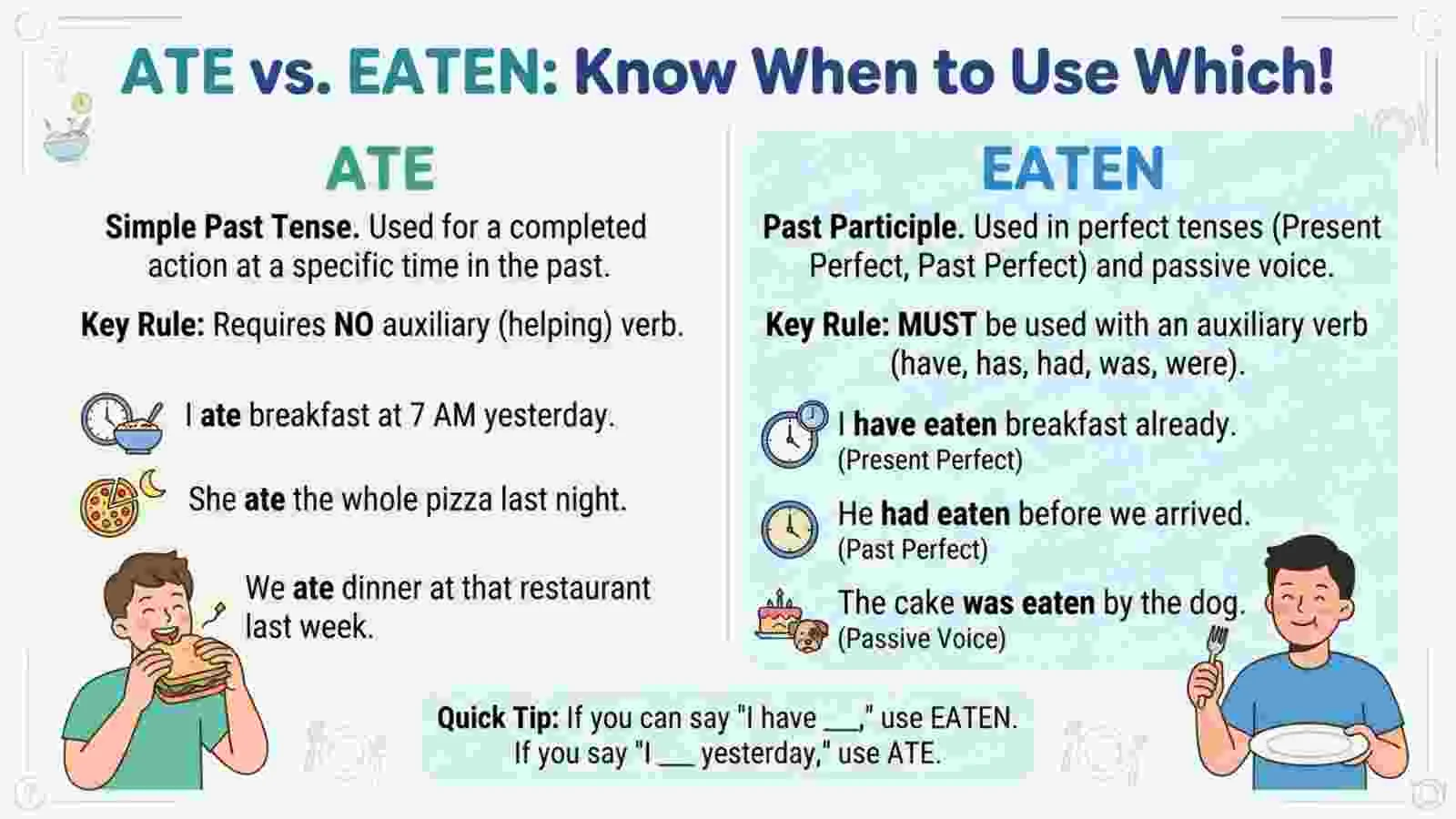
Ate = the simple past tense of eat (I ate breakfast). Eaten = the past participle of eat — used with has/have/had (I have eaten breakfast). They are two different verb forms, not interchangeable.
Have you ever wondered whether to use ate or eaten in a sentence?
You are not alone. Many English learners mix up these two words because both come from the verb “eat.” They have similar meanings, but they follow different grammar rules.
The good news is that the difference is easy to learn. You use ate when talking about a completed action in the past. You use eaten when forming perfect tenses with helping verbs such as “have,” “has,” or “had.”
For example, “I ate breakfast yesterday” is correct. However, “I have eaten breakfast” is also correct because it follows a different tense structure.
People often search for “ate or eaten” because they want to write better emails, speak English clearly, or avoid common grammar mistakes.
Understanding these words can help you improve your writing and confidence.
In this guide, you will learn the meaning of each word, its origin, the main grammar rules, and examples from everyday life.
You will also discover common mistakes and simple tips to help you choose the right word every time.
Ate or Eaten – Quick Answer
Ate is the simple past form of “eat,” while eaten is the past participle. Both words describe eating, but they are used in different sentence structures.
Use ate when an action happened in the past.
- I ate an apple yesterday.
- She ate lunch at noon.
- They ate dinner together last night.
Use eaten with helping verbs to form perfect tenses.
- I have eaten breakfast.
- She has eaten all the food.
- They had eaten before we arrived.
Remember this simple rule: ate stands alone as a past-tense verb, while eaten usually needs a helping verb.
| Verb form | Correct word | Example |
| Base form | Eat | I eat breakfast daily. |
| Simple past | Ate | I ate breakfast yesterday. |
| Past participle | Eaten | I have eaten breakfast. |
| Present perfect | Have/has eaten | She has eaten lunch. |
| Past perfect | Had eaten | We had eaten before the meeting. |
The Origin of Ate and Eaten
The words “ate” and “eaten” come from the verb eat, an old English word with Germanic roots. The verb has changed in form over many centuries, but its basic meaning has remained the same.
Unlike regular verbs, which often form the past tense by adding “-ed,” eat is an irregular verb. For example, “walk” becomes “walked,” but “eat” becomes “ate” in the simple past and “eaten” in the past participle.
These different forms developed through older patterns of English grammar. Today, they help show when an action happened and how it relates to another event or the present.
Here are the three main forms:
- Eat: The base form, used for habits and present actions.
- Ate: The simple past form, used for completed actions in the past.
- Eaten: The past participle, used with helping verbs and in some passive constructions.
For example, “I eat fruit every day” describes a habit. “I ate fruit yesterday” describes a past event. “I have eaten fruit today” connects the action to the present.
Learning these forms is important because using the wrong one can make a sentence sound incorrect.
British English vs American English Spelling
There is no spelling difference between British and American English when it comes to ate and eaten. Both varieties use the same spellings and follow the same basic grammar rules.
Some English words have different spellings in different countries. For example, British English uses “colour,” while American English uses “color.” However, the forms of the verb “eat” remain the same worldwide.
The main challenge is not regional spelling. It is choosing the correct verb form for the sentence.
| Grammar point | British English | American English |
| Simple past | I ate lunch. | I ate lunch. |
| Present perfect | I have eaten lunch. | I have eaten lunch. |
| Past perfect | I had eaten lunch. | I had eaten lunch. |
| Negative past | I did not eat lunch. | I did not eat lunch. |
| Question form | Did you eat lunch? | Did you eat lunch? |
Examples in British and American English
British English: “I have already eaten, so I do not need dinner.”
American English: “I ate earlier, so I am not hungry now.”
Both sentences are grammatically correct. The choice between simple past and present perfect can vary with context and conversational style, but neither country uses a different spelling for “ate” or “eaten.”
Which Spelling Should You Use?
You do not need to choose between British and American spelling for these words. Both forms are standard in English around the world. Instead, choose the correct form based on the tense and structure of your sentence.
For American English
Use “ate” for a completed past action and “eaten” with the appropriate helping verb.
Examples:
- I ate at a new restaurant yesterday.
- I have eaten there before.
American speakers often use the simple past for actions that happened recently, especially when discussing a finished event.
For British English and Commonwealth Countries
The same grammar rules apply in the United Kingdom, Pakistan, Australia, Canada, and other English-speaking regions.
Examples:
- She ate her lunch before class.
- She has eaten her lunch already.
The present perfect is common when the speaker wants to connect a past action with the present. However, the simple past is also correct when the context calls for it.
For Global and Professional Writing
Use standard grammar in emails, reports, schoolwork, and business communication.
For example:
- Correct: “I have eaten lunch, so I am ready for the meeting.”
- Correct: “I ate lunch before the meeting.”
- Incorrect: “I have ate lunch.”
Professional tip: If you use “have,” “has,” or “had” as a helping verb, choose “eaten,” not “ate.”
Common Mistakes with Ate and Eaten
Many learners make mistakes with these words because they use the simple past form where the past participle is required. Here are the most common errors and their corrections.
1. Using Ate After Have
Incorrect: I have ate my breakfast.
Correct: I have eaten my breakfast.
Why? The verb “have” requires the past participle “eaten” in the present perfect tense.
2. Using Ate After Had
Incorrect: She had ate before I arrived.
Correct: She had eaten before I arrived.
Why? The past perfect tense follows the structure “had + past participle.”
3. Using Eaten Alone in the Simple Past
Incorrect: We eaten dinner last night.
Correct: We ate dinner last night.
Why? The simple past normally uses “ate” without a helping verb.
4. Using Ate After Did
Incorrect: Did you ate lunch?
Correct: Did you eat lunch?
Why? After “did,” use the base form of the verb. The helping verb already shows the past tense.
5. Using Eaten After Does
Incorrect: Does he eaten meat?
Correct: Does he eat meat?
Why? After “does,” use the base form “eat,” not “ate” or “eaten.”
6. Forgetting the Helping Verb
Incorrect: I eaten all the food.
Correct: I have eaten all the food.
Why? In standard perfect-tense sentences, “eaten” needs a suitable helping verb.
7. Confusing Past and Present Perfect
Both of these sentences are correct:
- I ate breakfast at 8 a.m.
- I have eaten breakfast.
The first focuses on a past event. The second tells us that breakfast has been eaten, often because the result matters now.
Ate or Eaten in Everyday Examples
Understanding real-life examples makes it easier to use these words correctly. Here is how they appear in common types of writing.
1. In Emails
Correct: “I have eaten lunch and will join the meeting shortly.”
Correct: “I ate before leaving the office.”
These sentences work well in professional communication because the verb forms match their sentence structures.
2. In News Reports
Example: “The team ate dinner together after the match.”
Example: “The guests had eaten before the event began.”
News reports often use the simple past to describe completed events. The past perfect helps show that one event happened before another.
3. On Social Media
Example: “I ate the best pizza today!”
Example: “I have eaten here three times this week.”
The first sentence describes a past experience. The second emphasizes experience during a period that may still be continuing.
4. In Formal Writing
Example: “The participants had eaten before the training session started.”
Example: “The patient has eaten a light meal.”
Formal writing often uses perfect tenses when the timing or result of an action matters.
5. In Daily Conversation
Question: “Did you eat breakfast?”
Answer: “Yes, I ate breakfast.”
Another example:
Question: “Have you eaten yet?”
Answer: “Yes, I have eaten.”
Both exchanges are correct. The question determines which verb form is needed in the answer.
Ate or Eaten – Google Trends and Usage Data
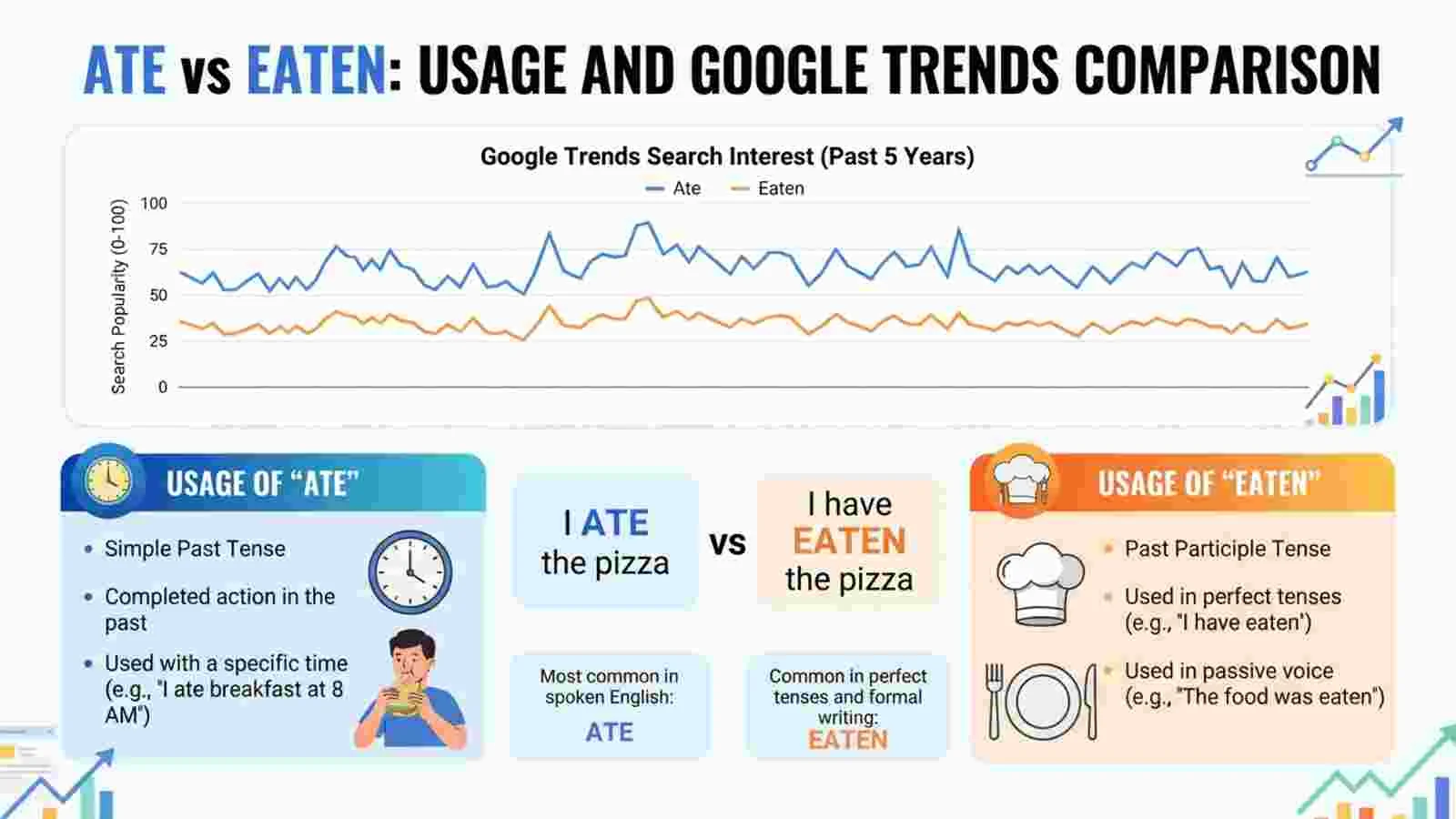
People search for “ate or eaten” when they want to understand English grammar, improve their writing, or prepare for school and language tests. Both words are common, but they serve different grammatical purposes.
There is no reliable reason to claim that one form is more popular in a particular country based only on the words themselves. Both are used in British English, American English, Pakistani English, and other varieties of English.
Google Trends can help compare search interest for phrases such as “ate or eaten,” “have ate or have eaten,” and “ate vs eaten.” However, search interest is not the same as the frequency of a word in everyday speech. Results can also change depending on the selected country, period, and search category.
For useful research, compare the same time range across the United States, the United Kingdom, Pakistan, Canada, and Australia. Then check related searches to understand what learners want to know.
For grammar decisions, trusted dictionaries and English grammar guides are more useful than search popularity alone. They confirm that “ate” is the simple past form and “eaten” is the past participle.
Comparison Table: Ate vs Eaten
| Feature | Ate | Eaten |
| Verb form | Simple past | Past participle |
| Base verb | Eat | Eat |
| Common structure | Subject + ate | Subject + have/has/had + eaten |
| Example | He ate an apple. | He has eaten an apple. |
| Refers to past action | Yes | Yes, with a helping verb in perfect tenses |
| Used after “did” | No | No |
| Used after “have” | No | Yes |
| Used after “had” | No | Yes |
| British spelling | Ate | Eaten |
| American spelling | Ate | Eaten |
Frequently Asked Questions
1. Is “ate” or “eaten” correct?
Both are correct, but they are used differently. “Ate” is the simple past form, while “eaten” is the past participle. For example, “I ate lunch” and “I have eaten lunch” are both correct.
2. Is it “I have ate” or “I have eaten”?
“I have eaten” is correct. The present perfect tense uses “have” or “has” followed by the past participle. Therefore, “I have ate” is grammatically incorrect in standard English.
3. Is it “I ate” or “I eaten”?
“I ate” is correct when you want to describe a completed past action. “I eaten” is incorrect as a standard standalone sentence because “eaten” normally needs a helping verb in this construction.
4. Is “had ate” correct?
No. Use “had eaten” to form the past perfect tense. For example, “I had eaten before the guests arrived” is correct.
5. Should I say “Did you eat” or “Did you ate”?
Say “Did you eat?” After “did,” use the base form of the verb. The word “did” already indicates the past tense.
6. Is “ate” British or American English?
“Ate” is used in both British and American English. The spelling is the same in both varieties, and the basic grammar rules do not change.
7. What is the past participle of “eat”?
The past participle of “eat” is “eaten.” The three main forms are eat, ate, and eaten. For example, “I eat daily,” “I ate yesterday,” and “I have eaten already.”
8. What does ate mean?
Ate means the simple past tense of eat — a completed action in the past. For example, I ate breakfast at 7 a.m.
9. What does eaten mean?
Eaten is the past participle of eat, used with has, have or had. For example, I have eaten breakfast.
10. What is the difference between ate and eaten?
Ate is the simple past form and stands alone (I ate lunch). Eaten is the past participle and needs a helping verb (I have eaten lunch).
11. When should I use eaten instead of ate?
Use eaten when a helping verb (have, has or had) comes before it — I have eaten lunch. Use ate on its own for a completed past action — I ate lunch.
Conclusion
Choosing between ate or eaten becomes simple once you understand the basic grammar rule. “Ate” is the simple past form of “eat,” while “eaten” is the past participle. The correct choice depends on how you build your sentence, not on whether you use British or American English.
Use “ate” when you describe a completed action in the past. For example, “I ate breakfast yesterday.” Use “eaten” with helping verbs such as “have,” “has,” and “had.” For example, “I have eaten breakfast” and “She had eaten before the meeting.”
Avoid common mistakes such as “I have ate,” “We eaten dinner,” and “Did you ate?” The correct forms are “I have eaten,” “We ate dinner,” and “Did you eat?”
These rules apply in schools, professional emails, everyday conversations, and formal writing around the world. A simple way to remember them is to practise the three verb forms: eat, ate, eaten.
With regular practice and careful attention to helping verbs, you can use these words with confidence and make your English clearer and more accurate.
Continue Reading:
- Jess’s vs Jess’: Meaning, Rules, and Examples ( for 2026)
- Mum vs Mom: Meaning, Differences, and Usage ( for 2026)
- Metre vs Meter: Meaning, Spelling, and Usage Explained ( for 2026)
- Cuter or Cutier: Correct Spelling, Meaning, and Usage ( for 2026)
- Selfs or Selves: Meaning, Grammar, and Examples (for 2026)

Mary Roach is an American science writer and bestselling author known for making unusual and complex scientific topics engaging, accessible, and humorous. Her books include Stiff, Packing for Mars, Gulp, and Fuzz.
Author at Simifind.com, sharing clear, informative content designed to help readers understand interesting topics and everyday questions.

6 thoughts on “Ate vs Eaten: Meaning, Grammar Rules, and Examples ( for 2026)”