
Moral and morale are different words. Moral = relating to right and wrong (moral values, a moral lesson; as a noun, the lesson of a story). Morale = the confidence and enthusiasm of a group (team morale, low morale). They are not interchangeable.
Have you ever stopped while writing because you were unsure whether to use moral or morale?
These two words look almost the same, but they have different meanings. A small spelling difference can change the message of your sentence.
This is why students, English learners, bloggers, and professional writers often search for moral or morale.
The word moral relates to right and wrong, good behavior, and the values that guide our choices.
The word morale refers to the confidence, spirit, and motivation of a person or group. For example, a story may teach a moral lesson, while a good leader may improve the morale of a team.
People often confuse these words because they share most of their letters and sound similar. However, knowing when to use each word can help you write better essays, emails, reports, and articles.
In this guide, you will learn the meanings of moral and morale, their origins, and their use in British and American English. You will also find simple examples, common mistakes, a comparison table, and answers to frequently asked questions.
Moral or Morale – Quick Answer
Both moral and morale are correct English words, but they have different meanings.
- Moral: Relates to right and wrong, good behavior, or a lesson about life.
- Morale: Refers to the confidence, happiness, and motivation of a person or group.
Examples:
- The story teaches an important moral lesson.
- The manager praised the staff to improve their morale.
- Honesty is an important moral value.
- The team’s morale improved after the victory.
The easiest way to remember the difference is this: moral is about values, while morale is about spirit and confidence.
The Origin of Moral and Morale
Although these words look similar, they have different histories. Understanding their origins can help you remember their meanings.
Where Does Moral Come From?
The word moral comes from the Latin word moralis, which relates to manners, customs, and behavior. It entered English through French.
Today, moral often describes ideas about right and wrong. It can also refer to a lesson that teaches people how to act.
Examples:
- She made a moral choice.
- The story has a clear moral.
- Moral values help guide our actions.
The word can function as an adjective, as in moral duty, or as a noun, as in the moral of the story.
Where Does Morale Come From?
The word morale comes from French and is linked to the idea of moral condition or mental and emotional spirit. Its modern English use focuses on confidence, enthusiasm, and group spirit.
Examples:
- The coach worked hard to raise team morale.
- Poor working conditions can lower employee morale.
- The soldiers showed strong morale during a difficult time.
Why Do People Confuse These Words?
Both words share the letters moral, and their pronunciation is similar in many varieties of English. The final -e in morale helps distinguish it in writing.
However, the difference is not only about spelling. Each word has its own meaning and use. A moral lesson teaches a value, while morale describes how confident or motivated people feel.
British English vs American English Spelling
British English and American English use the same standard spellings for moral and morale. Neither word changes spelling based on the country where you are writing.
| Word or phrase | British English | American English | Meaning |
| Moral | Moral | Moral | Related to right and wrong |
| Morale | Morale | Morale | Confidence or group spirit |
| Moral values | Moral values | Moral values | Principles of right behavior |
| Moral lesson | Moral lesson | Moral lesson | A lesson about behavior |
| Team morale | Team morale | Team morale | The team’s confidence and spirit |
| Employee morale | Employee morale | Employee morale | Workers’ motivation and satisfaction |
Examples in British English
- The book teaches an important moral lesson.
- The new policy improved employee morale.
- The teacher discussed moral values with the class.
Examples in American English
- The story has a strong moral message.
- The coach helped boost team morale.
- Good leadership can improve workplace morale.
These examples show that the words have the same spelling and meaning in both varieties of English.
Which Spelling Should You Use?
Choosing between moral and morale depends on what you want to express, not on your location.
For American English
Use moral when discussing ethics, values, or lessons. Use morale when discussing confidence, motivation, or team spirit.
Examples:
- The decision raised moral concerns.
- The manager wanted to improve employee morale.
For British English and Commonwealth Countries
The same rule applies in the United Kingdom, Pakistan, Australia, Canada, and other Commonwealth countries.
Examples:
- Education helps develop moral values.
- The team’s morale increased after the win.
For Global and Professional Writing
In academic essays, workplace reports, news articles, and formal emails, choose the word that matches your intended meaning.
Use moral when discussing:
- Ethics and values
- Right and wrong
- Good or bad behavior
- Lessons from stories
Use morale when discussing:
- Team spirit
- Employee motivation
- Confidence during difficult times
- Group enthusiasm and willingness to work
Professional tip: If you can replace the word with ethical or lesson, you probably need moral. If you can replace it with confidence or team spirit, you probably need morale.
Common Mistakes with Moral and Morale
Writers often mix up these words because they look alike. Here are common errors and their corrections.
1. Using Moral Instead of Morale
Incorrect: The manager tried to improve staff moral.
Correct: The manager tried to improve staff morale.
Why? The sentence refers to employees’ confidence and motivation, not their ethical values.
2. Using Morale Instead of Moral
Incorrect: The morale of the story is that honesty matters.
Correct: The moral of the story is that honesty matters.
Why? In this example, moral is the correct word because it refers to a lesson. Using morale would be incorrect.
3. Confusing Moral Values with Team Spirit
Incorrect: The team’s moral was high after winning the match.
Correct: The team’s morale was high after winning the match.
Why? The sentence describes the team’s excitement and confidence.
4. Using Morale for Ethical Behavior
Incorrect: She showed great morale by telling the truth.
Better: She showed strong moral character by telling the truth.
Why? Telling the truth relates to ethical behavior. Moral character is the suitable expression.
5. Assuming the Words Are British and American Variants
Incorrect assumption: Moral is British English, while morale is American English.
Correct understanding: Both words are used in British and American English, but they have different meanings.
Moral and Morale in Everyday Examples
These words appear in schoolwork, business communication, news, and everyday conversations. The examples below show how to use them naturally.
In Emails
Moral:
Dear Students,
Please remember that honesty and respect are important moral values in both academic and professional life.
Morale:
Dear Team,
Thank you for your hard work this month. Your positive attitude has helped improve team morale.
In News Articles
Moral:
The film raises moral questions about fairness, justice, and personal responsibility.
Morale:
The team’s morale improved after its first win of the season.
On Social Media
Moral:
A simple story can teach a powerful moral lesson about kindness.
Morale:
A little encouragement can boost your morale on a difficult day.
In Academic and Formal Writing
Moral:
Moral education can help students understand the importance of honesty and responsibility.
Morale:
Supportive leadership can improve employee morale and workplace performance.
In Everyday Conversation
- My parents taught me strong moral values.
- The team’s morale is better today.
- The story has a beautiful moral.
- A kind message can lift someone’s morale.
Remember that moral often relates to beliefs and behavior, while morale describes a person’s or group’s emotional spirit.
Moral or Morale – Google Trends and Usage Data
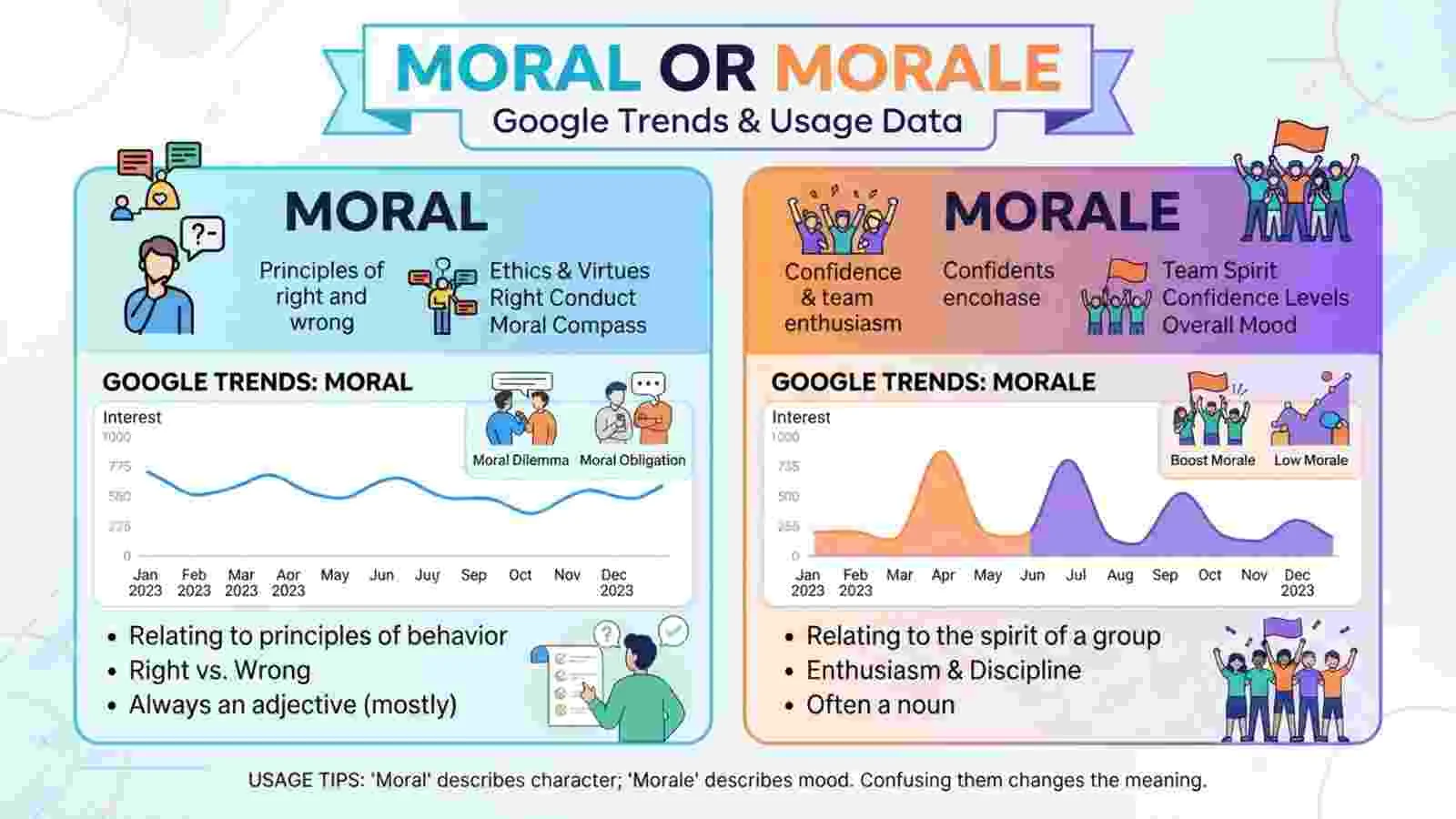
People search for moral or morale because they want to understand the difference, correct a spelling mistake, or choose the right word for a sentence.
However, exact search volumes and country rankings require current keyword research. Without verified live data, it would be misleading to claim that one word is more popular in a particular country.
Search Intent by Keyword
| Search term | Likely search intent | Content that answers it |
| Moral or morale | Understand the difference | Compare meanings and usage |
| Moral meaning | Learn a definition | Explain ethics and life lessons |
| Morale meaning | Learn a definition | Explain confidence and team spirit |
| Moral vs morale examples | Improve writing | Provide example sentences |
| Boost team morale | Workplace advice | Explain ways to improve motivation |
How to Check Google Trends
You can compare the terms using Google Trends.
- Search for moral and morale.
- Select a country, such as Pakistan, the United States, or the United Kingdom.
- Choose a time range, such as the past 12 months.
- Review interest over time and regional interest.
- Explore related queries to learn what people want to know.
Google Trends shows relative search interest rather than exact search volume. Also, moral has several uses, so its search interest may include topics unrelated to the spelling comparison.
For SEO, answer the main question near the start of your article. Include clear definitions, natural examples, common mistakes, and related questions. This helps readers find the answer without searching through unnecessary text.
Moral or Morale – Comparison Table
| Feature | Moral | Morale |
| Main meaning | Ethics, values, or a lesson | Confidence, spirit, or motivation |
| Common use | Moral values, moral duty | Team morale, employee morale |
| Part of speech | Noun or adjective | Noun |
| Example | Honesty is a moral value. | The team’s morale is high. |
| Related word | Ethical | Motivation |
| British spelling | Moral | Morale |
| American spelling | Moral | Morale |
This table gives you a quick way to compare the words and choose the right one for your sentence.
Frequently Asked Questions
1. What Is the Difference Between Moral and Morale?
Moral relates to right and wrong, values, or a lesson. Morale refers to confidence, motivation, and group spirit.
2. Is Moral or Morale Correct?
Both are correct words. The right choice depends on your meaning. Use moral for ethics and lessons, and morale for confidence and motivation.
3. What Is the Moral of a Story?
The moral of a story is the lesson it teaches about life or behavior. For example, a story about honesty may teach readers that telling the truth is important.
4. What Does Team Morale Mean?
Team morale means the confidence, enthusiasm, and motivation shared by a group. High team morale can help people work together and face challenges.
5. Is Morale the Same as Motivation?
Not exactly. Motivation is the desire to act or reach a goal. Morale is the overall spirit, confidence, and emotional outlook of a person or group.
6. Are Moral and Morale Spelled Differently in British and American English?
No. Both words have the same standard spelling in British and American English. Their meanings also remain the same.
7. How Can I Remember Moral vs Morale?
Think of a moral lesson as a lesson about right and wrong. Think of team morale as the team’s spirit and confidence. These phrases help you remember the difference.
8. What does moral mean?
Moral means relating to right and wrong, or the principles that guide good behavior (moral values, a moral choice). As a noun, a moral is the lesson of a story.
9. What does morale mean?
Morale means the confidence, enthusiasm and motivation of a person or a group (high morale, team morale, low morale).
10. How do you spell morale?
M-O-R-A-L-E — morale, with an e at the end. Remember: morale has an extra e, like enthusiasm.
Conclusion
Understanding the difference between moral or morale can make your English writing clearer and more accurate.
Although these words look almost the same, they serve different purposes. Moral relates to right and wrong, ethical values, and lessons that guide behavior.
Morale refers to the confidence, enthusiasm, and motivation of a person or group.
For example, a teacher may discuss moral values with students, while a manager may work to improve employee morale.
Both words are correct, and neither is limited to British or American English. The key is to understand the message you want to express before choosing your word.
When writing essays, reports, emails, or articles, check the context carefully. If the sentence is about honesty, fairness, or a lesson, moral is often the right choice.
If it is about confidence, teamwork, or motivation, use morale. You can also remember common phrases such as moral lesson, moral values, team morale, and employee morale.
With regular practice and attention to context, you can avoid these common mistakes. Learning this small difference will help you communicate with greater confidence in school, at work, and in everyday life.
Continue Reading:
- Governor vs. Garner: Meaning, Spelling, and Usage ( for 2026)
- Calendar vs. Calender: Meaning, Spelling, and Usage ( for 2026)
- Ate vs Eaten: Meaning, Grammar Rules, and Examples ( for 2026)
- Cuter or Cutier: Correct Spelling, Meaning, and Usage ( for 2026)
- Selfs or Selves: Meaning, Grammar, and Examples (for 2026)

Mary Roach is an American science writer and bestselling author known for making unusual and complex scientific topics engaging, accessible, and humorous. Her books include Stiff, Packing for Mars, Gulp, and Fuzz.
Author at Simifind.com, sharing clear, informative content designed to help readers understand interesting topics and everyday questions.




3 thoughts on “Moral vs. Morale: Definitions, Differences, and Examples ( for 2026)”