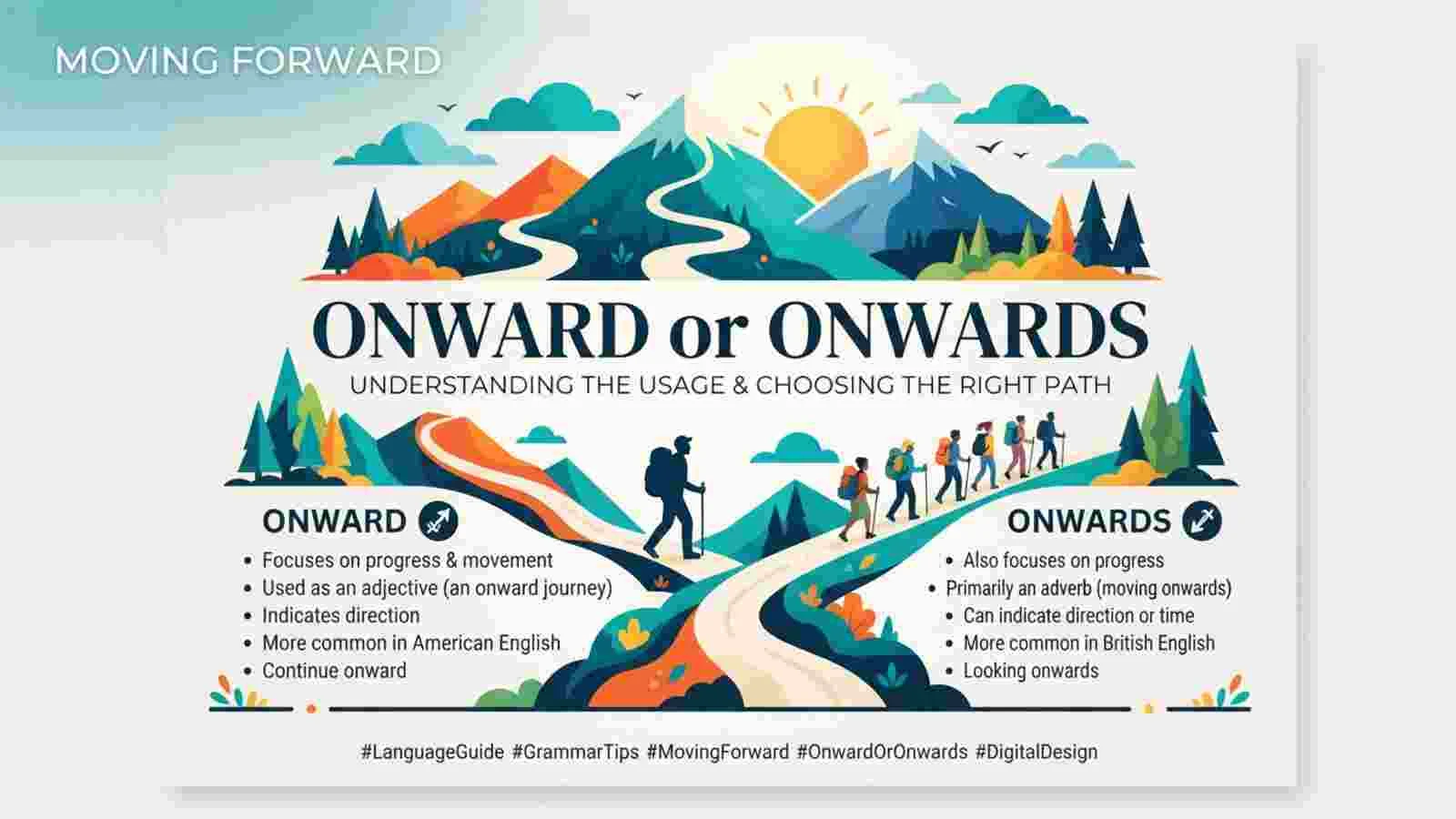
Both onward and onwards are correct and mean the same thing — moving forward or continuing from a point in time. American English often prefers onward; British English often uses onwards. From Monday onward = From Monday onwards.
Have you ever stopped while writing because you were unsure whether to use onward or onwards?
You are not alone. Many English learners and writers ask this question because both words look correct and have almost the same meaning.
The good news is that both forms are accepted in English. The main difference is how people use them in different regions and sentences.
The word onward often means moving forward or continuing from a point in time. Onwards carries the same basic meaning.
For example, you can write, “From Monday onward” or “From Monday onwards.” Both sentences are correct.
However, your choice may depend on your audience, writing style, and location.
American English often favors onward, while British English commonly uses both forms, especially onwards in everyday speech and writing.
In this guide, you will learn the meaning, origin, spelling rules, and common uses of these words.
You will also find examples, a comparison table, and answers to common questions. By the end, you will know which form to use in emails, essays, articles, and formal documents.
Onward or Onwards – Quick Answer
Both onward and onwards are correct. They mean moving forward, continuing, or starting from a particular point in time.
- Onward: We moved onward toward the village.
- Onwards: We moved onwards toward the village.
- From Monday onward: The new rules will apply from Monday onward.
- From Monday onwards: The new rules will apply from Monday onwards.
Both forms are widely understood. The difference is mainly regional and stylistic, rather than a difference in meaning.
Use onward if you prefer a concise style or write mainly for an American audience. Use onwards if it sounds more natural for your British English audience.
The Origin of Onward and Onwards
The word onward comes from Old English roots related to the idea of moving forward. It combines the sense of “on” with a word form meaning toward or in a particular direction.
Over time, onward developed the meaning of moving ahead, continuing a journey, or progressing toward a goal.
The word onwards developed as a related form. The ending -s appears in many English adverbs, such as towards, backwards, and afterwards. These forms often express direction, movement, or the passage of time.
English has changed over many centuries. Different regions have kept or preferred different forms. This is why both onward and onwards remain in modern English.
The two words share the same basic meaning. Neither is a misspelling, and neither is automatically more correct than the other.
British English vs American English Spelling
British and American English often differ in spelling and word choice. The difference between onward and onwards is mainly a matter of preference and usage.
American English often favors onward, especially in expressions about progress, movement, and future plans. British English commonly uses onwards, particularly in expressions such as “from then onwards.”
However, both forms appear in both varieties of English. These are common tendencies, not strict spelling rules.
| Feature | Onward | Onwards |
| Meaning | Forward or continuing | Forward or continuing |
| American English | Common | Also correct |
| British English | Correct | Common |
| Formal writing | Suitable | Suitable |
| Everyday speech | Common | Common |
| Example | From 2027 onward | From 2027 onwards |
Examples in American English
- We will move onward with the project.
- The road continues onward for five miles.
- From January onward, the office will open earlier.
Examples in British English
- We travelled onwards to the next town.
- From Monday onwards, the shop will close at six.
- The talks continued onwards into the evening.
Remember that these examples show common preferences, not exclusive rules. British writers can use onward, and American writers can use onwards.
Which Spelling Should You Use?
The best choice depends on your readers and the type of writing you are doing.
For an American Audience
Choose onward if you want to follow a common American preference.
Examples:
- The company will move onward with its plans.
- From next week onward, all staff must attend the meeting.
This form works well in business writing, news articles, and general communication.
For a British or Commonwealth Audience
Both forms are correct. However, onwards may sound more natural in expressions such as “from this point onwards.”
Examples:
- From tomorrow onwards, the new timetable will apply.
- We continued onwards after lunch.
Writers in countries such as the United Kingdom, Australia, and other Commonwealth countries may encounter both forms.
For Global and SEO Writing
If you write for an international audience, choose one form and use it consistently. Neither word is inherently better for SEO.
For example, if your website mainly targets American readers, onward may be a sensible choice. If it targets British readers, onwards may fit the audience’s language habits.
The most important goals are clarity, natural wording, and consistency.
Common Mistakes with Onward and Onwards
Writers sometimes make errors when choosing between these words. Here are common mistakes and their corrections.
Mistake 1: Thinking Onwards Is Incorrect
Incorrect claim: “Onwards is not a real English word.”
Correction: Both onward and onwards are accepted English words.
Example: “From Tuesday onwards, the office will open at nine.”
Mistake 2: Thinking the Words Have Different Meanings
Some learners believe that onward means movement while onwards means time. This is not a reliable rule.
Both can describe movement or continuation in time.
- The path leads onward.
- The path leads onwards.
- From that day onward, things changed.
- From that day onwards, things changed.
Mistake 3: Changing Forms Without a Reason
Switching between onward and onwards in the same article can make your writing feel inconsistent.
Better approach: Choose the form that fits your audience and use it consistently where possible.
Mistake 4: Using Onward When Another Word Fits Better
Sometimes forward or from now on may sound more natural.
Less natural: “I will onward my work tomorrow.”
Better: “I will continue my work tomorrow.”
Onward is not normally used as a verb. Use continue, move forward, or proceed when you need a verb.
Onward and Onwards in Everyday Examples
Both words appear in daily communication, professional writing, and published content.
In Emails
- From Monday onward, please send all reports to the new email address.
- From Monday onwards, please use the updated form.
Both sentences are correct. Pick the version that matches your preferred style.
In News Writing
- The team will move onward to the next stage of the competition.
- Talks continued onwards after the first round of meetings.
News writers may choose either form based on their publication’s style guide.
On Social Media
- Keep moving onward. Your hard work will pay off.
- The journey continues onwards!
Both forms can express progress, hope, and motivation.
In Formal Writing
- The policy will remain in effect from 1 January onward.
- The policy will remain in effect from 1 January onwards.
Both are suitable. In formal documents, follow the style guide used by your school, company, or publication.
In Academic Writing
- The study examines changes from 2010 onward.
- The study examines changes from 2010 onwards.
Both sentences are grammatical. Make sure your chosen form is used consistently throughout your paper.
Onward or Onwards – Google Trends and Usage Data
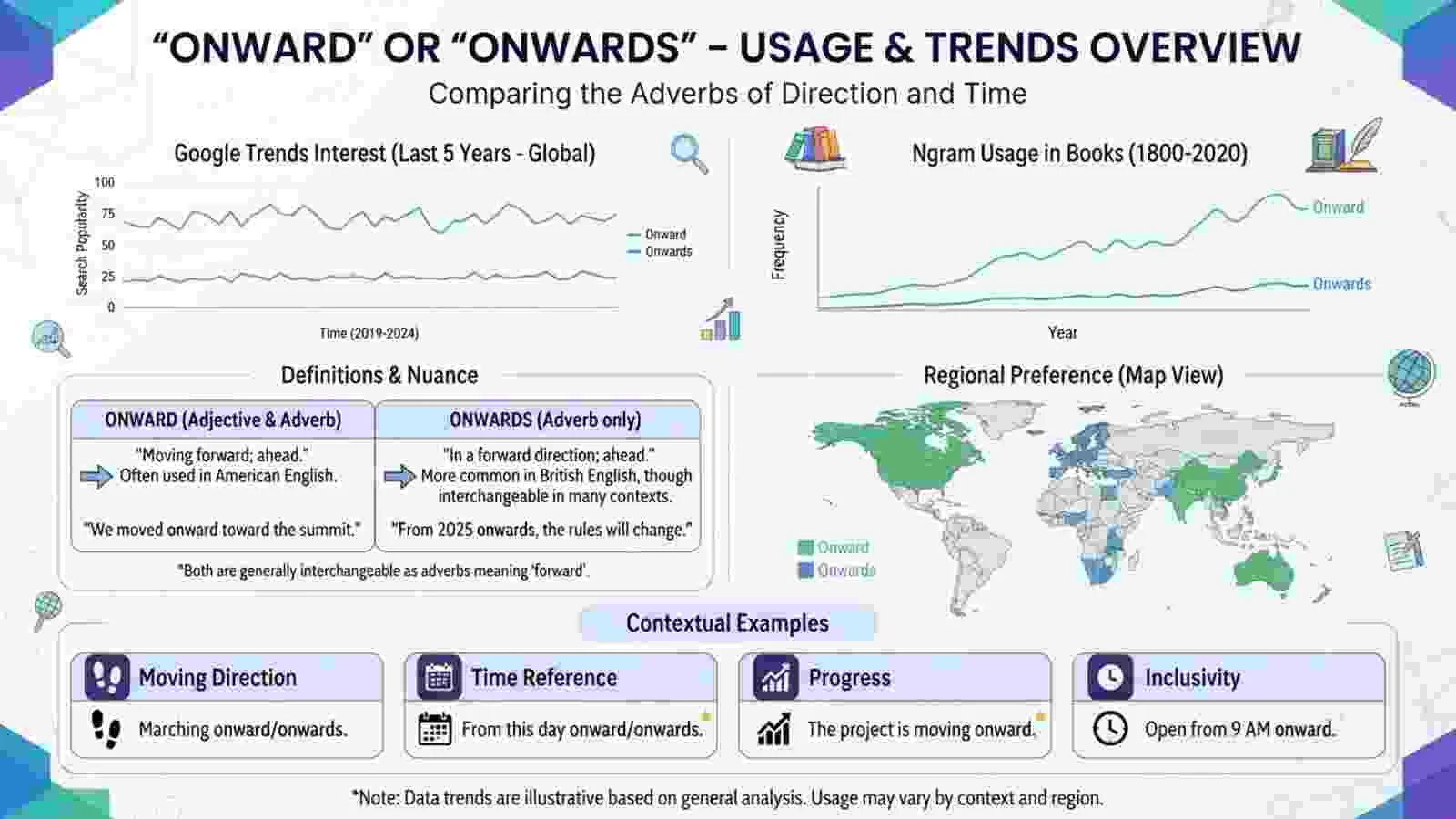
People search for onward or onwards because they want to know which form is correct, whether the words have different meanings, and which spelling fits British or American English.
Search interest can vary by country, writing context, and the questions people ask. However, search frequency alone does not determine whether a word is correct.
A useful distinction is:
- American English: Onward is often preferred.
- British English: Both forms are used, with onwards common in many contexts.
- International English: Either form is understandable and acceptable.
Google Trends can help compare relative search interest by region and over time. It does not provide a complete count of all word usage, and search interest is not the same as frequency in published writing.
To compare the terms, visit Google Trends and search for “onward” and “onwards.” Select your target country and a suitable time range. You can also compare related phrases, such as “from now onward” and “from now onwards.”
For SEO writers, the best approach is to answer the user’s question clearly, explain regional preferences, and use the words naturally rather than repeating them to increase keyword density.
Onward vs Onwards: Comparison Table
| Comparison | Onward | Onwards |
| Part of speech | Adverb; also used before a noun | Adverb |
| Core meaning | Forward or continuing | Forward or continuing |
| Correct spelling | Yes | Yes |
| Common US preference | Often preferred | Also accepted |
| Common UK preference | Accepted | Often preferred in some phrases |
| Time expressions | From June onward | From June onwards |
| Movement | Move onward | Move onwards |
| Formal use | Yes | Yes |
| SEO use | Suitable | Suitable |
Note that onward can also work as an adjective, as in “the onward journey.” Onwards is generally used as an adverb.
Frequently Asked Questions
1. Is Onward or Onwards Correct?
Both are correct. They share the same basic meaning of moving forward or continuing from a point in time.
2. Is Onward American or British English?
Onward is common in American English, but it is also correct in British English. It is not exclusive to either variety.
3. Do British People Say Onwards?
Yes. Onwards is common in British English, especially in phrases such as “from then onwards.” British speakers also use onward.
4. Is Onwards Grammatically Correct?
Yes. Onwards is a standard English adverb. For example, “We continued onwards toward the coast” is grammatically correct.
5. What Is the Difference Between Onward and Onwards?
There is little difference in meaning. Both can refer to movement, progress, or continuation. The main difference is regional preference and style.
6. Should I Write From Now Onward or From Now Onwards?
Both forms are correct. “From now onwards” is common in British English, while “from now onward” may suit an American style. “From now on” is another simple option.
7. Which Word Is Better for Formal Writing?
Neither is automatically better. Use the form that matches your audience and follow any required style guide. Consistency matters more than choosing one form over the other.
8. What does onward mean?
Onward means moving forward or continuing from a point in time.
9. What does onwards mean?
Onwards means the same as onward: moving forward or continuing from a point in time.
Conclusion
Choosing between onward and onwards is simple once you understand that both forms are correct. They share the same basic meaning and can describe movement, progress, or continuation from a point in time.
The main difference is regional preference. American English often favors onward, while British English commonly uses both forms and often uses onwards in phrases such as “from Monday onwards.” These preferences are not strict rules, so you can use either form when the sentence is clear and natural.
For professional writing, consider your audience before making a choice. If you write for an American publication, onward may be the more familiar option. For a British audience, onwards may sound more natural in some expressions. For international readers, either form is suitable.
Most importantly, do not treat onwards as a spelling mistake. Both words are accepted English, and neither has a major advantage for SEO. Choose the form that fits your sentence, keep your style consistent, and focus on making your message easy to understand.
Continue Reading:
- Hooves vs Hoofs: Meaning, Spelling, and Usage ( for 2026)
- Governor vs. Garner: Meaning, Spelling, and Usage ( for 2026)
- Moral vs. Morale: Definitions, Differences, and Examples ( for 2026)
- Cuter or Cutier: Correct Spelling, Meaning, and Usage ( for 2026)
- Teammate vs. Team Mate: Meaning, Spelling, and Usage ( for 2026)

Here’s a concise 2-line author bio suitable for Simifind.com:
James Dashner is an American bestselling author best known for The Maze Runner series and other popular young-adult fiction.
On Simifind.com, he shares clear, engaging insights and helpful content for readers interested in books, writing, and popular literature.








3 thoughts on “Onward vs Onwards: Meaning, Difference, and Usage ( for 2026)”