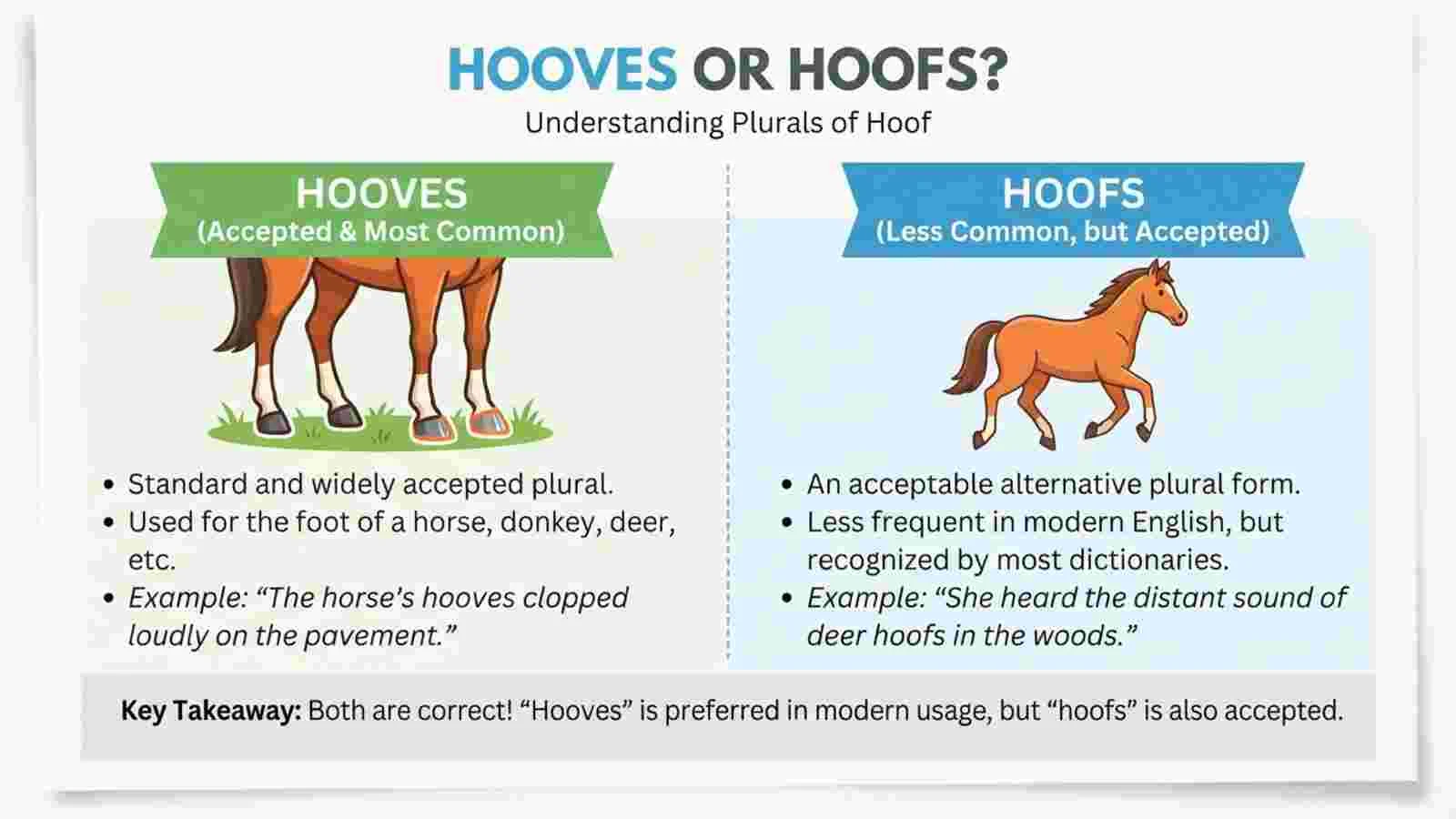
Hooves is correct. Hoofs is also accepted by some dictionaries, but hooves is the standard and far more common plural of hoof. Hooves = the hard feet of horses, cows, deer and similar animals.
Have you ever wondered whether to write hooves or hoofs?
You are not alone. Many people search for these words when writing about horses, cows, sheep, or other animals. Both spellings look correct, but which one should you use?
The good news is that both hooves and hoofs are correct plural forms of hoof. A hoof is the hard part of an animal’s foot. Horses, cows, goats, and deer all have hooves.
When you talk about more than one hoof, you can use either spelling.
However, hooves is the more common choice in modern English. It is widely used in books, schoolwork, animal care guides, and everyday writing.
The word hoofs is also correct, but it may look less familiar to some readers.
This guide explains the difference between hooves and hoofs. You will learn their meanings, origins, spelling rules, and common uses.
You will also find simple examples, a comparison table, and answers to common questions. By the end, you will know which spelling to choose for your audience and writing style.
Hooves or Hoofs – Quick Answer
Both hooves and hoofs are correct plural forms of the noun hoof.
- Hooves: The more common plural spelling.
- Hoofs: An accepted alternative spelling.
- Hoof: The singular form.
Examples:
- The horse has strong hooves.
- The horse has strong hoofs.
- The farmer checked the cow’s hooves.
- The animal left marks from its hoofs in the mud.
For most writing, choose hooves. It is familiar to readers and works well in formal and informal English.
The Origin of Hooves or Hoofs
The word hoof has a long history in English. It comes from Old English hōf, a word used for the hard foot of certain animals.
Over time, English developed different ways to form plural nouns. Many nouns simply add -s, such as book and books. Other nouns use different endings.
The plural of hoof developed two accepted forms: hoofs and hooves. The spelling with -ves follows a pattern seen in other English words, such as:
- Leaf → leaves
- Wolf → wolves
- Calf → calves
- Loaf → loaves
However, not every word ending in -f changes to -ves. For example, roof usually becomes roofs, and chief becomes chiefs.
This is why English spelling can feel confusing. The word hoof allows both plural forms, but hooves is now the more widely used option.
British English vs American English Spelling
British and American English both accept hooves and hoofs. Unlike words such as colour and color, this is not a clear British-versus-American spelling difference.
Writers in both countries can use either form. The main difference is usage and personal preference, not a strict national rule.
| Feature | Hooves | Hoofs |
| Singular form | Hoof | Hoof |
| Plural form | Hooves | Hoofs |
| Correct spelling | Yes | Yes |
| British English | Accepted | Accepted |
| American English | Accepted | Accepted |
| Common usage | More common | Less common |
| Best general choice | Recommended | Acceptable alternative |
Examples in British English
- The farmer cleaned the horse’s hooves.
- The deer left its hoofs in the soft ground.
Examples in American English
- The veterinarian examined the cow’s hooves.
- The horses’ hoofs were covered in mud.
These examples are correct in both varieties of English. If you are writing for a school, newspaper, or website, follow its preferred style guide and use one form consistently.
Which Spelling Should You Use?
The best choice depends on your readers and the type of writing you are doing. Since both spellings are correct, you do not need to worry about making a grammar mistake when choosing either one.
For American Readers
Use hooves in most cases. It is familiar and works well in school assignments, articles, reports, and everyday messages.
Example: The rancher checked the horses’ hooves before the ride.
For British and Commonwealth Readers
Use hooves as your general choice. It is widely understood in the UK and other English-speaking countries. You may also use hoofs when it fits your source or preferred style.
Example: The vet checked the sheep’s hooves for signs of injury.
For Global Websites and SEO Content
Choose hooves for a clear, familiar spelling. It is a good option for animal care guides, educational websites, and general articles.
You can mention hoofs once when explaining the alternative spelling. This helps readers who search for that version find the answer they need.
Professional tip: Consistency matters. Pick one form for your article and use it throughout, unless you are quoting a source that uses the other spelling.
Common Mistakes with Hooves or Hoofs
Writers sometimes make mistakes when forming the plural of hoof. Here are the most common ones and how to correct them.
1. Using Hoofes
Incorrect: The horse has dirty hoofes.
Correct: The horse has dirty hooves.
The standard plural spellings are hooves and hoofs, not hoofes.
2. Assuming Hoofs Is Always Wrong
Incorrect: Hoofs is never a correct English word.
Correct: Both hoofs and hooves are accepted plural forms.
You can use either form, although hooves is more common.
3. Using Hoove as the Singular Form
Incorrect: The cow has a damaged hoove.
Correct: The cow has a damaged hoof.
The singular form is always hoof.
4. Confusing Singular and Plural Possessives
- One animal’s hoof: The horse’s hoof is clean.
- One animal’s hooves: The horse’s hooves are clean.
- Several horses’ hooves: The horses’ hooves are clean.
Use the apostrophe carefully to show ownership.
5. Changing the Spelling Without a Reason
Incorrect: The horse’s hooves were sore. Its hoofs needed care.
Better: The horse’s hooves were sore. Its hooves needed care.
Both plural forms are correct, but using one consistently makes your writing easier to read.
Hooves or Hoofs in Everyday Examples
Both spellings can appear in many types of writing. The examples below show how to use them naturally.
In Emails
Subject: Horse Care Update
Hello,
The farrier checked the horse’s hooves today. They look healthy, and no extra treatment is needed.
Thank you.
In News Articles
The wildlife team found hoof marks near the edge of the forest. Experts believe the marks may belong to a group of deer.
On Social Media
“Happy horses with healthy hooves make every ride better!”
In Formal Writing
Regular hoof care helps prevent pain and supports healthy movement in horses and other hoofed animals.
In Everyday Conversation
- “The horse has very strong hooves.”
- “The mud covered the cow’s hoofs.”
- “The vet checked the animal’s hooves.”
These sentences are grammatically correct. Choose the version that best fits your usual writing style.
Hooves or Hoofs – Google Trends and Usage Data

People may search for hooves or hoofs when checking spelling, writing animal-related content, or completing school assignments. The search usually reflects a need to know whether one form is wrong.
In general English usage, hooves is the more common form. Hoofs remains a valid alternative.
Search interest can vary by country and topic. People who read horse-care guides, veterinary resources, farming articles, or wildlife reports may encounter both spellings.
However, exact search popularity by country requires current Google Trends data. Without a verified Trends comparison, it would be misleading to claim exact search volumes or state that one country strongly prefers a particular spelling.
For SEO content, consider these related keyword variations:
| Keyword variation | Search intent | Recommended use |
| Hooves or hoofs | Spelling comparison | Main keyword |
| Hooves meaning | Definition | Explain the word |
| Hoofs meaning | Alternative spelling | Clarify the plural |
| Plural of hoof | Grammar question | Give the direct answer |
| Is hoofs correct? | Spelling check | Confirm both forms |
| Hooves in a sentence | Usage examples | Provide examples |
| Hoof or hooves | Singular and plural | Explain the difference |
Use the main keyword naturally in your title, introduction, headings, and conclusion. Add related terms where they help answer readers’ questions. Avoid repeating the same phrase too often.
Frequently Asked Questions
1. Is it hooves or hoofs?
Both spellings are correct. Hooves is more common, so it is usually the best choice for general writing.
2. What is the plural of hoof?
The plural of hoof can be hooves or hoofs. Both forms are accepted in standard English.
3. Is hoofs grammatically correct?
Yes. Hoofs is a correct plural form of hoof. It is less common than hooves, but it is not a spelling mistake.
4. Why does hoof become hooves?
English has several plural spelling patterns. Some nouns ending in -f change to -ves in the plural. Hoof follows this pattern, but it also keeps the alternative plural form hoofs.
5. Do British people use hooves or hoofs?
Both forms are accepted in British English. Hooves is a good general choice, but hoofs is also correct.
6. Do Americans spell it hooves or hoofs?
American English accepts both spellings. Hooves is the more familiar choice for most general writing.
7. Can I use hooves and hoofs in the same article?
Yes, but it is usually better to choose one form and use it consistently. Use the other form when discussing spelling differences or quoting a source.
8. What does hooves mean?
Hooves are the hard, horny feet of animals like horses, cows, deer and goats — hooves is the plural of hoof.
9. How do you spell hooves?
Spell it H-O-O-V-E-S: hooves, from hoof with f changed to v and -es added.
10. What is the difference between hooves and hoofs?
There is no difference in meaning — both are correct plurals of hoof. The only difference is spelling and frequency: hooves is the standard and far more common form.
Conclusion
The choice between hooves or hoofs is simple once you know the rule. Both words are correct plural forms of hoof, which means the hard foot of an animal such as a horse, cow, goat, or deer.
The spelling hooves is more common in modern English. It is a strong choice for schoolwork, professional reports, blog posts, news articles, and animal care guides. The spelling hoofs is also correct and can be used when it matches your preferred style or source.
There is no strict rule that makes hooves British English and hoofs American English, or the other way around. Both spellings are accepted in both varieties.
If you are unsure which one to choose, remember this simple tip: use hooves for most writing. It is clear, familiar, and easy for readers to understand. Keep your spelling consistent, check your style guide when needed, and focus on making your message easy to read.
Whether you write about a horse’s hooves or a cow’s hoofs, your meaning will be clear. The important thing is to use the correct singular form, understand both plural options, and write with confidence.
Continue Reading:
- Governor vs. Garner: Meaning, Spelling, and Usage ( for 2026)
- Moral vs. Morale: Definitions, Differences, and Examples ( for 2026)
- Honoured vs Honored: Meaning, Spelling, and Usage ( for 2026)
- Cuter or Cutier: Correct Spelling, Meaning, and Usage ( for 2026)
- Selfs or Selves: Meaning, Grammar, and Examples (for 2026)

Mary Roach is an American science writer and bestselling author known for making unusual and complex scientific topics engaging, accessible, and humorous. Her books include Stiff, Packing for Mars, Gulp, and Fuzz.
Author at Simifind.com, sharing clear, informative content designed to help readers understand interesting topics and everyday questions.








3 thoughts on “Hooves vs Hoofs: Meaning, Spelling, and Usage ( for 2026)”