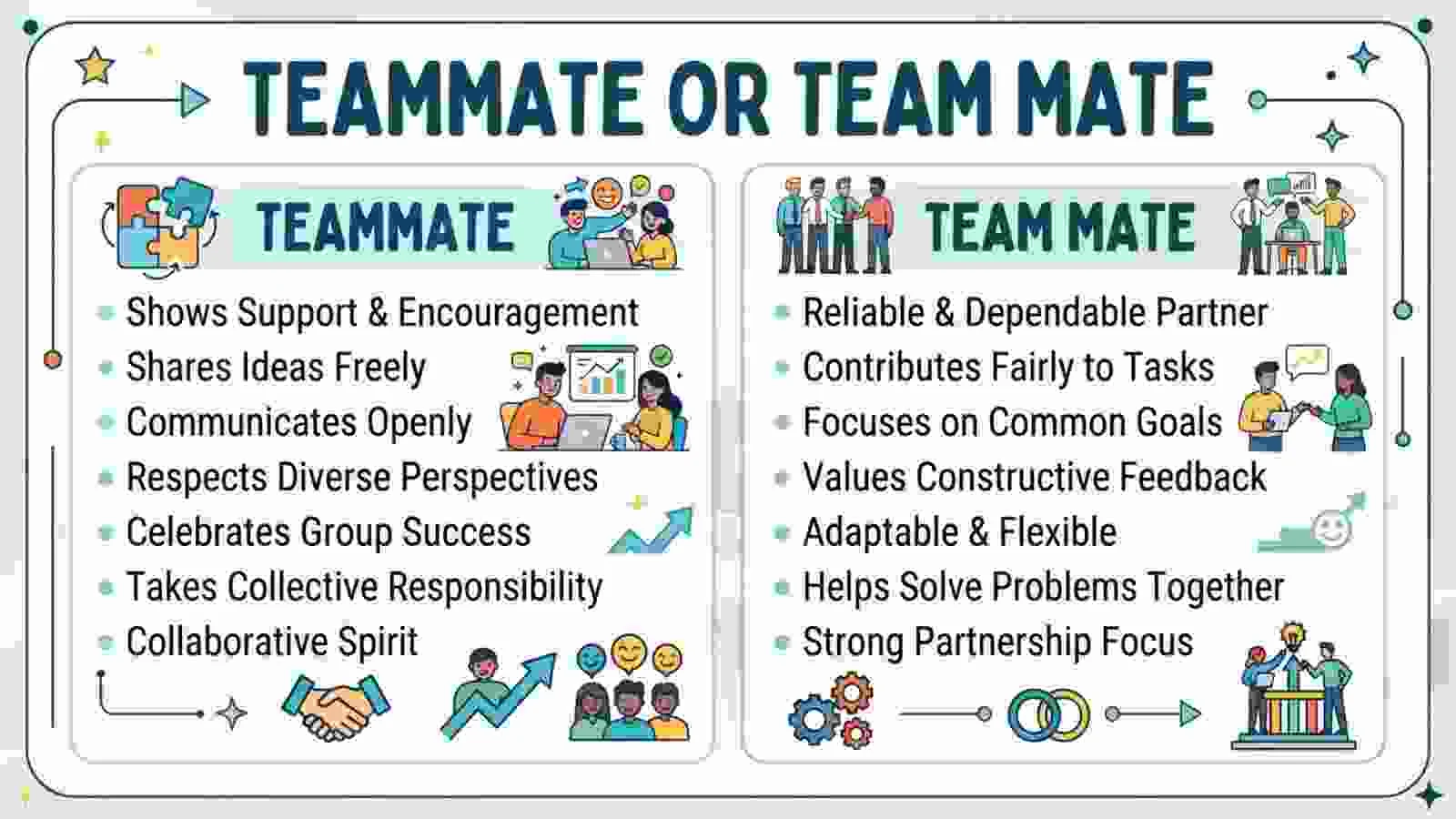
Teammate (one word) is the most common spelling. Team mate (two words) is also correct and means the same thing — a person on the same team as you. Use teammate for most readers.
Have you ever written the word teammate and wondered if it should be two words: team mate?
You are not alone. Many people search for teammate or team mate because both forms look correct. They also appear in writing, online posts, sports news, and daily chats.
The good news is that both spellings are used in English. However, teammate is the more common form, especially in American English.
The two-word form, team mate, is also correct and may appear in British English and other English-speaking regions.
This small spelling choice can cause confusion when you write a school paper, work email, sports report, or social media post.
You may want to know which form is best for your readers. You may also wonder whether one spelling is wrong.
In this guide, you will learn the meaning, origin, spelling rules, and correct use of both forms. We will also compare American and British English, share simple examples, and answer common questions.
By the end, you will know which spelling to choose and how to use it with confidence.
Teammate or Team Mate – Quick Answer
Both teammate and team mate are correct. They have the same meaning: a person who belongs to the same team as another person.
- Teammate: The more common one-word spelling, especially in American English.
- Team mate: A correct two-word form that is also used in British and other varieties of English.
Examples:
- My teammate helped me win the match.
- My team mate helped me win the match.
Both sentences are correct. The meaning does not change.
For most readers, teammate is the simplest choice. Use team mate if your style guide or publication prefers the two-word form.
The Origin of Teammate or Team Mate
This word teammate comes from two words: team and mate.
The word team refers to a group of people who work or play together.
The word mate means a friend, partner, or companion. When these words join, they describe someone who belongs to the same group.
The word mate has old roots in Germanic languages. Over time, English speakers began using it to describe friends and partners. The word team also has a long history in English and first referred to a group working together, including animals used for work.
As English developed, people began joining words to make new terms. This process is called compounding. Words such as classmate, roommate, and teammate follow this pattern.
Some compound words are written as one word. Others use a space or a hyphen. This is why teammate and team mate can both appear in English.
Today, the one-word spelling is widely used, especially in American writing. The two-word spelling remains understandable and accepted in many contexts.
British English vs American English Spelling
British and American English often use different spellings. For example, British English uses colour, while American English uses color. However, the difference between teammate and team mate is not a strict national rule.
Both forms appear in English-language writing. American English generally favors teammate, while team mate is also found in British English and other varieties.
Comparison Table
| Feature | Teammate | Team mate |
| Spelling | One word | Two words |
| Meaning | A member of the same team | A member of the same team |
| American English | Very common | Less common |
| British English | Used | Also used |
| Grammar | Noun | Noun phrase |
| Example | My teammate scored. | My team mate scored. |
| Best use | General and professional writing | When preferred by a style guide |
Which Form Is More Common?
The one-word form, teammate, is widely used in modern English. It is especially common in American sports reports, workplace writing, and online content.
The two-word form, team mate, is also understood. However, readers may see it less often in many modern publications.
Remember that spelling preferences can vary by publisher, region, and writing style. Neither form changes the meaning of the sentence.
Which Spelling Should You Use?
Your choice depends on your audience and the type of writing you are doing.
For American Readers
Use teammate. It is the familiar and widely used spelling in American English.
Example: My teammate shared the project notes with me.
For British and Commonwealth Readers
Both teammate and team mate may be understood. Check the spelling used by your school, employer, newspaper, or publisher.
Example: Every team mate played an important role.
For Global English
Choose teammate if you want a simple, widely recognized form. It works well for websites, blogs, business emails, school assignments, and general communication.
For SEO Content
If your target keyword is teammate or team mate, include both forms naturally in your article. Use the main spelling consistently in headings and body text. Explain that both have the same meaning.
Do not repeat either form too often just to improve rankings. Clear and helpful writing is more important than keyword repetition.
Common Mistakes with Teammate or Team Mate
Writers sometimes make simple mistakes when using these words. Here are the most common ones.
1. Thinking Team Mate Is Always Wrong
Incorrect idea: Team mate is never correct.
Correction: Both forms are used in English. Teammate is generally the safer choice for modern general writing.
2. Changing the Meaning
Some writers think teammate means a close friend, while team mate means only a person on a team.
This is not correct. Both forms have the same basic meaning.
3. Using a Hyphen Without a Reason
Example: My team-mate helped me.
This form is less common than teammate and team mate. Follow your style guide if it uses a hyphen.
4. Writing Teammate as Two Words in Every Sentence
Using team mate is not a serious grammar error. However, changing between teammate and team mate without a reason can make your writing look inconsistent.
Choose one form and use it throughout the same piece of writing.
5. Confusing Teammate with Teammates
Use teammate for one person and teammates for two or more people.
- Singular: My teammate is kind.
- Plural: My teammates are kind.
Teammate or Team Mate in Everyday Examples
Both spellings can be used in many types of writing. The examples below show how the word works in daily life.
In Emails
“Hi Sarah, my teammate will send you the report this afternoon.”
This sentence is clear and professional. It tells the reader that another person from the same team will send the report.
In Sports News
“The captain praised every teammate after the final match.”
Sports reports often use teammate when describing players who work together.
On Social Media
“Great game today! Proud of every teammate on our team.”
This short sentence works well for a sports post or team photo.
In Formal Writing
“Each teammate contributed to the success of the research project.”
The one-word form fits formal writing, school essays, and workplace reports.
In British-Style Writing
“She thanked her team mate for the support.”
This sentence is also understandable and correct. Use the form preferred by your publication or organization.
Teammate or Team Mate – Google Trends and Usage Data
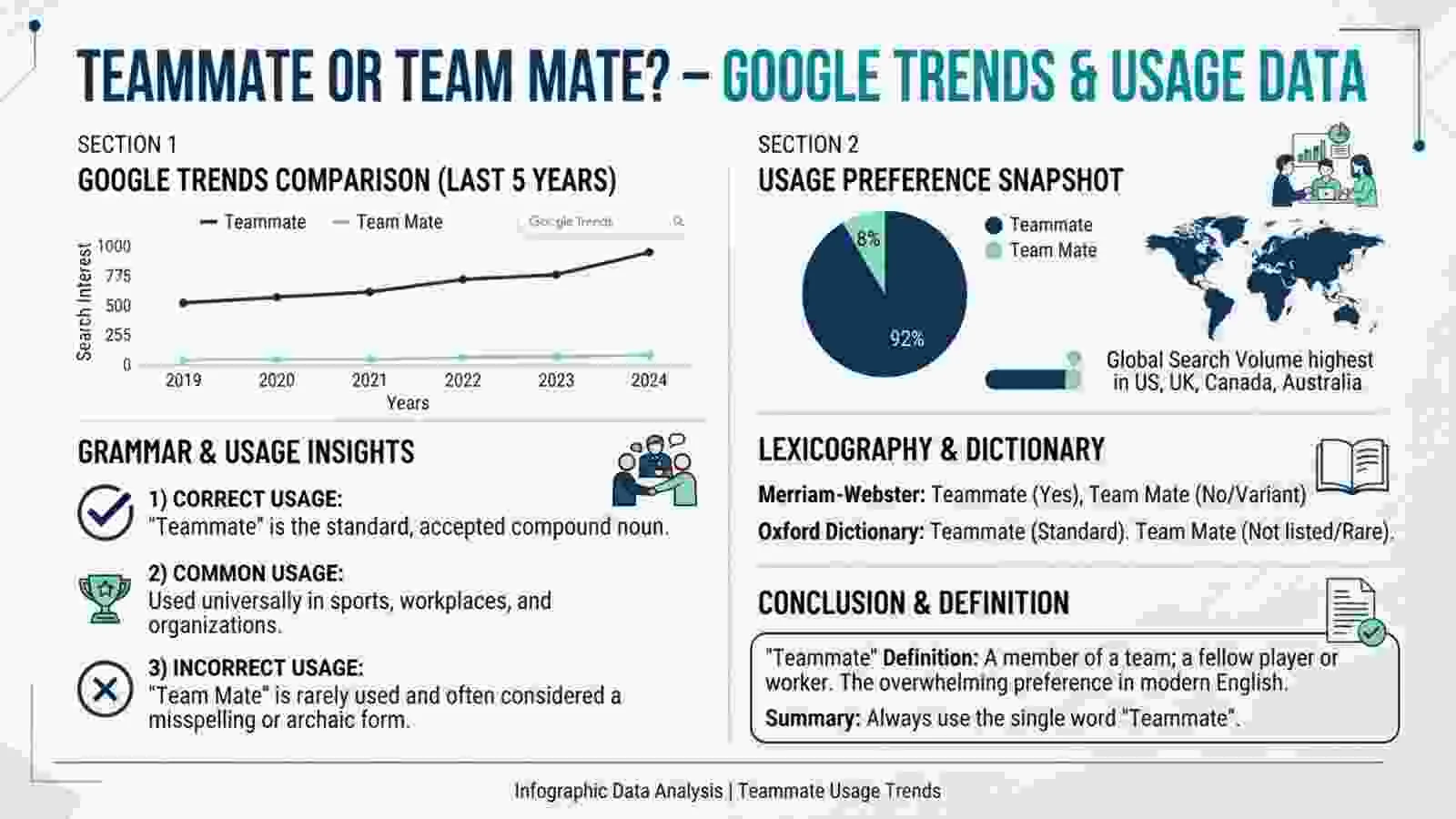
People may search for teammate or team mate when they want to check spelling, meaning, or regional usage. The question is common because English compound words do not all follow one spelling pattern.
However, exact popularity by country should be checked with current search data. Without a verified Google Trends comparison, it would be misleading to give exact search volumes or claim that one country always prefers a specific form.
What Influences Search Interest?
Several factors can affect which spelling people search for:
- Country: Local spelling habits may influence word choice.
- Sports: Players and fans often use the word when discussing team members.
- Workplaces: Employees may use it when writing about colleagues.
- Education: Students may search for the correct spelling in essays.
- SEO: Writers may compare both forms to understand search intent.
How to Check Google Trends
You can compare both spellings directly using Google Trends.
- Visit Google Trends.
- Enter teammate and team mate as separate search terms.
- Select the country you want to study.
- Choose a time range, such as the past 12 months.
- Compare interest over time and by region.
Google Trends reports relative search interest, not exact search volume. Its results can also change with the selected country, date range, and search category.
For SEO purposes, use both spellings naturally, but favor teammate as the main form for broad English-language content.
Teammate vs Team Mate: Comparison Table
| Word or phrase | Meaning | Example |
| Teammate | A person on your team | My teammate is helpful. |
| Team mate | A person on your team | My team mate is helpful. |
| Teammates | More than one team member | My teammates are ready. |
| Team members | People who belong to a team | The team members met today. |
| Colleague | A person you work with | My colleague checked the report. |
| Partner | A person who works with you | My partner finished the task. |
Although teammate and team mate have the same meaning, colleague and partner may have different meanings depending on the situation.
For example, a colleague may work in another department, while a teammate usually belongs to the same team or group.
FAQs About Teammate or Team Mate
1. Is teammate one word or two?
Teammate is one word. Team mate is also used as a two-word form. Both refer to a person on the same team.
2. Is teammate or team mate correct in British English?
Both forms are used in British English. Check your publication’s style guide to choose the preferred form.
3. Which spelling is correct in American English?
Teammate is the more common choice in American English. It is suitable for most general and professional writing.
4. Does teammate mean the same as team mate?
Yes. Both forms have the same basic meaning. The difference is in spelling, not meaning.
5. Is team-mate correct?
The hyphenated form team-mate appears in some writing, but it is less common than teammate and team mate. Follow your chosen style guide.
6. What is the plural of teammate?
The plural is teammates. For example: “My teammates helped me prepare for the match.”
7. Which spelling is best for SEO?
Use teammate as your main spelling for broad English-language content. Include team mate naturally when discussing spelling differences and related searches.
8. What does teammate mean?
Teammate means a person who belongs to the same team as another person.
9. Is teammate a real word?
Yes, teammate is a real English word. It is the common one-word spelling for a person on the same team.
10. Teammate or team mate — which is correct?
Both are correct, but teammate is the most common spelling, so use teammate for most readers.
Conclusion
Choosing between teammate and team mate is simple once you know the main rule. Both forms refer to a person who belongs to the same team as another person. Their meaning stays the same, even though the spelling looks different.
The one-word form, teammate, is widely used in modern English and is especially common in American English. It is a strong choice for blogs, business emails, school essays, sports reports, and professional documents.
The two-word form, team mate, is also used and understood in British English and other English-speaking settings. It may be the right choice when a publisher, teacher, or employer prefers it.
For most writers, the best advice is to use teammate and keep your spelling consistent. If you write for a specific country or publication, check its style guide before making your final choice.
For SEO content, mention both forms in a natural way so readers can find the answer they need. Focus on clear examples, correct grammar, and helpful information instead of repeating keywords.
In short, both spellings work, but teammate is the best general choice for most modern writing.
Continue Reading:
- Onward vs Onwards: Meaning, Difference, and Usage ( for 2026)
- Hooves vs Hoofs: Meaning, Spelling, and Usage ( for 2026)
- Governor vs. Garner: Meaning, Spelling, and Usage ( for 2026)
- Cuter or Cutier: Correct Spelling, Meaning, and Usage ( for 2026)
- Selfs or Selves: Meaning, Grammar, and Examples (for 2026)

Here’s a concise 2-line author bio suitable for Simifind.com:
James Dashner is an American bestselling author best known for The Maze Runner series and other popular young-adult fiction.
On Simifind.com, he shares clear, engaging insights and helpful content for readers interested in books, writing, and popular literature.








3 thoughts on “Teammate vs. Team Mate: Meaning, Spelling, and Usage ( for 2026)”