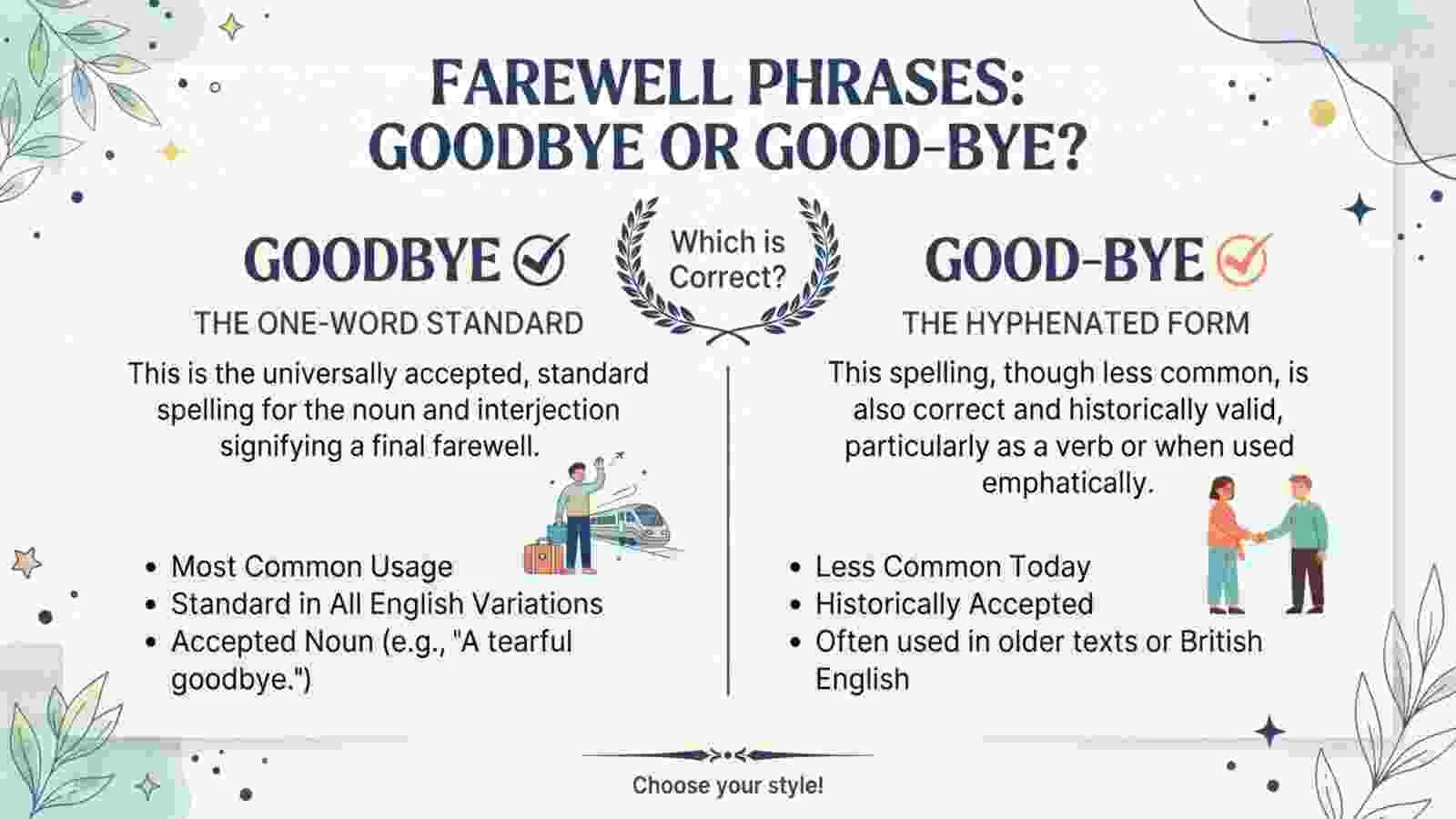
Both goodbye and good-bye are correct and mean the same thing — a farewell. Goodbye (one word) is the most common spelling in modern writing. Good-bye (hyphenated) is the older form and is still correct. ‘Good bye’ (two words) is not the standard spelling.
Have you ever wondered whether to write goodbye or good bye?
You may see both forms in books, messages, or online posts. This can make it hard to know which spelling is correct.
The good news is that the answer is simple. Goodbye is the standard spelling in modern English.
People often search for this phrase because they want to write clear emails, text messages, school assignments, or formal letters.
They may also wonder if British and American English use different spellings. In most cases, they do not. Both varieties of English use goodbye as the normal form.
The phrase comes from an older expression used when people parted. Over time, the words joined to form the single word we use today.
The two-word form, good bye, still appears in some older texts or creative writing, but it is not the usual choice in modern English.
In this guide, you will learn the difference between goodbye and good bye, explore their history, and see examples of correct usage.
You will also learn which spelling to use in professional writing and everyday conversations.
Goodbye or Good Bye – Quick Answer
Goodbye is the correct and widely accepted spelling in modern English. It is written as one word.
Use goodbye in emails, text messages, letters, stories, and formal documents.
Examples:
- Correct: She waved goodbye to her friends.
- Correct: I said goodbye before leaving.
- Less common: She waved good bye to her friends.
The two-word form, good bye, is uncommon in modern writing. Unless you are quoting an older text or following a special creative style, choose the one-word spelling.
Quick Comparison Table
| Form | Status | Example |
| Goodbye | Standard | We said goodbye at the door. |
| Good bye | Uncommon | He whispered good bye. |
| Good-bye | Older or stylistic form | She wrote a final good-bye. |
Easy rule: When you mean a farewell, write goodbye as one word.
The Origin of Goodbye
The word goodbye has an interesting history. It began as a longer expression used when people parted ways.
The expression developed from “God be with ye,” which meant that God should stay with and protect the person leaving. Over time, people shortened the phrase in everyday speech.
By the 16th and 17th centuries, forms such as God be with you and God b’wy were used. These forms gradually changed into the familiar word goodbye.
The spelling also changed over time. The word good became part of the modern spelling, likely influenced by other farewell expressions, such as good day and good evening.
This history helps explain why people sometimes write good bye as two words. The original expression contained several separate words, so the older forms can seem natural.
However, modern English treats goodbye as a single word. It functions as a noun or an interjection.
Examples:
- Noun: Their goodbye was short but warm.
- Interjection: Goodbye! See you tomorrow.
Today, the one-word spelling is the safest and most natural choice.
British English vs American English Spelling
British English and American English often differ in spelling. For example, British English uses colour, while American English uses color. However, goodbye is standard in both varieties.
There is no major British-American spelling difference for this word. Writers in the United Kingdom, the United States, Canada, and Australia commonly use goodbye.
British and American Comparison Table
| Feature | British English | American English |
| Standard spelling | Goodbye | Goodbye |
| Two-word form | Good bye (uncommon) | Good bye (uncommon) |
| Hyphenated form | Good-bye (older or stylistic) | Good-bye (older or stylistic) |
| Common phrase | Say goodbye | Say goodbye |
| Example | She said goodbye to her teacher. | She said goodbye to her teacher. |
Why Do People Confuse the Spellings?
The confusion often comes from the word’s history. People may think good bye should remain two words because it resembles a phrase.
Others may have seen the hyphenated form good-bye in older books. These forms can still appear, but they are not the usual choice in modern writing.
For schoolwork, business communication, and online content, use goodbye.
Which Spelling Should You Use?
The best spelling depends on your audience and the type of writing. In this case, the choice is easy because goodbye works across major English varieties.
For American Readers
Use goodbye in school assignments, emails, reports, and personal messages.
Example: I said goodbye to my coworkers after the meeting.
For British and Commonwealth Readers
Use goodbye in the same way. British English does not require a different spelling.
Example: She waved goodbye before boarding the train.
For Global English
If you write for an international audience, choose goodbye. It is familiar, clear, and widely accepted.
Example: Thank you for your help. Goodbye, and have a great day!
For Formal Writing
Use goodbye in professional emails, reports, letters, and other formal documents. You may choose a more specific closing, such as Kind regards or Sincerely, depending on the situation.
Example:
Dear Mr. Smith,
Thank you for your time and support.
Kind regards,
Anna
In a personal letter, Goodbye may be suitable. In a business email, a professional sign-off is often better.
Common Mistakes with Goodbye or Good Bye
Writers sometimes use different forms because they are unsure of the spelling. Here are common mistakes and how to correct them.
Mistake 1: Writing Good Bye as Two Words
Incorrect or less common: We said good bye after lunch.
Preferred: We said goodbye after lunch.
Use one word in normal modern English.
Mistake 2: Adding a Hyphen Without a Reason
Less common: He gave me a good-bye before leaving.
Preferred: He said goodbye before leaving.
The hyphenated form may appear in older or stylistic writing, but the one-word form is more common.
Mistake 3: Confusing Goodbye with Good Night
These expressions do not always mean the same thing.
- Goodbye: Used when parting.
- Good night: Often used when leaving at night or before someone goes to sleep.
Example: She said goodbye to her guests and wished them good night.
Mistake 4: Using Goodbye as an Email Sign-Off in Every Situation
Although Goodbye is correct, it may sound too direct in a professional email.
Instead, consider:
- Best regards
- Kind regards
- Sincerely
- Thank you
Choose a closing that matches your relationship with the reader.
Mistake 5: Assuming British and American English Differ
Both British and American English normally use goodbye. You do not need to change the spelling for either audience.
Goodbye or Good Bye in Everyday Examples
Seeing the word in real situations can help you remember the correct form.
In Emails
Professional writing often uses a polite closing instead of the word goodbye.
Example:
Thank you for your help with this project. I look forward to speaking with you again.
Best regards,
James
For a less formal email, you could write:
It was great working with you. Goodbye, and take care!
In News Writing
News stories may use goodbye when describing a person’s departure or retirement.
Example: The longtime coach said goodbye to the team after his final match.
On Social Media
The word is common in posts, comments, and captions.
Examples:
- Saying goodbye to an amazing year!
- Goodbye, summer. Hello, autumn!
- It is never easy to say goodbye to old friends.
In Formal Writing
Formal writing often uses more specific wording.
Example: The director announced her departure after ten years with the company.
This sounds more professional than saying that the director said goodbye.
In Stories and Personal Messages
The word works well in emotional or personal writing.
Examples:
- He said goodbye with a smile.
- Their final goodbye brought tears to her eyes.
- I will never forget the day we said goodbye.
Goodbye or Good Bye – Google Trends & Usage Data
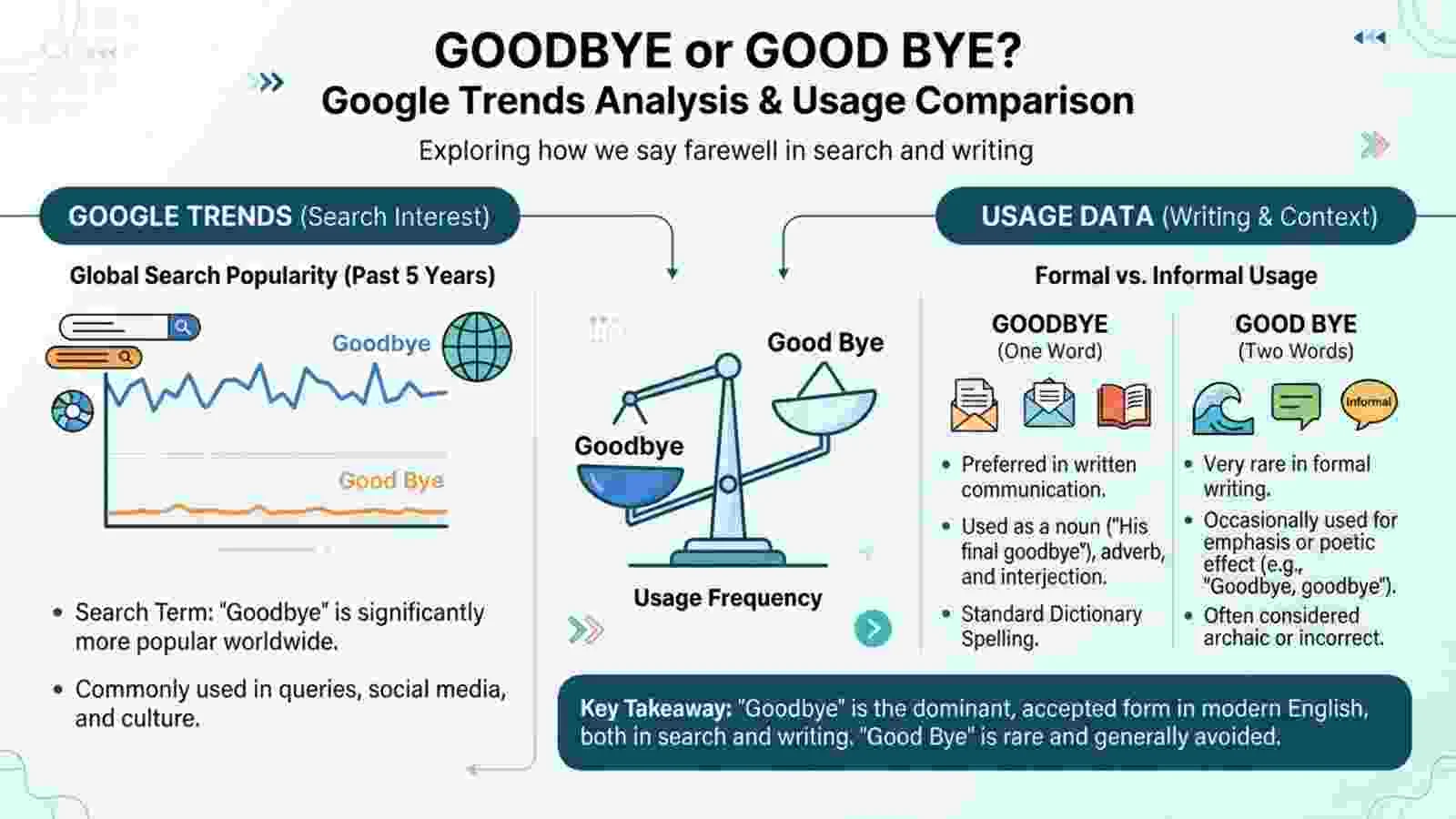
People may search for goodbye or good bye when they want to check spelling, improve their English, or write a message correctly.
Search interest can come from several situations:
- Students checking the correct spelling.
- Professionals writing emails and letters.
- Bloggers creating language and grammar content.
- English learners comparing common expressions.
- People writing farewell messages for friends or family.
Popularity by Country
The spelling goodbye is standard in American, British, Canadian, and Australian English. Searches for the alternative good bye may occur in any of these countries because people want to check whether the phrase should be one word or two.
However, exact search volumes and country rankings can change over time. Without current Google Trends data, it would be misleading to claim that one country searches for this phrase more than another.
You can compare regional interest using Google Trends by entering goodbye and good bye, selecting a country, and choosing a time range.
Search Intent
The main search intent is informational. Most readers want a quick answer about spelling.
For SEO content, the best approach is to answer the question at the beginning, explain the history, compare the forms, and provide clear examples. This helps readers find the answer quickly while giving them enough detail to understand the rule.
Comparison Table: Goodbye and Its Variations
| Word or Phrase | Meaning or Use | Recommendation |
| Goodbye | A farewell | Best standard choice |
| Good bye | An uncommon two-word form | Avoid in normal writing |
| Good-bye | Older or stylistic spelling | Use only when appropriate |
| Farewell | A more formal or emotional farewell | Useful in formal or literary writing |
| See you later | An informal expression | Good for casual conversations |
| Take care | A warm, friendly closing | Good for messages and emails |
| Bye | A short, casual farewell | Best for informal situations |
This table shows that goodbye is not the only way to end a conversation. The right choice depends on tone, audience, and context.
FAQs About Goodbye or Good Bye
1. Is goodbye or good bye correct?
Goodbye is the standard spelling in modern English. The two-word form is uncommon and usually unnecessary.
2. Is goodbye one word or two words?
It is normally written as one word: goodbye. This is the preferred spelling in everyday and professional writing.
3. Do British people write good bye?
British English generally uses goodbye as one word. The standard spelling is the same in American English.
4. Is good-bye also correct?
The hyphenated form good-bye appears in older texts and some stylistic writing. However, goodbye is the more common modern form.
5. Why is goodbye written as one word?
The word developed from the older expression “God be with ye.” Over time, the expression became shorter and eventually formed the single word goodbye.
6. Can I use goodbye in a formal email?
Yes, but it may sound too direct in some professional settings. Closings such as Kind regards or Sincerely are often more suitable.
7. What is another word for goodbye?
Common alternatives include farewell, bye, see you later, and take care. Choose one based on the situation and the level of formality.
8. Goodbye or good-bye — which is correct?
Both are correct, but goodbye is the standard spelling in modern writing. Good-bye is the older hyphenated form and is still correct; use goodbye for most writing.
9. What does goodbye mean?
Goodbye means farewell — it is the word you say when you or someone else is leaving, e.g. ‘She waved goodbye to her friends.’
10. What is the difference between goodbye and good-bye?
There is no difference in meaning — both mean a farewell. Goodbye is the modern one-word spelling; good-bye is the older hyphenated form.
11. How do you spell goodbye?
Spell it G-O-O-D-B-Y-E, as one word. Remember it comes from ‘God be with ye’ — goodbye.
Conclusion
When choosing between goodbye or good bye, the best option is clear. Use goodbye as one word in modern English.
It is the standard spelling in both British and American English, and it works well in most everyday situations.
The two-word form good bye may appear in older texts or unusual writing styles, while good-bye is an older or stylistic variant. Neither is needed for normal modern writing.
Remember that the right farewell also depends on your audience. You can use goodbye in personal messages, stories, and casual conversations.
In professional emails, a closing such as Kind regards or Sincerely may sound more natural.
If you are writing for a website, school assignment, or international audience, choose goodbye for clear and consistent spelling. You do not need separate British and American versions.
The easiest way to remember the rule is simple: write goodbye as one word. This choice keeps your writing natural, professional, and easy to understand.
Continue Reading:
- Tardies vs Tardys: Meaning, Spelling, and Usage ( for 2026)
- Autumn or Fall: Meaning, Usage, and Differences ( for 2026)
- Teammate vs. Team Mate: Meaning, Spelling, and Usage ( for 2026)
- Cuter or Cutier: Correct Spelling, Meaning, and Usage ( for 2026)
- Selfs or Selves: Meaning, Grammar, and Examples (for 2026)

Mary Roach is an American science writer and bestselling author known for making unusual and complex scientific topics engaging, accessible, and humorous. Her books include Stiff, Packing for Mars, Gulp, and Fuzz.
Author at Simifind.com, sharing clear, informative content designed to help readers understand interesting topics and everyday questions.



3 thoughts on “Goodbye or Good Bye: Definition, Origin, and Usage ( for 2026)”