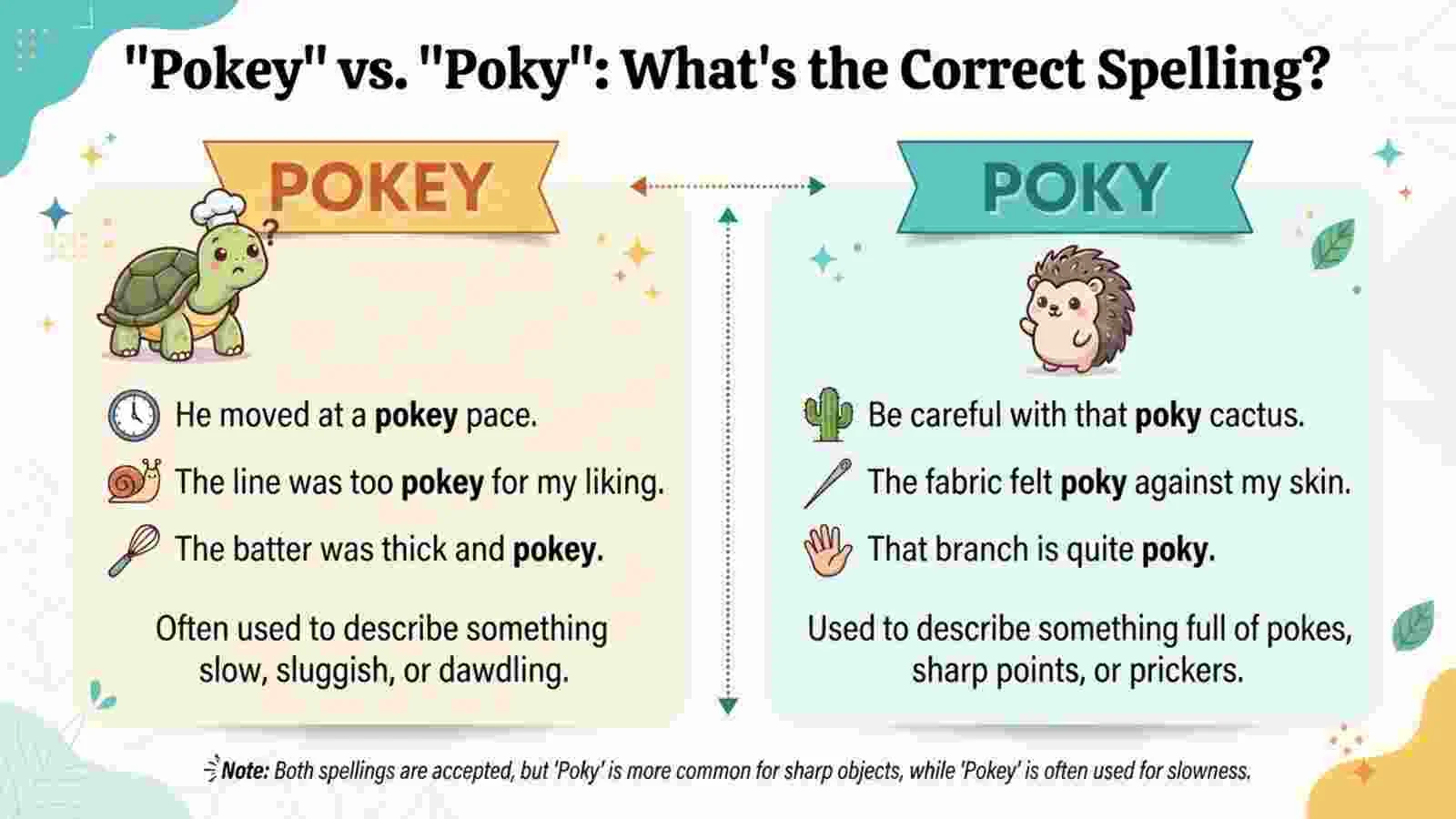
Poky is correct and the standard spelling — it means slow, or (for a horse) slow-moving and lazy. Pokey is a common variant spelling, also used as a nickname and in the phrase ‘the pokey’ (slang for prison). In normal writing, use poky.
Have you ever stopped while writing because you were unsure whether to use pokey or poky?
You are not alone. Many people search for these words because they look almost the same but may follow different spelling habits.
If you want to describe a slow person, a small room, or a place that feels cramped, choosing the right word can be confusing.
The good news is that both pokey and poky are correct spellings. They have the same basic meaning in many contexts.
The main difference is regional spelling and personal writing style. In American English, poky is often the preferred spelling, while pokey is also widely used.
Both forms can describe something small, cramped, or slow.
This guide explains the meaning, origin, and correct use of pokey and poky.
You will learn how British and American English treat these words, see simple examples, and discover which spelling works best for your readers.
We will also cover common mistakes, everyday usage, and frequently asked questions. By the end, you will know how to choose the right spelling with confidence.
Pokey or Poky – Quick Answer
Pokey and poky are both correct. They can mean small, cramped, slow, or lacking speed. The spelling you choose may depend on your audience and preferred style.
- Poky: A common spelling in American English.
- Pokey: Another accepted spelling, often used in informal writing.
Examples
- The room was too poky for our family.
- We stayed in a pokey little hotel.
- He walked at a poky pace.
- The old car was slow and pokey.
Both spellings work in these sentences. However, it is best to choose one form and use it consistently throughout your writing.
The Origin of Pokey and Poky
The word poky developed in American English in the nineteenth century. It is linked to the idea of being slow, cramped, or confined. Over time, people began using it to describe small rooms, narrow spaces, and people or things that moved slowly.
The word pokey developed as a spelling variant. The extra e does not create a major change in meaning or pronunciation. Both forms are usually pronounced the same way.
English has many words with more than one accepted spelling. Some differences come from regional habits, while others develop through informal use. The same word may gain an extra letter over time without changing its meaning.
For example, English has spelling pairs such as gray and grey. These words have the same meaning, but their use varies by region. Pokey and poky work in a similar way, although their regional preferences are less strict.
Today, both spellings appear in informal writing, descriptions, and everyday speech. The choice often depends on the writer’s preferred spelling and the style guide being followed.
British English vs American English Spelling
The difference between pokey and poky is not a strict British-versus-American rule. Still, poky is a familiar spelling in American English, while pokey is also used in the United States and elsewhere.
British English does not have a firm rule that requires writers to use pokey. Both spellings may be understood, though the preferred form can vary by dictionary, publication, and writer.
Comparison Table
| Feature | Poky | Pokey |
| Correct spelling | Yes | Yes |
| Main meaning | Small, cramped, or slow | Small, cramped, or slow |
| American English | Common | Also used |
| British English | Understood | Also used |
| Pronunciation | Usually the same | Usually the same |
| Formal writing | Acceptable when appropriate | Acceptable when appropriate |
| Informal writing | Common | Common |
Examples in Both Forms
Using poky:
- The office is too poky for six workers.
- We waited for the poky bus.
- They live in a poky apartment.
Using pokey:
- The office is too pokey for six workers.
- We waited for the pokey bus.
- They live in a pokey apartment.
The meaning stays the same in these examples. The key is to follow your chosen dictionary or house style when writing for a specific audience.
Which Spelling Should You Use?
The best spelling depends on your readers and the type of content you create.
For American Readers
Use poky if you want a familiar American spelling. It is a good choice for American blogs, schoolwork, and general articles. However, pokey is also understood and used in American English.
For British and Commonwealth Readers
Either spelling may be understood. Check the dictionary or style guide used by your school, workplace, or publisher. Do not assume that every British publication prefers pokey.
For Global Readers
Choose one spelling and use it throughout your article. Since the two forms have the same basic meaning, consistency matters more than switching between them.
For Academic and Professional Writing
In formal writing, use the spelling accepted by your chosen dictionary or organization. If the word sounds too informal for your topic, consider a clearer alternative.
For example:
- Instead of “a poky office,” write “a small office.”
- Instead of “a poky pace,” write “a slow pace.”
These alternatives may sound more neutral in reports, business emails, and academic work.
Common Mistakes with Pokey and Poky
Writers sometimes make simple mistakes when choosing between these words. Here are the main points to remember.
1. Thinking One Spelling Is Always Wrong
Both pokey and poky are accepted spellings. Avoid marking either form as incorrect without checking the relevant dictionary or style guide.
Correct: The room feels poky.
Correct: The room feels pokey.
2. Assuming They Have Different Meanings
In common use, the two spellings usually carry the same meaning. The extra letter does not normally change the word’s meaning.
3. Switching Between Spellings
Using both forms in one article can make your writing look inconsistent.
Better: Choose poky for the whole article if that is your preferred form.
4. Using the Word in the Wrong Context
Poky and pokey are informal words. They may not suit every professional or academic sentence.
Less formal: The waiting room is poky.
More neutral: The waiting room is small and cramped.
5. Confusing Meaning with Pronunciation
Both words are usually pronounced alike. Do not add an extra sound just because pokey has an extra letter.
Pokey or Poky in Everyday Examples
Both spellings can appear in casual conversation, emails, social media posts, and descriptive writing.
In Emails
Informal:
“The meeting room feels poky when the whole team is inside.”
More professional:
“The meeting room is too small for the whole team.”
Use the more formal version when writing to a client or manager.
In News and Articles
A writer may use either spelling to describe a small building or a slow service.
Example:
“The café was a poky little place, but its food was excellent.”
For a news article, follow the publication’s spelling policy.
On Social Media
Both forms work in casual posts.
Example:
“Moving out of my poky old room and into a bigger space!”
The tone is relaxed, so the informal word fits well.
In Formal Writing
Poky and pokey may be acceptable, but clearer words are often better.
Example:
“The office was small and poorly designed.”
This sentence gives readers more detail than simply calling the office poky.
In Everyday Speech
People may say:
- “This room is too poky.”
- “That little shop feels pokey.”
- “The old computer is a bit poky.”
The word can describe a cramped space or something that feels slow.
Pokey or Poky – Google Trends and Usage Data
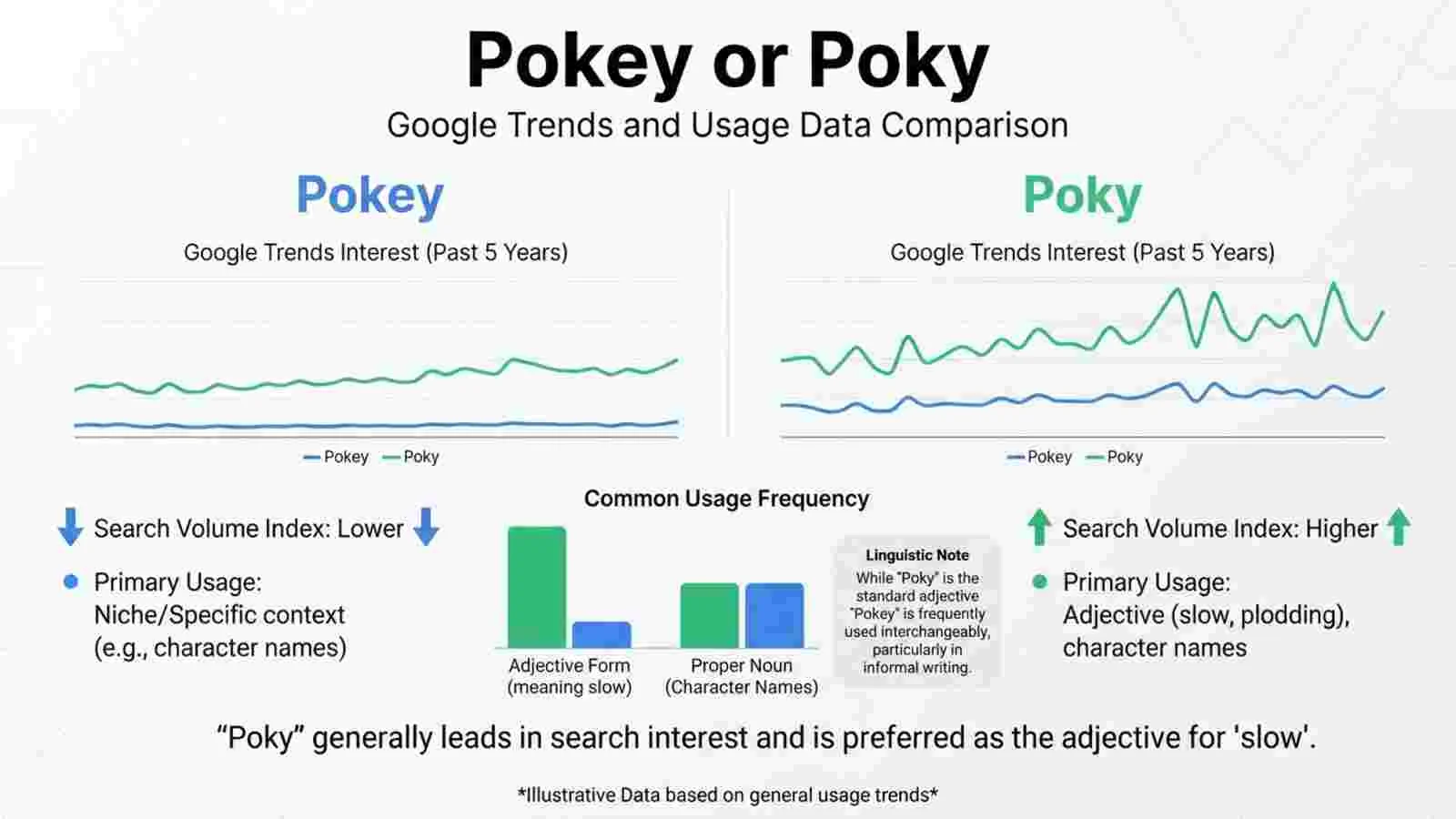
People may search for pokey or poky when checking spelling, editing an article, or learning English. The search often reflects a simple question: Are both forms correct, and which one should I use?
There is no verified, current Google Trends comparison provided here, so exact search volumes and country rankings should not be assumed.
Google Trends can help compare interest in the two spellings. To study their popularity, set the same time range and compare the search terms separately. You can also select countries such as the United States, the United Kingdom, Canada, and Australia.
Keep these points in mind:
- Search interest: Shows relative interest, not the total number of searches.
- Regional use: A spelling may be more familiar in one country than another.
- Search intent: People may be looking for a definition, spelling advice, or example sentences.
- Context: The word may appear in casual descriptions, reviews, or discussions about slow movement.
If you write about pokey or poky, answer the main question early: both spellings are correct. Give clear examples, and use one spelling consistently so your readers are not confused.
Frequently Asked Questions
1. Is pokey or poky correct?
Both are correct spellings. They usually have the same meaning, so your choice can depend on regional preference or a style guide.
2. Is poky more common in American English?
Poky is a familiar spelling in American English. However, pokey is also used in the United States, so it is not incorrect.
3. Is pokey British or American?
Pokey is used in both British and American English. Its use is not limited to one country.
4. Do pokey and poky mean the same thing?
Yes. Both can describe a small, cramped place or something that moves slowly.
5. How do you pronounce pokey and poky?
They are usually pronounced the same way: “POH-kee.”
6. Can I use poky in formal writing?
Yes, but it may sound informal. In professional reports, you may prefer words such as small, cramped, or slow, depending on the meaning.
7. Which spelling is better for SEO?
You can use either spelling, but choose one as your main form and explain the alternative naturally. Focus on answering readers’ questions rather than repeating both keywords unnecessarily.
8. Is pokey a word?
Yes, pokey is a real word. It is a variant spelling of poky, meaning slow, small, or cramped. It is also used as a nickname and in the slang phrase “the pokey” for prison.
9. What does poky mean?
Poky means slow, or small and cramped. For example, “a poky little room” means a small, cramped room, and “a poky horse” means a slow-moving horse.
10. What does pokey mean?
Pokey means the same as poky — slow, small, or cramped. For example, “He moved at a pokey pace.” It is also used in the slang phrase “the pokey” for prison.
11. How do you spell poky?
P-O-K-Y — poky, without an e. Remember: poke + y = poky. Do not add an extra e — “pokey” is the common variant spelling.
Conclusion
The choice between pokey and poky is simple once you know that both spellings are correct. They usually have the same meaning and pronunciation.
Both can describe a cramped room, a small building, or something that moves slowly.
Poky is a familiar form in American English, while pokey is also widely understood and used. Neither spelling should be treated as universally wrong.
If you are writing for a particular country, check the dictionary or style guide preferred by your readers. This is especially helpful when preparing school assignments, website articles, or professional documents.
For global content, choose one spelling and use it consistently. If you want a more formal tone, consider words such as small, cramped, or slow. These choices can make your meaning clearer and suit a wider range of readers.
The main lesson is to focus on meaning, audience, and consistency. Once you understand these points, you can use pokey or poky with confidence in everyday writing.
Continue Reading:
- Judgemental or Judgmental: Meaning, Spelling, and Usage ( for 2026)
- Goodbye or Good Bye: Definition, Origin, and Usage ( for 2026)
- Tardies vs Tardys: Meaning, Spelling, and Usage ( for 2026)

Mary Roach is an American science writer and bestselling author known for making unusual and complex scientific topics engaging, accessible, and humorous. Her books include Stiff, Packing for Mars, Gulp, and Fuzz.
Author at Simifind.com, sharing clear, informative content designed to help readers understand interesting topics and everyday questions.




2 thoughts on “Pokey or Poky: Meaning, Differences, and Usage ( for 2026)”