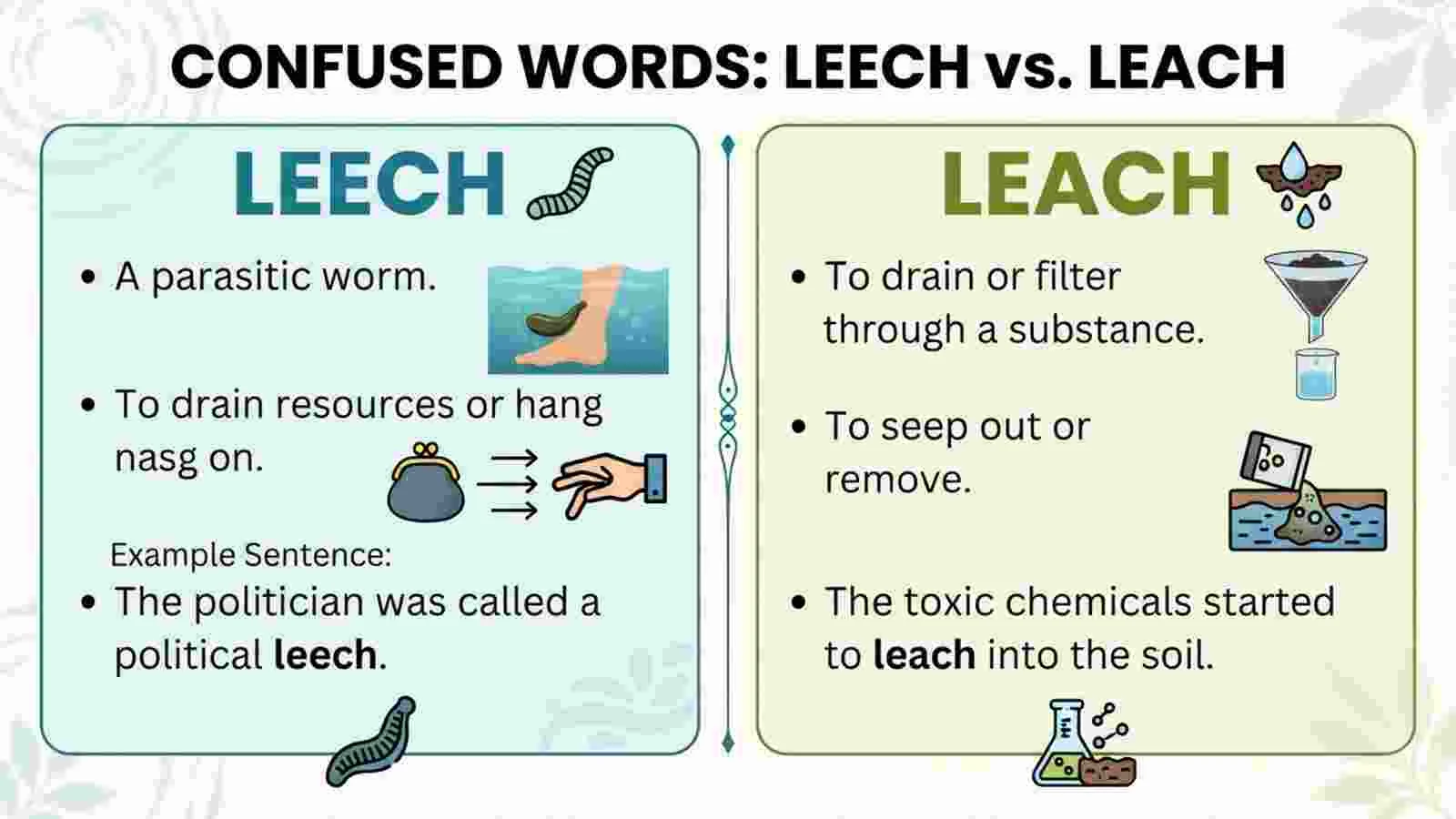
Leech is correct for the blood-sucking worm (and, figuratively, a person who lives off others). Leach is a different word — it means to drain or wash out a substance (water leaches chemicals from soil). They are not interchangeable.
Have you ever seen the words leech and leach and wondered which one is correct?
These words sound the same, but they have different meanings. Using the wrong word can change the meaning of your sentence.
A leech is a small worm-like animal that can attach to people or animals and suck blood.
The word can also describe a person who takes money, time, or help from others without giving anything back. For example, “He is a leech who always asks for money.”
Leach, on the other hand, is a verb. It means to remove or drain a substance from something, often through a liquid.
For example, rain can leach harmful chemicals from the soil into nearby water.
People often search for “leech or leach” because both words sound alike. However, their spelling, meaning, and use are different.
This guide explains their origins, spelling rules, common mistakes, and everyday examples. By the end, you will know when to use each word in emails, schoolwork, articles, and professional writing.
Leech or Leach – Quick Answer
Both leech and leach are correct English words, but they have different meanings.
- Leech (noun): A small animal that feeds on blood. It can also mean a person who takes advantage of others.
- Leach (verb): To remove or wash a substance from something, often by using water or another liquid.
Quick Examples
- Correct: The leech attached itself to the frog.
- Correct: Rain can leach minerals from the soil.
- Correct: Stop acting like a leech and pay your share.
- Correct: Scientists studied how chemicals leach into groundwater.
Remember this simple rule: a leech is an animal or a person who takes from others, while to leach means to drain or remove a substance.
Leech vs. Leach: Definition
Leech refers to a blood-sucking worm that attaches to animals or humans. It can also describe someone who takes advantage of others for personal benefit. Leach is a verb meaning to remove or drain substances from something, usually through the process of liquid passing through it.
Leech vs. Leach: Key Differences
The main difference between leech and leach is their meaning and usage. Leech is commonly used as a noun for a small worm or a person who exploits others, while leach describes the process of extracting or washing out substances from soil, rocks, or other materials.
When to Use Leech or Leach
Use leech when referring to the blood-feeding worm or someone who depends excessively on another person. Use leach when discussing the removal of chemicals, minerals, or nutrients through water or another liquid.
Leech vs. Leach: Examples in Sentences
Understanding these words through examples makes their differences easier to remember:
- The leech attached itself to the animal’s skin.
- He is acting like a leech by constantly taking money from his friends.
- Heavy rainfall can leach nutrients from the soil.
- Chemicals may leach into groundwater from contaminated land.
Are Leech and Leach Pronounced the Same?
Yes, leech and leach are homophones, meaning they have the same pronunciation but different spellings and meanings. Both are pronounced as “leech” (/liːtʃ/), so context helps readers understand which word is intended.
The Origin of Leech and Leach
The words have different histories, even though they sound alike.
The Origin of Leech
The word leech comes from Old English lǣce, which referred to a physician or healer. The related Germanic word history also connects with healing and medical care.
In earlier times, people used leeches in medical treatments. They believed that removing blood could help treat certain illnesses. The word later became strongly associated with the blood-feeding animal itself.
Today, doctors may use specially raised medical leeches in certain procedures to help blood flow in damaged tissue. The word also has a negative figurative meaning when it describes someone who takes advantage of another person.
Example: “He is a leech who depends on his friends for money.”
The Origin of Leach
The verb leach developed from Middle English forms related to washing or filtering substances through a liquid. It is associated with the process of allowing water or another liquid to pass through material and carry away soluble substances.
The term is common in science, farming, environmental studies, and chemistry.
Example: “Heavy rain can leach nutrients from farmland.”
Why Do the Spellings Differ?
English has many words that sound the same but have different meanings and origins. These words are called homophones.
Leech and leach are homophones. Their different spellings help readers understand their meanings from the sentence.
British English vs American English Spelling
The words leech and leach are spelled the same in British English and American English. There is no standard regional spelling change between them.
The difference is based on meaning, not location.
| Word | British English | American English | Meaning |
| Leech | Leech | Leech | A blood-feeding animal or a person who takes advantage of others |
| Leach | Leach | Leach | To remove a substance through liquid |
| Leeches | Leeches | Leeches | Plural of leech |
| Leaches | Leaches | Leaches | Third-person singular form of the verb leach |
| Leeched | Leeched | Leeched | Past tense of leech as a verb |
| Leached | Leached | Leached | Past tense of leach |
British English Examples
- The doctor used a leech during the treatment.
- Water can leach nutrients from the soil.
- The report warned that waste could leach into local streams.
American English Examples
- A leech was found in the pond.
- Chemicals may leach from old pipes.
- The study examined how rain leaches minerals from rocks.
These examples follow standard usage in both varieties of English.
Which Spelling Should You Use?
The right choice depends on what you want to say, not where your readers live.
For American English Readers
Use leech when you mean the animal or a person who takes advantage of others.
Use leach when describing the movement or removal of substances through a liquid.
Example: “The researchers found that pollutants leach into groundwater.”
For British English and Commonwealth Readers
Follow the same rule. British, Australian, Canadian, and other Commonwealth English users generally distinguish these words by meaning rather than spelling.
Example: “The farmer tested the soil to see whether nutrients had leached away.”
For Global and Professional Writing
If you write for a global audience, choose the word that fits the sentence. Scientific and environmental writing often uses leach, while medical and everyday writing may use leech.
Before publishing, check the sentence carefully. A spellchecker may accept both words, even when one is wrong for your meaning.
Common Mistakes with Leech and Leach
These words are easy to confuse because they sound alike. Here are common mistakes and how to correct them.
Mistake 1: Using Leech for a Chemical Process
Incorrect: Rain can leech harmful chemicals from the soil.
Correct: Rain can leach harmful chemicals from the soil.
Why? The sentence describes a liquid carrying chemicals away. The correct verb is leach.
Mistake 2: Using Leach for the Animal
Incorrect: A leach attached itself to my leg.
Correct: A leech attached itself to my leg.
Why? The blood-feeding animal is spelled leech.
Mistake 3: Confusing the Noun and Verb
Incorrect: The leeching of nutrients was caused by heavy rain, when the intended meaning is a chemical process.
Better: The leaching of nutrients was caused by heavy rain.
Why? Leaching is the noun or participle formed from the verb leach.
Mistake 4: Using the Wrong Word in Figurative Writing
Incorrect: He is a leach who always borrows money.
Correct: He is a leech who always borrows money.
Why? The figurative use of leech describes someone who takes advantage of others.
Mistake 5: Assuming British and American Rules Differ
Incorrect assumption: British writers use leach, while Americans use leech for the same meaning.
Correct rule: Both varieties use the same spellings and meanings.
Helpful tip: If you can replace the word with “blood-feeding animal” or “person who takes advantage,” use leech. If you mean “wash out” or “drain away,” use leach.
Leech and Leach in Everyday Examples
These words appear in different settings. Understanding the context helps you choose the correct spelling.
In Emails
Leech:
“Please speak with him about the money he keeps asking for. I do not want to call him a leech, but the situation is becoming unfair.”
Leach:
“Please review the report on how rainwater may leach chemicals from the storage area.”
In News Reports
Leech:
“Medical staff used leeches as part of a treatment to improve blood flow.”
Leach:
“Researchers warned that pollutants could leach into nearby groundwater.”
On Social Media
Leech:
“Do not be a leech. Support your friends instead of always asking them for favors.”
Leach:
“The heavy rain may leach nutrients from the garden soil.”
In Academic and Scientific Writing
Leech:
“Medicinal leeches may be used in selected surgical cases to relieve venous congestion.”
Leach:
“The experiment measured how quickly the chemical could leach from the material into water.”
In Formal Writing
Use leech when discussing the animal, medical treatment, or a person who takes unfair advantage of others.
Use leach when discussing soil science, pollution, water movement, chemistry, or the removal of substances.
Example: “The researchers assessed the risk of metals leaching from industrial waste into the surrounding soil.”
Leech or Leach – Google Trends and Usage Data
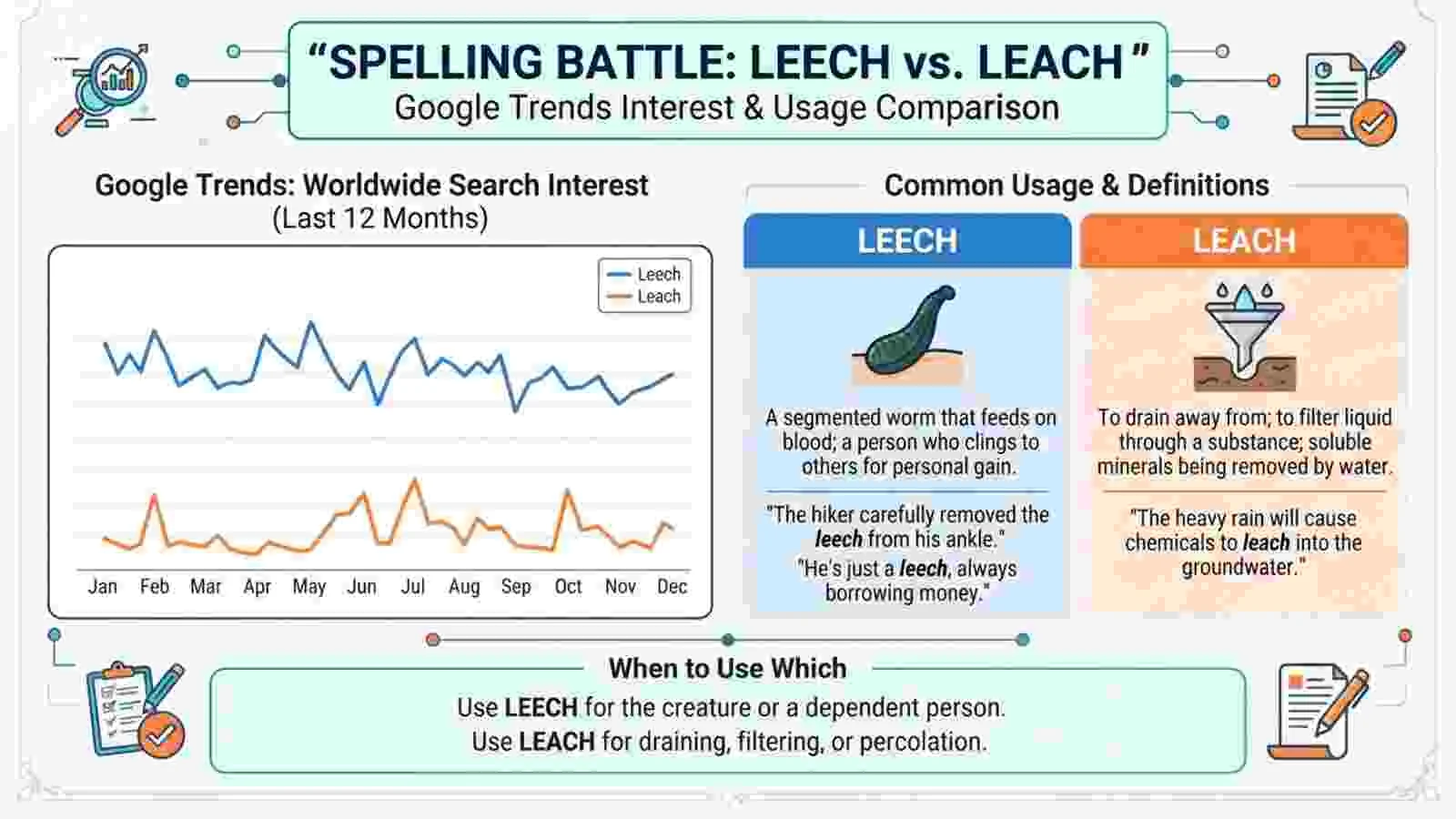
People may search for “leech or leach” when checking spelling, writing a school assignment, editing an article, or reading scientific material.
However, the two words appear in different contexts, so their search patterns may not be directly comparable.
Why People Search for Leech
Common search intentions include:
- The meaning of a leech.
- Whether leeches are harmful.
- The use of leeches in medical treatment.
- The figurative meaning of calling someone a leech.
- The difference between leech and leach.
Why People Search for Leach
Common search intentions include:
- The meaning of leaching.
- How chemicals leach into water.
- Nutrient leaching in soil.
- Environmental pollution and groundwater.
- The correct spelling of leach or leech.
Which Word Is More Popular?
Search interest depends on the topic, location, and time period. General animal-related searches may favor leech, while environmental science and chemistry searches may favor leach.
Google Trends measures relative search interest over a selected period and region. It does not provide exact total search counts. Without a specific live Trends comparison, it would be misleading to claim that one word is always more popular or to assign country rankings.
For SEO writers, the best approach is to target the user’s intent. An article about spelling should explain both words clearly. A science article should focus on leaching, while a medical or animal article should use leech where appropriate.
Comparison Table: Leech vs Leach
| Feature | Leech | Leach |
| Main word type | Noun; also a verb | Verb; also used in forms such as leaching and leached |
| Main meaning | A blood-feeding animal | To remove a substance through liquid |
| Figurative meaning | A person who takes advantage of others | No equivalent common meaning |
| Science use | Medicine and biology | Chemistry, soil science, and environmental studies |
| Example | The leech attached to the skin. | Rain can leach minerals from rocks. |
| British spelling | Leech | Leach |
| American spelling | Leech | Leach |
Frequently Asked Questions
1. What is the difference between leech and leach?
A leech is a blood-feeding animal or a person who takes advantage of others. To leach means to remove a substance from material through liquid.
2. Is leech or leach the correct spelling?
Both are correct. Use leech for the animal or the figurative meaning. Use leach for a process in which liquid removes a substance.
3. Is leech a noun or a verb?
Leech is mainly a noun, but it can also be a verb meaning to drain or depend on someone — for example, “He leeched money off his friends.” As a noun it names the animal: “The leech attached itself to the skin.”
4. Is leach a noun or a verb?
Leach is mainly a verb. It describes a substance being washed or drained out by a liquid. Related forms include leached and leaching.
5. Do British people spell leach differently from Americans?
No. Both British and American English use leech and leach with the same spellings and meanings.
6. What does it mean to call someone a leech?
Calling someone a leech means that the person takes help, money, time, or other resources from others without giving much in return. It is usually an insult.
7. What does leaching mean in science?
Leaching is the process by which a liquid carries soluble substances away from a solid material. For example, rainwater can leach nutrients from soil or pollutants from waste.
8. What does leech mean?
A leech is a small blood-sucking worm that attaches to people or animals and feeds on their blood. Figuratively, a leech is a person who lives off others without giving anything back.
9. What does leach mean?
Leach means to drain or wash a substance out of something, usually with a liquid — for example, rain leaches nutrients from soil and chemicals from waste into groundwater.
10. How do you spell leech?
Spell it L-E-E-C-H: leech — double e, then ch. Remember, the animal’s name ends in -eech, while the draining verb ends in -each (leach).
Conclusion
The difference between leech and leach is simple once you learn what each word means. A leech is a small animal that feeds on blood.
The word can also describe a person who takes advantage of other people. In contrast, leach is a verb that describes how a liquid removes or carries a substance away from a material.
Both words are correct in British and American English. Their spellings do not change based on the country, so the meaning of your sentence should guide your choice.
For example, write “The leech attached itself to the skin” when talking about the animal. Write “Rain can leach nutrients from the soil” when describing a natural process. These examples show why choosing the right word matters.
If you are writing an email, an academic paper, a news article, or an SEO blog post, always check the context before choosing between the two. A spellchecker may not catch the mistake because both words are valid English words.
Keep this rule in mind: a leech takes or feeds, while leach means to wash or drain something away. This simple tip will help you use both words correctly and write with greater confidence.
Continue Reading:
- Pokey or Poky: Meaning, Differences, and Usage ( for 2026)
- Judgemental or Judgmental: Meaning, Spelling, and Usage ( for 2026)
- Goodbye or Good Bye: Definition, Origin, and Usage ( for 2026)
- Cuter or Cutier: Correct Spelling, Meaning, and Usage ( for 2026)
- Selfs or Selves: Meaning, Grammar, and Examples (for 2026)

Here’s a concise 2-line author bio suitable for Simifind.com:
James Dashner is an American bestselling author best known for The Maze Runner series and other popular young-adult fiction.
On Simifind.com, he shares clear, engaging insights and helpful content for readers interested in books, writing, and popular literature.








1 thought on “Leech or Leach: Meaning, Spelling, and Usage ( for 2026)”