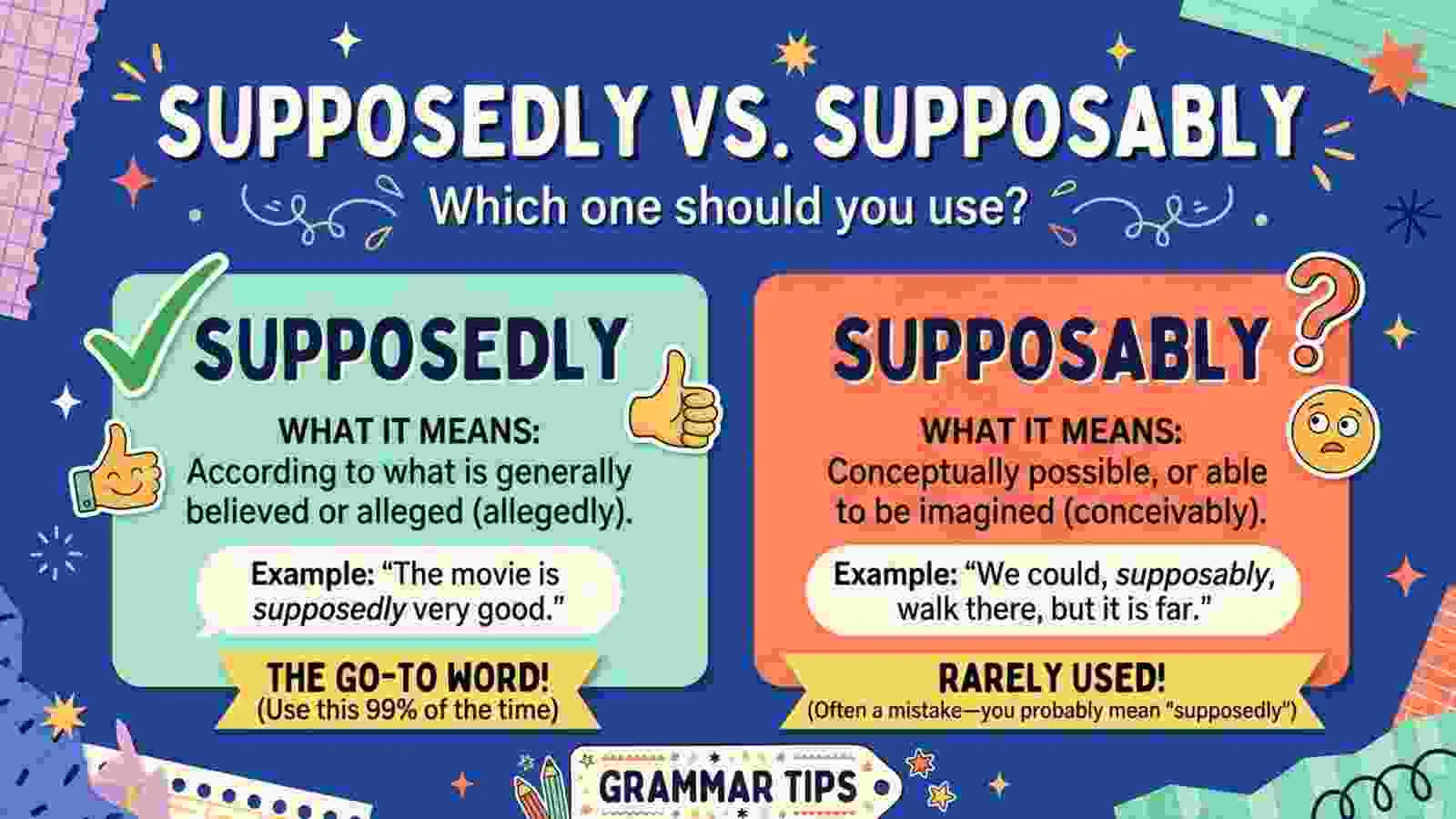
Supposedly is correct. Supposably is incorrect in standard English — it is a common mispronunciation/misspelling of supposedly. Supposedly = according to what is said or believed (but maybe not true). Use supposedly, not supposably.
Have you ever heard someone say “supposably” and wondered if they used the right word?
You are not alone. Many people search for supposedly or supposably because the two words sound alike and have similar meanings. However, they are not used in the same way.
The word supposedly is much more common in everyday English. It means something is believed, claimed, or said to be true, but it may not be proven.
For example, “He is supposedly the best player on the team” means people say he is the best, but this may not be certain.
The word supposably is also a real English word. It means something can be supposed or imagined. Yet, it is rare in modern writing and speech.
Knowing the difference helps you write better emails, school assignments, blog posts, and professional messages.
It also helps you avoid word-choice mistakes. In this guide, you will learn the meanings, origins, spelling rules, and common uses of both words.
You will also see simple examples to help you choose the right word with confidence.
Supposedly or Supposably – Quick Answer
Supposedly is the best choice in most cases. It means something is said or believed to be true, but it may not be confirmed.
Supposably means something can be supposed or imagined. It is correct in limited contexts, but people rarely use it.
Examples:
- Supposedly: She is supposedly moving to London next month.
- Supposably: The result is supposably possible under these conditions.
The second example is unusual. In most everyday situations, writers would choose another phrase, such as “it is possible to suppose” or “it can be imagined.”
| Word | Meaning | Commonness | Best use |
| Supposedly | Reported or believed to be true | Very common | Everyday and formal writing |
| Supposably | Able to be supposed or imagined | Rare | Limited or technical contexts |
Simple rule: Use “supposedly” when you mean “reportedly,” “apparently,” or “as people say.”
The Origin of Supposedly and Supposably
Both words come from the verb suppose, which means to think, believe, or accept something as possible.
The verb “suppose” entered English through Old French and has roots in Latin. Its original sense involved placing something under or assuming something as a basis for thought.
Over time, English developed related words, including “supposed,” “supposedly,” and “supposable.”
Where Does Supposedly Come From?
“Supposedly” is formed from “supposed” and the suffix “-ly.” The suffix helps form an adverb.
The word describes something that is believed, claimed, or expected to be true.
Example: “The shop is supposedly open today.”
This sentence means that people believe the shop is open, but the speaker may not know for sure.
Where Does Supposably Come From?
“Supposably” comes from “supposable,” which means able to be supposed or considered possible. The suffix “-ly” turns the adjective into an adverb.
The word is valid, but it is not common in everyday English. Many speakers use it by mistake when they intend to say “supposedly.”
Example: “The idea is supposably possible.”
This wording is rare and may sound awkward. “The idea is supposedly possible” or “The idea is considered possible” may be clearer, depending on the intended meaning.
Why Do People Confuse These Words?
The two words look and sound similar. Both relate to the idea of supposing something. However, their meanings differ.
People may also hear “supposably” in casual speech and assume it is the standard form. For clear communication, it is best to understand the difference and choose the word that fits your meaning.
British English vs American English Spelling
The difference between “supposedly” and “supposably” is mainly about meaning and usage, not regional spelling.
Unlike words such as “colour” and “color,” these two words are not standard British and American spelling alternatives. Both forms exist in English, but “supposedly” is far more common in both varieties.
British English Usage
British writers commonly use “supposedly” to report a claim or belief.
Examples:
- The train is supposedly arriving at noon.
- He supposedly knows the answer.
- The new policy will supposedly save money.
“Supposably” is rare in British English. In most cases, “supposedly” is the more natural choice.
American English Usage
American English also uses “supposedly” much more often.
Examples:
- She is supposedly the new manager.
- The package was supposedly delivered yesterday.
- This is supposedly the fastest route.
American speakers may use “supposably” in casual conversation, sometimes by mistake. However, it is not a standard replacement for “supposedly.”
Comparison Table
| Feature | Supposedly | Supposably |
| British English | Common | Rare |
| American English | Common | Rare |
| Standard spelling | Yes | Yes, but uncommon |
| Main meaning | Reported or believed to be true | Able to be supposed |
| Formal writing | Usually appropriate | Use only when the meaning fits |
| Everyday conversation | Natural | May sound unusual |
| Common substitute | Reportedly, apparently | Conceivably, if the meaning fits |
The key point is that neither word belongs exclusively to British or American English. The main difference is how often people use each word and what they mean by it.
Which Spelling Should You Use?
The right choice depends on your meaning, your audience, and the type of writing you are doing.
For American Readers
Use “supposedly” when describing a claim, rumor, belief, or uncertain fact.
Example: “The company is supposedly launching a new product.”
This sentence tells readers that the launch has been reported or expected, but it may not be confirmed.
For British and Commonwealth Readers
The same rule applies in the United Kingdom, Pakistan, Canada, Australia, and other English-speaking communities.
Example: “The teacher is supposedly on leave this week.”
“Supposably” is not a British spelling of “supposedly.” It has a separate meaning, even though many people confuse the two.
For Global and Professional Writing
If you write for an international audience, choose words that most readers know and understand.
Use “supposedly” for claims that are not confirmed. If you mean that something is possible to imagine, consider using “conceivably,” “possibly,” or “in theory.”
Examples:
- Unclear: The plan is supposably effective.
- Clearer: The plan is supposedly effective.
- Clearer for possibility: The plan could possibly work.
For professional emails, academic work, and SEO articles, supposedly is usually the safer choice when reporting what people say or believe.
Common Mistakes with Supposedly and Supposably
These words are easy to mix up. The following mistakes show how to use them more clearly.
Mistake 1: Using Supposably to Mean Reportedly
Incorrect for the intended meaning: “He is supposably a famous writer.”
Better: “He is supposedly a famous writer.”
The second sentence means that people claim he is famous, but the claim may need proof.
Mistake 2: Thinking Supposably Is Always Wrong
“Supposably” is a real word. It is not automatically incorrect simply because it is uncommon.
However, you should use it only when you mean that something can be supposed or considered possible. Even then, a clearer phrase may be better.
Mistake 3: Using Supposedly When You Mean Certainly
Incorrect if certainty is intended: “She is supposedly the winner,” when the result is officially confirmed.
Better: “She is the winner.”
“Supposedly” can suggest that a claim is unconfirmed or that the speaker has doubts. Use it carefully.
Mistake 4: Confusing Supposedly with Supposed To
“Supposedly” is an adverb. “Supposed to” is a phrase used to describe an expectation, duty, or plan.
Examples:
- Supposedly: He is supposedly at home.
- Supposed to: He is supposed to be at home.
The first reports a claim. The second describes an expectation.
Mistake 5: Using the Word Without Checking the Meaning
Always ask yourself what you want to say. Are you reporting a claim, or are you describing something that can be imagined?
If you are reporting a claim, use “supposedly.” If you mean that something is possible, choose a clearer word such as “possibly” or “conceivably” when appropriate.
Supposedly or Supposably in Everyday Examples
These words may appear in emails, news reports, social media posts, and formal writing. The right choice depends on the message.
In Emails
Supposedly: “The meeting is supposedly scheduled for Monday, but I have not received confirmation.”
This sentence makes it clear that the date is not certain.
Supposably: “The plan is supposably workable.”
This sounds unusual. A clearer version is “The plan may be workable.”
In News Writing
Supposedly: “The missing documents were supposedly found in the office.”
This reports a claim without presenting it as a proven fact.
News writers often prefer words such as “reportedly” when they need a neutral tone.
Supposably: This word is uncommon in news reports. “Possibly” or “conceivably” may be more suitable when discussing what could happen.
On Social Media
Supposedly: “This is supposedly the best phone of the year!”
The word can show doubt, surprise, or uncertainty.
Supposably: “This is supposably the best phone.”
Readers may think the writer meant “supposedly.” For a clear post, use the more common word.
In Academic Writing
Supposedly: “The method is supposedly effective, but more evidence is needed.”
This sentence questions a claim and calls for proof.
Supposably: Use this word only if its precise meaning is needed. In most academic writing, “theoretically,” “possibly,” or “conceivably” will be clearer.
In Formal Reports
Supposedly: “The system was supposedly tested before release.”
This wording suggests that testing was claimed or expected, but the writer may not have verified it.
If the tests are confirmed, write: “The system was tested before release.”
Clear wording helps readers understand whether information is confirmed, reported, or uncertain.
Supposedly – Google Trends and Usage Data
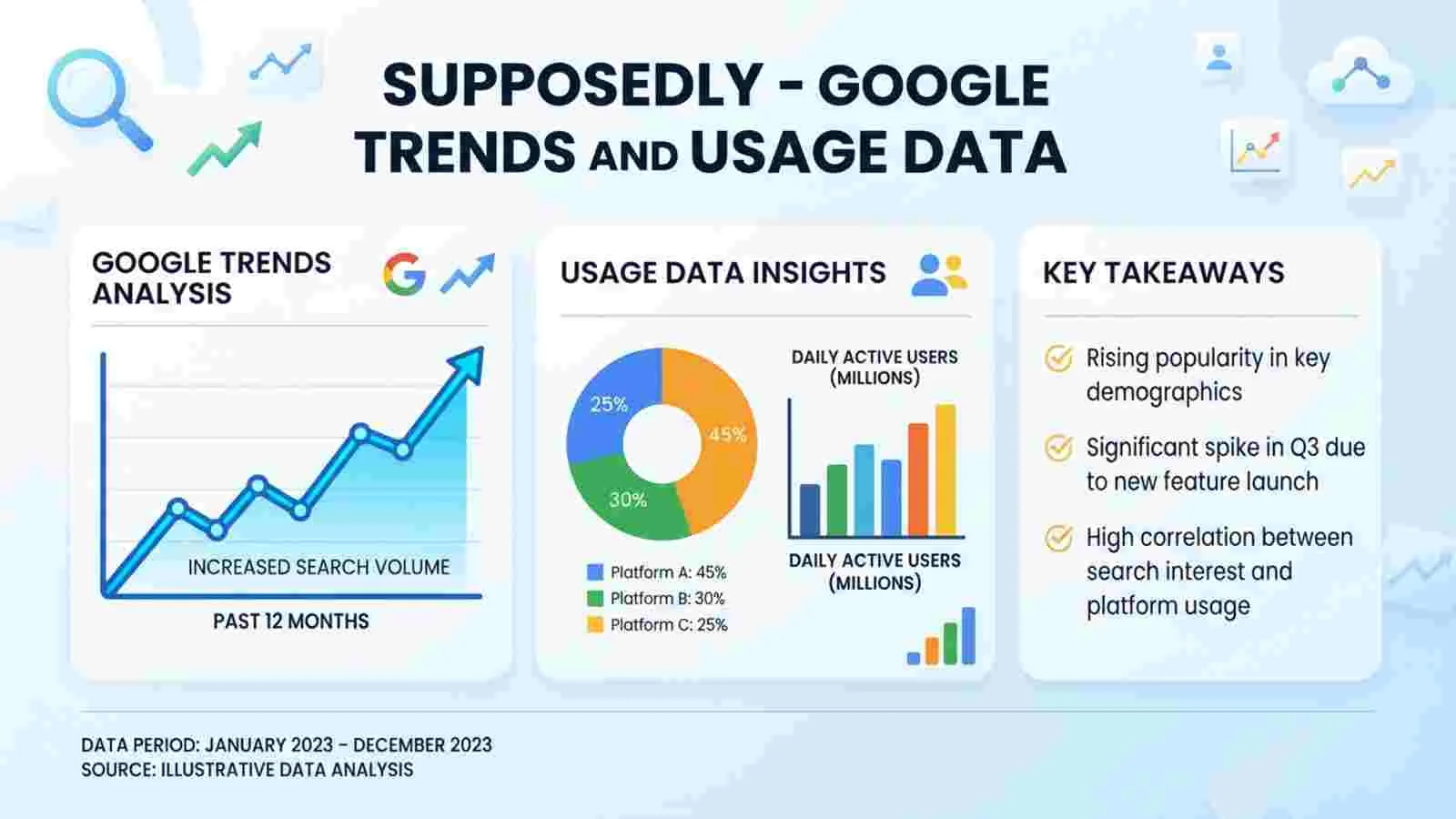
People often search for “supposedly or supposably” because they want to know which word is correct. They may have heard both words in conversation or seen “supposably” in a message, video, or online post.
However, exact Google Trends popularity cannot be confirmed here without checking current trend data. It would be misleading to provide invented search volumes, rankings, or country percentages.
Which Word Is More Popular?
In general English usage, “supposedly” is much more common than “supposably.” It appears naturally in conversation, journalism, online discussions, and formal writing.
“Supposably” is rare and often appears when speakers confuse it with “supposedly.”
What Do People Search For?
Common search intentions include:
- Supposedly vs. supposably
- Is supposably a real word?
- What does supposedly mean?
- Is supposedly correct in formal writing?
- What is the difference between supposedly and supposably?
These searches show that users need a clear definition and practical examples.
How to Check Country-Level Trends
To compare interest by country, open Google Trends and enter “supposedly” and “supposably.” Select a time range and compare the results by region.
Remember that Google Trends uses relative interest scores, not exact search counts. A higher score does not directly tell you how many people searched for a term.
For writers and SEO professionals, the main lesson is to focus on the user’s question: explain the difference, show examples, and make the correct choice easy to understand.
Frequently Asked Questions
1. Is supposedly or supposably correct?
Both are real English words, but they have different meanings. “Supposedly” is the usual choice when reporting something believed or claimed to be true. “Supposably” means able to be supposed or imagined.
2. Is supposably a real word?
Yes. “Supposably” is a real word, but it is rare. Many people use it when they mean “supposedly,” which is much more common.
3. Why do people say supposably instead of supposedly?
The words sound similar and both relate to “suppose.” Because of this, some speakers confuse them. In casual speech, “supposably” is often used unintentionally in place of “supposedly.”
4. Is supposedly correct in formal writing?
Yes. “Supposedly” is suitable for formal writing when you need to describe an unconfirmed claim or belief. If the information is confirmed, a direct statement may be clearer.
5. Do British people use supposably?
The word exists in English, including British English, but it is rare. British writers commonly use “supposedly” when describing something said or believed to be true.
6. What is another word for supposedly?
Depending on the sentence, alternatives include “reportedly,” “apparently,” “allegedly,” and “presumably.” These words are not exact synonyms in every context, so choose one that matches your meaning.
7. Can I use supposedly and supposably in the same sentence?
Yes, if each word has a distinct and suitable meaning. However, this is rarely necessary. Most sentences become clearer when you use “supposedly” for a claim and a more familiar word such as “possibly” for a possibility.
8. What does supposedly mean?
Supposedly means according to what is said or believed — it describes something people claim or expect to be true, but which may not be confirmed.
9. What is the difference between supposedly and supposably?
Supposedly means according to what is said or believed (reportedly), while supposably means able to be supposed or imagined. Supposedly is very common; supposably is rare.
10. How do you spell supposedly?
Spell it S-U-P-P-O-S-E-D-L-Y: supposedly, with a double p and -edly at the end.
Conclusion
The difference between supposedly or supposably is simple once you understand what each word means. “Supposedly” is the common choice when you want to report something that people say, believe, or expect to be true. It works well in everyday conversation, emails, news reports, academic work, and professional writing.
“Supposably” is also a real English word, but it is rarely used. It refers to something that can be supposed or imagined. Because the word is uncommon, it may confuse readers when used in everyday writing.
If you are unsure which word to choose, ask yourself whether you are reporting a claim or describing a possibility. For a claim, use “supposedly.” For a possibility, consider clearer words such as “possibly,” “conceivably,” or “in theory.”
Remember that this is not a British-versus-American spelling issue. Both words exist in both varieties of English, but their meanings and commonness differ. By choosing the word that fits your message, you can write with greater clarity and avoid a common vocabulary mistake.
Final tip: When in doubt, use “supposedly” for reported claims and choose a clearer alternative when discussing possibilities.
Continue Reading:
- Leech or Leach: Meaning, Spelling, and Usage ( for 2026)
- Pokey or Poky: Meaning, Differences, and Usage ( for 2026)
- Judgemental or Judgmental: Meaning, Spelling, and Usage ( for 2026)
- Cuter or Cutier: Correct Spelling, Meaning, and Usage ( for 2026)
- Selfs or Selves: Meaning, Grammar, and Examples (for 2026)

Mary Roach is an American science writer and bestselling author known for making unusual and complex scientific topics engaging, accessible, and humorous. Her books include Stiff, Packing for Mars, Gulp, and Fuzz.
Author at Simifind.com, sharing clear, informative content designed to help readers understand interesting topics and everyday questions.






2 thoughts on “Supposedly or Supposably: Meaning, Difference, and Usage ( for 2026)”