Have you ever typed a word in a message and suddenly wondered, “Wait, is it vein or vain?”
These two words sound exactly alike, but their meanings are completely different—and using the wrong one can change your entire sentence.
Recently, I was chatting with a friend when I suddenly saw the term “vein or vain” pop up, and honestly, I had no clue which spelling was correct at first.
I kept wondering, “Am I missing something here?” It was a little confusing, and I didn’t want to respond the wrong way.
So, I decided to look into vein or vain and understand their meanings, differences, and proper usage.
After learning the difference, I realized how important it is to know these commonly confused words.
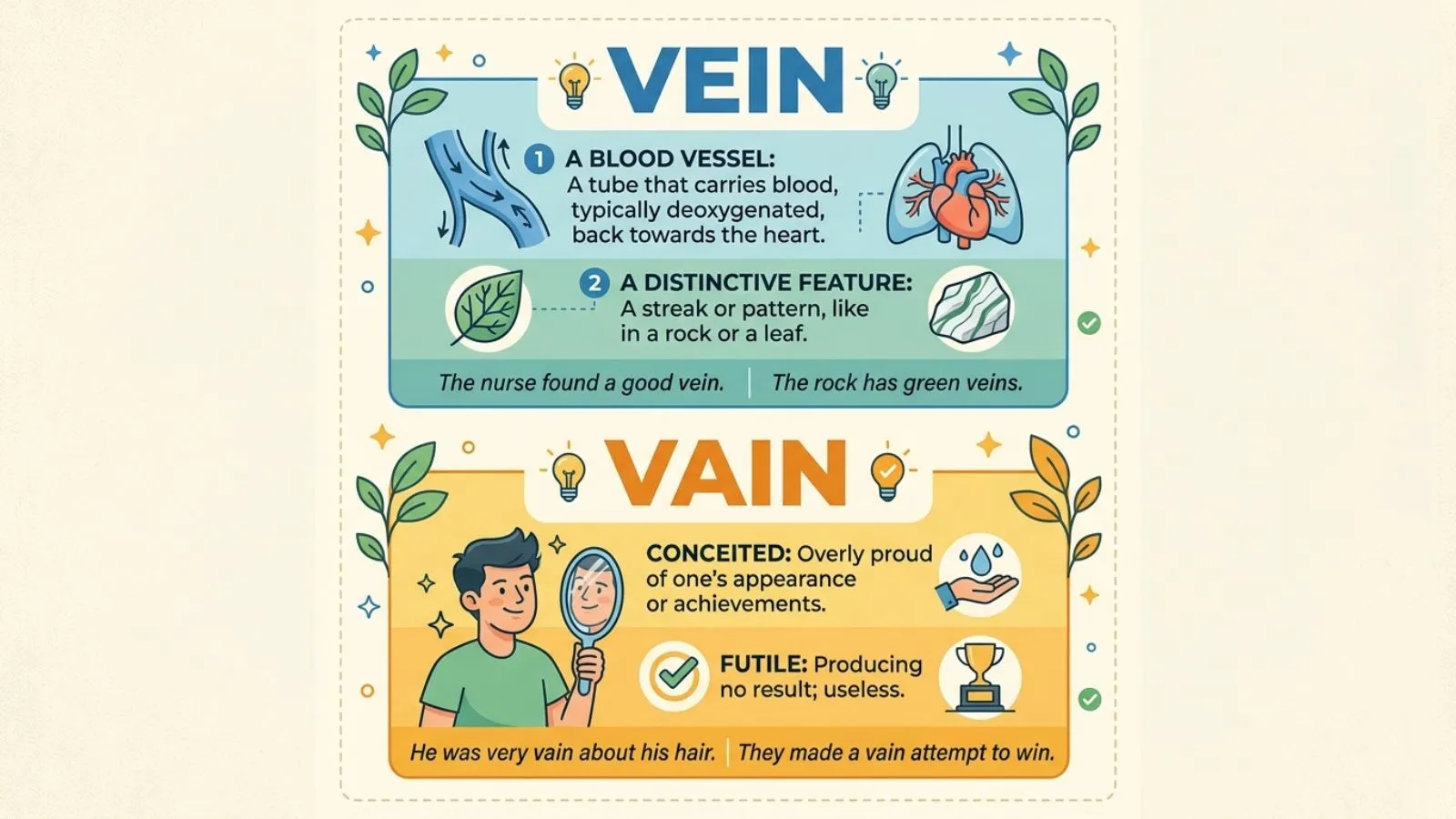
“Vein” usually refers to a blood vessel or a distinctive streak in something, while “vain” often describes someone who is overly proud or something that produces no useful result.
Once I understood the context, I could use the right word with confidence—and now I feel ready whenever I see vein or vain in chats, social media, or everyday writing.
Vein or Vain – Quick Answer
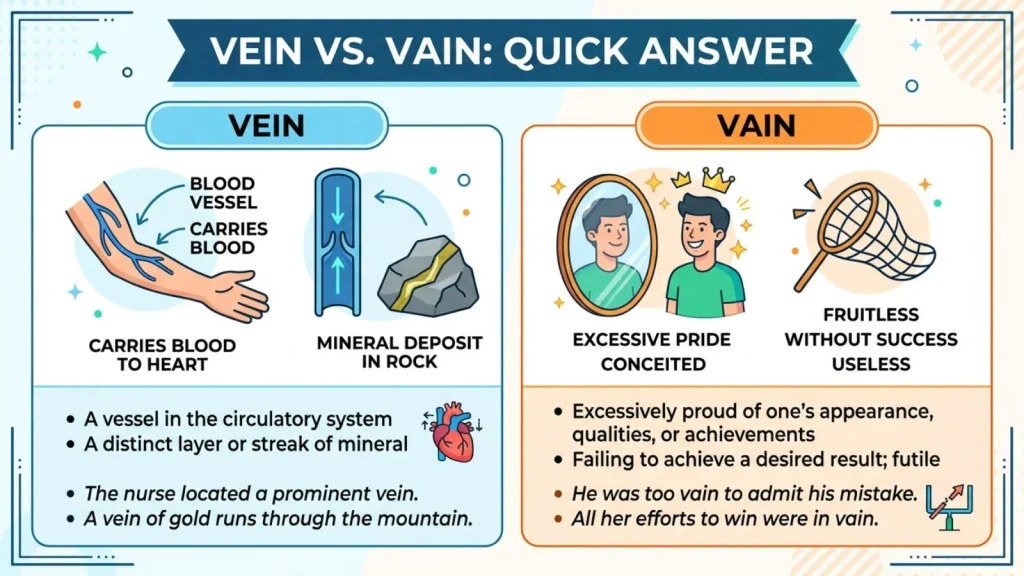
Here is the short version:
- Vein (noun) means a blood vessel, or a streak of mineral in rock, or a style/mood.
- Example: “The doctor checked the vein in her arm.”
- Example: “He wrote the essay in a humorous vein.”
- Vain (adjective) means overly proud of your looks, or useless/unsuccessful.
- Example: “He is too vain to wear glasses in public.”
- Example: “She tried in vain to fix the printer.”
Quick trick: Vein has an “e” like “extremity” (veins are in your body). Vain has an “a” like “arrogant” (vain people are full of themselves).
The Origin of Vein and Vain
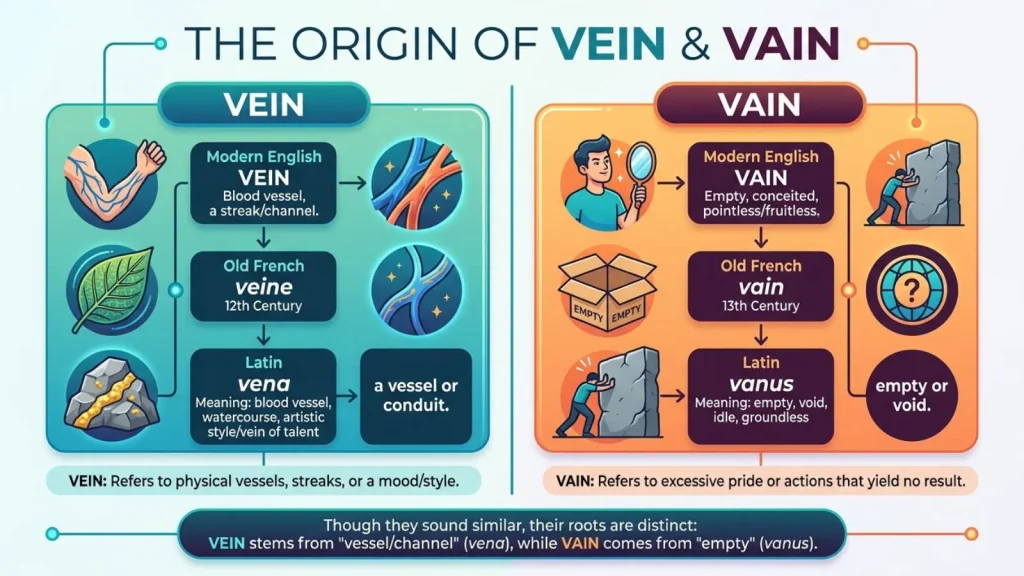
Both words come from Old French, and further back, from Latin. But they come from two completely different Latin roots.
- Vein comes from the Latin word vena, meaning a blood vessel. This root also gives us “venous,” a medical term for veins.
- Vain comes from the Latin word vanus, meaning empty or without substance. This root also gives us “vanity” and “evanescent” (fading quickly, like something empty).
They entered English separately around the 13th and 14th centuries. Over time, English pronunciation shifted so both words sound identical today. The spelling stayed different because the words never merged in meaning. English often keeps old spellings even after pronunciation changes, which is why we still have so many homophones.
Is This a British vs American Spelling Issue vein or vain ?
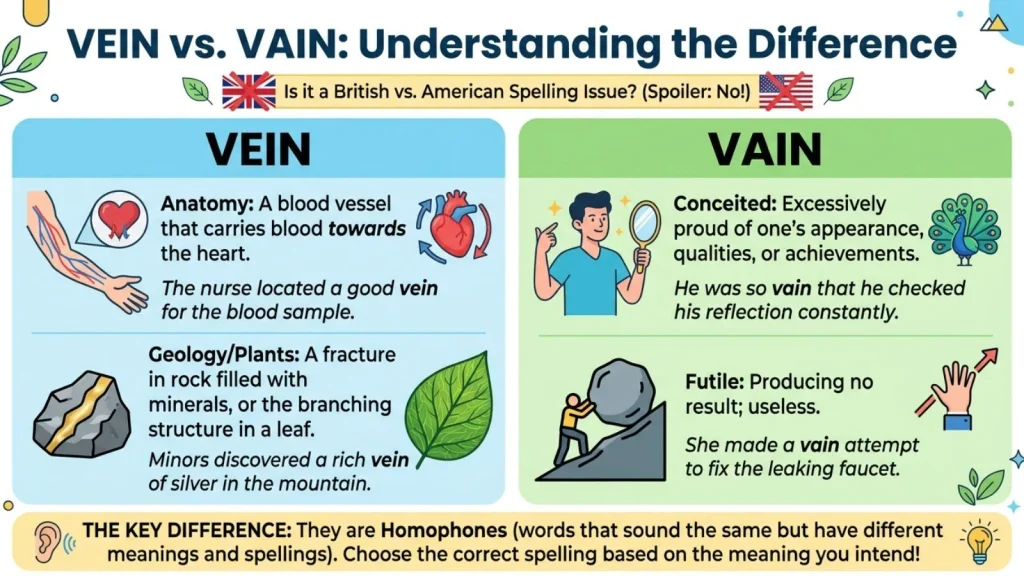
Many word-confusion questions online (like “color vs colour”) really are regional spelling differences. This one is not.
“Vein” and “vain” are spelled the same way in both British and American English. There is no US version and no UK version. The confusion is not regional. It is about meaning, not geography.
There is, however, a third homophone that often joins this pair: vane, as in “weather vane” (a device that shows wind direction). All three words are pronounced the same in both British and American English.
| Word | Pronunciation | Meaning | Word Type | Regional Difference? |
| Vein | /veɪn/ | Blood vessel; streak; style | Noun | None |
| Vain | /veɪn/ | Overly proud; useless | Adjective | None |
| Vane | /veɪn/ | Device that shows wind direction; blade (as in “fan vane”) | Noun | None |
Since spelling rules do not change by country here, the real skill is learning to spot which meaning you need, not which region you are writing for.
Which Word Should Use vein or vain ?
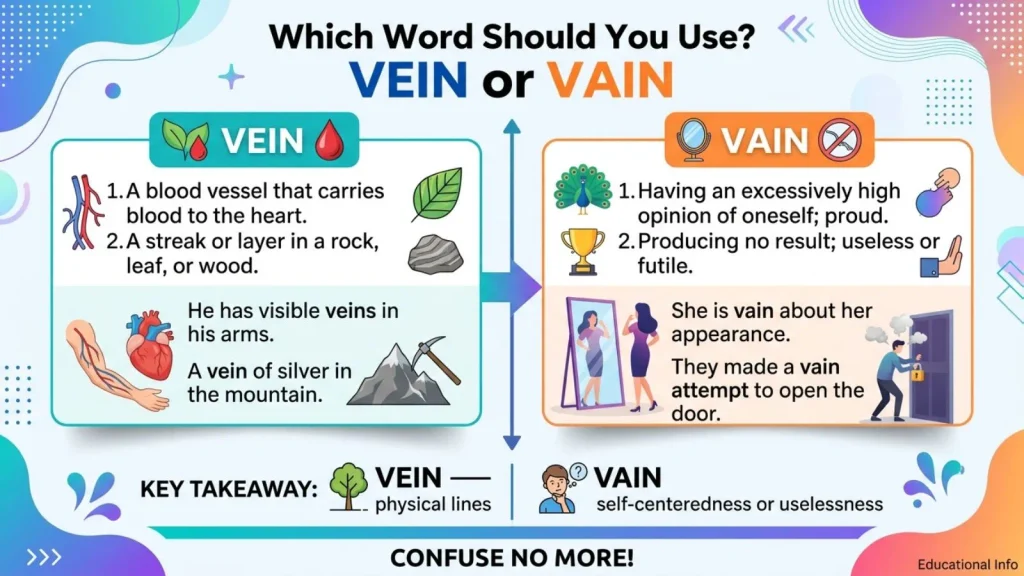
Since this is not a US vs UK issue, the advice is the same everywhere English is spoken. Use context, not location, to choose the right word.
- If you mean a body part or a style/mood → use vein. (“A vein in his neck,” “in a lighter vein.”)
- If you mean prideful or unsuccessful → use vain. (“She is vain about her hair,” “in vain.”)
- If you mean a wind instrument or device → use vane. (“The weather vane spun in the storm.”)
- For global or professional writing (emails, reports, articles) → always double-check meaning before publishing. Spell checkers will not catch this error, since all three words are real, correctly spelled words.
Common Mistakes with Vein or Vain
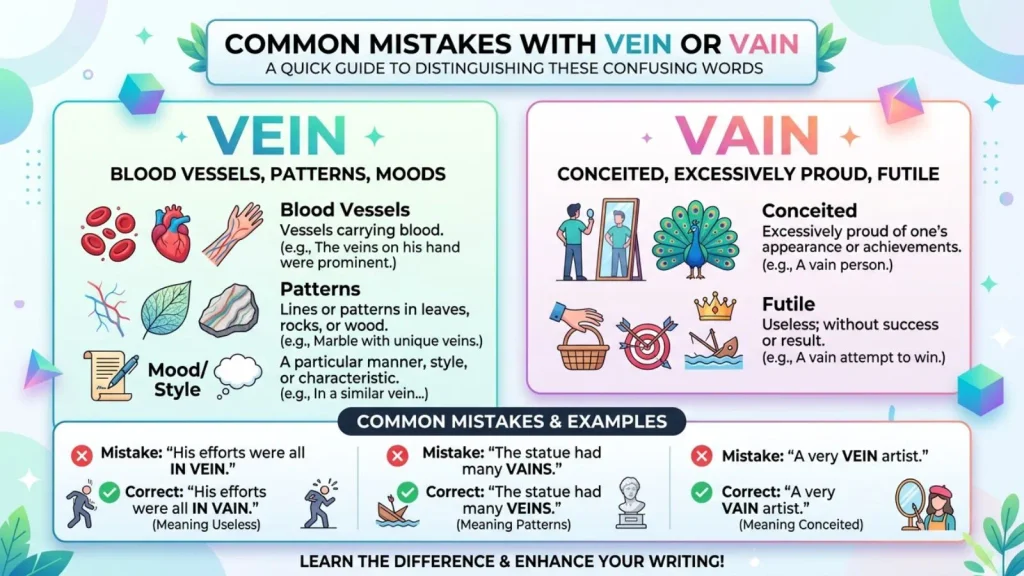
- “He tried in vein to open the door.” Wrong. Should be “in vain” (meaning without success).
- “She wrote the report in a similar vain.” Wrong. Should be “similar vein” (meaning style or manner).
- “He has a vain of gold in that mine.” Wrong. Should be “vein of gold” (a mineral streak).
- “The vein weather vane spun.” This mixes up spelling entirely. It should simply be “weather vane.”
- Assuming spell check will catch it. It will not. All three words are correctly spelled. Only the meaning is wrong.
The fastest fix: read the sentence aloud and ask, “Am I talking about a body part, pride, or a device?”
Vein or Vain in Everyday Examples
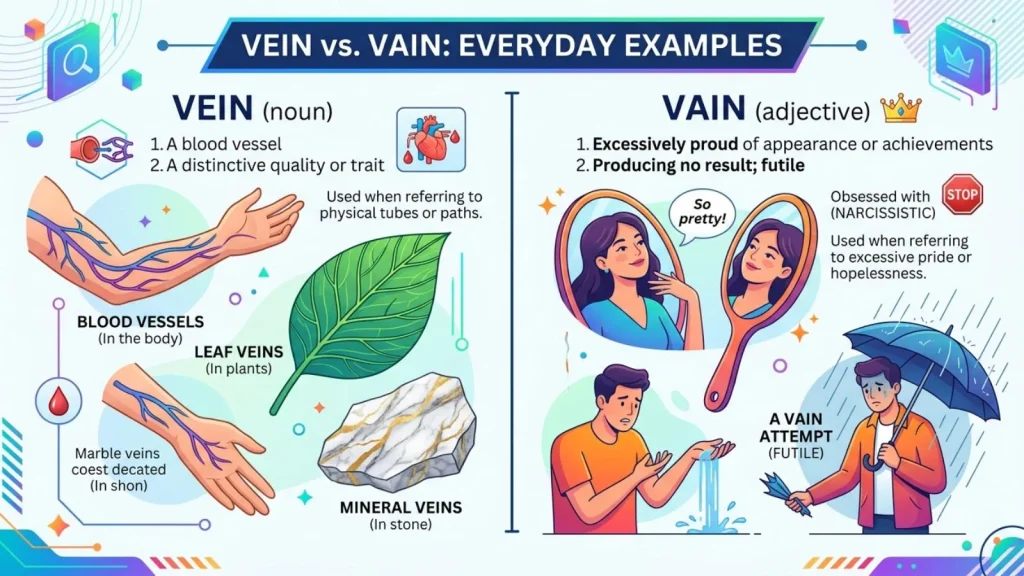
In emails: “Let’s continue the project in the same vein as last quarter’s approach.”
In news headlines: “Officials warned that the peace talks may end in vain.”
Social media posts: “He’s so vain, he checks his reflection in every window. 😂”
In formal writing: “The geologist identified a vein of quartz running through the rock face.”
In casual conversation: “Don’t be vain, just wear the raincoat.”
Each example shows the word doing a different job: a blood vessel, a style, a failed effort, pride, or a mineral streak. Context always signals which one you need.
Vein or Vain – Google Trends & Usage Data
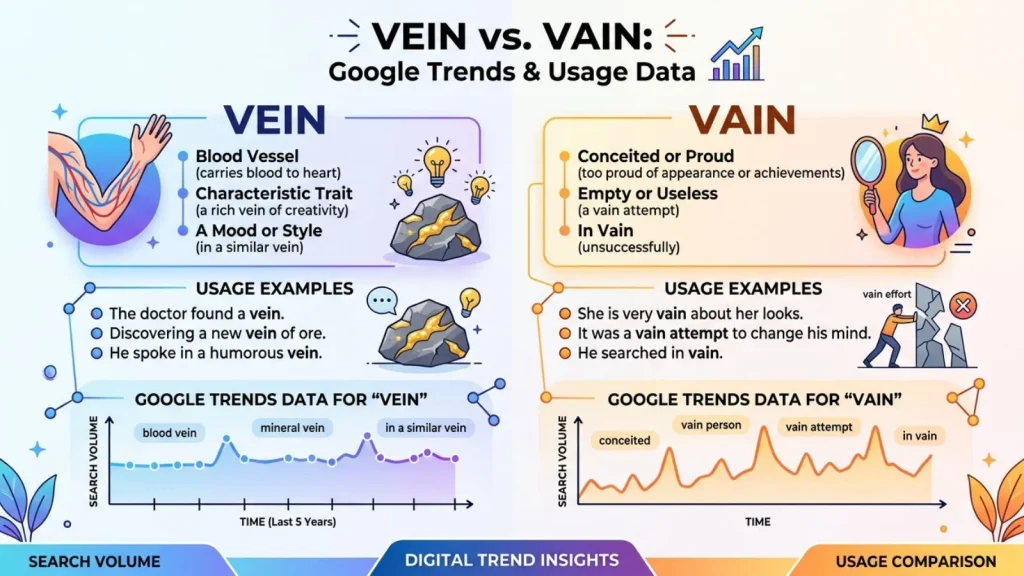
Search interest in this word pair stays fairly steady year-round, without major spikes. It tends to come from three types of searchers:
- Students and writers double-checking grammar before submitting work.
- Non-native English speakers learning tricky homophones.
- General readers who saw the word in a book, song, or article and want to confirm its meaning.
Interest is fairly even across English-speaking countries, since (as shown above) this is not a regional spelling issue. The searches spike slightly during back-to-school months, when students write more essays and reports.
Comparison Table: Vein vs Vain vs Vane
| Feature | Vein | Vain | Vane |
| Pronunciation | /veɪn/ | /veɪn/ | /veɪn/ |
| Part of speech | Noun | Adjective | Noun |
| Core meaning | Blood vessel, streak, style | Overly proud; useless | Device showing wind direction |
| Example | “A vein in his arm” | “He is very vain” | “The weather vane” |
| Common phrase | “In a similar vein” | “In vain” | “Weather vane” |
| Root language | Latin vena | Latin vanus | Old English fana |
FAQs
1. Do “vein” and “vain” sound the same?
Yes. They are homophones, pronounced identically as /veɪn/, but spelled differently and mean different things.
2. Is “vein or vain” a British vs American spelling difference?
No. Both words are spelled the same way in British and American English. The confusion is about meaning, not region.
3. What does “in vain” mean?
It means an effort failed or had no result. Example: “They searched in vain for the missing keys.”
4. What does “in a similar vein” mean?
It means “in a similar style or manner.” Example: “He wrote another poem in a similar vein.”
5. Is there a third word that sounds like vein and vain?
Yes. “Vane,” as in “weather vane,” also sounds the same.
6. How can I remember the difference between vein and vain?
Link “vein” to body parts (veins carry blood) and “vain” to vanity (both start differently but “vain” and “vanity” share the same root).
7. Will spell check catch a vein/vain mistake?
No. All three words are real, correctly spelled words. Spell check only flags misspellings, not wrong word choice.
Conclusion
“Vein or vain” is a classic case of two words that sound alike but mean very different things. A vein is a blood vessel, a streak of mineral, or a style. Vain describes pride or failed effort. There is also a third lookalike, “vane,” used for wind direction devices.
Unlike “color vs colour,” this is not a British vs American spelling issue. Every English speaker, no matter where they live, needs to choose based on meaning, not region. The safest method is to picture the context: bodies and style use “vein,” pride and failure use “vain,” and wind devices use “vane.”
Once you link each word to its meaning, the mix-up disappears for good. Read your sentence back and ask what you are really describing. That one habit will save you from this error every time you write.

Here’s a concise 2-line author bio suitable for Simifind.com:
James Dashner is an American bestselling author best known for The Maze Runner series and other popular young-adult fiction.
On Simifind.com, he shares clear, engaging insights and helpful content for readers interested in books, writing, and popular literature.