Have you ever wondered whether you should write “rein” or “reign” when both words sound exactly the same?
Hey, I want to share something that happened to me recently about rein or reign.
I was chatting with a friend when I suddenly saw this term pop up, and honestly, I had no clue which word was correct at first.
I kept wondering, “Am I missing something?” It was a little confusing, and I didn’t want to respond with the wrong spelling.
So, I decided to look into rein or reign and understand their meanings and proper contexts.
After learning the difference, I realized how important these two words are to understand because they sound alike but have completely different meanings.
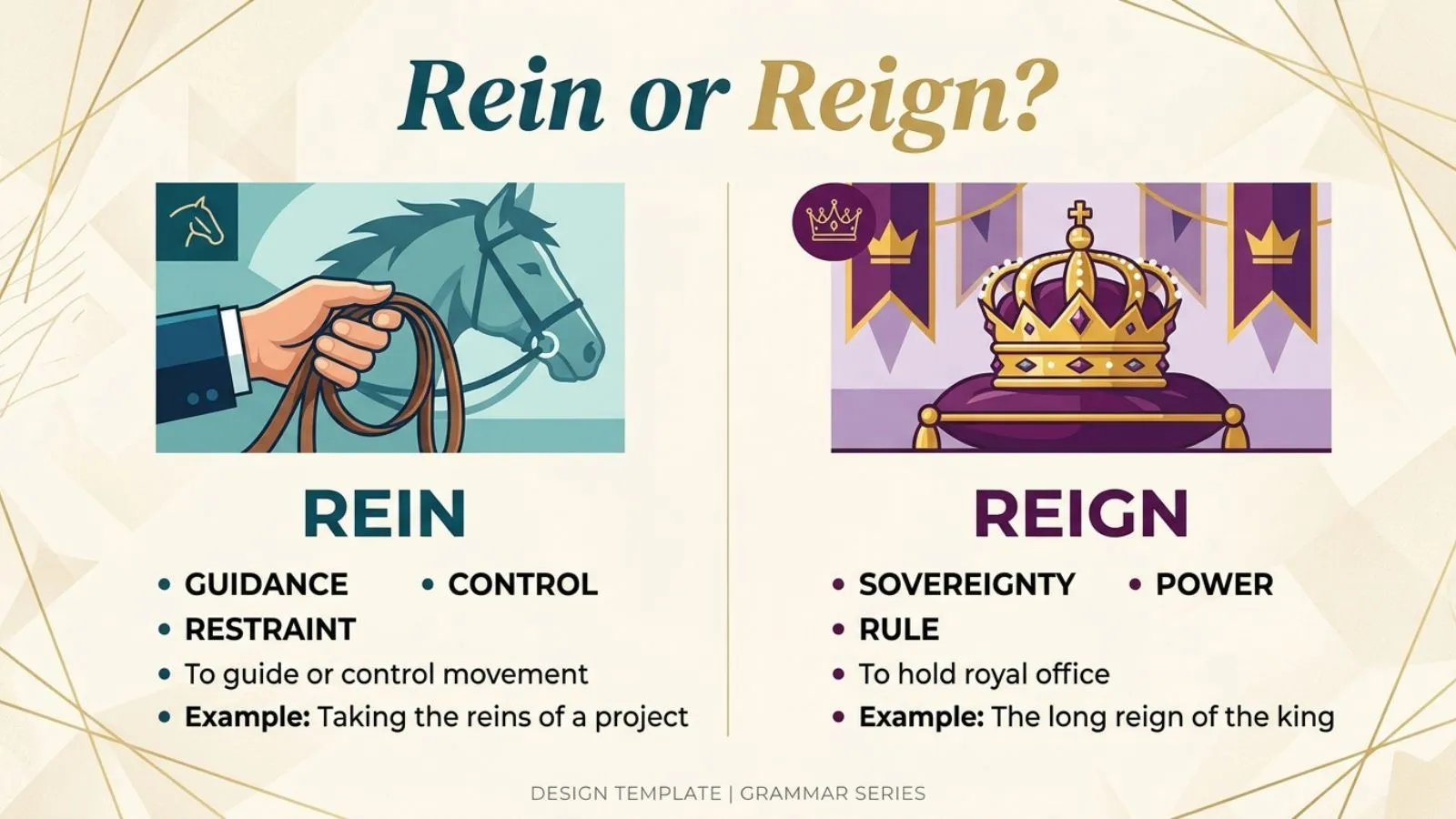
“Rein” can refer to controlling or guiding something, while “reign” relates to the rule or authority of a king or queen.
Knowing this simple difference helped me avoid awkward mistakes in conversations, writing, and social media.
Now, whenever I see rein or reign, I know exactly which word fits the context, and I can use it with confidence.
Rein or Reign – Quick Answer
Here’s the short version:
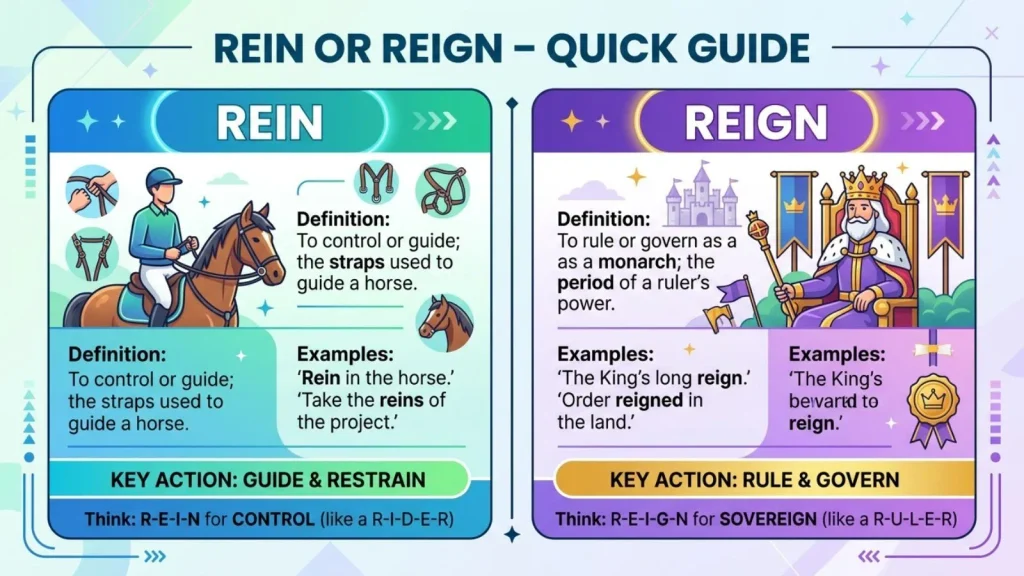
- Rein is a strap used to control a horse. Used in phrases like free rein, rein in, and hold the reins.
- Reign is the period a monarch rules, or the act of ruling. Used in phrases like the queen’s reign and a reign of terror.
Quick examples:
- ✅ She gave her team free rein to redesign the website.
- ✅ The king’s reign lasted for over 40 years.
- ✅ The manager needs to rein in spending this quarter.
- ❌ She gave her team free reign to redesign the website. (Wrong — no monarchy involved here.)
If you’re talking about control or restraint, use rein. If you’re talking about ruling power, use reign.
The Origin of Rein or Reign
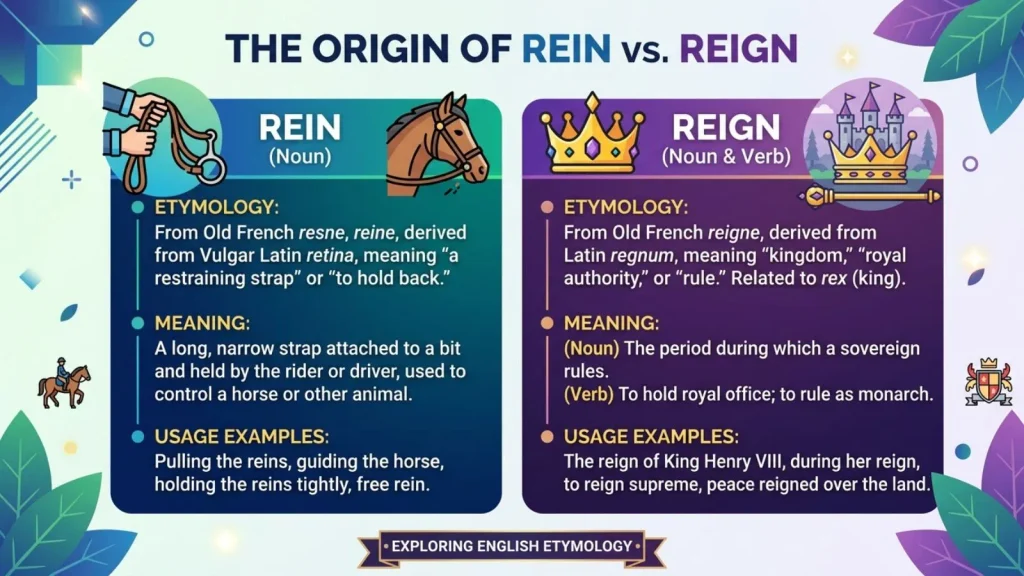
Both words trace back to Old French, which is exactly why they collided in English.
- Rein comes from the Old French word rene, meaning a strap used to guide a horse. It’s tied to physical control — literally holding the leather straps that steer an animal.
- Reign comes from the Old French word regne, which traces back to the Latin regnum, meaning kingdom or royal rule. It’s tied to authority and governance.
Because both words entered English around the same period, from the same source language, and ended up sounding identical, writers have mixed them up for centuries. The confusion isn’t a modern typing error — it’s a side effect of English borrowing so heavily from French and Latin at once.
Same Sound, Different Words — Not a Spelling Variant Rein or Reign
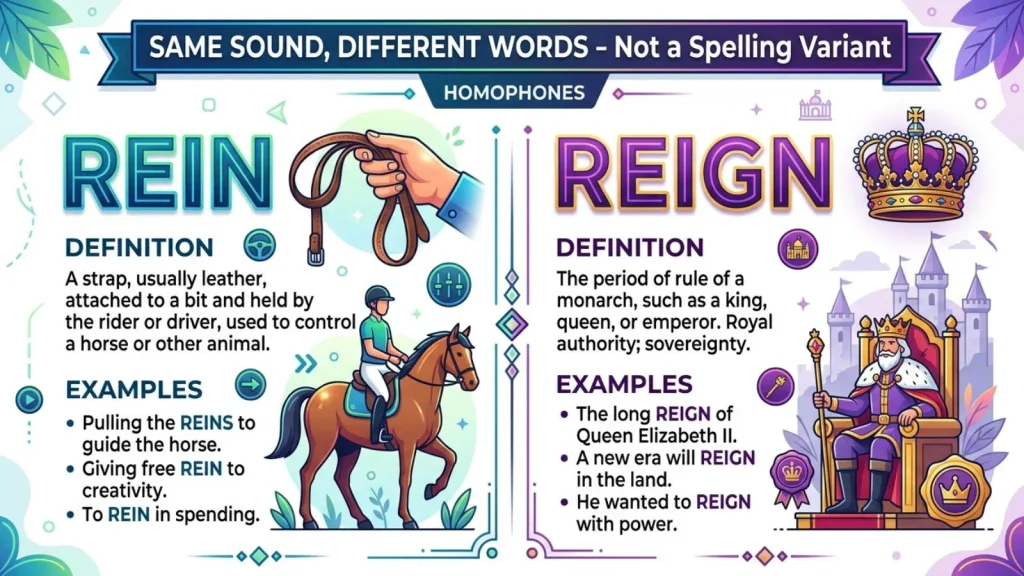
Unlike words such as color/colour or organize/organise, “rein” and “reign” are not regional spelling differences. British English and American English spell both words exactly the same way and use them for exactly the same meanings. This isn’t a US-vs-UK issue — it’s a same-sound, different-word issue that trips up writers everywhere.
There is one related word to watch: rain (falling water), a third homophone that joins the confusion in casual writing.
| Word | Meaning | Example | Used in US? | Used in UK? |
| Rein | Strap to control a horse; restraint | “Rein in your spending.” | Yes | Yes |
| Reign | Period or act of ruling | “The queen’s reign began in 1952.” | Yes | Yes |
| Rain | Water falling from clouds | “It might rain tomorrow.” | Yes | Yes |
Which Spelling Should Use Rein or Reign ?
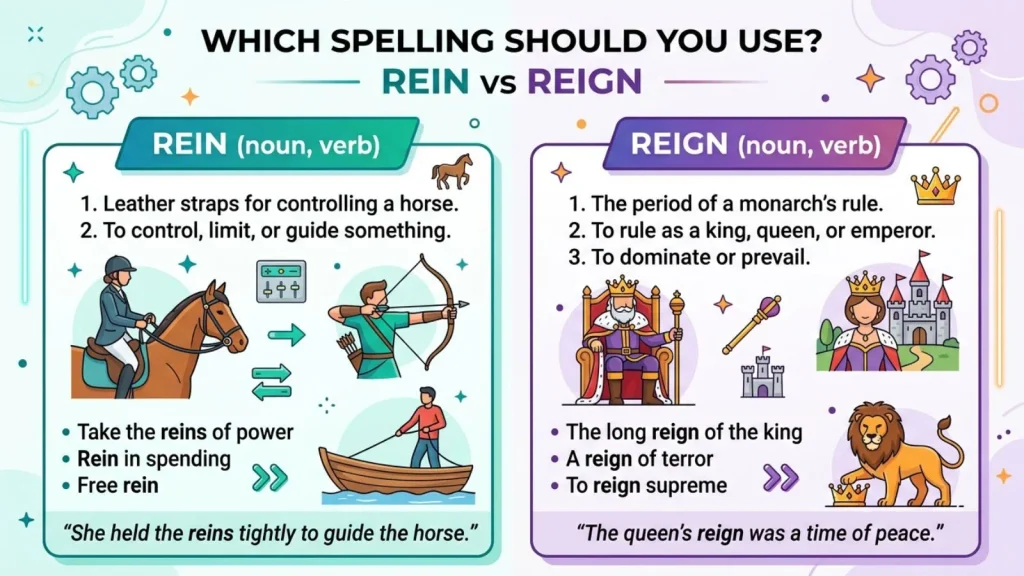
Since spelling doesn’t change by region here, the real question is which word fits your meaning. Here’s guidance by context:
- US and UK writers alike: Use rein for control, restraint, or guidance. Use reign for rule, power, or a period of leadership.
- Business and professional writing: “Free rein” is the correct idiom when giving someone freedom to act. Avoid “free reign” in reports, resumes, and formal emails — it’s a common but incorrect substitution.
- Journalism and formal publishing: Style guides like AP and Chicago both require rein in phrases about control (rein in inflation) and reign only for ruling periods or dominance (a reign of dominance in sports).
- Everyday casual writing: Mistakes here are common and usually forgiven, but getting it right builds credibility.
Common Mistakes with Rein or Reign
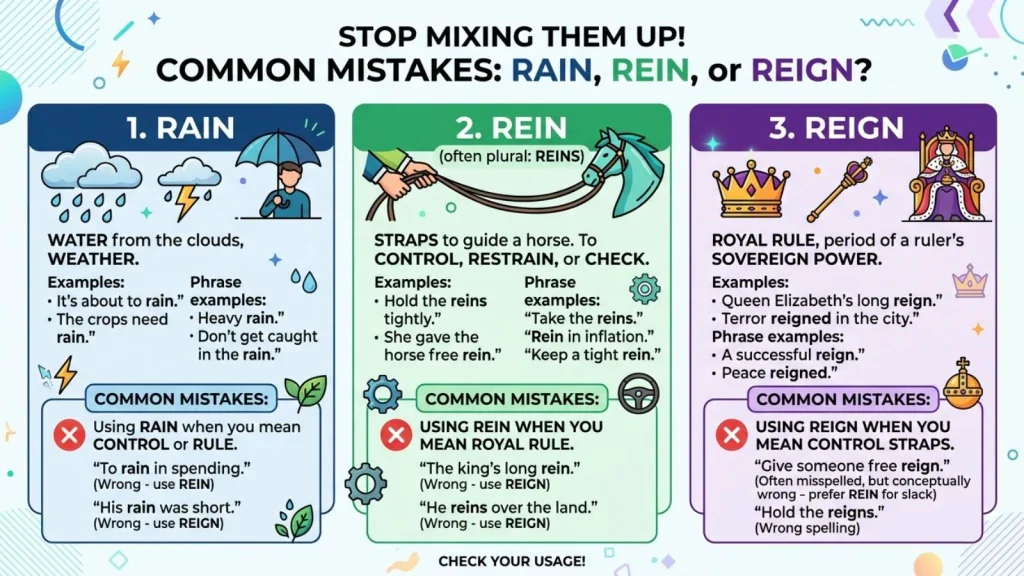
- “Free reign” instead of “free rein” — the most common error. The phrase comes from loosening a horse’s reins to let it move freely, not from royal power.
- “Reign in” instead of “rein in” — when you mean to hold back or control something, the correct phrase is rein in (like pulling back on reins), not reign in.
- “Take the reign” instead of “take the reins” — this idiom is about grabbing physical reins to steer, so it should stay plural: reins.
- Confusing “rain” with either word — spellcheck sometimes won’t flag this since all three are valid words.
- Using “reign” for any kind of general control — reign is specific to ruling or dominating (a country, era, or competition), not everyday management tasks.
Rein or Reign in Everyday Examples
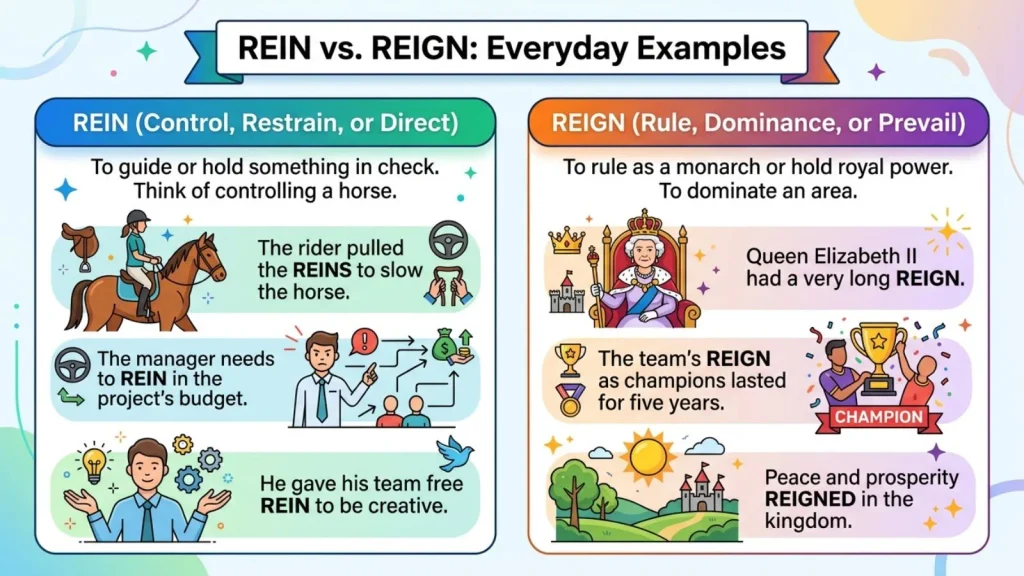
Email:
“I’ll give you free rein on the campaign design — just keep me updated on progress.”
News headline:
“Central Bank Moves to Rein In Rising Inflation”
Social media post:
“This team’s reign at the top of the league continues for a third straight year. 🏆”
Formal report:
“Management should rein in unnecessary expenses before the next fiscal quarter.”
Historical writing:
“Queen Victoria’s reign remains one of the longest in British history.”
Rein or Reign – Google Trends & Usage Data
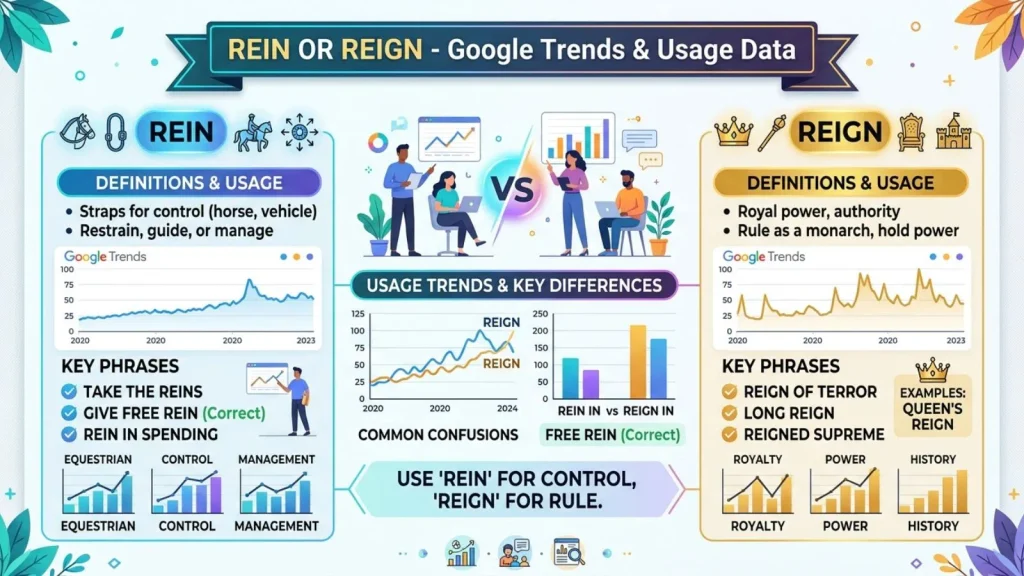
Search interest in “rein or reign” stays steady year-round, with small spikes tied to royal news events, elections, and sports championships — moments when “reign” naturally appears more often in headlines.
General patterns show:
- United States: Frequent searches for “free rein vs free reign,” often from writers checking business or academic writing.
- United Kingdom and Commonwealth countries: Higher natural use of “reign” due to ongoing coverage of royal family history and monarchy-related news.
- Global searches: Consistent interest from ESL learners and students, since homophones are a common stumbling block in English learning.
Despite regional differences in how often each word appears in news content, correct usage rules remain identical everywhere English is written.
Rein or Reign — Comparison Table
| Term | Part of Speech | Meaning | Common Phrase | Correct Example |
| Rein | Noun/Verb | Strap for horse control; to restrain | Free rein, rein in | “Give the new hire free rein on the project.” |
| Reign | Noun/Verb | Period of rule; to rule or dominate | A reign of, reign supreme | “The champion continues to reign supreme.” |
| Reins | Noun (plural) | Physical straps for guiding a horse | Take the reins | “She took the reins of the family business.” |
| Rain | Noun/Verb | Precipitation | Rain check, rain or shine | “We’ll meet rain or shine.” |
FAQs
1. Is it “free rein” or “free reign”?
It’s “free rein.” The phrase comes from loosening a horse’s reins to allow free movement, not from royal authority.
2. Is it “reign in” or “rein in”?
“Rein in” is correct. It means to pull back or control something, just like pulling reins to slow a horse.
3. What does “reign supreme” mean?
It means to be the top or most dominant power in a situation, often used for champions, rulers, or leading brands.
4. Are “rein,” “reign,” and “rain” all pronounced the same?
Yes, all three are homophones in most English accents, which is exactly why they get confused in writing.
5. Is “free reign” ever correct?
Only if you’re specifically talking about a monarch’s free or unrestricted rule. In almost all other contexts, “free rein” is correct.
6. Does British English spell these words differently from American English?
No. Both words are spelled identically in British and American English. The confusion is about word choice, not regional spelling.
7. Why do so many people get “rein” and “reign” wrong?
Because they sound identical and both relate loosely to control or power, making it easy to pick the wrong one without realizing it.
Conclusion
“Rein or reign” isn’t a spelling variation — it’s a mix-up between two different words that happen to sound the same.
Rein relates to control, restraint, and guidance, rooted in the straps used to steer a horse. Reign relates to ruling power, tied to monarchs and periods of leadership.
The phrases that trip people up most are “free rein” (not “free reign”) and “rein in” (not “reign in”). Both mistakes are common because the words sound identical and both loosely relate to power or control, but the underlying imagery is different: one is about horses, the other about kings and queens.
Whether you’re writing a business email, a news article, or a social media caption, the rule stays the same everywhere English is written: use “rein” for control and restraint, and “reign” for rule and dominance. Keep that distinction in mind, and you’ll never mix them up again.
Continue Reading:
- Saber or Conocer: Spanish Meaning, Rules, and Examples (for 2026)
- Focusses or Focuses: Examples, Rules, and Correct Usage (for 2026)
- Ketchup or Catsup: Meaning, Spelling, and Usage (for 2026)

Here’s a concise 2-line author bio suitable for Simifind.com:
James Dashner is an American bestselling author best known for The Maze Runner series and other popular young-adult fiction.
On Simifind.com, he shares clear, engaging insights and helpful content for readers interested in books, writing, and popular literature.