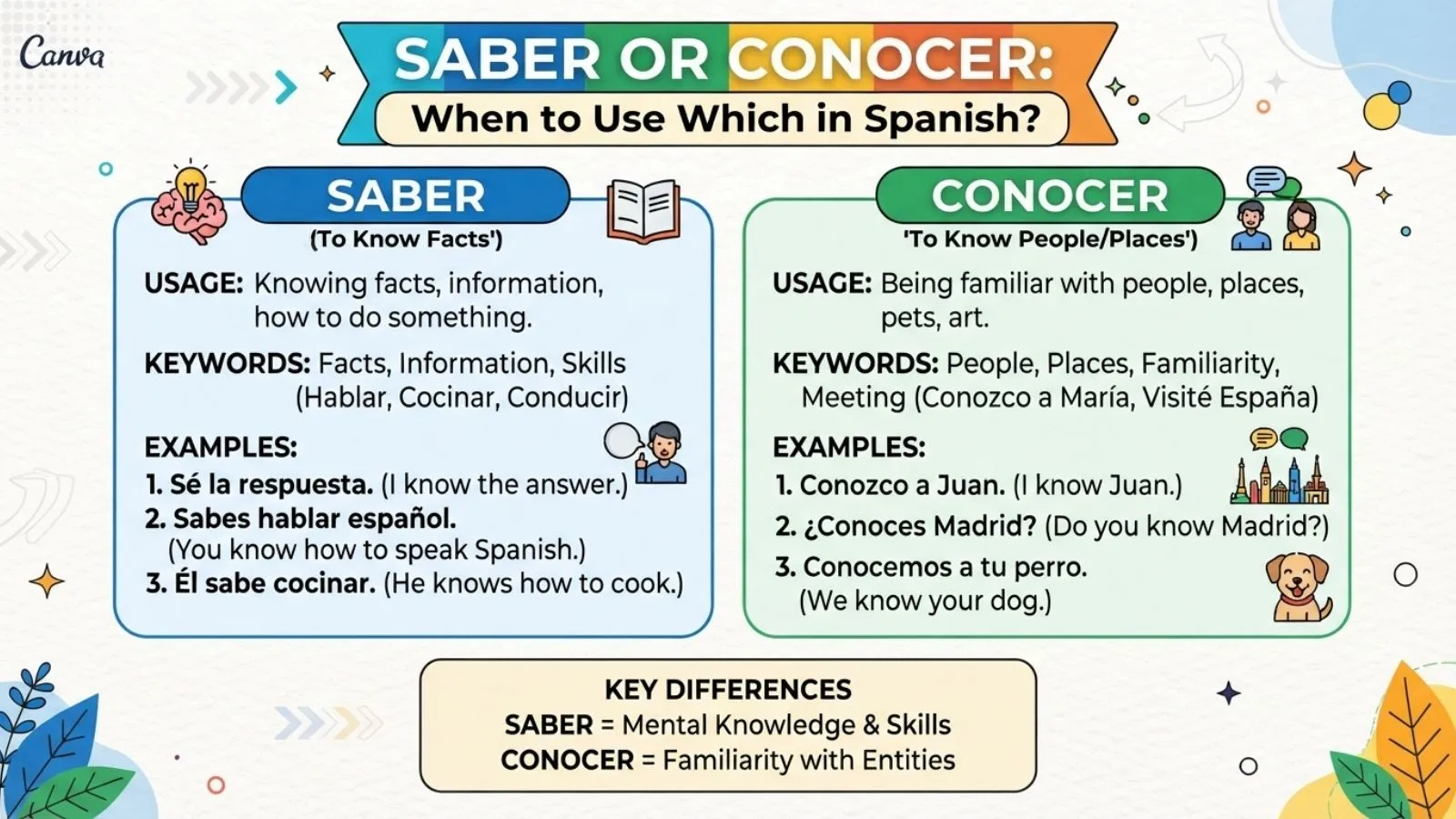
Have you ever wondered why Spanish has two different words for “to know”—saber and conocer?
Knowing which one to use can completely change the meaning of your sentence.
Hey, I want to share something that happened to me recently about Saber or Conocer.
I was chatting with a friend when I suddenly saw these Spanish terms pop up, and honestly, I had no clue at first why there were two different words for “know.”
I kept wondering, “Am I missing something here?” It was a bit confusing, and I didn’t want to respond the wrong way.
So, I decided to look into Saber or Conocer and understand their meaning and context.
After learning the difference, I realized how important these two words are for speaking and writing Spanish correctly.
Saber is generally used for knowing facts, information, or how to do something, while conocer is commonly used for knowing or being familiar with a person, place, or thing.
Understanding this simple difference helped me avoid awkward mistakes in conversations.
Now, whenever I see Saber or Conocer, I feel more confident knowing which word fits the situation.
Saber or Conocer – Quick Answer
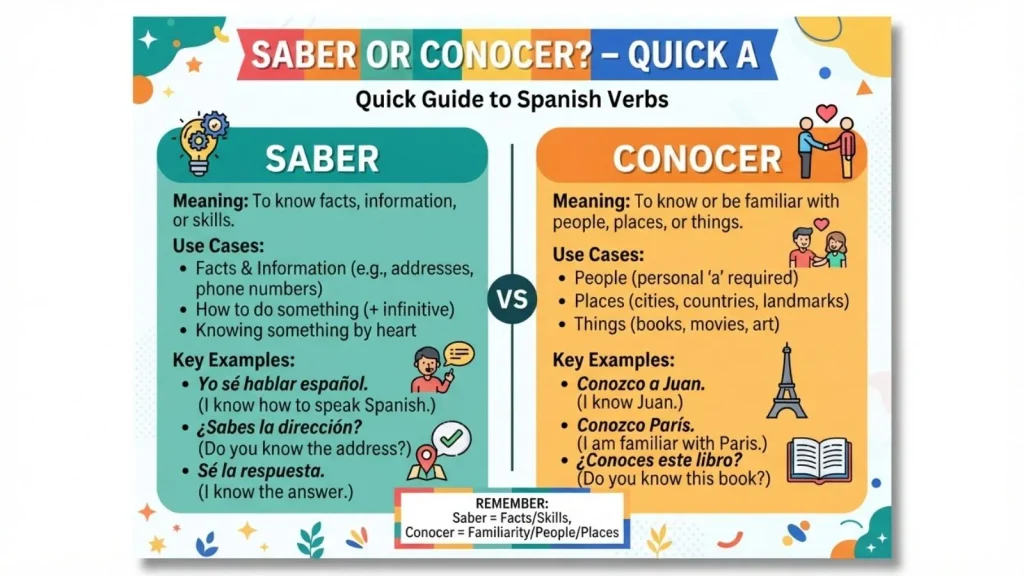
Use saber for facts, information, and skills. Use conocer for people, places, and things you are familiar with.
Quick examples:
- Sé la respuesta. (I know the answer.) → fact → saber
- Sé nadar. (I know how to swim.) → skill → saber
- Conozco a Juan. (I know Juan.) → person → conocer
- Conozco Madrid. (I know Madrid.) → place → conocer
A simple test: if you can replace “know” with “know how to” or “know that,” use saber. If you can replace it with “am familiar with” or “have met,” use conocer.
The Origin of Saber and Conocer
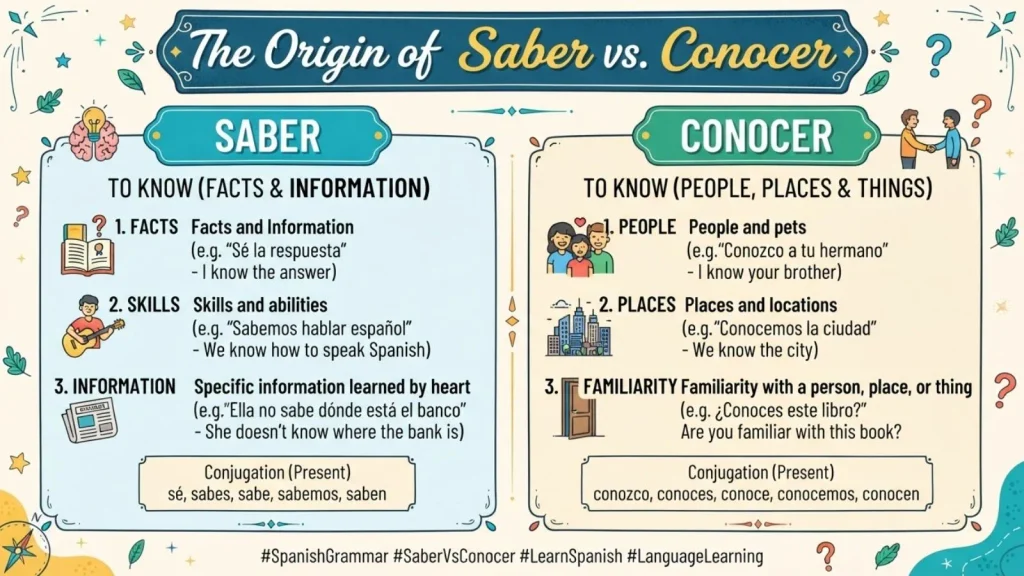
Both verbs come from Latin.
Saber comes from the Latin verb sapere, meaning “to taste” or “to be wise.” Over time, it shifted to mean “to know” in the sense of facts and knowledge. The English word “sapient” shares this root.
Conocer comes from the Latin verb cognoscere, meaning “to become acquainted with” or “to learn.” This is the same root behind English words like “cognition” and “recognize.”
Latin already had this split. Classical Latin used scire for factual knowledge and cognoscere for familiarity.
Spanish kept the second verb and swapped scire for a descendant of sapere. French and Italian made similar choices, which is why French has savoir and connaître, and Italian has sapere and conoscere.
English lost this distinction over time and settled on one word, “know,” which is why English speakers find the split confusing today.
Sentence With Conocer
The Spanish verb conocer means “to know,” “to meet,” or “to be familiar with” someone or a place. It is commonly used when talking about knowing people, becoming acquainted with someone, or being familiar with a place.
Examples:
- Quiero conocer a tu familia. — I want to meet your family.
- Conozco a María. — I know María.
- Me gustaría conocer España. — I would like to visit/get to know Spain.
- ¿Conoces este lugar? — Do you know this place?
- Ayer conocí a un nuevo amigo. — Yesterday, I met a new friend.
Use conocer for familiarity or meeting people and places. For knowing facts or information, Spanish usually uses saber instead.
Saber vs Conocer – Key Differences
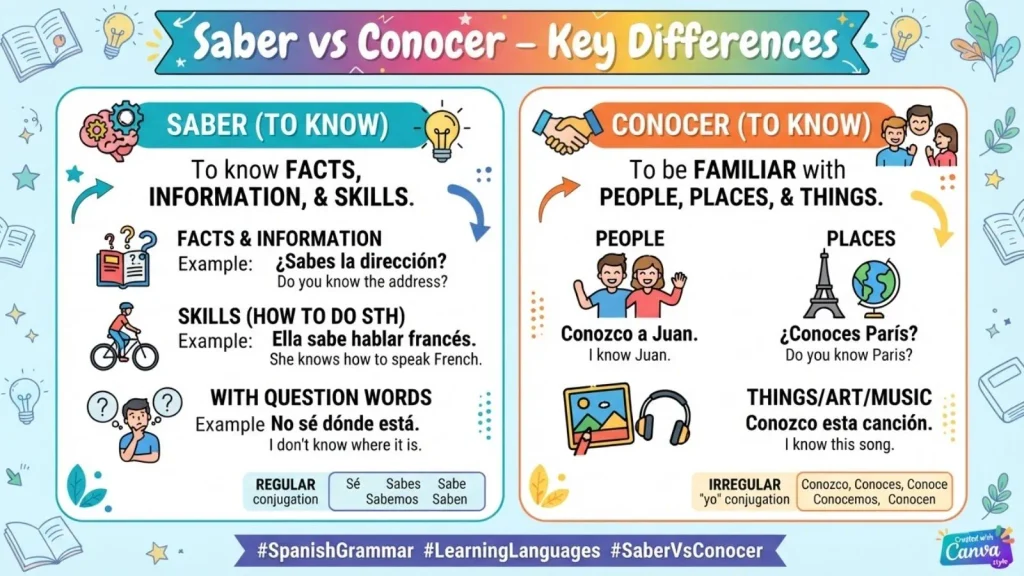
The two verbs are not interchangeable. Each one covers a specific type of knowledge.
Saber covers:
- Facts and information (Sé que llueve. – I know it’s raining.)
- Skills, often with an infinitive (Sé cocinar. – I know how to cook.)
- Memorized information (Sé mi número de teléfono. – I know my phone number.)
Conocer covers:
- People (Conozco a tu hermana. – I know your sister.)
- Places (Conozco Barcelona. – I know Barcelona.)
- Things you’ve experienced or are familiar with (Conozco esa película. – I’m familiar with that film.)
One extra rule: when conocer is followed by a person, Spanish adds the word a right before that person. Grammar teachers call this the “personal a.” Saber does not use this rule.
| Feature | Saber | Conocer |
|---|---|---|
| Latin root | sapere | cognoscere |
| Covers | Facts, skills, information | People, places, familiarity |
| Followed by infinitive | Yes (sé nadar) | No |
| Needs personal “a” for people | No | Yes (conozco a Ana) |
| English equivalent | to know (a fact), to know how | to know (a person/place), to be familiar with |
| Example | Sé la verdad. | Conozco la ciudad. |
Which One Should You Use Saber or Conocer?
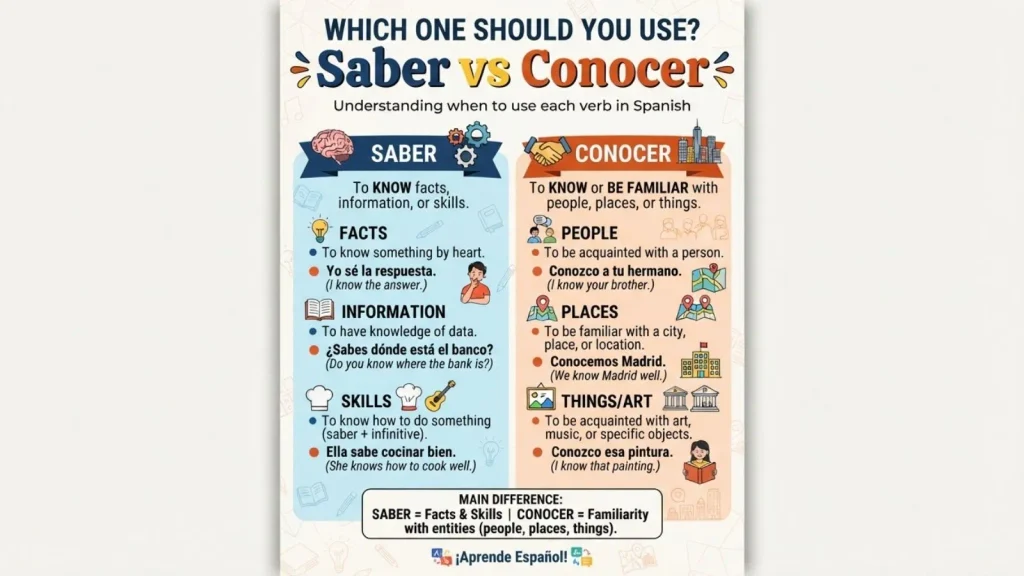
Talking about facts or skills?
Use saber. This covers memorized details, general knowledge, and anything you can do, like a language or a sport.
Talking about people, places, or media?
Use conocer. This covers anyone you’ve met, anywhere you’ve been, and anything you’ve read, watched, or heard before.
Beginners should start with the fact-vs-familiarity rule above. It covers most everyday sentences.
Intermediate and advanced learners should also learn the preterite forms. In the preterite tense, supe means “I found out” (a sudden discovery), and conocí means “I met” (a first encounter). These shift the meaning of both verbs into a specific moment rather than an ongoing state.
Travelers and casual learners can rely on the simple test from the quick answer section: swap in “know how to / know that” for saber, and “am familiar with / have met” for conocer.
Common Mistakes with Saber and Conocer
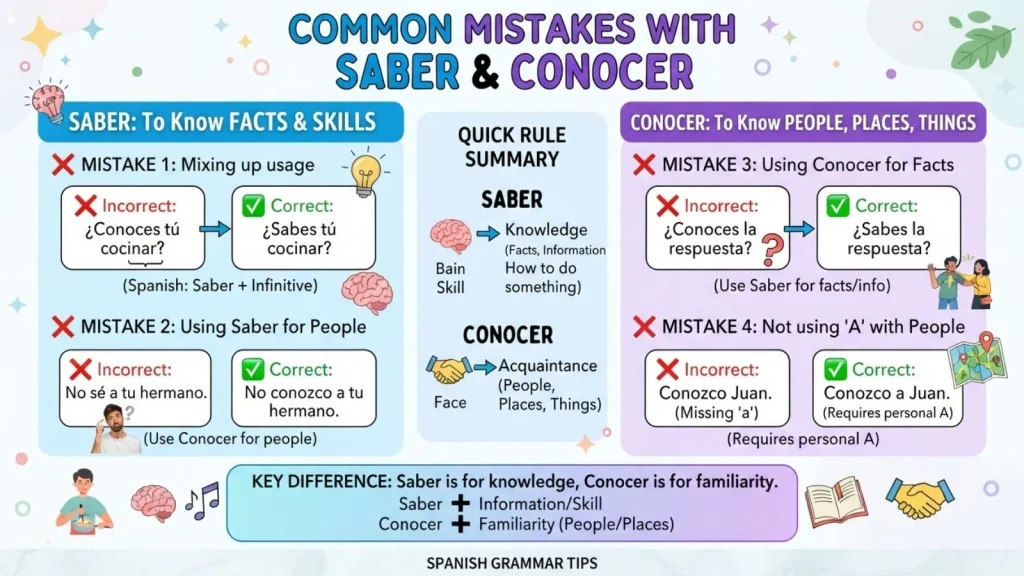
Mistake 1: Saber for people. ❌ Sé a tu amigo. ✅ Conozco a tu amigo.
Mistake 2: Forgetting the personal a with conocer. ❌ Conozco Juan. ✅ Conozco a Juan.
Mistake 3: Conocer for facts. ❌ Conozco la respuesta. ✅ Sé la respuesta.
Mistake 4: Missing the preterite tense shift. ❌ Supe a María en la fiesta. (mixing up the verbs) ✅ Conocí a María en la fiesta. (I met María at the party.)
Mistake 5: Using saber for skills without the infinitive. ❌ Sé español muy bien when trying to say “I know how to speak Spanish well.” ✅ Sé hablar español muy bien.
Saber and Conocer in Everyday Examples
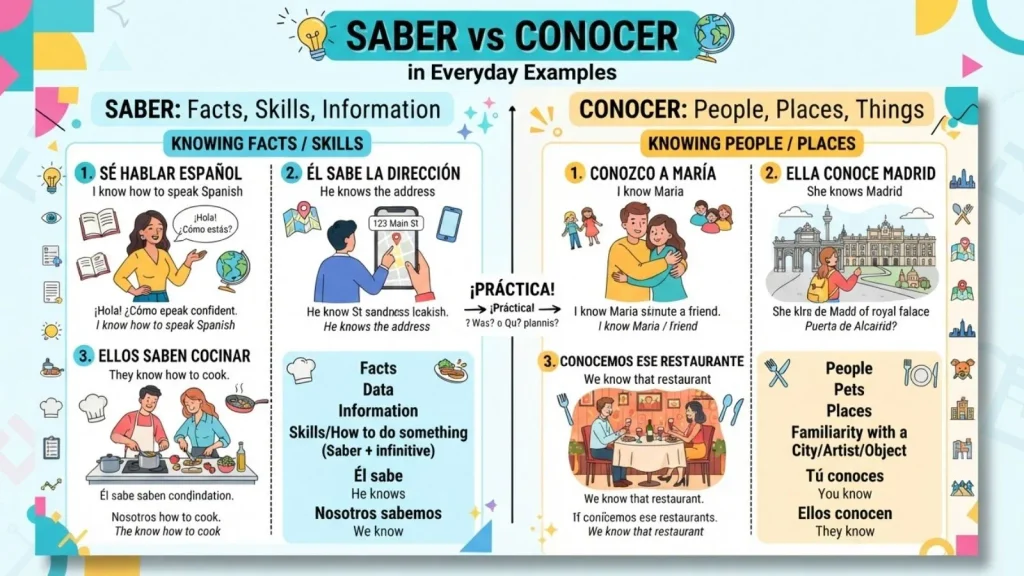
In emails: Le informo que ya sé los resultados del proyecto. (I’m letting you know I already have the project results.)
In news writing: Los expertos ya conocen las causas del incidente. (Experts are now familiar with the causes of the incident.)
On social media: ¿Conocen este restaurante? ¡Sé que la comida es increíble! (Do you know this restaurant? I know the food is amazing!)
In formal writing: El comité conoce el informe completo y sabe que se requieren cambios inmediatos. (The committee is familiar with the full report and knows immediate changes are required.)
Saber or Conocer – Google Trends & Usage Data
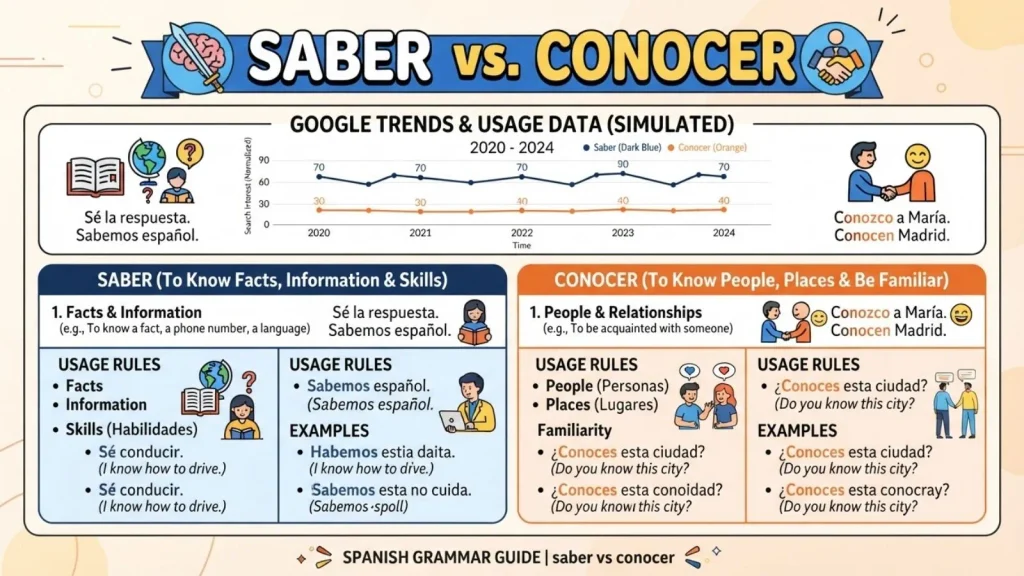
Search interest for “saber or conocer” comes mostly from Spanish-language learners in the United States, Canada, and the United Kingdom, where Spanish is a common second-language course
Search volume rises during back-to-school months (August–September) and again in January, matching new semester enrollment.
Within Spanish-speaking countries, this comparison rarely appears as a search term, since native speakers absorb the distinction early and don’t need to look it up.
Learner-focused sites, language apps, and grammar blogs drive most of the traffic on this topic, and mobile searches make up the majority, reflecting on-the-go study habits during commutes or class breaks.
| Term Variation | Typical Searcher | Search Intent |
|---|---|---|
| saber or conocer | Beginner/intermediate learner | Basic rule and examples |
| saber vs conocer | Student comparing usage | Side-by-side comparison |
| saber conocer preterite | Intermediate/advanced learner | Tense-specific meaning shift |
| when to use saber and conocer | Beginner | Practical usage rule |
| saber conocer exercises | Student, teacher | Practice material |
FAQs
1. What’s the easiest way to remember saber vs conocer?
Saber = facts and skills. Conocer = people, places, and familiarity. If you can say “I know how to” or “I know that,” use saber.
2. Can saber and conocer ever be used interchangeably?
Rarely. In a few cases, like knowing a subject area (Conozco/Sé de historia), both can work, but the meaning shifts slightly. In most sentences, only one verb is correct.
3. Why does conocer need the word “a” before a person?
This is the “personal a” rule in Spanish grammar. It marks a direct object as a person and appears with conocer whenever the object is human.
4. What does saber mean in the preterite tense?
In the preterite, saber means “found out” or “learned,” referring to a specific moment of discovery, not ongoing knowledge.
5. What does conocer mean in the preterite tense?
In the preterite, conocer means “met,” referring to the moment you first encountered a person or place.
6. Is conocer used for places you’ve only heard of, not visited?
No. Conocer implies direct familiarity, usually from visiting or experiencing something firsthand. For places you’ve only heard about, Spanish speakers typically use other phrasing, such as he oído hablar de (I’ve heard of).
7. Do French and Italian have the same split as Spanish?
Yes. French uses savoir and connaître, and Italian uses sapere and conoscere, following the same Latin-based pattern as Spanish’s saber and conocer.
Conclusion
Saber and conocer both mean “to know,” but they cover different ground. Saber handles facts, information, and skills. Conocer handles people, places, and familiarity.
The split traces back to Latin, where sapere and cognoscere already carried these separate meanings, long before Spanish, French, and Italian each kept the distinction in their own way.
The fastest way to choose the right verb is a simple swap test: try “know how to” or “know that” first. If it fits, use saber. it doesn’t, try “am familiar with” or “have met.” If that fits better, use conocer.
Watch for the two most common slip-ups: using saber for people, and forgetting the personal a after conocer.
Also remember that both verbs shift meaning in the preterite tense which , saber becomes “found out,” and conocer becomes “met.”
With the fact-vs-familiarity rule and a little practice, you’ll stop pausing mid-sentence and start using saber and conocer with confidence.

Here’s a concise 2-line author bio suitable for Simifind.com:
James Dashner is an American bestselling author best known for The Maze Runner series and other popular young-adult fiction.
On Simifind.com, he shares clear, engaging insights and helpful content for readers interested in books, writing, and popular literature.





1 thought on “Saber or Conocer: Spanish Meaning, Rules, and Examples (for 2026)”