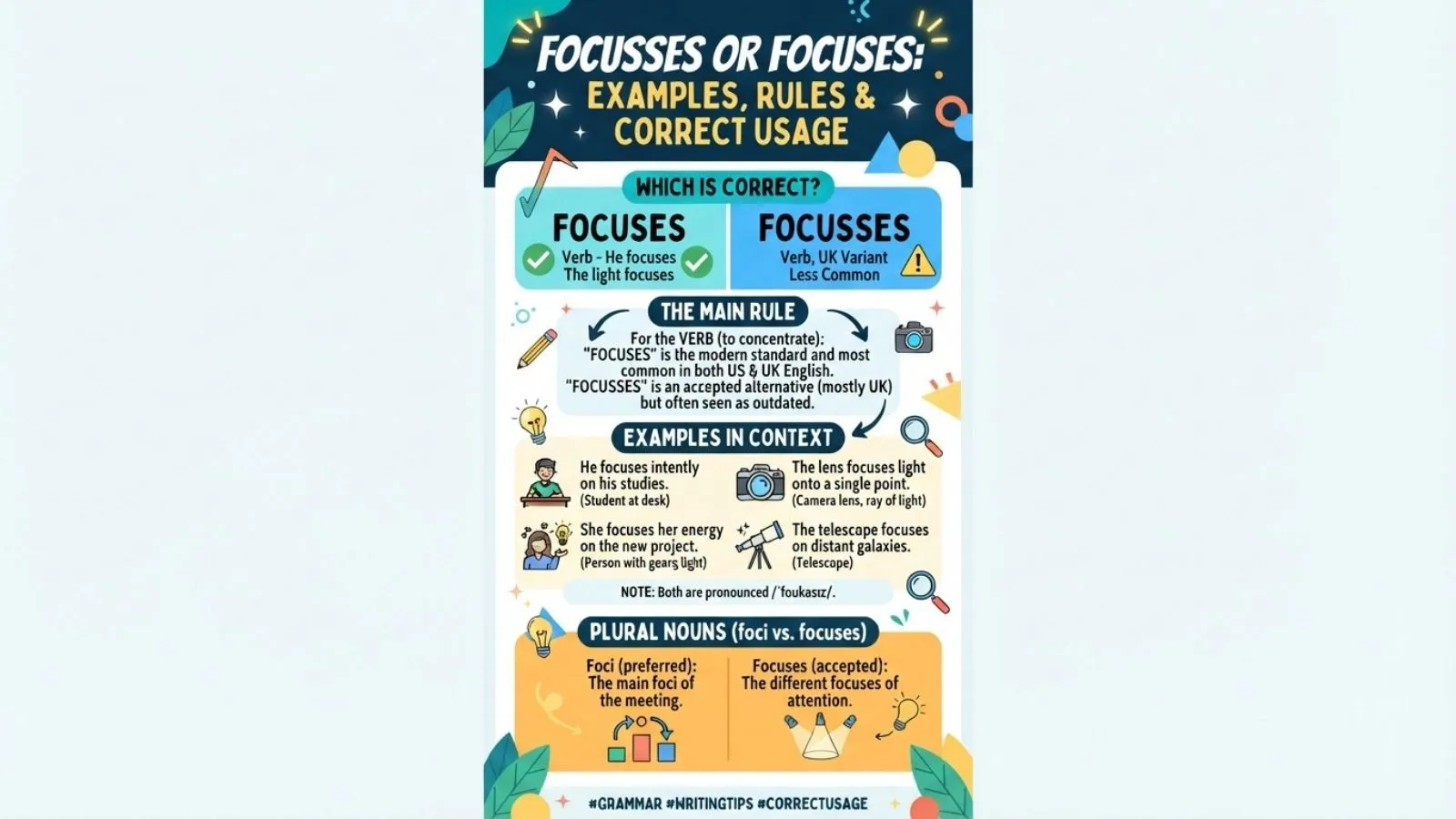
Have you ever stopped mid-sentence and wondered, “Is it focusses or focuses?”
It’s a small spelling difference, but choosing the wrong form can make your writing look less polished.
Hey, I want to share something that happened to me recently about Focusses or Focuses.
Chatting with a friend when I suddenly saw this term pop up, and honestly, I had no clue which spelling was correct at first.
I kept wondering, “Am I missing something here?” It was a bit confusing, and I didn’t want to respond the wrong way.
So, I decided to look into Focusses or Focuses and figure out their meaning, spelling, and proper usage.
After understanding the difference, I realized how important it is to know which form is correct, especially when writing messages, emails, social media posts, or professional content.
I handled my confusion by learning the proper spelling and usage, and now I feel ready whenever I see Focusses or Focuses in writing.
Focusses or Focuses – Quick Answer
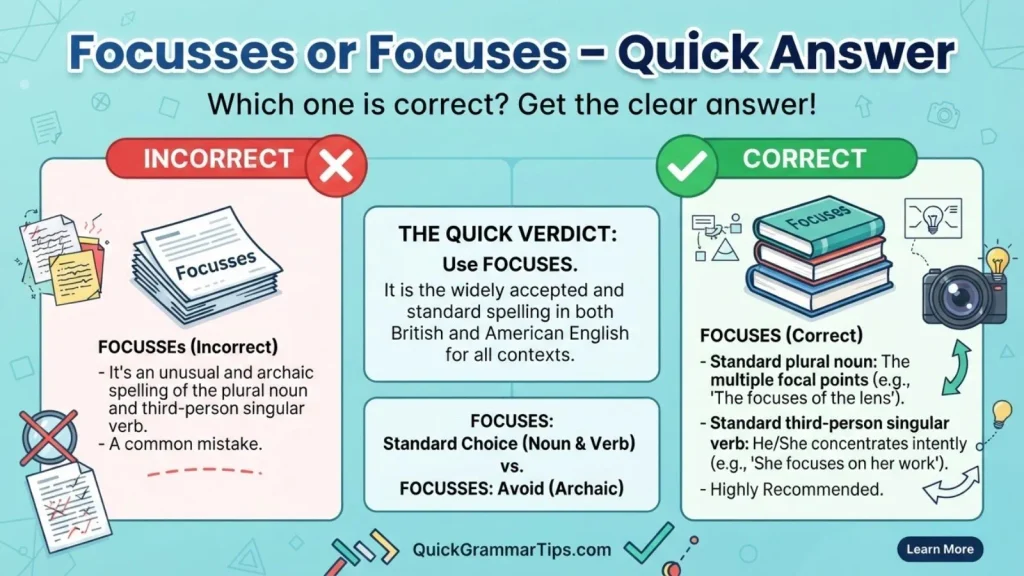
“Focuses” is the correct and standard spelling almost everywhere, including the UK.
“Focusses” is a rare variant. Some British dictionaries list it as acceptable, but most British writers today use “focuses” too.
Quick examples:
- ✅ “This course focuses on writing skills.” (correct, standard)
- ⚠️ “This course focusses on writing skills.” (rare, older British style)
- ✅ “She focused on her goals.” (past tense, standard everywhere)
- ⚠️ “She focussed on her goals.” (rare British variant)
If you are unsure, use “focuses.” It is safe in the US, UK, Canada, Australia, and every other English-speaking country.
The Origin of Focusses or Focuses
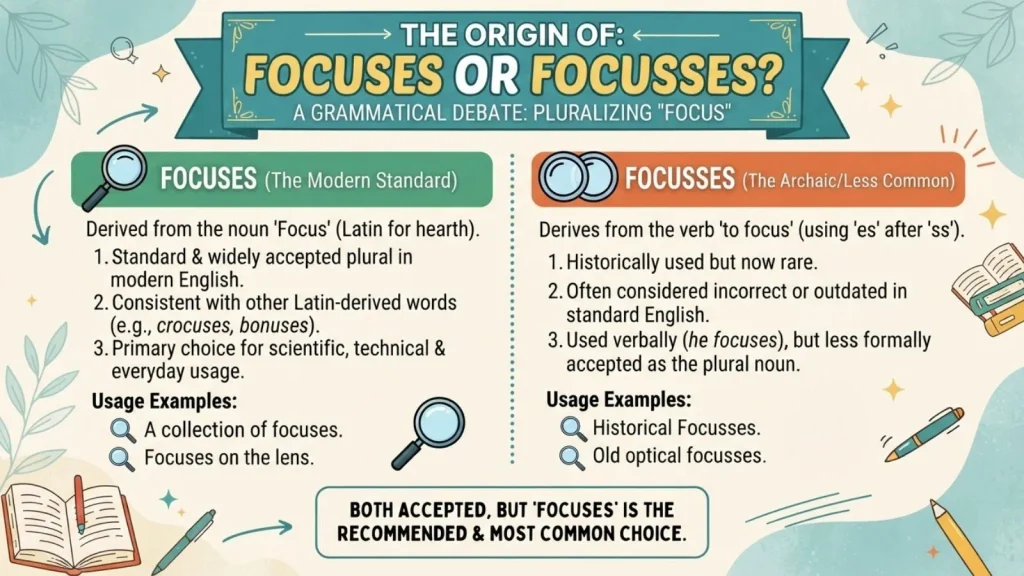
The word “focus” comes from Latin. In Latin, focus means “hearth” or “fireplace.” Scientists later used it to describe the point where light rays meet, like light passing through a lens onto a single spot near a fire.
English borrowed the word in the 1600s for science and optics. Over time, people also started using “focus” to mean “the center of attention,” as we do today.
The spelling confusion comes from a general English rule. Short verbs ending in one vowel plus one consonant sometimes double that consonant before adding an ending. Think of “stop” becoming “stopped.”
Some early British writers applied this rule to “focus” too, doubling the s to get “focusses” and “focussed.”
But “focus” does not follow this pattern the way “stop” does, because the stress and vowel sound work differently.
Over the last century, most style guides, including British ones, dropped the double s. That is why “focuses” is now the accepted standard almost everywhere.
Focuses Meaning: Definition and How to Use It
“Focuses” is the third-person singular form of the verb “focus.” It means to give attention to one particular person, thing, subject, or goal. When someone focuses on something, they concentrate their thoughts, energy, or effort on it instead of being distracted by other things.
For example, “She focuses on her studies” means that she gives most of her attention and effort to studying.
What Does “Focuses” Mean?
The word focuses can have slightly different meanings depending on the context:
- Concentrates attention: “He focuses on his work.”
- Gives importance to: “The article focuses on healthy living.”
- Directs effort toward a goal: “She focuses on improving her skills.”
- Adjusts a camera or lens: “The photographer focuses the camera on the subject.”
Focuses in a Sentence
Here are some simple examples:
- He focuses on his goals every day.
- The teacher focuses on grammar skills.
- This book focuses on personal growth.
- She focuses carefully on the details.
Focuses vs. Focus
The main difference is grammatical. “Focus” can be used with I, you, we, and they, while “focuses” is normally used with he, she, it, or a singular noun.
- I focus on my work.
- They focus on their studies.
- She focuses on her work.
- The lesson focuses on grammar.
In simple terms, “focuses” means concentrates, gives attention to, or directs effort toward something
British English vs American English Spelling
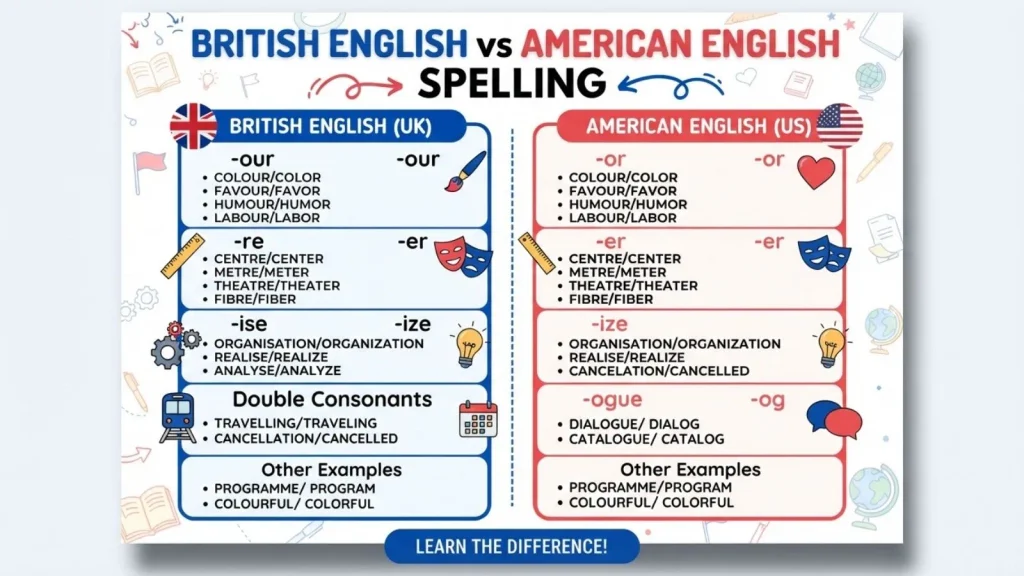
English has many words that split between British and American spelling. Think of “colour” vs. “color” or “organise” vs. “organize.” People naturally assume “focus” follows the same split. It mostly does not.
Here is the real pattern:
- American English: always uses “focuses,” “focused,” and “focusing.”
- British English: mostly uses “focuses,” “focused,” and “focusing” too. “Focusses,” “focussed,” and “focussing” appear only in older or more formal British texts, and even there, they are becoming rare.
This makes “focus” different from most US/UK spelling pairs. It is not a true 50/50 split. It is a mostly settled word with one small, fading exception.
Focussed or Focused in Canada: Which Spelling Is Correct?
In Canadian English, both “focussed” and “focused” are considered correct, but “focused” is the more common and widely preferred spelling in modern Canadian writing. Canadian English follows a mix of British and American conventions, so both forms may appear in dictionaries and published content.
Focused uses one s, while focussed uses a double s. For example:
- She remained focused on her studies.
- The team is focused on improving customer service.
- He stayed focussed on his long-term goals.
If you are writing for a Canadian audience, focused is generally the safest choice because it is widely recognized and commonly used in everyday, academic, business, and online writing.
Comparison Table: Focus Spelling by Region
| Form | American English | British English (modern) | British English (older/rare) |
| Base verb | focus | focus | focus |
| Present tense (he/she) | focuses | focuses | focusses |
| Past tense | focused | focused | focussed |
| -ing form | focusing | focusing | focussing |
| Noun (plural) | focuses / foci | focuses / foci | focuses / foci |
Which Spelling Should You Use focuses,” “focused?
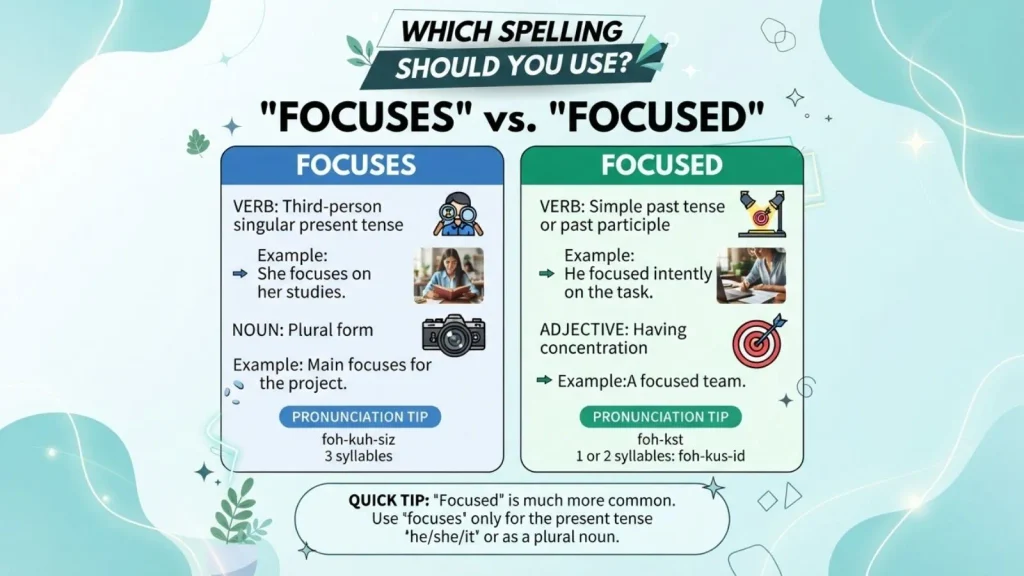
Your choice depends on your audience and the style guide you follow.
If you write for a US audience: Always use “focuses,” “focused,” and “focusing.” Never use the double s forms. US style guides like AP and Chicago do not accept “focussed.”
If you write for a UK or Commonwealth audience (UK, Ireland, Australia, New Zealand, South Africa): Use “focuses,” “focused,” and “focusing” too. This is now the modern standard. Only use “focussed” if you are matching an older document, a specific house style, or a British dictionary entry that lists it as a valid variant.
If you write for a global or mixed audience: Use “focuses.” It reads correctly everywhere and never looks wrong to any reader, US or UK.
If you use spellcheck or grammar tools: Most tools, including Word and Google Docs, will flag “focusses” and “focussed” as errors by default, even in British English mode. That is a strong sign of which form is now preferred.
Focused or Focussed: Which Spelling Is Correct in UK English?
Both focused and focussed are accepted in UK English, but focused is now more common and is generally the preferred spelling in modern British writing. Focussed is also correct, especially in traditional British usage.
- Focused — widely used in modern UK English and international English.
- Focussed — an accepted British variant, often seen in older or more traditional writing.
Examples
- She remained focused on her studies. ✅
- She remained focussed on her studies. ✅
- The team is focused on improving its results. ✅
If you are writing for a UK audience, you can use either spelling, but focused is usually the safer and more widely recognized choice
Common Mistakes with Focusses or Focuses
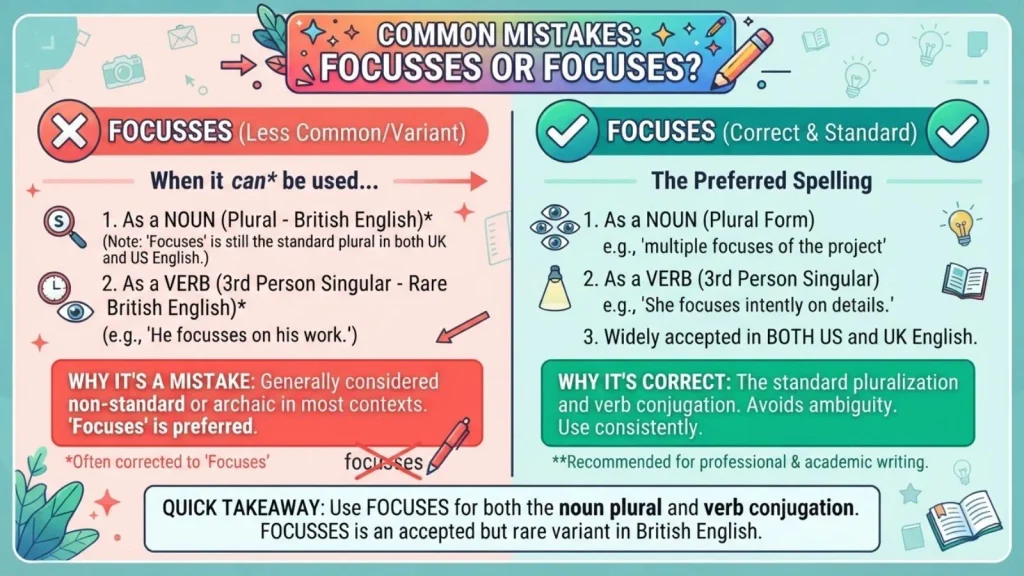
Here are the errors people make most often, with corrections.
- Mistake:“Focus” doubles its consonant like “stop” does. Correction: It mostly does not. Use “focuses,” not “focusses.”
- Mistake: Using “focussed” because you think it is “proper British.” Correction: Modern British style guides now favor “focused.”
- Mistake: Mixing spellings in one document, like “focuses” in one paragraph and “focussed” in another. Correction: Pick one style and stay consistent through the whole document.
- Mistake: Confusing “focus” (noun/verb about attention) with “focust” or “foccus” through simple typos. Correction: The correct spelling is always “focus,” with one c and one s.
- Mistake: Writing “he focus on the project” without the correct verb ending. Correction: Use “he focuses on the project” for present tense with he/she/it.
Focusses or Focuses in Everyday Examples
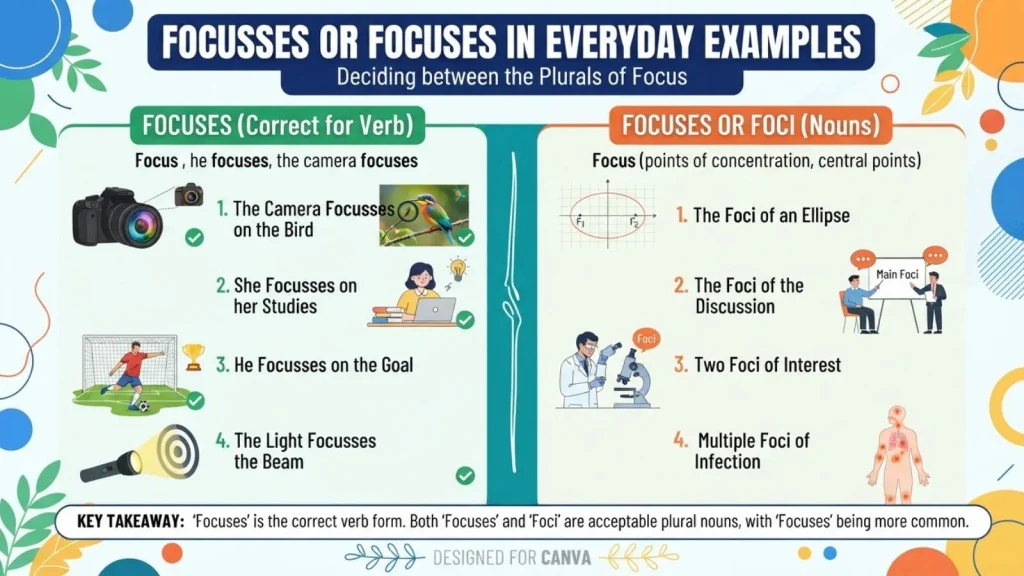
In emails: “This quarter, our team focuses on customer retention rather than new sign-ups.”
News writing: “Senator’s speech focused heavily on healthcare reform.”
In social media posts: “New video! Today we’re focusing on 5-minute morning workouts. 💪”
In formal or academic writing: “This study focuses on the long-term effects of remote work on employee wellbeing.”
In British formal writing (rare, older style): “The committee’s report focussed on regional infrastructure needs.”
Notice how “focuses” and “focused” appear in nearly every context, casual and formal, US and UK. The double-s form shows up only occasionally, mostly in older or traditional British documents.
Focusses or Focuses –Usage Data
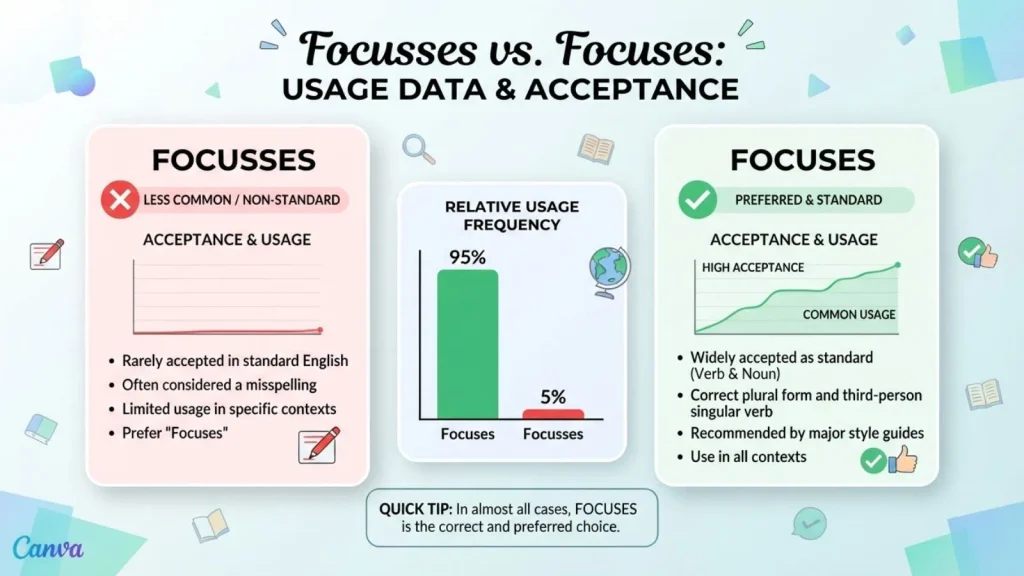
Search and usage data consistently show the same pattern:
- “Focuses” is searched and used far more often than “focusses” worldwide, including in the UK.
- In the United States, “focusses” and “focussed” are almost never used.
- In the United Kingdom, Australia, and Canada, “focuses” now leads by a large margin, though “focussed” still appears occasionally in older books, government documents, and some traditional publishers.
- Global English content, including most major news outlets like the BBC and The Guardian, primarily uses “focuses” and “focused” today.
The trend over the last few decades points in one direction: the single-s spelling is winning, even in British English.
Keyword Variation Comparison Table
| Search Term | Common Usage | Region Most Used | Recommended? |
| focuses | Very common | Global (US, UK, everywhere) | ✅ Yes, always safe |
| focussed | Rare | UK (older texts) | ⚠️ Only for older/UK style match |
| focused | Very common | Global (US, UK, everywhere) | ✅ Yes, always safe |
| focussing | Rare | UK (older texts) | ⚠️ Only for older/UK style match |
| focusing | Very common | Global (US, UK, everywhere) | ✅ Yes, always safe |
FAQs
1. Is “focusses” a real word?
Yes, it is a real but rare variant of “focuses,” found mainly in older British English.
2. Is “focused” or “focussed” correct in British English?
Modern British English mostly uses “focused.” “Focussed” is an older variant still accepted by some dictionaries but rarely used today.
3. Do Americans ever use “focussed”?
No. American English always uses “focused,” never “focussed.”
4. Which spelling does Microsoft Word or Google Docs prefer?
Both tools generally accept “focuses” and “focused” as correct, even in UK English mode, and often flag “focusses” and “focussed.”
5. Is “focuses” singular or plural?
“Focuses” is the present-tense verb form for he/she/it, as in “she focuses.” It is also a plural noun form, as in “the two focuses of the lens.” “Foci” is the more formal plural noun.
6. Should students use “focuses” or “focusses” in essays?
Students should use “focuses.” It is accepted in every major style guide, including MLA, APA, and Chicago.
7. Why does spellcheck sometimes not flag “focussed”?
Some British English dictionaries still list it as a valid, if rare, variant, so certain spellcheck settings may allow it. This does not mean it is the preferred modern spelling.
Conclusion
The debate between “focusses” and “focuses” has one clear winner: “focuses.”
While “focusses” and “focussed” technically exist as older British variants, modern English, in both the US and UK, has largely moved to the single-s spelling.
If you remember one rule, remember this: use “focuses,” “focused,” and “focusing” in almost every situation.
This works for emails, essays, news articles, social media, and business writing, no matter where your reader lives.
Save the double-s forms only for matching a specific older document or a house style that requires it.
Consistency matters more than perfection. Pick one spelling and use it throughout your document.
When in doubt, the single-s spelling is the safe, modern, and widely accepted choice across the English-speaking world.

Mary Roach is an American science writer and bestselling author known for making unusual and complex scientific topics engaging, accessible, and humorous. Her books include Stiff, Packing for Mars, Gulp, and Fuzz.
Author at Simifind.com, sharing clear, informative content designed to help readers understand interesting topics and everyday questions.



1 thought on “Focusses or Focuses: Examples, Rules, and Correct Usage (for 2026)”