Have you ever wondered whether “shyer” or “shier” is the correct spelling when describing someone who is more shy?
Hey, I want to share something that happened to me recently about shyer or shier.
I was chatting with a friend when I suddenly saw this term pop up, and honestly, I had no clue which spelling was correct at first.
I kept wondering, “Am I missing something here?” It was a bit confusing, and I didn’t want to use the wrong word in conversation.
So, I decided to look into shyer or shier and understand its meaning, spelling, and proper context.
After learning the difference, I realized how helpful it is to know which form is accepted in English.
A small spelling choice can make your writing sound much more natural and confident.
I handled the confusion by learning the correct usage, and now I feel ready whenever I see shyer or shier in chats, social media, or everyday writing.
Shyer or Shier – Quick Answer
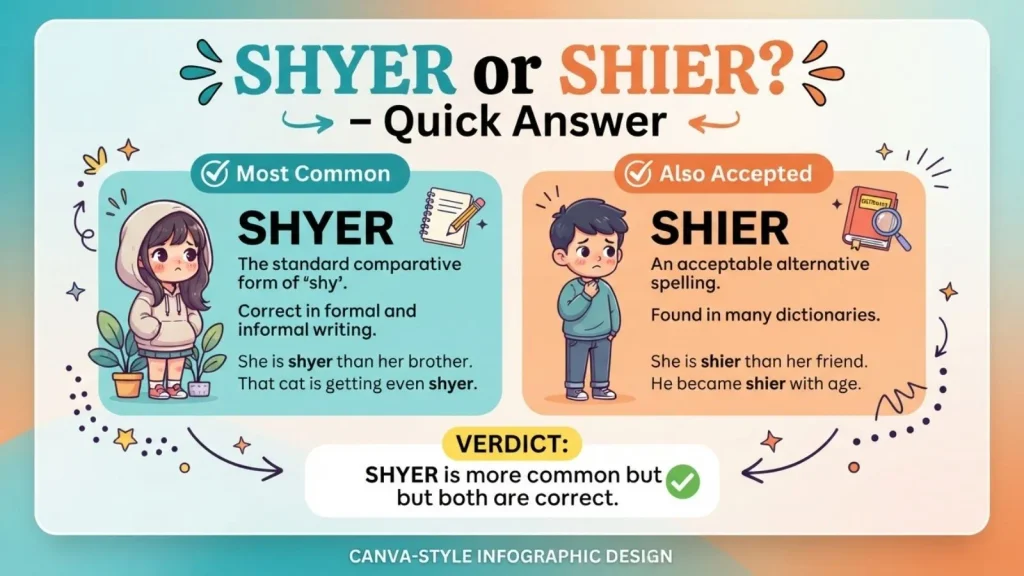
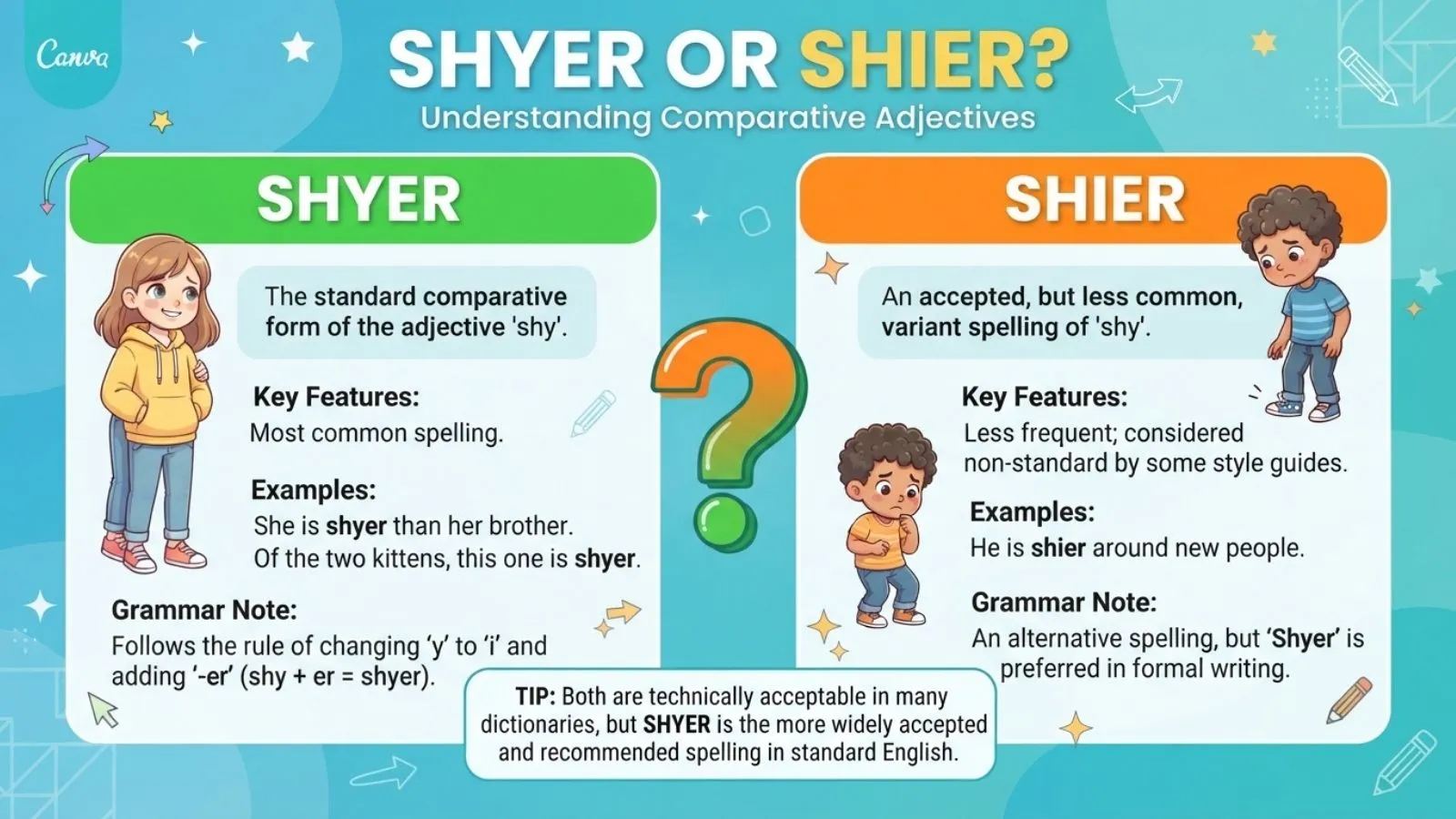
Both “shyer” and “shier” are correct. They mean the same thing: more shy.
- Shyer is the more common spelling. It keeps the “y” from the base word “shy.”
- Shier is a valid variant. It follows the standard English rule of changing “y” to “i” before adding a suffix.
Example sentences:
- “She was shyer than her older brother.” ✅
- “She was shier than her older brother.” ✅
Most dictionaries, including Merriam-Webster, list “shyer” as the primary spelling and “shier” as an accepted alternate. If you are unsure which to use, “shyer” is the safer default choice for most readers.
The Origin of Shyer or Shier
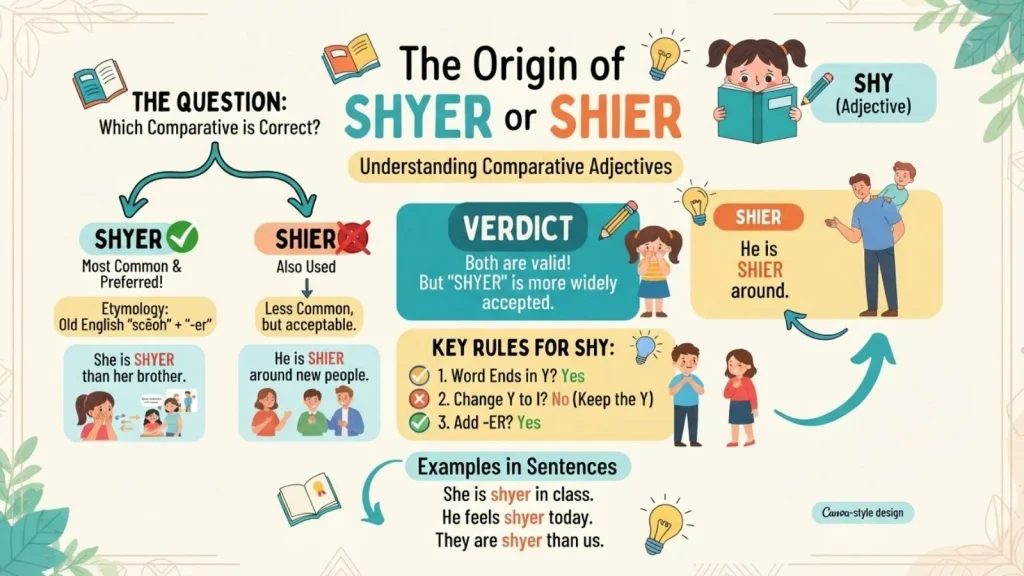
The word “shy” comes from Old English “sceoh,” meaning easily frightened or timid. Over centuries, the spelling settled into the short, simple form we use today: “shy.”
The confusion starts with English spelling rules for adding suffixes. The general rule says: when a word ends in a consonant plus “y,” change the “y” to “i” before adding “er” or “est.” This rule works well for most words:
- happy → happier
- busy → busier
- easy → easier
But short one-syllable words ending in “y” often resist this rule. Words like “shy,” “dry,” and “sly” are old and common. Over time, English speakers kept both spellings alive. Writers used “shyer” because it looked closer to the root word “shy.” Others followed the standard rule and wrote “shier.”
Neither version won completely. Dictionaries eventually accepted both. This is why the confusion still exists today. It is not a modern mistake. It is a centuries-old spelling split that never fully resolved.
Sentence With “Shyer”
“Shyer” is the comparative form of “shy,” meaning more timid, reserved, or less confident around people than someone or something else. It is used when comparing two people, situations, or levels of shyness.
Example:
“Emma is shyer than her sister when meeting new people.”
Here, “shyer” shows that Emma is more shy or less comfortable with strangers than her sister.
More examples:
- “He became shyer after moving to a new school.”
- “Sarah is shyer than her best friend.”
- “The shyer child stayed close to his mother.”
- “I was shyer as a teenager than I am now.”
- “She is getting shyer around large groups.”
British English vs American English Spelling
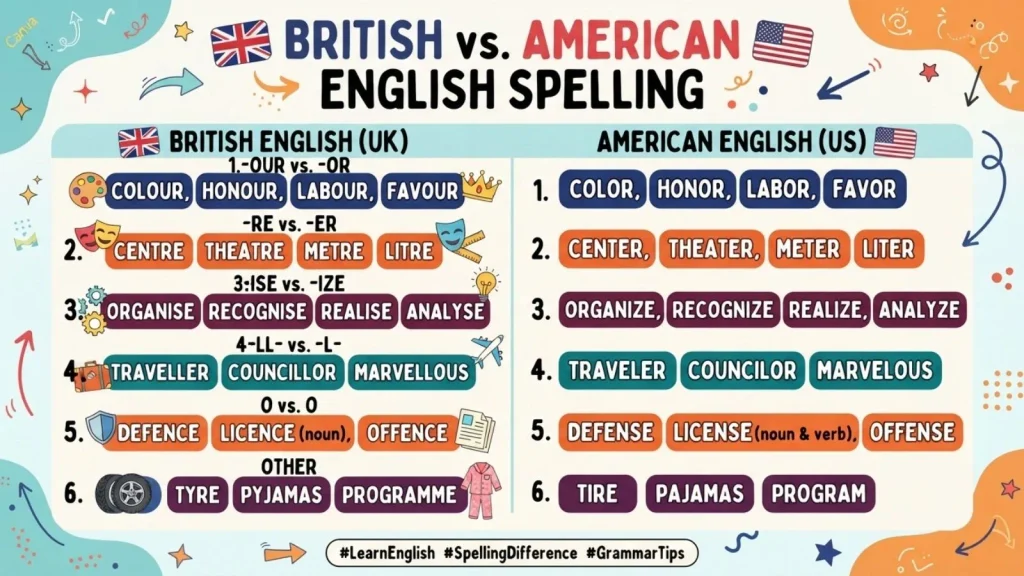
Many spelling debates in English come down to British versus American rules (think “colour” vs “color”). The shyer/shier debate is different. It is not a strict national split. Both spellings appear in British and American writing. However, some patterns do show up.
American English tends to favor “shyer” and “shyest” in casual and formal writing alike. British English also favors “shyer,” but “shier” appears more often in British academic and literary texts than in American ones.
Here is a comparison table to make this clear:
| Feature | Shyer | Shier |
| Follows standard suffix rule (y → i) | No | Yes |
| More common in dictionaries | Yes (primary) | Yes (secondary) |
| Common in American English | Very common | Less common |
| Common in British English | Common | Occasionally used |
| Similar words with same pattern | dryer, slyer | drier, slier |
| Risk of looking like a typo | Low | Slightly higher |
Notice the similar case of “dry.” Most people write “drier” for the comparative form of dry (this room is drier than that one), while “dryer” is reserved for the machine (clothes dryer). “Shy” does not follow this same split. Both “shyer” and “shier” refer only to the adjective, not to any object or machine.
Which Spelling Should You Use Shyer or Shier?
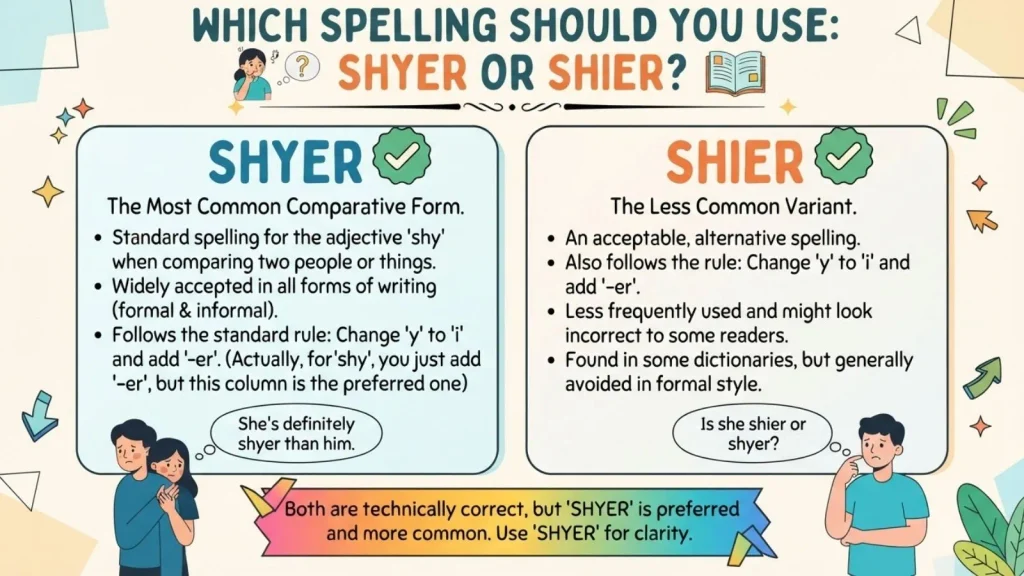
The right choice depends on your audience and your goals.
If you write for a US audience: Use “shyer.” It is the more familiar spelling and matches most American style guides and dictionaries.
If you write for a UK or Commonwealth audience: “Shyer” is still the safer choice, though “shier” will not confuse readers or look incorrect. Some British editors prefer “shier” because it follows the standard spelling rule.
If you write for a global or mixed audience: Choose “shyer.” It is the more widely recognized spelling worldwide and appears more often in books, news, and online content. This lowers the chance that a reader will think you made a typing mistake.
If you follow a strict style guide: Check the guide first. Some academic or publishing style guides specify one spelling. When in doubt, stay consistent. Do not switch between “shyer” and “shier” in the same document.
Common Mistakes with Shyer or Shier
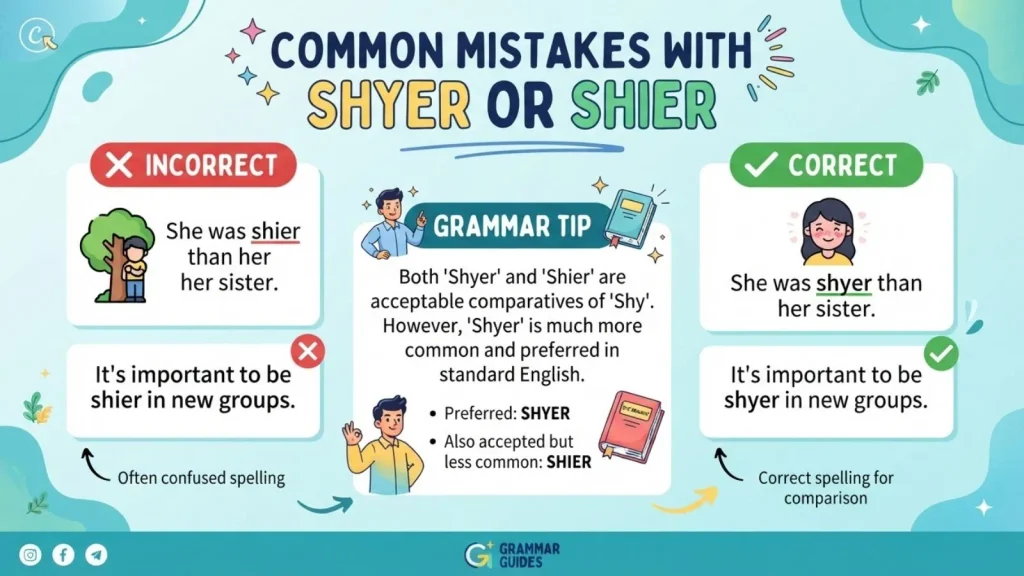
Even careful writers slip up with this word. Here are the most frequent errors.
- Mixing both spellings in one document. Wrong: “He became shier each year, though he was shyer than his sister.” Right: Pick one spelling and use it throughout.
- Confusing it with “shyly” or “shied.” “Shyly” is an adverb (he smiled shyly). “Shied” is a past-tense verb (he shied away from the question). Neither relates directly to the comparative form.
- Adding an extra letter by mistake. Wrong: “shyier” or “shieyer.” These are not real words. There is no double vowel combination here.
- Using “more shy” instead of the correct comparative. “More shy” is grammatically acceptable but sounds less natural than “shyer” in most everyday writing.
- Assuming only one spelling exists. Some writers correct “shier” to “shyer” (or the reverse) by habit, without checking that both are valid.
Shyer or Shier in Everyday Examples
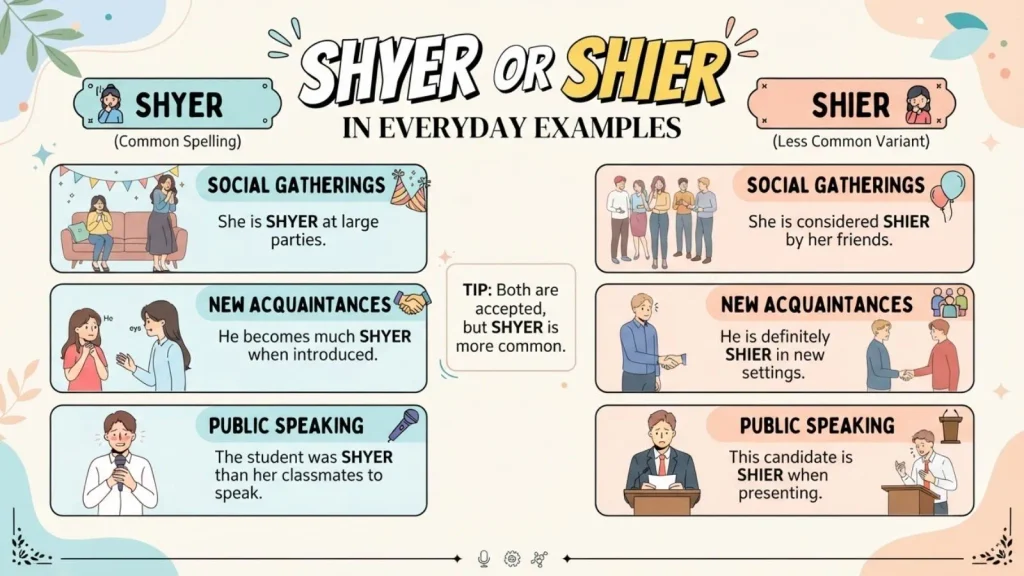
In emails: “I noticed Tom seemed shyer than usual during the meeting today.”
News writing: “Polls show that younger voters are shier about sharing political opinions online.”
Social media posts: “Ngl I get shyer every time I meet new people lol 😅”
Formal writing or essays: “The study found that children raised in quieter households tended to be shier in group settings.”
Fiction and storytelling: “He was shyer than she remembered, his voice barely rising above a whisper.”
These examples show that both spellings fit naturally into different tones, from casual chats to academic essays. The choice rarely changes the meaning. It only shifts the formality or regional feel of the sentence slightly.
Shyer or Shier – Google Trends & Usage Data
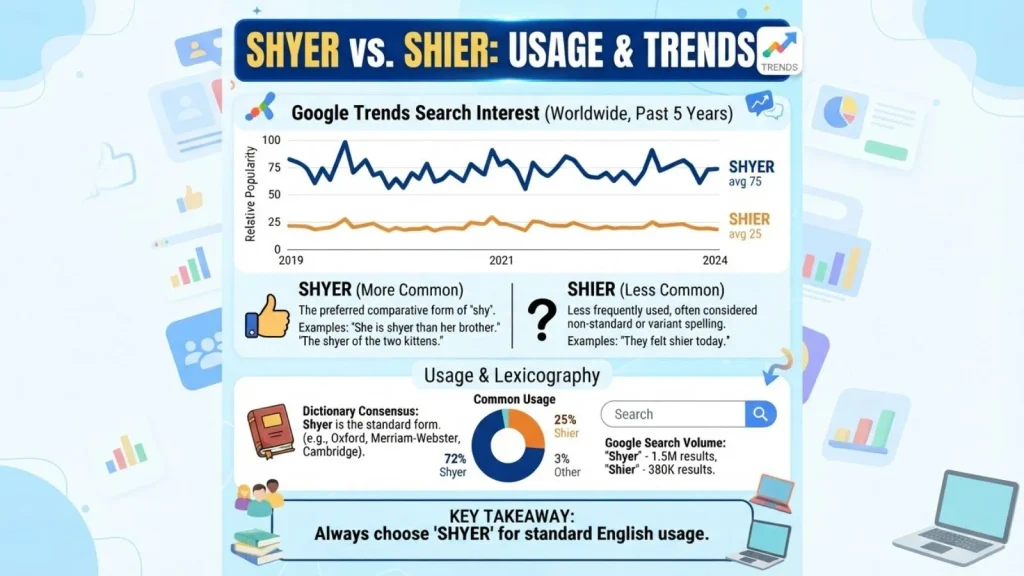
Search interest in “shyer vs shier” tends to come from people checking grammar before finishing a piece of writing. This includes students, bloggers, content writers, and English language learners.
General usage patterns show:
- “Shyer” appears far more often in published books, news articles, and online content than “shier.”
- Searches asking “is it shyer or shier” are common among English learners in Asia, Europe, and Latin America, where grammar rules are studied closely.
- English-speaking countries like the US, UK, Canada, and Australia show similar search behavior, with “shyer” consistently the more searched and more used term.
- Interest in this topic often spikes during the school year, when students are writing essays and want to confirm correct grammar.
The takeaway: “shyer” is the safer, more widely used choice, but “shier” is not wrong. It is simply less common.
Keyword Variations Comparison Table
| Term | Correct? | Common Use | Notes |
| Shyer | Yes | Very common | Preferred in most style guides |
| Shier | Yes | Less common | Follows standard “y to i” rule |
| Shyest | Yes | Common | Superlative form of shyer |
| Shiest | Yes | Less common | Superlative form of shier |
| Shyier | No | Not used | Incorrect spelling |
| More shy | Yes | Occasional | Acceptable but less natural |
FAQs
1. Is “shyer” or “shier” correct?
Both are correct. “Shyer” is more common and is listed first in most dictionaries.
2. Which spelling do dictionaries prefer?
Merriam-Webster and most major dictionaries list “shyer” as the main spelling, with “shier” as an accepted variant.
3. Is “shier” British English?
No. “Shier” is not exclusive to British English. It appears in both British and American writing, though less often than “shyer.”
4. What is the superlative form?
The superlative forms are “shyest” and “shiest.” “Shyest” is the more common choice, matching the pattern of “shyer.”
5. Can I use “more shy” instead?
Yes. “More shy” is grammatically correct, though “shyer” sounds more natural in everyday speech and writing.
6. Why does English allow two spellings for one word?
Short adjectives ending in “y,” like “shy,” “dry,” and “sly,” often resist the standard spelling rule. Over time, both the rule-following and rule-breaking spellings became accepted.
7. Will using “shier” make my writing look wrong?
No. “Shier” is a real, dictionary-approved word. It will not look incorrect, though some readers may find it less familiar than “shyer.”
Conclusion
“Shyer” and “shier” both mean the same thing: more shy. Neither spelling is wrong. The confusion comes from an old English spelling rule that short words like “shy” do not always follow strictly.
For most writing, “shyer” is the safer and more widely recognized choice.
It appears more often in dictionaries, books, and everyday writing across both American and British English.
“Shier” is a valid alternative that follows the standard “y to i” spelling rule, but it is used less frequently.
If you write for a global audience, stick with “shyer.” If you follow a specific style guide, check its preference and stay consistent throughout your document.
Avoid mixing both spellings in the same piece of writing, and remember that “shyier” is never correct.
In short: when in doubt, choose “shyer.” It is the clearer, more familiar, and more commonly accepted spelling in modern English.

Here’s a concise 2-line author bio suitable for Simifind.com:
James Dashner is an American bestselling author best known for The Maze Runner series and other popular young-adult fiction.
On Simifind.com, he shares clear, engaging insights and helpful content for readers interested in books, writing, and popular literature.