Hey, I want to share something that happened to me recently about baring or barring.
One small spelling difference can completely change the meaning of a sentence, and “baring” and “barring” are a perfect example.
I was chatting with a friend when I suddenly saw this term pop up, and honestly, I had no clue what it meant at first.
I kept wondering, “Am I missing something here?” It was a bit confusing, and I didn’t want to respond the wrong way.
So, I decided to look into baring or barring and figure out its meaning and context.
After understanding it, I realized how important it is to know these terms to avoid awkward situations in conversations.
I handled it by learning the proper meaning and responding confidently, and now I feel ready whenever I see baring or barring again in chats or social media.
Baring or Barring – Quick Answer
Here is the short version:
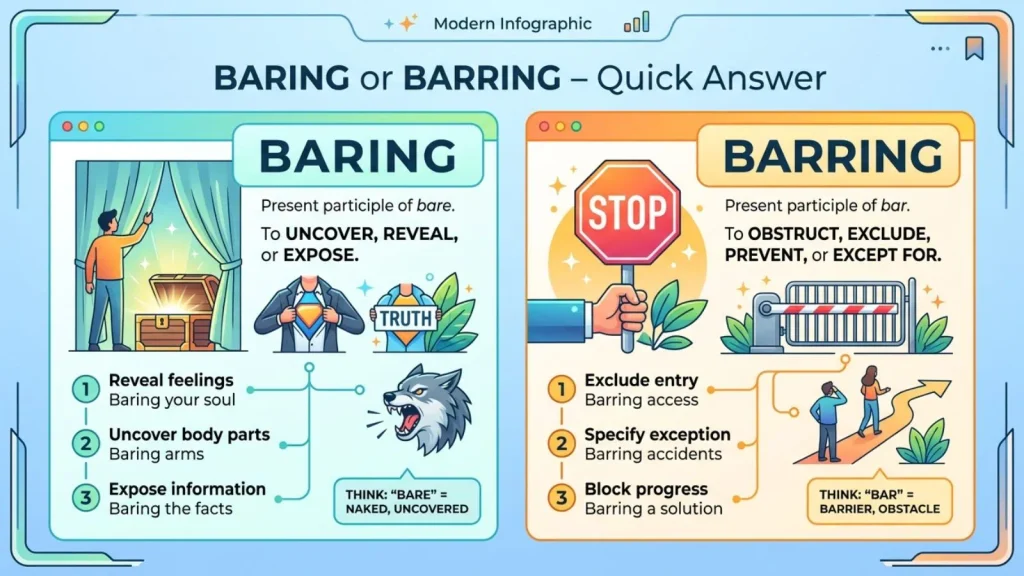
- Baring means uncovering or revealing something. It comes from the word bare.
- Example: She was baring her feelings for the first time.
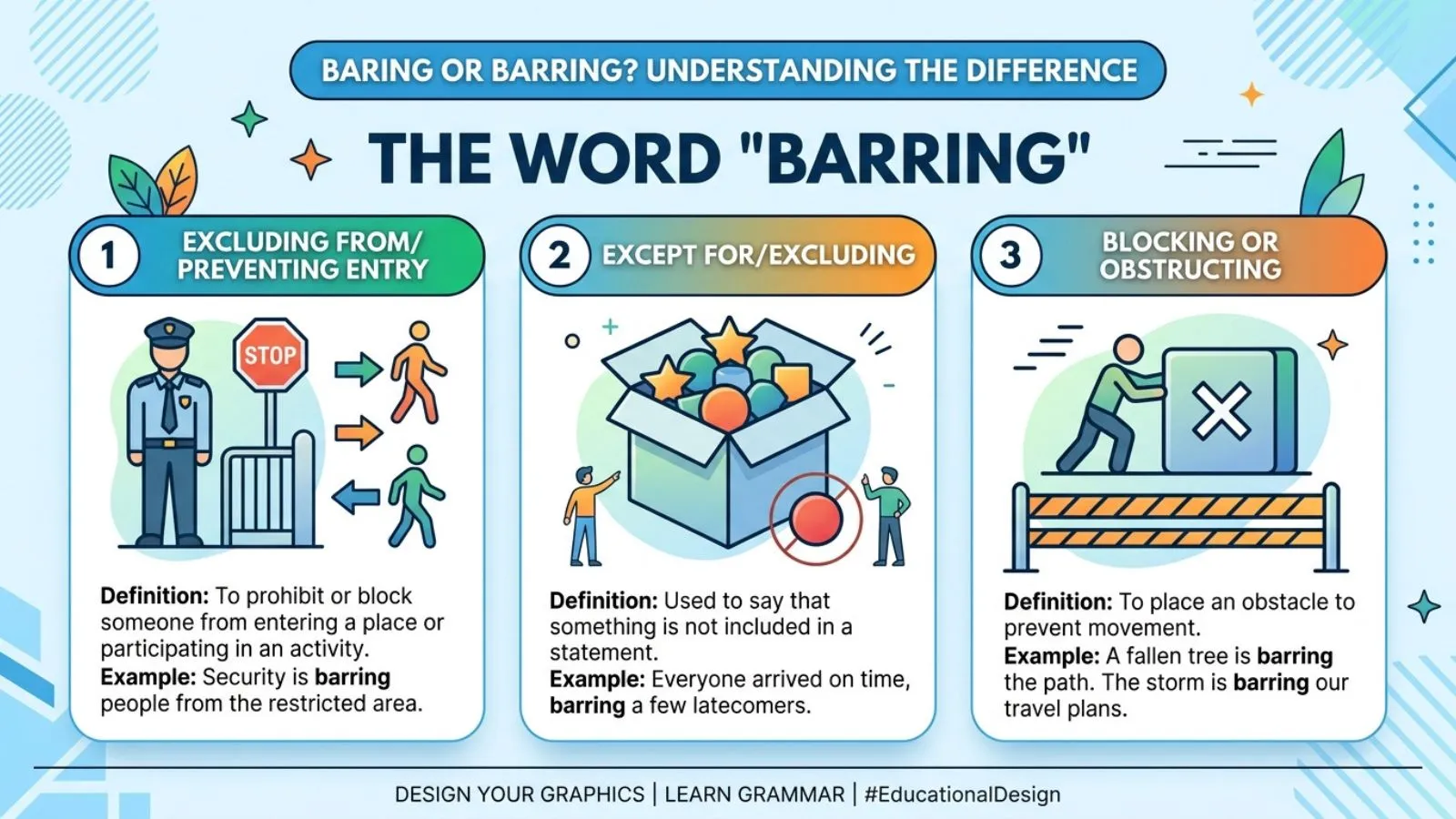
- Barring means preventing, blocking, or excluding something. It comes from the word bar. It can also mean “except for.”
- Example: Barring rain, the game will start on time.
These are two different words. They are not two spellings of the same word. The double “r” in barring is not a style choice. It follows a plain spelling rule, which you will see below.
The Origin of Baring or Barring
Both words trace back to simple English roots.
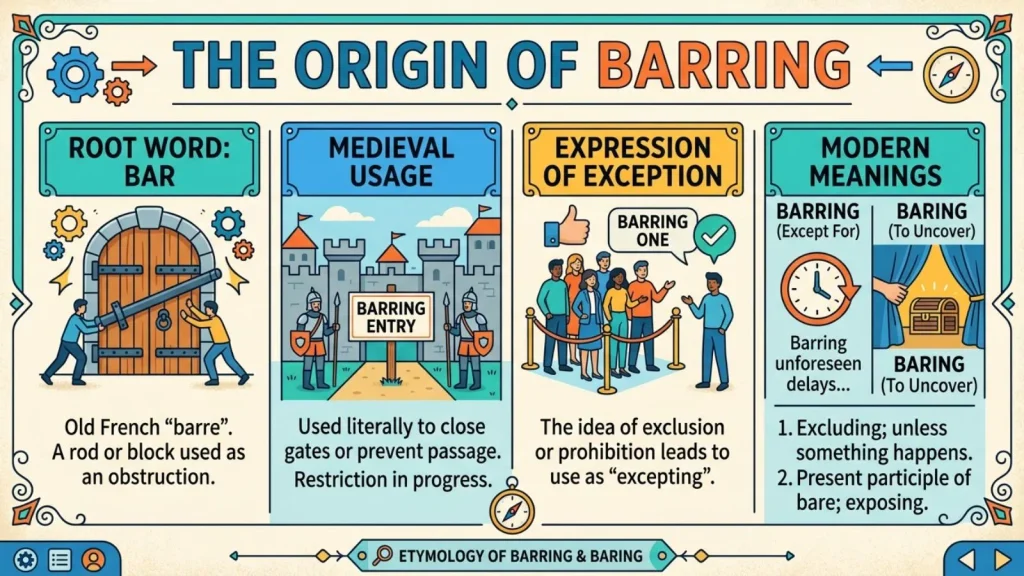
Bare comes from Old English bær, meaning uncovered or plain. Over time, English speakers added -ing to turn it into a verb form: baring. Since bare already ends in a silent e, that e gets dropped before adding -ing.
Bar comes from Old French barre, meaning a rod or barrier. It kept a similar meaning in English: something that blocks or stops. When -ing is added, English spelling rules require doubling the final consonant. That gives us barring.
So the difference is not about dialect or region. It is about two separate root words that happen to look alike once you add an ending.
British English vs American English Spelling baring or barring
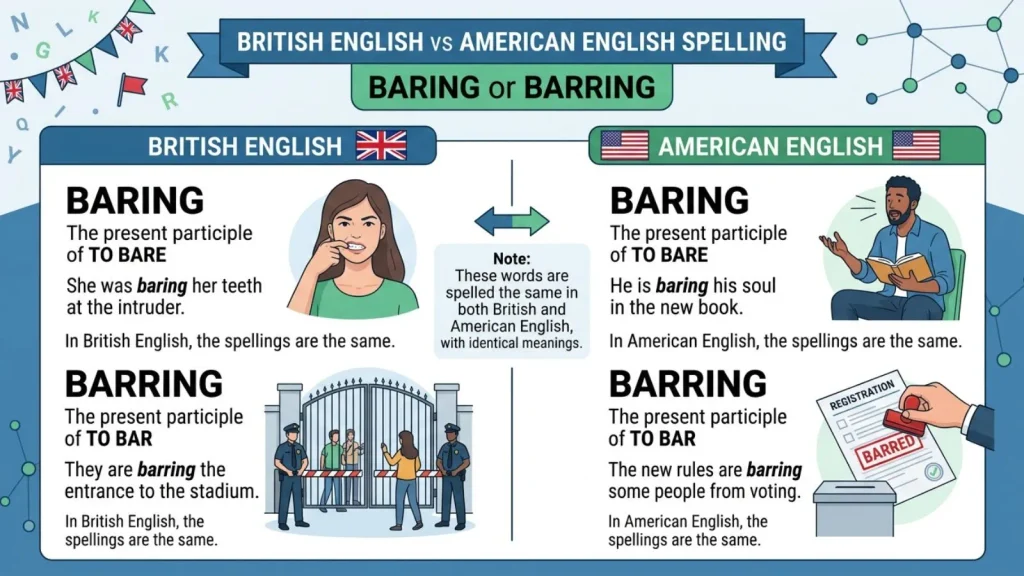
This is where most confusion starts. People assume baring and barring are like color and colour — one American, one British. That is not true.
Both British English and American English spell these words the same way. The doubling rule for short verbs is a shared rule across all standard English, not a regional one.
Here is a simple comparison to clear this up.
| Feature | Baring | Barring |
| Root word | Bare | Bar |
| Meaning | Uncover, reveal | Block, prevent, except for |
| Rule applied | Drop silent e, add -ing | Double final consonant, add -ing |
| British spelling | Baring | Barring |
| American spelling | Baring | Barring |
| Regional difference? | None | None |
The real British vs American differences show up in other words, like colour/color or travelling/traveling. Baring and barring are not part of that group. They are simply two different words that both use standard spelling rules correctly.
Which Spelling Should Use baring or barring ?
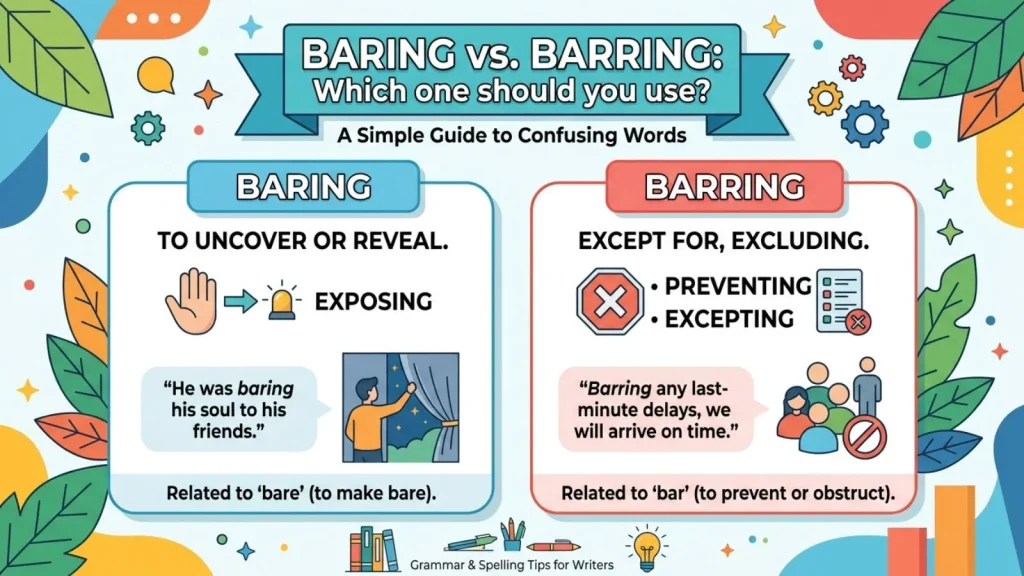
Since spelling does not change by region, your choice depends only on meaning, not on where your reader lives.
- Usebaring when you mean uncovering, revealing, or exposing something.
- Baring your soul in a letter.
- Baring your arms in summer.
- Usebarring when you mean stopping, blocking, or excluding something.
- Barring entry to unregistered guests.
- Barring a last-minute change, the deal is done.
This advice holds true whether you write for a US audience, a UK or Commonwealth audience, or a global one. Focus on the meaning of your sentence, not on the country of your reader.
Common Mistakes with Baring or Barring
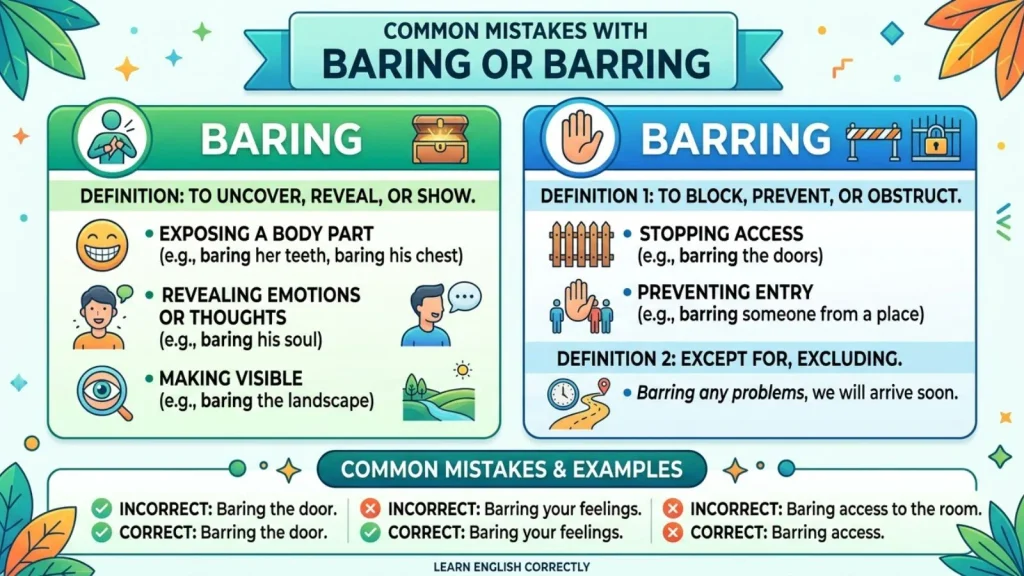
Here are the errors people make most often, and how to fix them.
- Mistake: Barring her feelings, she stayed quiet. Fix: Baring her feelings, she stayed quiet. (She revealed her feelings.)
- Mistake: Baring unforeseen delays, the flight leaves at noon. Fix: Barring unforeseen delays, the flight leaves at noon. (Unless delays happen.)
- Mistake: Writing baring with one r as baring but meaning “to block.” Fix: Use barring with two rs for the blocking meaning.
- Mistake: Confusing bearing with baring. Bearing relates to carrying weight or direction, not uncovering. Fix: Check the root word first: bear (carry) vs bare (uncover) vs bar (block).
Baring or Barring in Everyday Examples
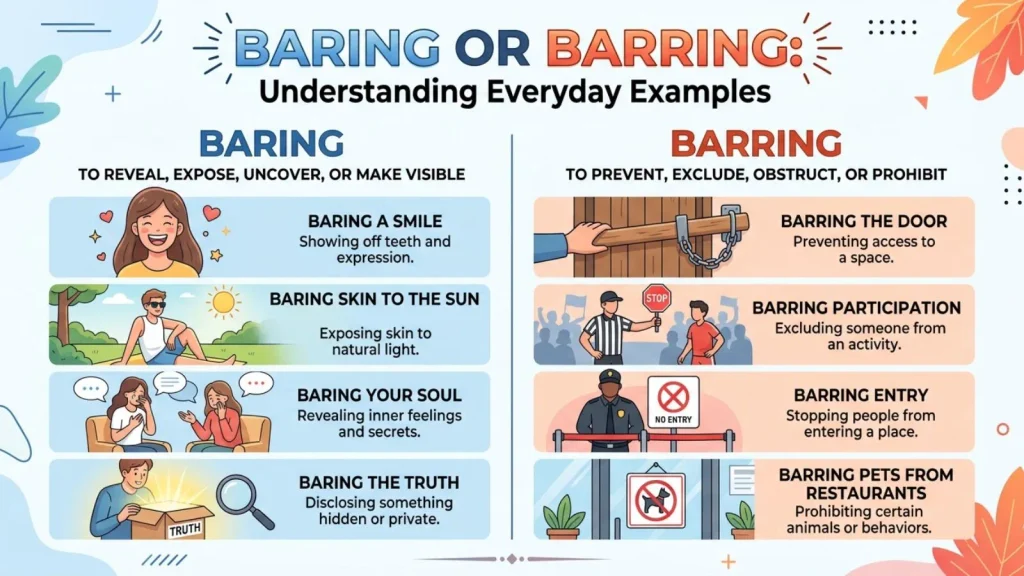
In emails: Barring any objections, we will move forward with the proposal on Monday.
News headlines: Company Bars Former Employee from Re-Entering Office Actress Opens Up, Baring Details of Her Struggle
In social media posts: Baring it all today — new tattoo reveal! 🎨 Barring a miracle, my team is not making the playoffs. 😩
In formal writing: The court is barring the release of the documents until further review. The report focuses on baring the true cost of the project.
Baring or Barring – Search Trends & Usage Data
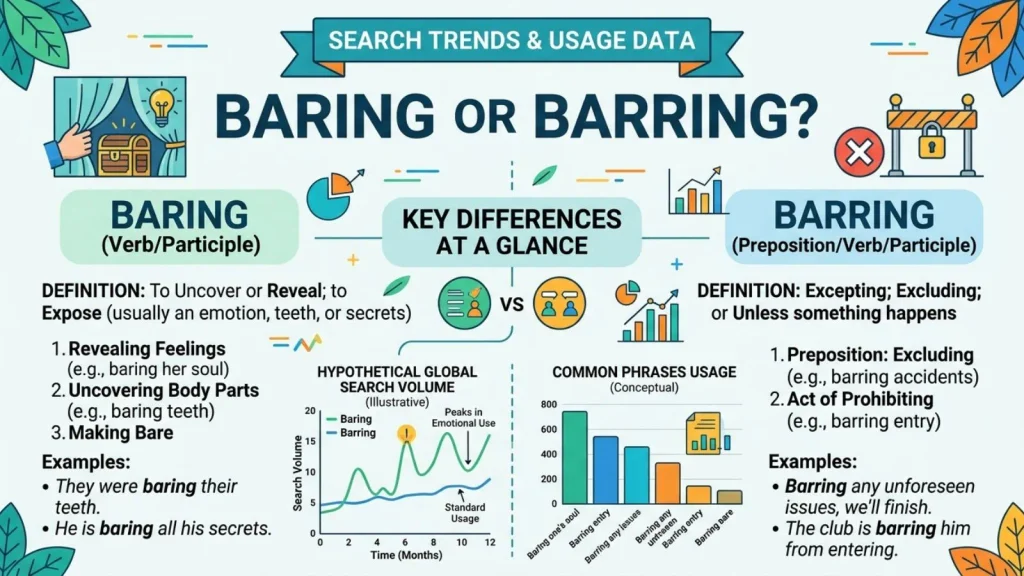
Barring is searched and used far more often than baring. This is because barring appears in common phrases like “barring any issues” or “barring bad weather,” which show up in news, weather reports, sports updates, and business writing.
Baring appears less often. It is mostly used in personal, emotional, or descriptive writing, such as memoirs, interviews, or fashion articles about “baring skin.”
Search interest for this exact phrase, “baring or barring,” is steady across English-speaking countries. It spikes around grammar-check queries rather than trending news events, showing that people search for it mainly to double-check their writing, not because of a viral story.
Keyword Variations Comparison Table
| Word Form | Base Word | Meaning | Example |
| Bare | Bare | Uncovered, plain | The wall was bare. |
| Baring | Bare | Uncovering (verb -ing form) | Baring her arms in the heat. |
| Bared | Bare | Past tense of bare | She bared her true feelings. |
| Bar | Bar | To block or a rod/barrier | Bar the door. |
| Barring | Bar | Blocking, or “except for” | Barring rain, we will go. |
| Barred | Bar | Past tense of bar | He was barred from entry. |
| Bearing | Bear | Carrying, direction, manner | She walked with quiet bearing. |
Frequently Asked Questions
1. Is “barring” a real word?
Yes. Barring is the present participle of bar. It means blocking, excluding, or “except for.”
2. Is “baring” a real word?
Yes. Baring is the present participle of bare. It means uncovering or revealing.
3. Do British and American English spell these words differently?
No. Both use the same spelling for baring and barring. The words differ by meaning, not by region.
4. What does “barring that” mean?
It means “except for that” or “unless that happens.” Example: Barring that, everything is set.
5. Is it “bearing” or “baring” my soul?
The correct phrase is baring my soul, meaning to reveal your true feelings.
6. Why does “barring” have two r’s but “baring” has one?
Because of spelling rules. Bar is a short word ending in one vowel plus one consonant, so the consonant doubles before -ing. Bare ends in a silent e, which is simply dropped before -ing.
7. Can “barring” and “baring” ever mean the same thing?
No. They come from different root words and never share meaning, even though they look and sound similar.
Conclusion
Baring and barring look almost the same, but they mean very different things. Baring comes from bare and means uncovering or revealing something.
Barring comes from bar and means blocking, excluding, or “except for.”
This is not a British versus American spelling issue. Both regions spell these words the same way.
The confusion comes from two short root words that follow normal English spelling rules and end up looking alike once -ing is added.
To choose the right word, ask what you mean. If you mean “revealing,” use baring. If you mean “blocking” or “unless,” use barring.
This simple check works in emails, news writing, social posts, and formal documents, no matter where your reader lives.
Once you know the root words, bare and bar, you will never second-guess this spelling again.

Here’s a concise 2-line author bio suitable for Simifind.com:
James Dashner is an American bestselling author best known for The Maze Runner series and other popular young-adult fiction.
On Simifind.com, he shares clear, engaging insights and helpful content for readers interested in books, writing, and popular literature.