Hey, I want to share something that happened to me recently about faired or fared.
I was chatting with a friend when I suddenly saw this term pop up, and honestly, I had no clue what it meant at first.
Have you ever wondered whether you should write “faired” or “fared” when talking about how someone did in a situation?
I kept wondering, “Am I missing something here?” It was a bit confusing, and I didn’t want to respond the wrong way.
So, I decided to look into faired or fared and figure out its meaning and context.
After understanding it, I realized how important it is to know these terms to avoid awkward situations in conversations.
I handled it by learning the proper meaning and responding confidently, and now I feel ready whenever I see faired or fared again in chats or social media.
Faired or Fared – Quick Answer
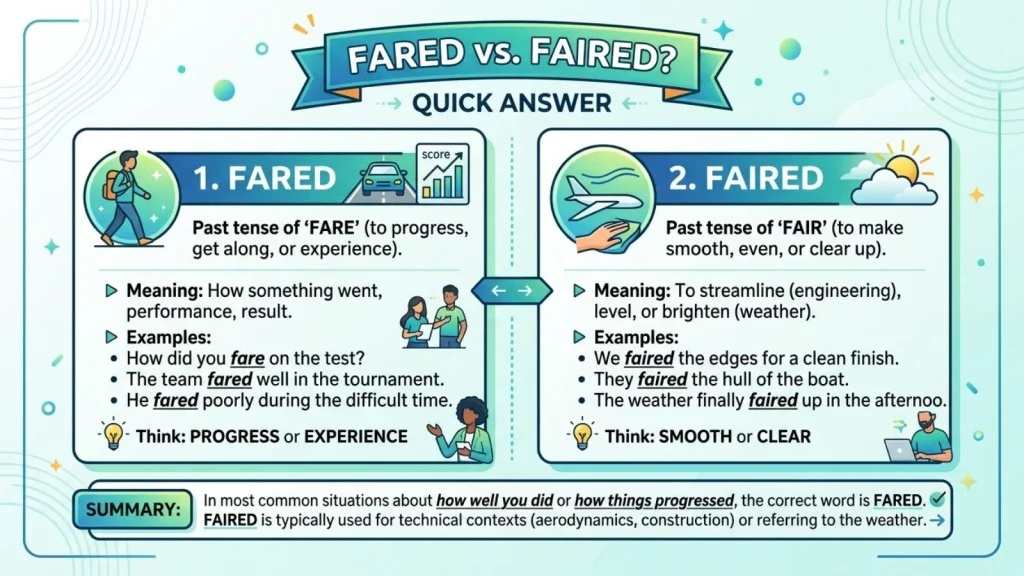
Use fared when you mean “how something turned out” or “how someone performed.”
- The team fared well in the finals.
- How did your interview fare?
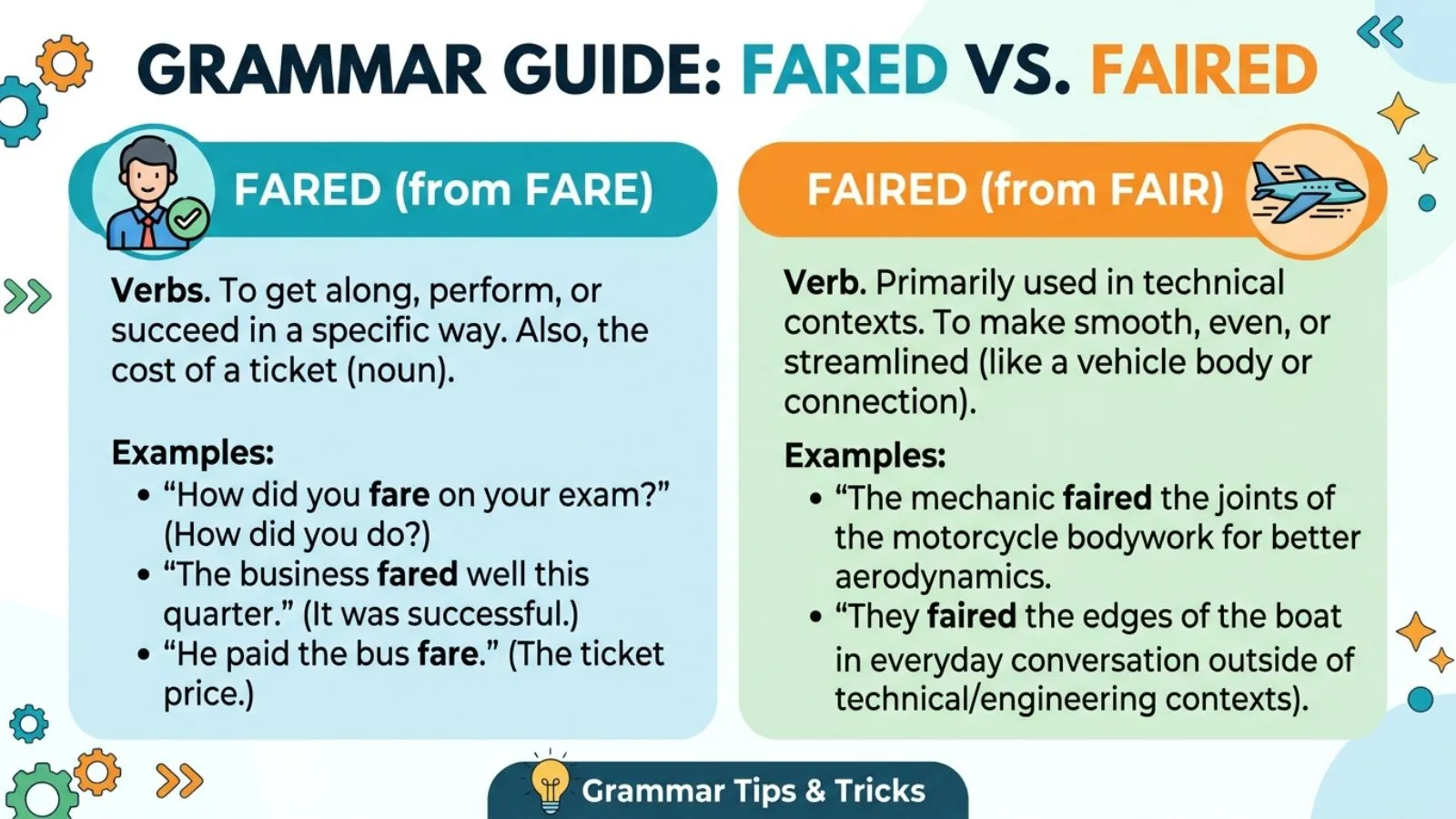
Use faired only in technical contexts, mainly boats, cars, and aircraft. It means “made smooth” or “shaped to reduce drag.”
- The hull was faired before painting.
- Engineers faired the wing’s edge.
For everyday writing, fared is almost always the word you want.
The Origin of Fared (and Faired)
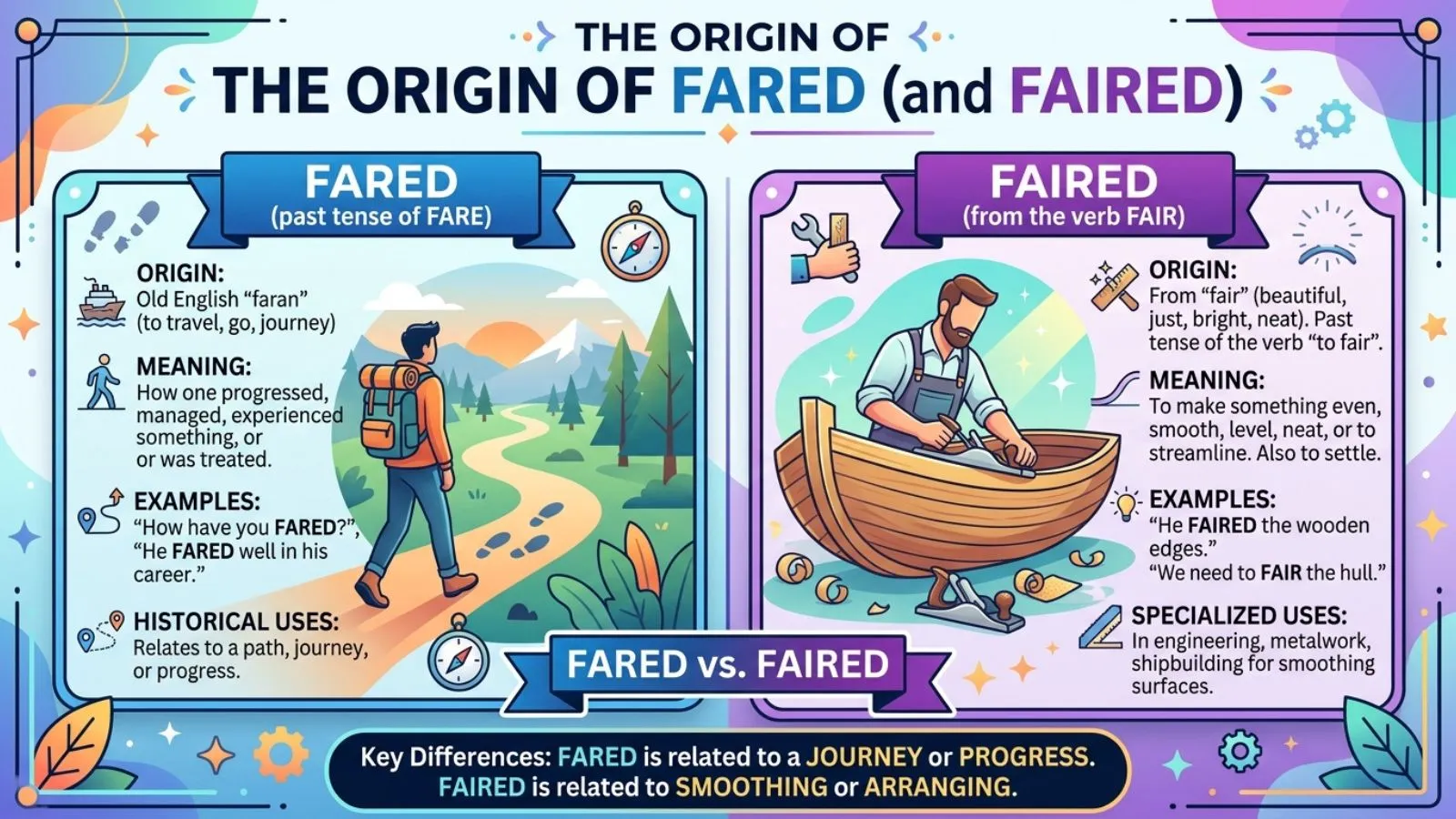
Fared comes from the verb “fare.” In Old English, “faran” meant “to travel” or “to get along.” Over time, “fare” kept both meanings. You still see the travel sense in words like “airfare” and “thoroughfare.” The “how things turned out” sense gives us “fared.”
Faired comes from a completely different root: the adjective “fair,” in the sense of “smooth” or “even.” Shipbuilders started using “fair” as a verb centuries ago, meaning to smooth a curved surface. “Faired” is just the past tense of that verb.
So these words aren’t spelling variants of one another. They are two separate words that happen to sound alike. That’s the real source of the confusion, not a regional spelling split.
British English vs American English Spelling
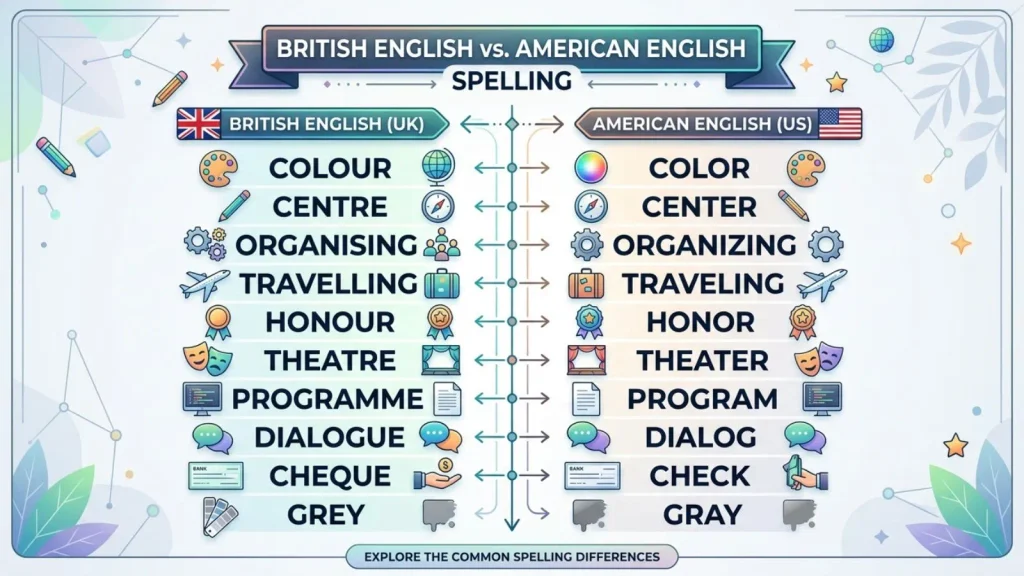
Here’s an important point: British and American English do not spell this word differently. Fared is correct in both dialects when you mean “turned out” or “got along.”
Faired also stays the same in both dialects. It’s used the same way by engineers and boatbuilders in the US, UK, and elsewhere.
The confusion isn’t about British vs. American spelling. It’s about mixing up two different words that share a similar sound.
| Word | US English | UK English | Meaning |
| Fared | fared | fared | Turned out, got along, performed |
| Faired | faired | faired | Made smooth (technical, boats/planes) |
| Fair (verb) | fair | fair | To smooth a surface |
| Fare (noun) | fare | fare | Cost of travel; food served |
Which Spelling Should Use faired or fared?
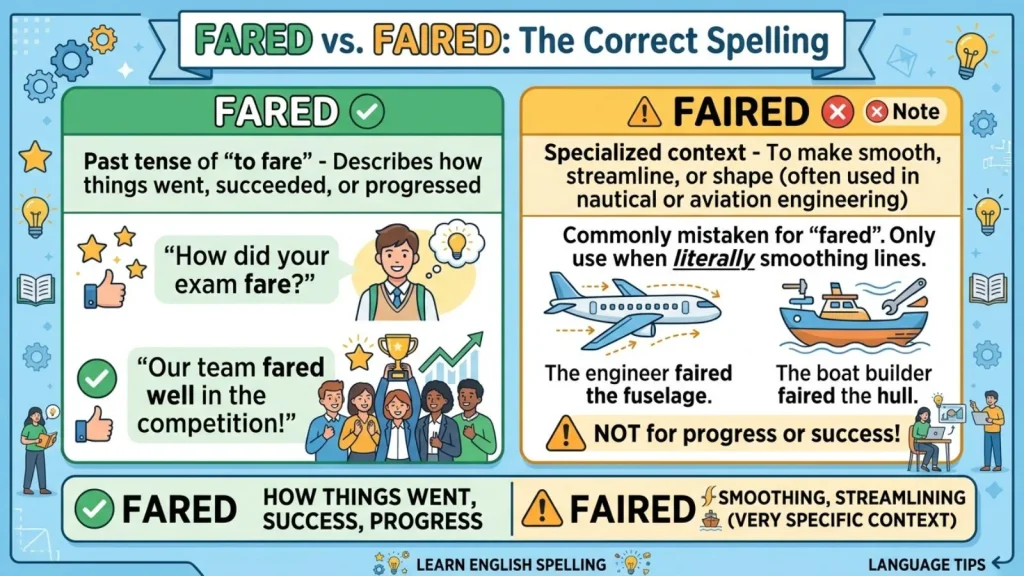
For US writers: Use “fared” in nearly all everyday writing. Save “faired” for engineering, boatbuilding, or aviation content.
For UK and Commonwealth writers: The same rule applies. “Fared” covers everyday use. “Faired” stays inside technical fields.
For global or business writing: Default to “fared” unless your topic is specifically about vehicle design, hull shaping, or aerodynamics. If your audience isn’t in a technical trade, they will likely misread “faired” as a typo.
Common Mistakes with Faired or Fared
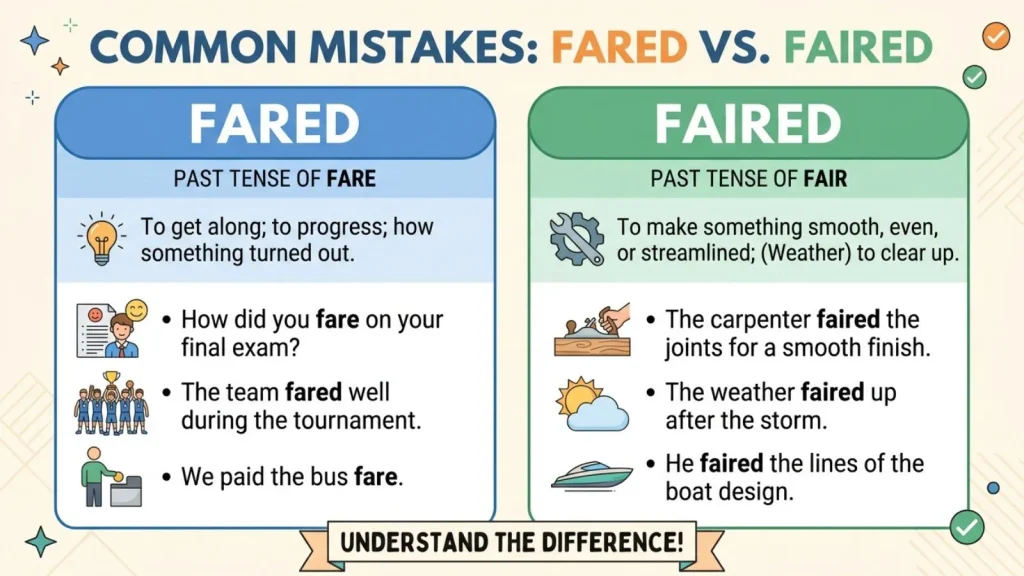
Mistake 1: Writing “faired” instead of “fared.” Wrong: The company faired poorly last quarter. Right: The company fared poorly last quarter.
Mistake 2: Confusing “fared” with “feared.” Wrong: I’m not sure how the exam feared for you. Right: I’m not sure how the exam fared for you.
Mistake 3: Using “faired” as a general adjective. Wrong: She faired better than expected on the test. Right: She fared better than expected on the test.
Mistake 4: Assuming spellcheck will catch it. Both words exist, so most spellcheckers stay silent. Read the sentence out loud and ask: “Am I talking about an outcome, or a smooth surface?” That answers it.
Faired or Fared in Everyday Examples
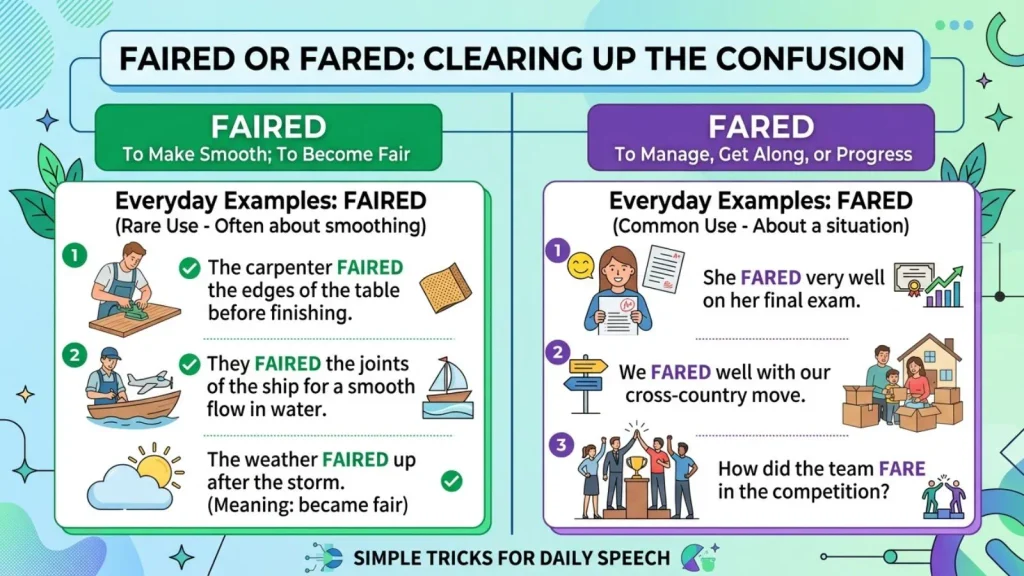
In emails: “Just checking in—how did the product launch fare last week?”
In news headlines: “Local businesses fared better than expected during the holiday season.”
On social media: “Not sure how my team fared in the draft, but I’m hopeful 🤞”
In formal writing: “The report outlines how each region fared against its quarterly targets.”
In technical writing (the rare correct use of “faired”): “The prototype’s fuselage was faired to reduce wind resistance during testing.”
Notice that “fared” fits naturally into casual and professional writing. “Faired” only appears in specialized, technical text.
Faired or Fared – Google Trends & Usage Data
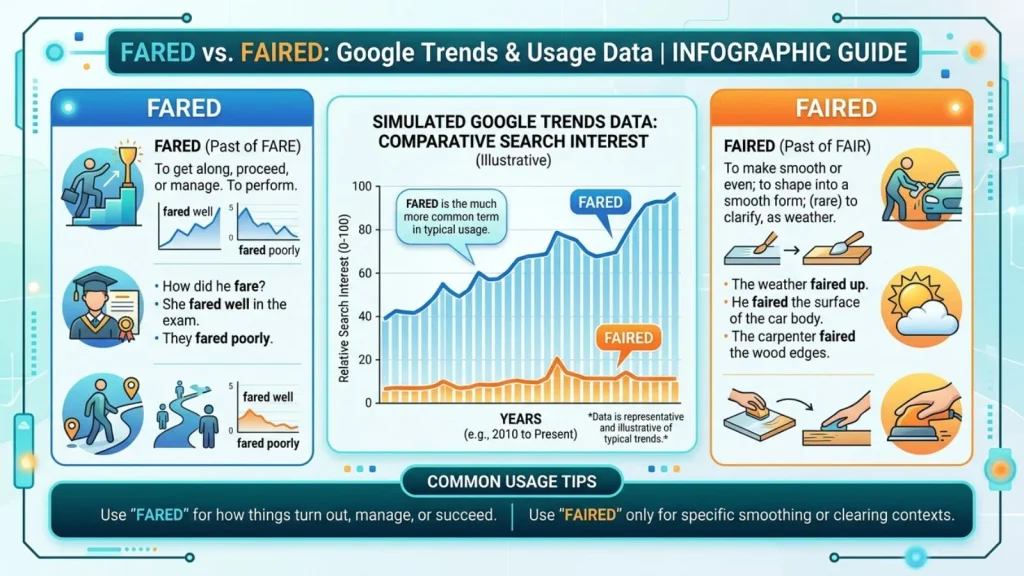
Search interest in “faired or fared” spikes around major events: elections, sports finals, earnings season, and exam results. This is when people write sentences about outcomes and second-guess their spelling.
Usage patterns show:
- United States: Searches lean toward everyday usage, mostly business and sports contexts.
- United Kingdom and Commonwealth countries: Similar pattern, with added interest during school exam seasons.
- Technical and engineering communities: Small but steady searches for “faired,” tied to boatbuilding, car design, and aviation forums.
Across all regions, “fared” dominates general search volume. “Faired” stays a niche term used by a specific professional audience.
Comparison Table: Keyword Variations
| Term | Correct Use | Example Sentence | Common Setting |
| Fared | How something turned out | The startup fared well this year. | General, business, news |
| Faired | Made smooth (technical) | The car’s body was faired for speed. | Engineering, aviation, boats |
| Feared | Was afraid of | She feared the worst. | General, emotional context |
| Fair (verb) | To smooth | They plan to fair the boat’s hull. | Technical, present tense |
FAQs
1. Is “faired” a real word?
Yes. It’s the past tense of the verb “fair,” meaning to smooth a curved surface. It’s mainly used in boatbuilding, car design, and aviation.
2. Is “fared” or “faired” more common?
“Fared” is far more common. It fits everyday writing about outcomes and performance.
3. Can I use “faired” to describe how a business performed?
No. That’s a common error. Use “fared” instead: The business fared well this quarter.
4. Do British and American English spell this word differently?
No. Both dialects use “fared” for outcomes and “faired” for technical smoothing. There’s no regional spelling split here.
5. Why doesn’t spellcheck catch this mistake?
Because both words are spelled correctly on their own. Spellcheck only flags words that don’t exist, not words used in the wrong context.
6. What’s an easy way to remember the difference?
Think of “fare” as a journey or outcome. “Fared” tells you how that journey went. Think of “fair” as smooth. “Faired” means something was made smooth.
7. Is “faired” ever correct in casual writing?
Rarely. Unless you’re specifically discussing vehicle design or aerodynamics, stick with “fared.”
Conclusion
The choice between “faired” and “fared” comes down to context, not dialect. “Fared” is the word almost everyone needs. It describes how something turned out, whether that’s a business quarter, a sports match, or a job interview. “Faired” belongs to a much smaller world: boatbuilders, car designers, and aircraft engineers use it to describe smoothing a surface.
There’s no British-versus-American spelling battle here. Both regions use each word the same way. The real issue is that these two words sound alike but come from completely different roots—”fare” (to travel or get along) and “fair” (smooth or even).
When in doubt, ask yourself what you’re describing. An outcome or performance? Use “fared.” A smoothed technical surface? Use “faired.” For nearly all everyday, business, and news writing, “fared” is the safe, correct choice.

Mary Roach is an American science writer and bestselling author known for making unusual and complex scientific topics engaging, accessible, and humorous. Her books include Stiff, Packing for Mars, Gulp, and Fuzz.
Author at Simifind.com, sharing clear, informative content designed to help readers understand interesting topics and everyday questions.