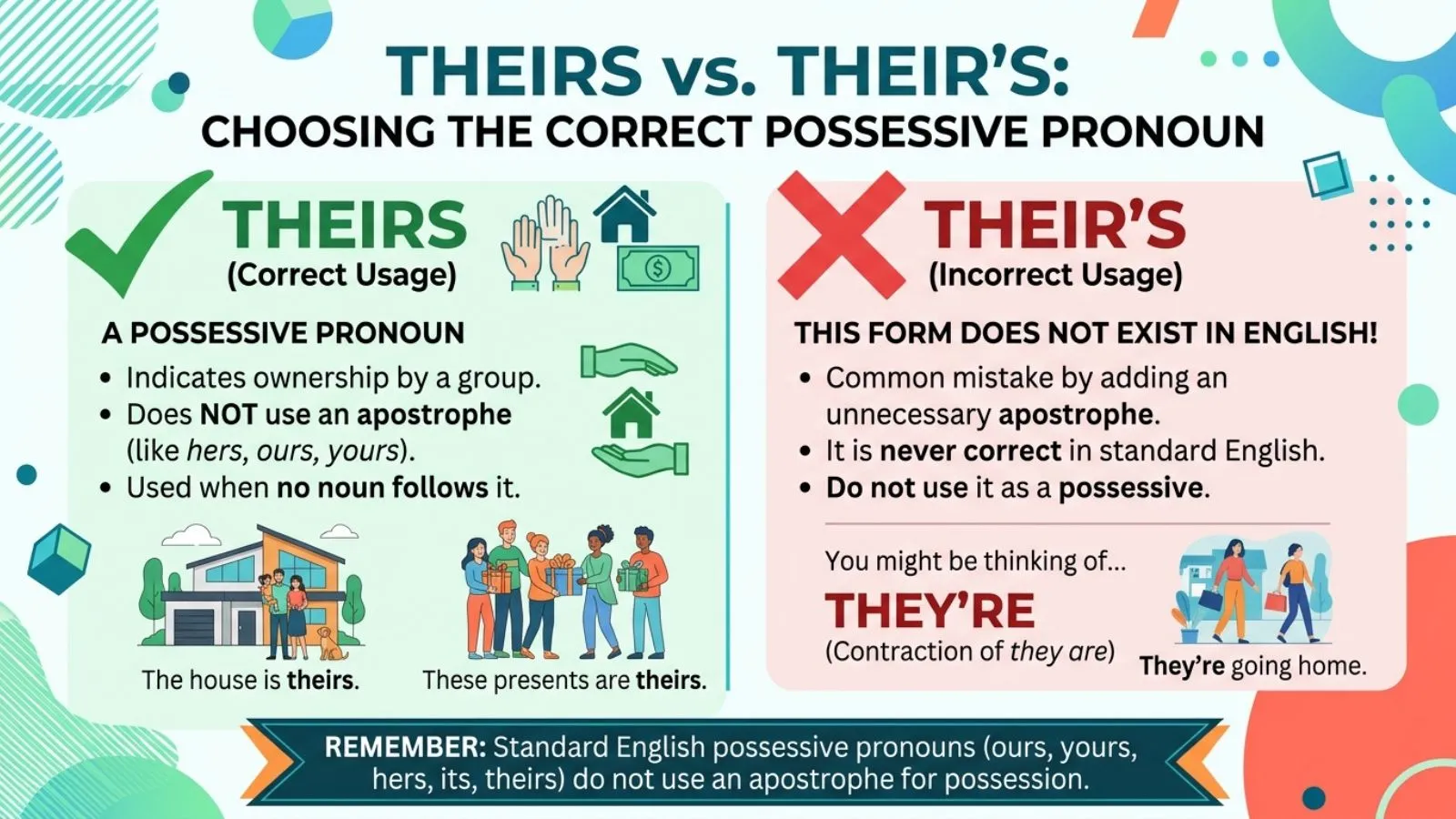
Have you ever wondered whether “theirs” or “their’s” is the correct way to show that something belongs to someone?
Hey, I want to share something that happened to me recently about “Theirs” or “Their’s.”
I was chatting with a friend when I suddenly saw this term pop up, and honestly, I had no clue which form was correct at first.
I kept wondering, “Am I missing something here?” It was a bit confusing, and I didn’t want to respond the wrong way.
So, I decided to look into theirs or their’s and figure out its meaning and proper usage.
After understanding it, I realized how important it is to know the correct form to avoid awkward mistakes in everyday conversations and writing.
I handled it by learning the proper spelling and grammar rule, and now I feel ready whenever I see “theirs” or “their’s” again in chats, social media, or writing.
“Theirs” or “Their’s” – Quick Answer
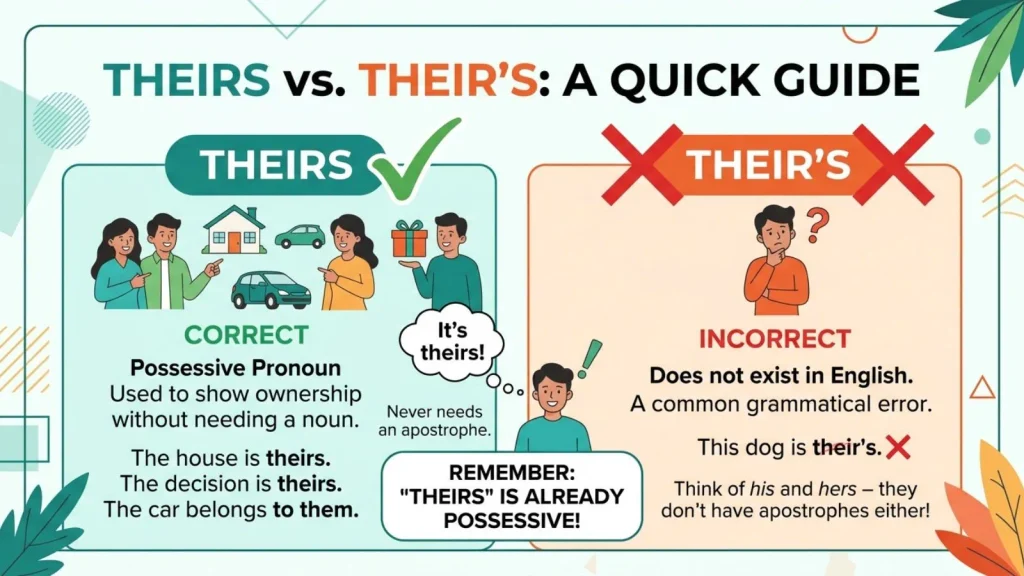
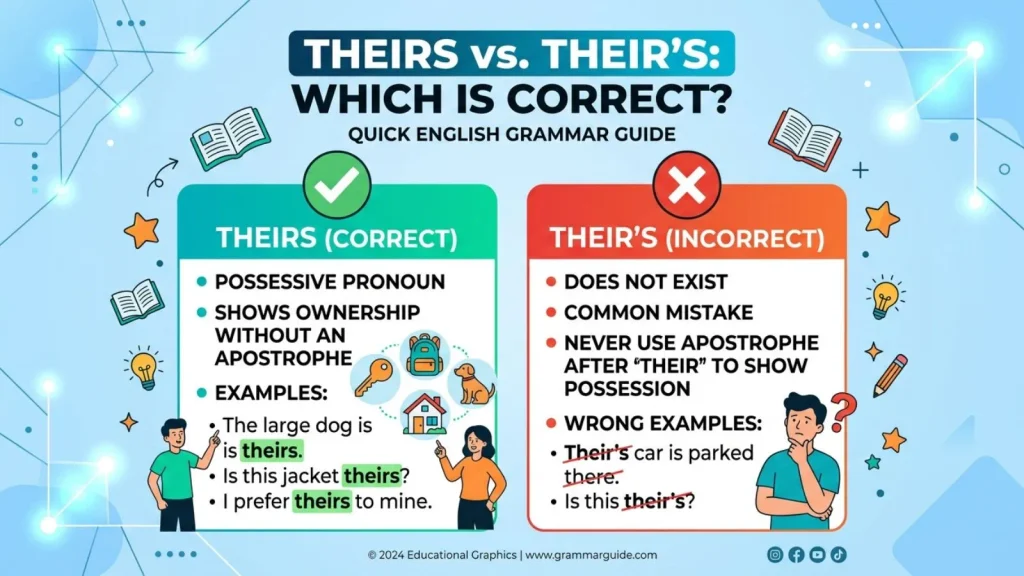
“Theirs” is correct. “Their’s” is always wrong.
There is no situation in standard English — formal or informal, British or American — where “their’s” is the correct spelling.
- ✅ The last slice of pizza is theirs.
- ❌ The last slice of pizza is their’s.
- ✅ Is this car theirs?
- ❌ Is this car their’s?
“Theirs” is a possessive pronoun. Like hers, ours, yours, and its, it never takes an apostrophe. If you remember one rule from this article, remember this one.
The Origin of “Theirs”
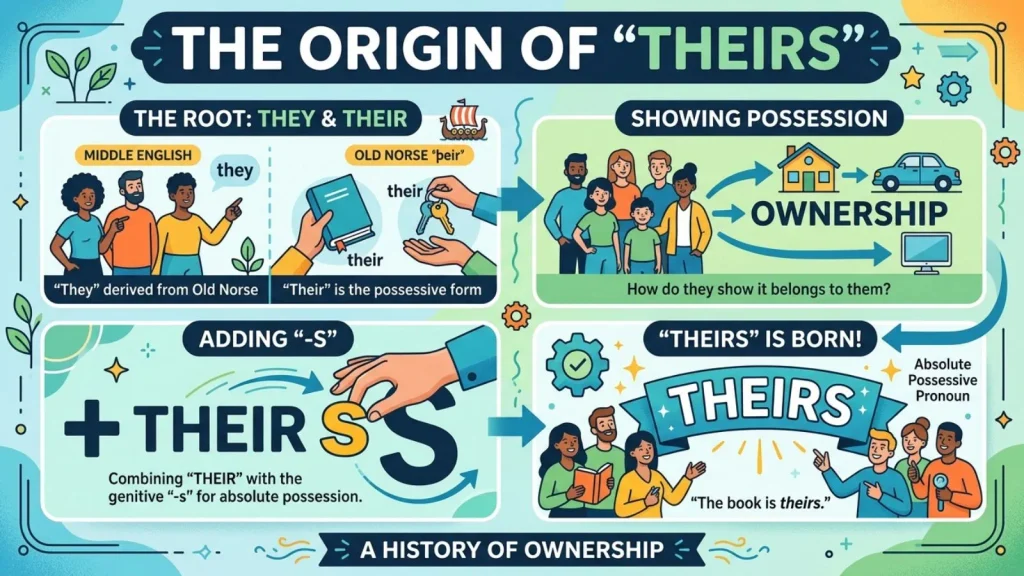
“Theirs” comes from Middle English theirs, built from the possessive pronoun their plus an added -s, following a pattern shared by other absolute possessive pronouns (ours, yours, hers). These words evolved to stand alone in a sentence without needing a noun right after them — you can say “the book is theirs” instead of “the book is their book.”
The apostrophe confusion has a clear cause: the apostrophe-s rule for regular nouns. We write “Maria’s car,” “the team’s decision,” and “the cat’s toy,” so it feels logical to apply the same rule to pronouns. But English possessive pronouns (his, hers, its, ours, yours, theirs) formed as their own separate category centuries ago, and that category simply never picked up the apostrophe. It’s a rule about word type, not about meaning.
This is different from the classic “its vs. it’s” mix-up, where “it’s” actually is a correct word — just a contraction of “it is,” not a possessive. “Theirs” has no contraction counterpart at all, which makes “their’s” even less justifiable. There is no expansion it could stand for.
British English vs American English Spelling
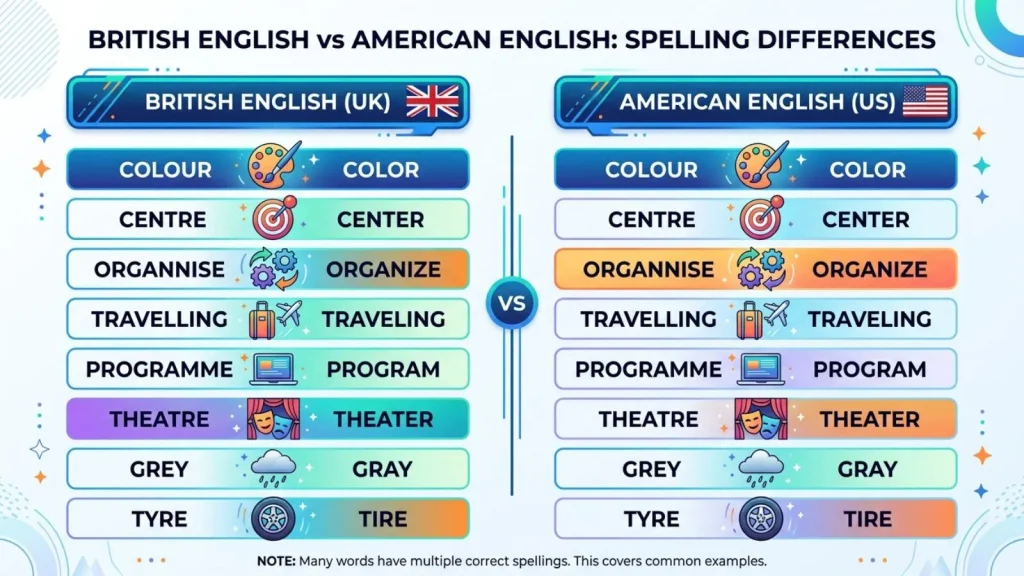
Here’s some good news: this is one of the rare spelling questions where British and American English fully agree. Both dialects treat “theirs” as a possessive pronoun with no apostrophe. There’s no regional variation to navigate, unlike “colour/color” or “realise/realize.”
| Feature | British English | American English |
| Correct spelling | theirs | theirs |
| Apostrophe used? | No | No |
| “Their’s” acceptable? | No | No |
| Example sentence | “That house is theirs.” | “That house is theirs.” |
| Formal writing | theirs | theirs |
| Common in casual texting | Sometimes misspelled as “their’s” | Sometimes misspelled as “their’s” |
The only real “variation” is in error rate, not correctness — some data suggests the “their’s” mistake shows up slightly more often in informal, fast-typed text (texting, social media) than in edited writing, regardless of country.
Which Spelling Should Use “Theirs” or “Their’s” ?
Since there’s no dialect split here, the advice is the same everywhere:
- US writers: Use “theirs.” No apostrophe, in any context.
- UK and Commonwealth writers (Canada, Australia, India, etc.): Use “theirs.” Same rule applies.
- Global / ESL writers: Use “theirs.” This is one spelling rule you don’t need to adjust based on your audience’s country.
- Academic and business writing: Always “theirs” — an apostrophe here reads as a basic proofreading error to editors and teachers.
- Texting and casual chat: Still “theirs” — but if you type “their’s” by habit, it’s a minor slip, not a dialect choice.
In short: audience doesn’t change this one. Get it right once, and it’s right everywhere.
Common Mistakes with “Theirs”
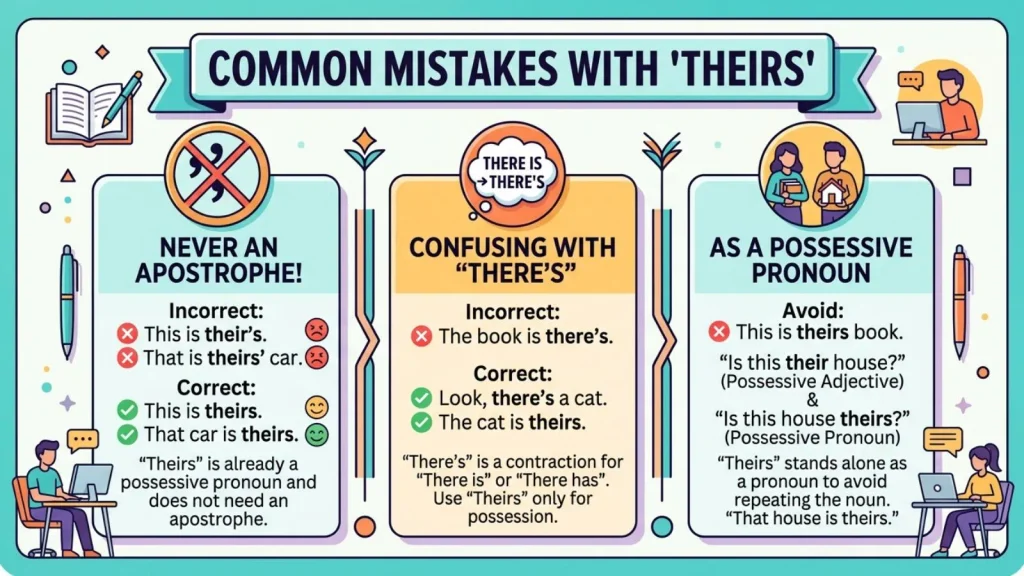
- Adding an apostrophe: “their’s”
- ❌ The mistake belongs to their’s.
- ✅ The mistake belongs to theirs.
- Confusing “theirs” with “there’s”
- “There’s” is a contraction of “there is.” It sounds similar but means something completely different.
- ❌ Their’s a problem with the schedule.
- ✅ There’s a problem with the schedule.
- ✅ The scheduling problem is theirs to fix.
- Confusing “theirs” with “there’re” or “their are”
- ❌ Their are three options.
- ✅ There are three options.
- Using “theirs” before a noun
- “Theirs” stands alone; it doesn’t attach to a noun the way “their” does.
- ❌ Theirs car is parked outside.
- ✅ Their car is parked outside.
- ✅ That car is theirs.
- Overcorrecting into “theirs'”
- Some writers add an apostrophe after the s instead of before it. Still wrong.
- ❌ The decision is theirs’.
- ✅ The decision is theirs.
“Theirs” in Everyday Examples
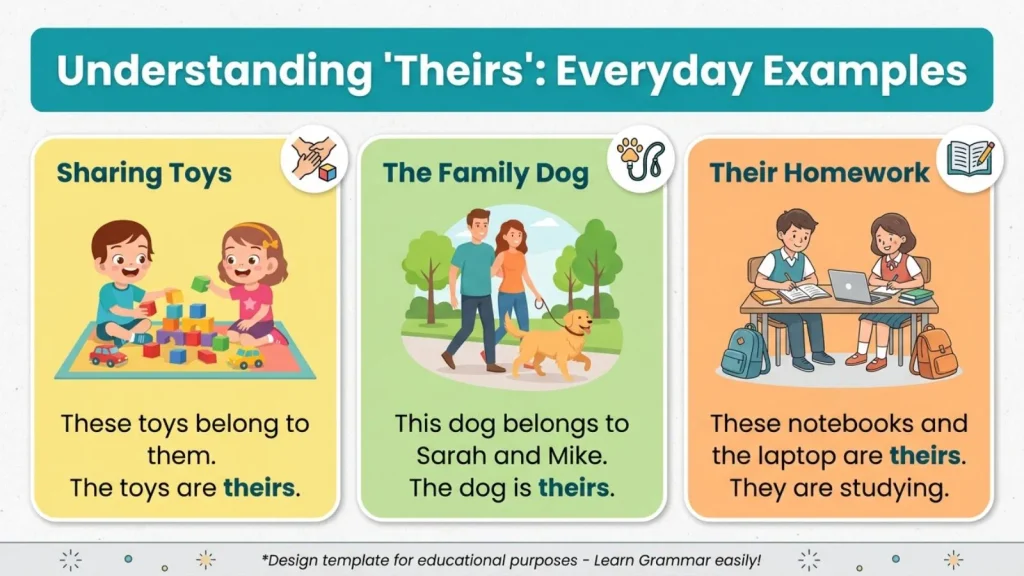
In emails: “Thanks for sending your feedback — we’ll compare it with theirs before finalizing the report.”
In news writing: “The victory belongs to the entire team, not just the coaching staff — it’s theirs.”
Social media posts: “Not our idea, it’s honestly theirs 👏 credit where it’s due.”
In formal/academic writing: “The methodology used in this study differs from theirs in three key respects.”
In customer service replies: “If the item was purchased under their account, the warranty is theirs to claim.”
“Theirs” – Google Trends & Usage Data
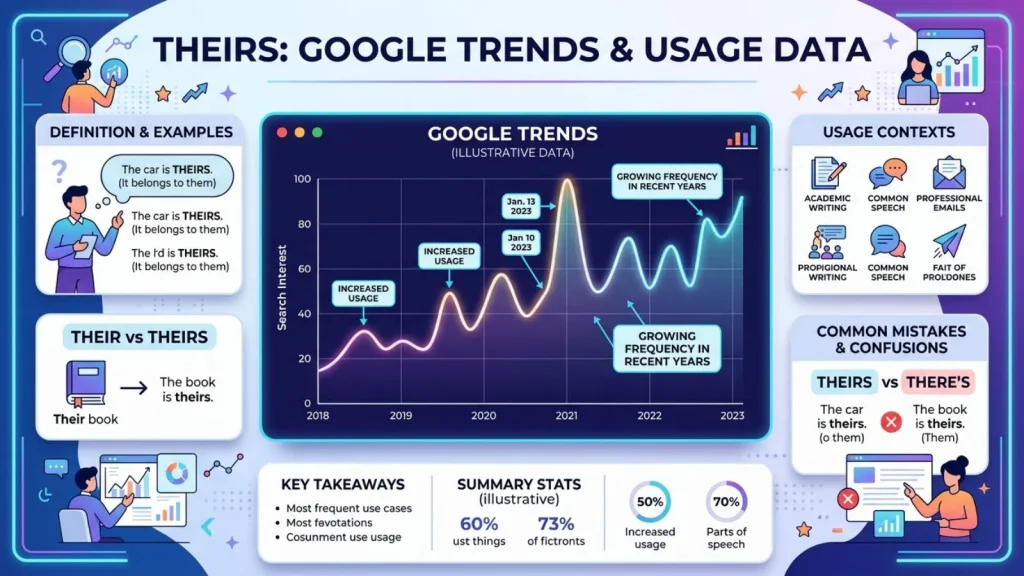
Search interest in “theirs vs their’s” spikes consistently around back-to-school periods (August–September) and during major grammar-check season for students and content writers, according to general keyword-tracking patterns. The query is especially common among:
- US-based searchers, often students checking essay grammar or professionals proofreading emails.
- UK, Canadian, and Australian searchers, typically double-checking that regional spelling doesn’t apply here (it doesn’t).
- Non-native English speakers and ESL learners, who are taught the apostrophe-s possessive rule early and then encounter the pronoun exception later.
- Content writers and editors, searching it as a quick style-guide confirmation before publishing.
Because this is a “no regional variation” case, search demand is fairly evenly spread across English-speaking countries, unlike true British/American spelling differences (e.g., “color vs colour”), which show sharp country-based search patterns.
Keyword Variation Comparison Table
| Term | Correct? | Meaning | Example |
| Theirs | ✅ Yes | Possessive pronoun (belonging to them) | “The trophy is theirs.” |
| Their’s | ❌ No | Not a word | — |
| Theirs’ | ❌ No | Not a word | — |
| Their | ✅ Yes (different use) | Possessive adjective (used before a noun) | “Their trophy is on the shelf.” |
| There’s | ✅ Yes (different word) | Contraction of “there is” | “There’s a trophy on the shelf.” |
| There | ✅ Yes (different word) | Refers to a place | “Put the trophy there.” |
Frequently Asked Questions
1. Is “their’s” ever correct in any form of English?
No. Not in American English, British English, or any recognized dialect. “Theirs” is the only correct spelling.
2. Why doesn’t “theirs” need an apostrophe like other possessives?
Because it’s a possessive pronoun, not a possessive noun. Possessive pronouns (his, hers, its, ours, yours, theirs) show ownership through their own form and never use an apostrophe.
3. What’s the difference between “their,” “there,” and “theirs”?
“Their” describes ownership before a noun (“their house”). “There” refers to a place or is used in “there is/are.” “Theirs” stands alone to show ownership (“the house is theirs”).
4. Is “theirs” singular or plural?
“Theirs” refers back to a plural or collective owner (“they”), so it’s used when the owner is plural — for example, “the decision is theirs” (their decision).
5. Can I use “theirs” in formal writing?
es. “Theirs” is standard in academic, business, and professional writing. It’s the correct, expected form.
6. Why do so many people write “their’s” by mistake?
t’s an overcorrection from the apostrophe-s rule used for regular nouns (like “Maria’s”), applied incorrectly to a pronoun that doesn’t follow that rule.
7. Does autocorrect fix “their’s” automatically?
Not always. Many spell checkers flag it, but some autocorrect tools and messaging apps miss it, especially in casual typing. It’s worth double-checking manually.
Conclusion
The rule is simple, and it never changes based on where you’re writing from: “theirs” is correct, and “their’s” is not.
Unlike true British-versus-American spelling differences, this isn’t a regional choice — it’s a fixed rule of English grammar.
“Theirs” belongs to a small group of possessive pronouns, alongside hers, ours, and yours, that show ownership without an apostrophe.
The confusion almost always comes from one place: the apostrophe-s pattern we use for regular nouns, like “the team’s decision.”
That pattern doesn’t apply here. If you keep one mental shortcut, make it this: possessive pronouns stand on their own and never take an apostrophe.
Whether you’re writing a formal report, a quick text, or a school essay, the safe choice is always “theirs” — no exceptions, no regional variations, no apostrophe. Get comfortable with this one rule, and you’ll never second-guess it again.

Here’s a concise 2-line author bio suitable for Simifind.com:
James Dashner is an American bestselling author best known for The Maze Runner series and other popular young-adult fiction.
On Simifind.com, he shares clear, engaging insights and helpful content for readers interested in books, writing, and popular literature.


1 thought on “Theirs vs. Their’s: Meaning, Grammar, and Correct Usage (for 2026)”