Ever wondered whether “shoutout” is one word or “shout out” should be written as two?
Hey, I want to share something that happened to me recently about Shoutout or Shout Out.
I was chatting with a friend when I suddenly saw this term pop up, and honestly, I had no clue what it meant at first.
I kept wondering, “Am I missing something here?” It was a bit confusing, and I didn’t want to respond the wrong way.
So, I decided to look into Shoutout or Shout Out and figure out its meaning and context.
After understanding it, I realized how important it is to know these terms to avoid awkward situations in conversations.
I handled it by learning the proper meaning and responding confidently, and now I feel ready whenever I see Shoutout or Shout Out again in chats or social media.
Shoutout or Shout Out – Quick Answer
Here is the simple rule.
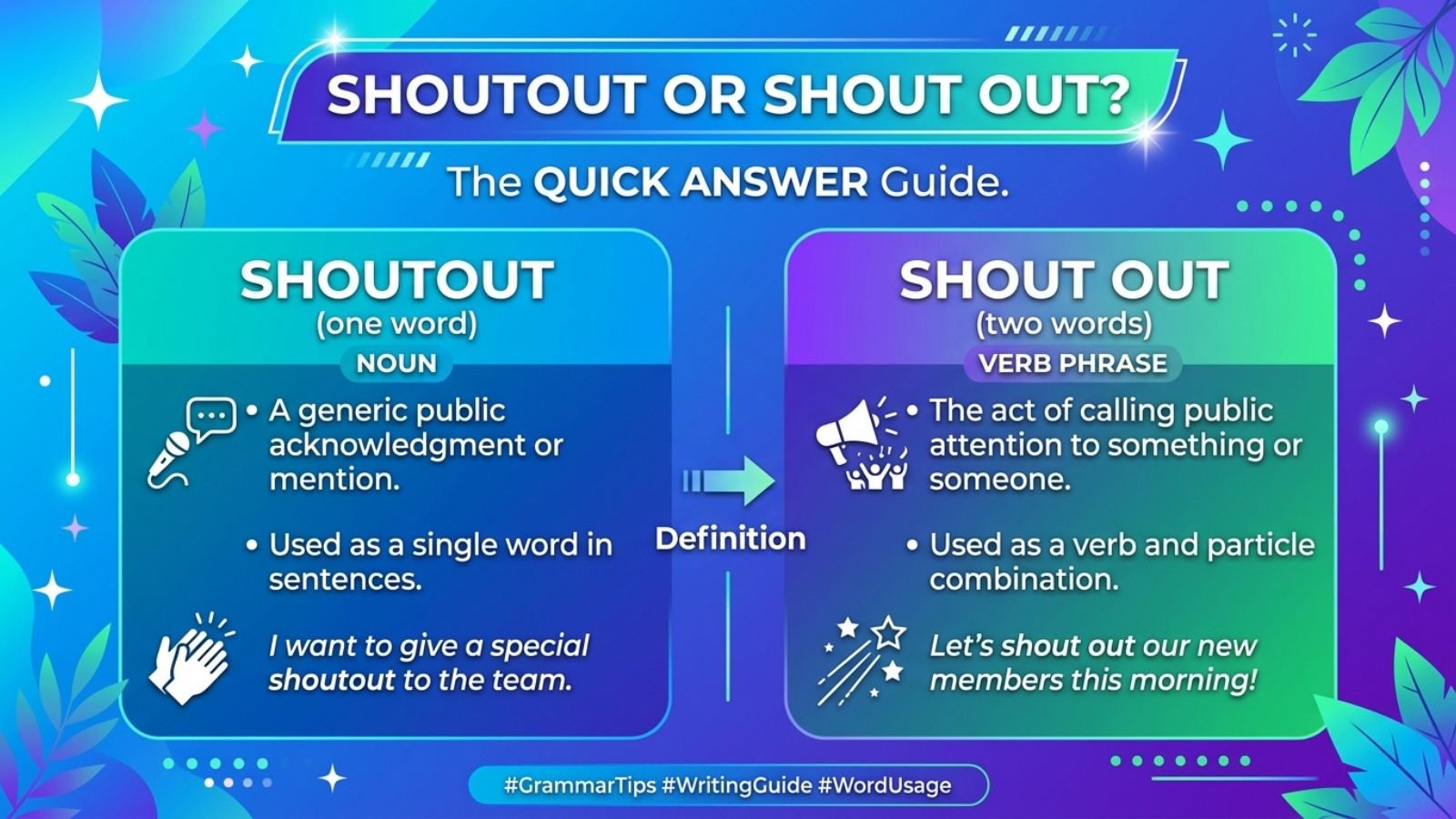
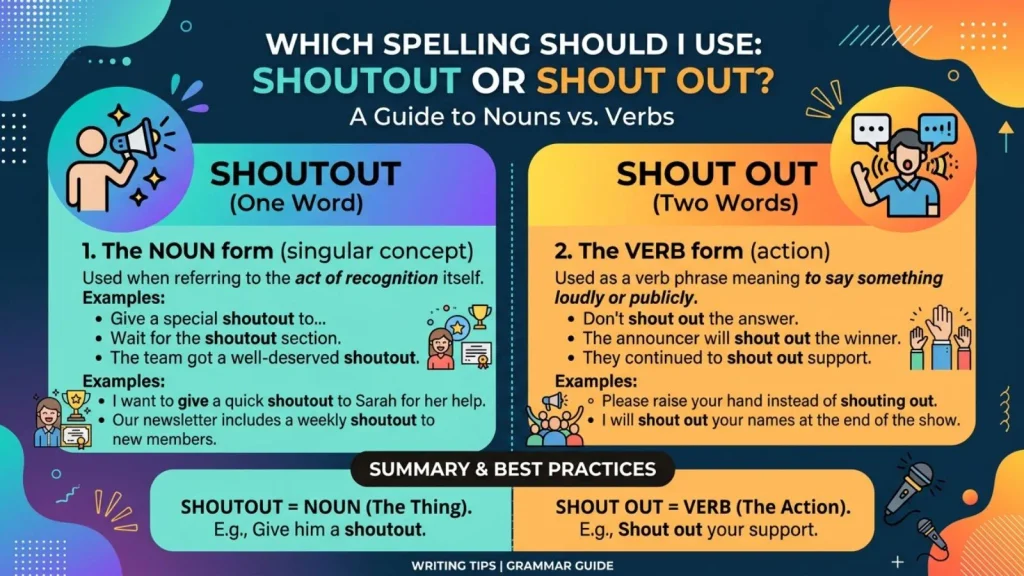
- “Shoutout” (one word) is a noun. It means a public mention of thanks or praise.
- “Shout out” (two words) is a verb phrase. It means to call out loud, or to give someone that mention.
Examples:
- “I want to give a shoutout to my team.” (noun)
- “I want to shout out my team.” (verb)
- “Can you shout out the answer?” (call loudly)
If you can replace the word with “mention” or “credit,” use shoutout. If you can replace it with “call out” or “yell,” use shout out.
The Origin of Shoutout
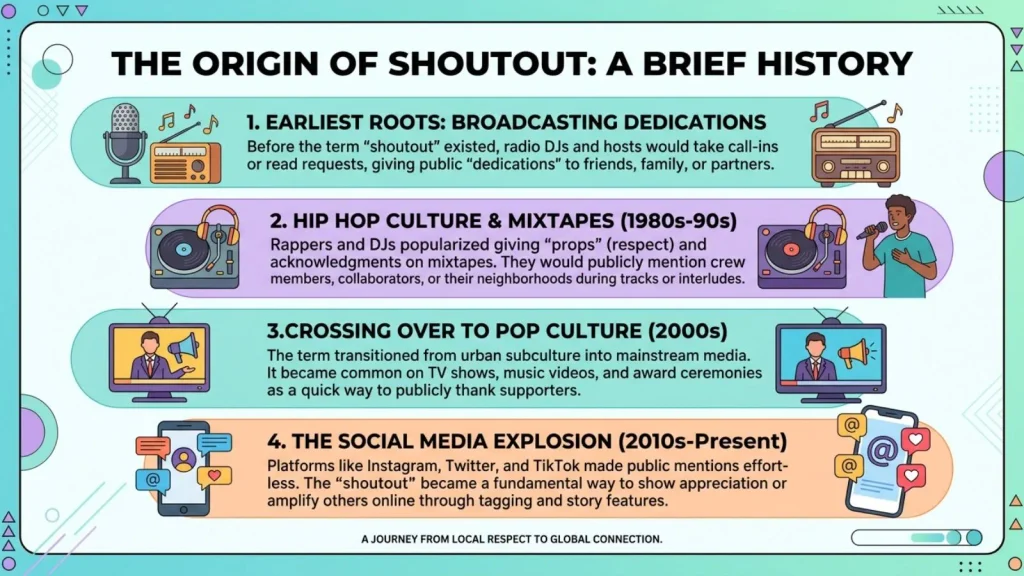
The word comes from two simple English words: “shout” and “out.” At first, people used it only as a verb phrase. It meant to call something loudly, often to get someone’s attention.
In the 1990s, hip-hop and radio culture changed the word’s job. DJs began giving “shout outs” to friends, fans, and neighborhoods on air. This new use was a noun. It meant a public thank-you or mention.
As the phrase became more common, English did what it often does with popular phrases: it merged the words into one. This is a normal pattern. “Log in” became “login.” “Set up” became “setup.” Over time, “shout out” followed the same path and became “shoutout” when used as a noun.
This is also why spelling differences exist. Language change does not happen at the same speed everywhere. Some editors and dictionaries adopted “shoutout” early. Others still prefer the two-word form in all cases. Neither side is wrong — they are simply at different points in the same shift.
British English vs American English Spelling
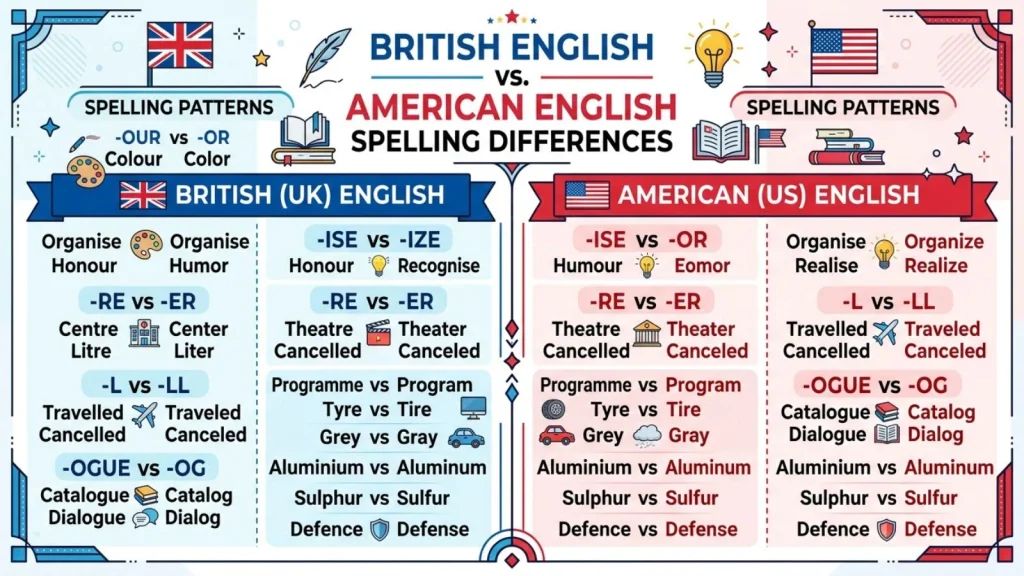
American English tends to merge phrasal nouns into single words faster than British English does. This pattern shows up with “shoutout” too.
- American English widely accepts “shoutout” as a single word, especially in casual and digital writing.
- British English is more cautious. Many British style guides still prefer “shout out” as two words, even when used as a noun.
Here is a comparison table.
| Feature | American English | British English |
| Noun form | shoutout | shout out (sometimes shout-out) |
| Verb form | shout out | shout out |
| Hyphenated form | Rare | shout-out (used more often) |
| Common in | Social media, marketing, casual writing | News, formal writing |
| Dictionary status | Widely listed as one word | Often listed as two words or hyphenated |
Note the hyphenated form, “shout-out.” It appears more in British and formal writing. It sits between the American one-word style and the traditional two-word style.
Which Spelling Should Use Shoutout or Shout Out ?
Your choice depends on your audience and your writing style.
If you write for a US audience: Use “shoutout” as one word for the noun. This matches how most American readers see it online and in casual media.
If you write for a UK or Commonwealth audience: Use “shout out” or “shout-out.” Many British, Australian, and Canadian style guides still prefer the space or the hyphen.
If you write for a global or mixed audience: Pick one style and stay consistent. For casual content like social media, “shoutout” is now the more common global choice. For formal writing, “shout-out” is a safer, more neutral option.
If you are unsure: Check your style guide first. If you don’t have one, follow the AP Stylebook (which now accepts “shoutout” as one word) for American content, or a British style guide for UK content.
Common Mistakes with Shoutout
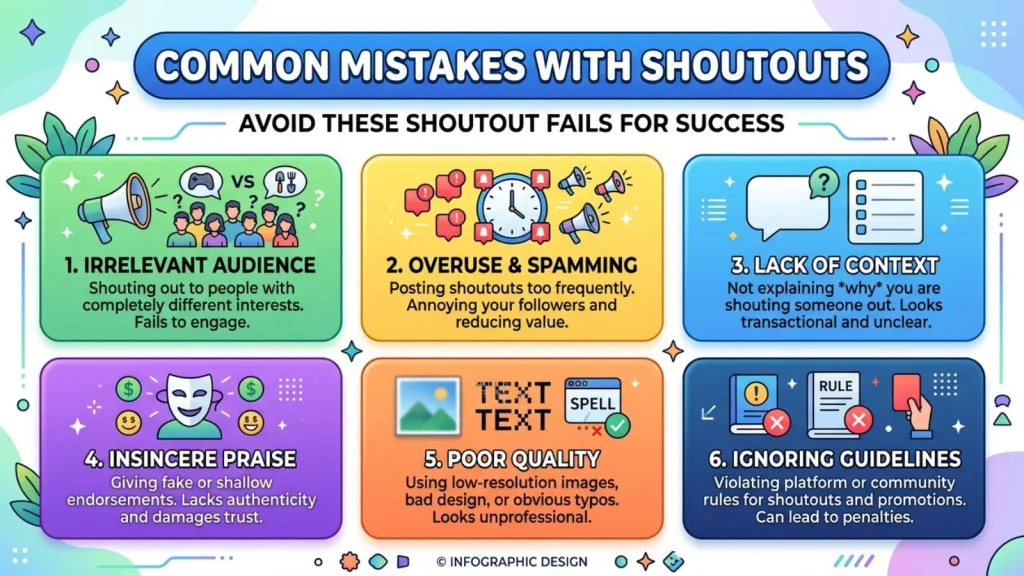
Here are the most frequent errors people make, and how to fix them.
- Mistake: “I’ll shoutout to you later.” (using the noun form as a verb) Fix: “I’ll shout out to you later.”
- Mistake: “Give me a shout out.” when writing casual American content that calls for “shoutout” Fix: “Give me a shoutout.” (still correct in formal or British contexts)
- Mistake: Mixing both spellings in the same piece of writing. Fix: Pick one style — one word, two words, or hyphenated — and use it throughout.
- Mistake: Using “shout-out” and “shoutout” interchangeably in the same sentence. Fix: Choose one form per document for consistency.
- Mistake: Treating “shoutout” as a verb in formal writing. Fix: Remember: “shoutout” is a noun. Use “shout out” or “give a shoutout” for the action.
Shoutout in Everyday Examples

In an email: “I wanted to send a quick shoutout to the design team for finishing the project early.”
In a news article: “The mayor gave a shout-out to local volunteers during her speech.”
On social media: “Big shoutout to everyone who came to the launch event last night! 🎉”
In formal writing: “The report includes a shout-out to the research staff whose data made this study possible.”
As a verb, in conversation: “Don’t forget to shout out if you need help carrying that box.”
Shoutout – Google Trends & Usage Data

Search interest for “shoutout” and “shout out” has grown steadily with the rise of social media, podcasts, and live streaming. People search for both spellings because platforms and creators use them inconsistently, which keeps the confusion alive.
Usage patterns tend to follow these general trends:
- The single-word “shoutout” sees higher search volume in the United States, especially tied to social media and marketing content.
- The two-word “shout out” and hyphenated “shout-out” remain common search terms in the UK, Australia, and other English-speaking regions outside North America.
- Searches spike around cultural moments like award shows, live streams, and viral social media trends, when people want to know how to write a public thank-you correctly.
Keyword Variations Comparison Table
| Variation | Part of Speech | Common Region | Example |
| shoutout | Noun | US, global casual | “Thanks for the shoutout!” |
| shout out | Verb phrase | Global | “I’ll shout out your name.” |
| shout-out | Noun (hyphenated) | UK, formal writing | “A shout-out to our sponsors.” |
| shoutouts | Noun (plural) | US, global casual | “She gives shoutouts every week.” |
FAQs
1. Is “shoutout” one word or two?
It depends on use. As a noun (a public mention), it is often one word: “shoutout.” As a verb phrase (to call out loud), it stays two words: “shout out.”
2. Is “shout-out” with a hyphen correct?
Yes. The hyphenated form “shout-out” is common, especially in British and formal writing, when used as a noun.
3. What is the plural of “shoutout”?
The plural is “shoutouts,” written as one word, matching the singular noun form.
4. Is “shoutout” a real word in the dictionary?
Yes. Major dictionaries, including Merriam-Webster, list “shoutout” as a standard noun.
5. Can I use “shoutout” in formal writing?
Yes, but check your style guide. Some formal and British style guides prefer “shout-out” or “shout out” instead.
6. What does “give a shoutout” mean?
It means to publicly thank, credit, or mention someone, often on social media, radio, or in a speech.
7. Why do people spell this word differently?
English phrases often merge into single words over time. “Shoutout” is partway through this shift, so American and British English, along with formal and casual writing, treat it differently.
Conclusion
The spelling of “shoutout” or “shout out” is not random. It follows a clear rule based on grammar and region.
As a noun, meaning a public thank-you or mention, American English favors “shoutout” as one word.
As a verb phrase, meaning to call out loud, it stays “shout out” everywhere. British and formal writing often prefer “shout-out” or “shout out” even for the noun form.
Your best choice depends on your audience. Write for casual American readers? Use “shoutout.” Write for UK or Commonwealth readers, or formal documents? Use “shout out” or “shout-out.” Whatever you choose, stay consistent throughout your writing.
This small detail matters more than it seems. Correct spelling builds trust with your readers. It shows care and attention. Now that you know the rule, you can use “shoutout” or “shout out” with confidence, in any context, for any audience.

Mary Roach is an American science writer and bestselling author known for making unusual and complex scientific topics engaging, accessible, and humorous. Her books include Stiff, Packing for Mars, Gulp, and Fuzz.
Author at Simifind.com, sharing clear, informative content designed to help readers understand interesting topics and everyday questions.