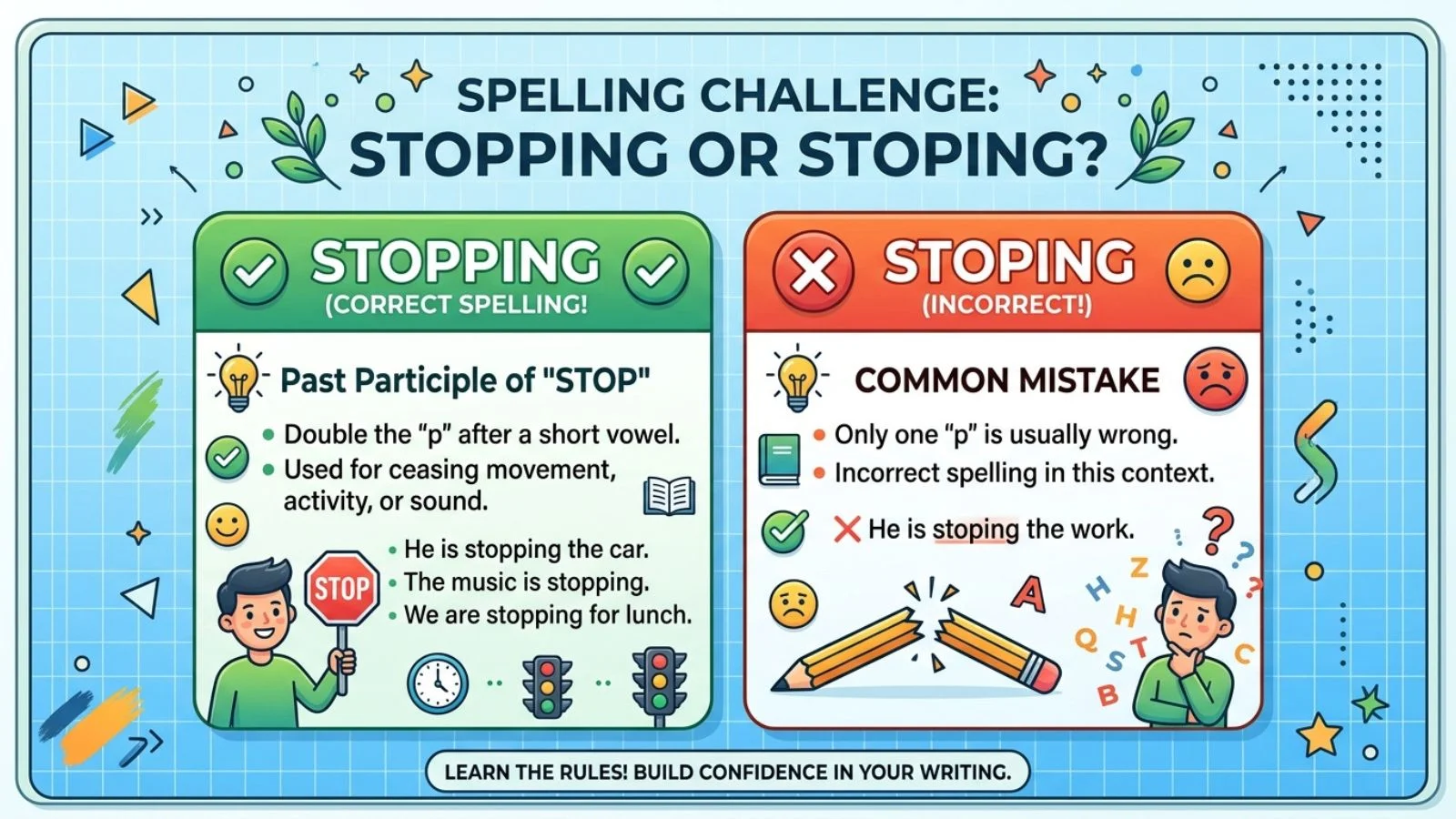
Stopping or Stoping can be confusing because both spellings look almost identical, but only one is correct in standard English.
Hey, I want to share something that happened to me recently about Stopping or Stoping.
I was chatting with a friend when I suddenly saw this term pop up, and honestly, I had no clue which spelling was correct at first.
I kept wondering, “Am I missing something here?” It was a bit confusing, and I didn’t want to respond the wrong way.
So, I decided to look into Stopping or Stoping and figure out the correct spelling, meaning, and context.
After understanding the rule, I realized how important it is to know these small spelling differences to avoid awkward situations in conversations.
I handled it by learning the proper spelling and responding confidently, and now I feel ready whenever I see Stopping or Stoping again in chats, writing, or social media.
Stopping or Stoping – Quick Answer
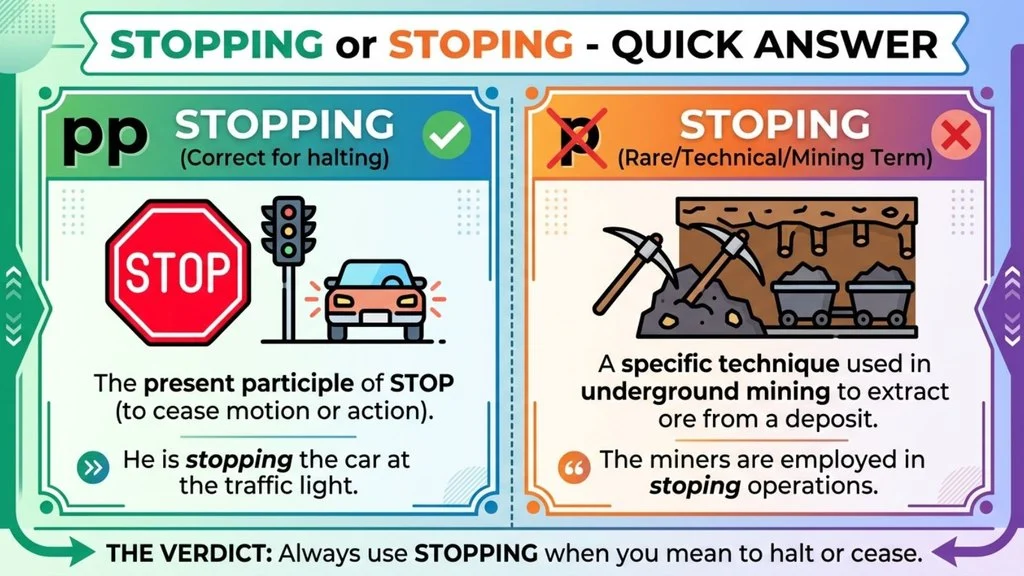
Stopping is the correct spelling when you mean the -ing form of the everyday verb stop.
- Correct: The bus is stopping at the next station.
- Correct: She is stopping by the store.
- Correct: Please stop stopping every few minutes.
- Incorrect in ordinary English: The bus is stoping at the next station.
The basic form is:
stop → stopping
The final p is doubled before -ing. Cambridge lists stop/stopped/stopping among verbs that follow this consonant-doubling pattern.
However, stoping is not always a spelling mistake. In mining and geology, stoping is a technical noun referring to processes involving the excavation or removal of rock or ore.
| Word | Meaning | Everyday English? |
| Stopping | Coming to a halt or ending an action | Yes |
| Stoping | A mining/geological process | Technical |
| Stop | To halt or cease | Yes |
| Stopped | Past tense of stop | Yes |
So, if you mean “coming to a halt,” use stopping.
The Origin of Stopping or Stoping
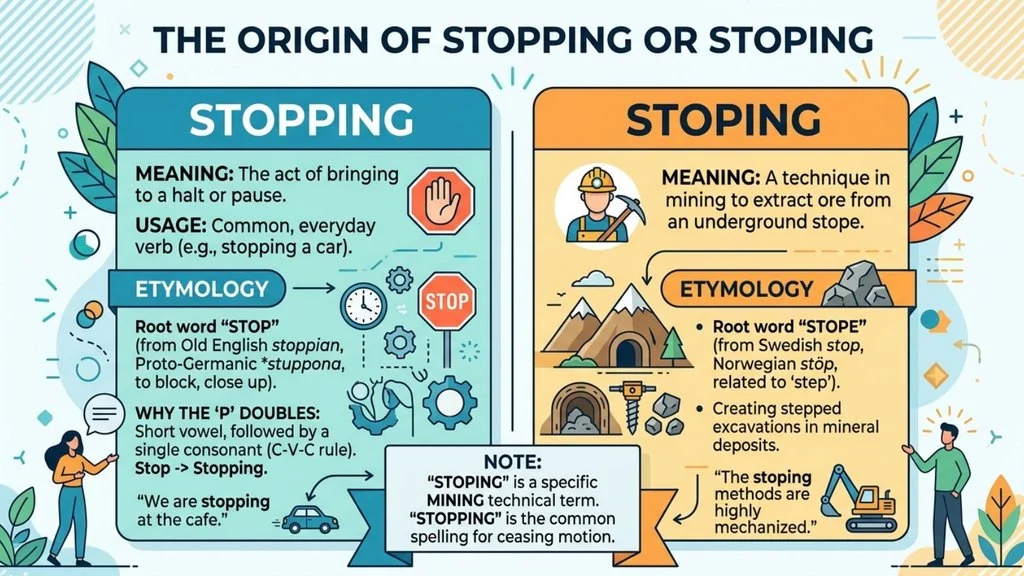
The everyday word stopping comes from the verb stop plus the suffix -ing.
English spelling uses a common rule for many short verbs. When a one-syllable verb ends in a single consonant after a single vowel, the final consonant is often doubled before a vowel-starting suffix.
For example:
- run → running
- sit → sitting
- plan → planning
- shop → shopping
- stop → stopping
Therefore:
stop + ing → stopping
The double p is not optional in standard everyday spelling.
The word stoping, however, has a different history. It is associated with stope, a mining term. Dictionary sources trace stoping to stope + -ing and record it as a technical term.
Collins records stoping as a geology term and dates the word to around 1770–80.
This means the two spellings are not simply British and American versions of the same word. They can represent different words with different meanings.
British English vs American English Spelling
There is no major British-versus-American spelling difference between stopping and stoping when you mean the ordinary verb stop.
Both British and American English use:
stopping
For example:
- British English: “The train is stopping here.”
- American English: “The train is stopping here.”
The spelling remains the same.
The technical word stoping also appears in both British and American English in geology and mining contexts. Collins gives separate British and American entries for the technical term.
Comparison Table
| Feature | British English | American English |
| Present participle of stop | stopping | stopping |
| Past tense | stopped | stopped |
| Technical geology term | stoping | stoping |
| Meaning of stopping | Coming to a halt | Coming to a halt |
| Spelling difference | None | None |
So, unlike words such as colour/color or centre/center, this is not mainly a regional spelling issue.
Which Spelling Should Use Stopping or Stoping ?
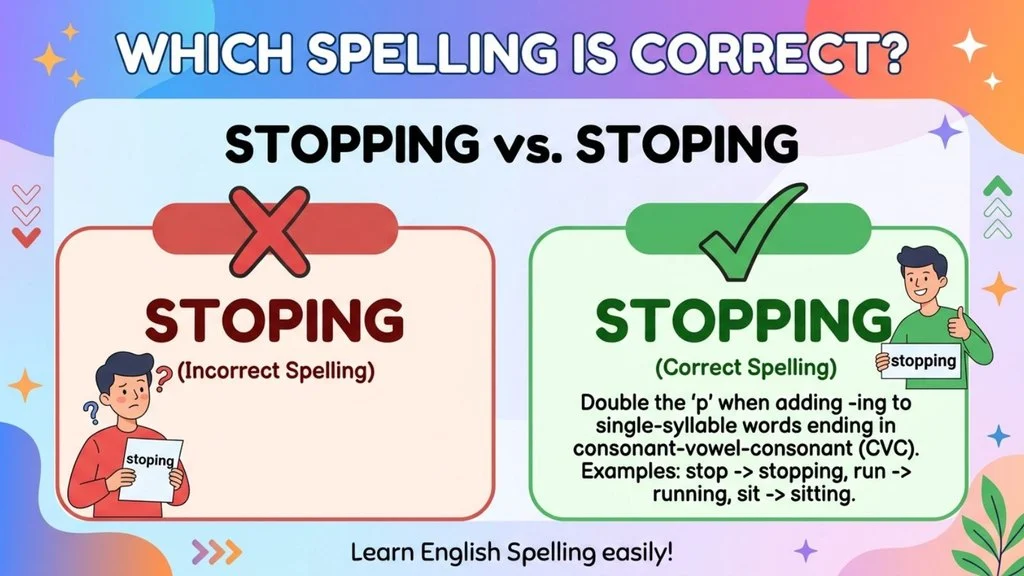
For almost all everyday writing, choose stopping.
If You Write for a US Audience
Use stopping:
The driver is stopping the car.
If You Write for a UK or Commonwealth Audience
Use stopping:
The train is stopping at the next station.
The same spelling works in both varieties of English.
If You Work in Mining or Geology
You may need stoping because it has a specialized technical meaning.
For example:
The engineers studied the stoping method used in the mine.
In this sentence, stoping is not a mistake. It refers to a mining or geological process.
For Global English
If your audience is general and you mean halting or ceasing, always use stopping.
This avoids confusion and follows standard English spelling.
Common Mistakes with Stopping or Stoping
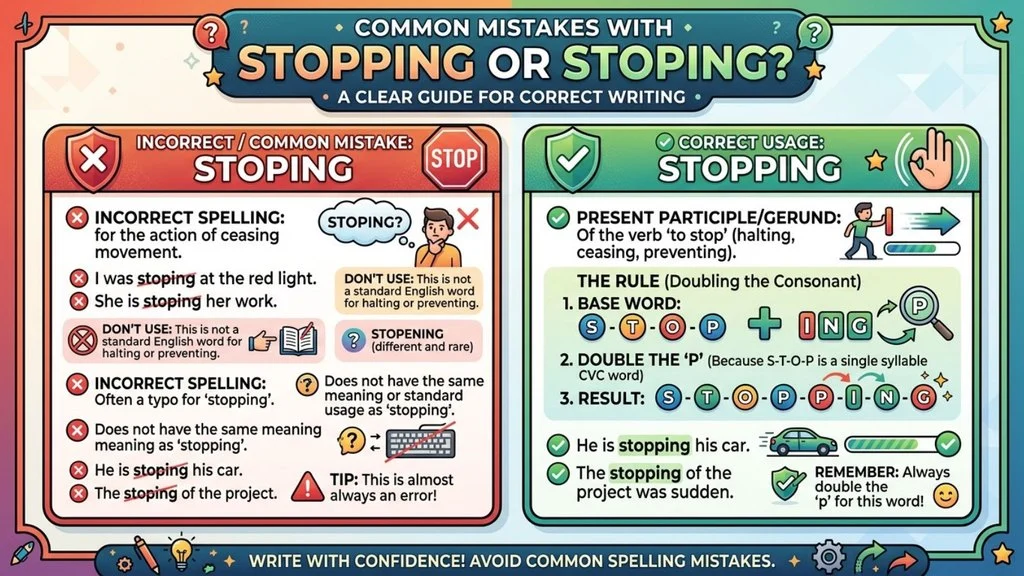
The most common mistake is leaving out the second p.
Mistake 1: Stoping
❌ She is stoping the car.
✅ She is stopping the car.
Mistake 2: Stoped
❌ The bus stoped suddenly.
✅ The bus stopped suddenly.
The same doubling pattern applies when adding -ed:
stop → stopped
Mistake 3: Using Stoping in Formal Writing
❌ We are stoping production next week.
✅ We are stopping production next week.
Mistake 4: Thinking It Is a US/UK Difference
Some writers assume that stoping might be British while stopping is American.
That is not the case. Both varieties use stopping for the normal verb form.
Easy Memory Rule
Remember:
STOP has one P. STOPPING has two Ps. STOPPED has two Ps.
stop → stopped → stopping
This simple pattern can prevent many spelling errors.
Stopping or Stoping in Everyday Examples
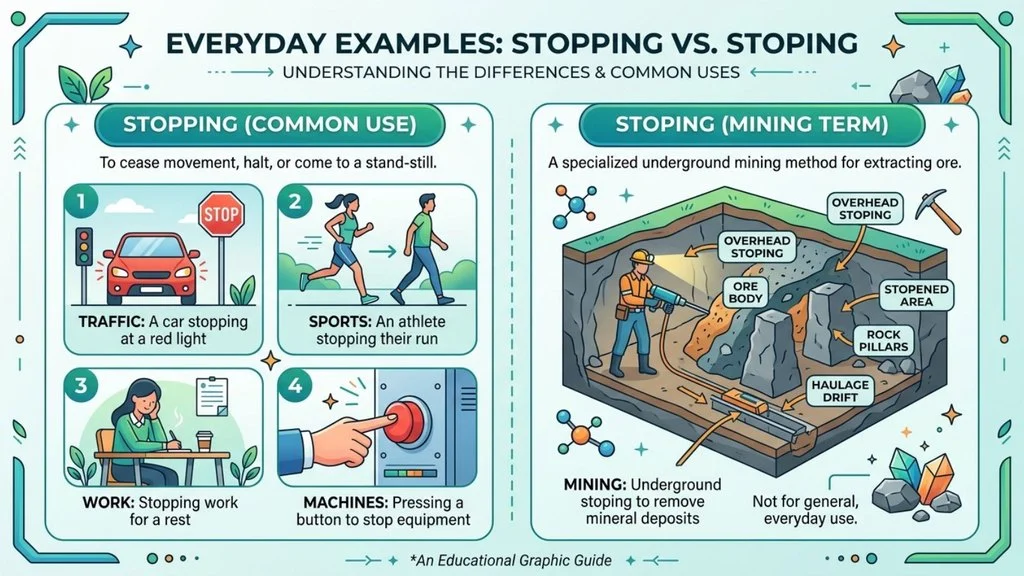
In Emails
We are stopping the service at the end of the month.
In a News Report
The heavy rain caused traffic to stop, with several vehicles stopping along the highway.
On Social Media
I am stopping for coffee before heading home.
In Formal Writing
The company is stopping production temporarily.
In Conversation
Why are you stopping here?
In a Technical Mining Report
The engineers examined the effects of stoping on the underground structure.
The last example uses stoping correctly because it refers to a specialized mining process. Mining references define stoping as the excavation or removal of ore or rock from underground workings.
Stopping or Stoping – Google Trends & Usage Data
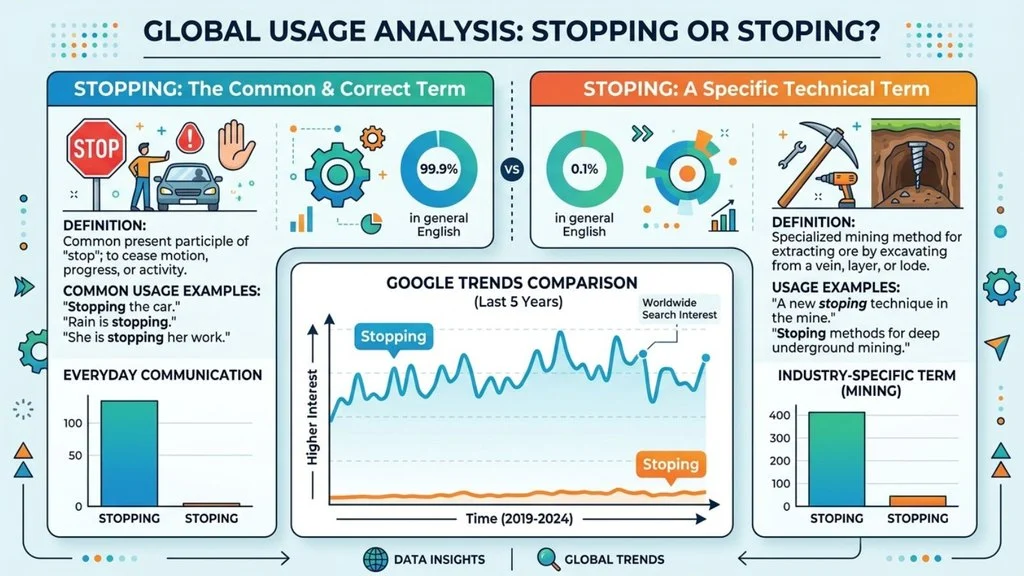
Google Trends measures search interest rather than exact word frequency. Its data can be explored by country, time period, category, and search term, but the public Trends pages do not provide a reliable fixed worldwide search-volume number for stopping vs stoping from the information available here.
For this keyword, search intent is also important.
Stopping has broad everyday uses. People may search it when checking:
- spelling
- grammar
- verb forms
- writing corrections
- English homework
- emails and documents
Stoping has a much narrower technical meaning. It is mainly connected with:
- mining
- geology
- ore extraction
- underground excavation
- geological processes
Dictionary sources confirm that stoping is a specialized geology or mining term.
Google Trends should therefore be interpreted carefully. A search for stoping does not necessarily mean someone is asking whether stopping is spelled correctly. The search may come from a student, engineer, geologist, or mining professional looking for the technical term.
Stopping vs Stoping: Comparison Table
| Word | Correct for ordinary English? | Meaning | Example |
| Stopping | Yes | Halting or ending something | The car is stopping. |
| Stoping | No, not for the ordinary verb | Mining/geology process | The mine uses stoping methods. |
| Stop | Yes | To halt or cease | Please stop talking. |
| Stopped | Yes | Past form of stop | The train stopped. |
| Stopping | Yes | -ing form of stop | She is stopping now. |
FAQs About Stopping or Stoping
Is it stopping or stoping?
Stopping is correct when you mean the -ing form of the everyday verb stop.
Why does stopping have two p’s?
The final consonant of the short verb stop is doubled before adding -ing, giving stopping. Cambridge includes stop/stopping among common examples of this spelling pattern.
Is stoping ever a correct word?
Yes. Stoping is a specialized mining and geology term. It can refer to the removal or excavation of ore or rock in underground workings.
Is stopping the same in British and American English?
Yes. Both British and American English spell the normal -ing form of stop as stopping.
Is it stoped or stopped?
The correct past-tense spelling is stopped, with two p’s.
What is the easiest way to remember stopping?
Think of the word as:
stop + ing = stopping
Remember that the final p doubles.
What does stoping mean in mining?
In mining, stoping refers to extracting ore from an underground mine, creating or working within a space known as a stope.
Conclusion
The answer to stopping or stoping depends on what you mean. In normal English, stopping is the correct spelling. It is the present participle of stop and describes the act of coming to a halt, ending an activity, or preventing something from continuing. The spelling uses two p’s because the final consonant is doubled before -ing in this type of short verb.
The word stoping is different. It is a legitimate technical term used in mining and geology. It can describe the process of extracting ore or excavating rock in underground workings.
For everyday writing, school assignments, emails, social media, and professional communication, choose stopping. This spelling works in both British and American English.
The easiest forms to remember are:
stop → stopped → stopping
Once you know this pattern, the spelling becomes much easier. Just remember that stoping is reserved for its specialized technical meaning, while stopping is the normal everyday form.

Mary Roach is an American science writer and bestselling author known for making unusual and complex scientific topics engaging, accessible, and humorous. Her books include Stiff, Packing for Mars, Gulp, and Fuzz.
Author at Simifind.com, sharing clear, informative content designed to help readers understand interesting topics and everyday questions.




1 thought on “Stopping or Stoping: Meaning, Spelling, and Usage (for 2026)”