
Have you ever wondered whether to say alumni or alumna when talking about someone who studied at a school, college, or university?
Hey, I want to share something that happened to me recently about Alumni or Alumna.
I was chatting with a friend when I suddenly saw this term pop up, and honestly, I had no clue what it meant at first.
I kept wondering, “Am I missing something here?” It was a bit confusing, and I didn’t want to respond the wrong way.
So, I decided to look into Alumni or Alumna and figure out its meaning and context.
After understanding it, I realized how important it is to know these terms to avoid awkward situations in conversations.
I handled it by learning the proper meaning and responding confidently, and now I feel ready whenever I see Alumni or Alumna again in chats or social media.
Alumni or Alumna – Quick Answer
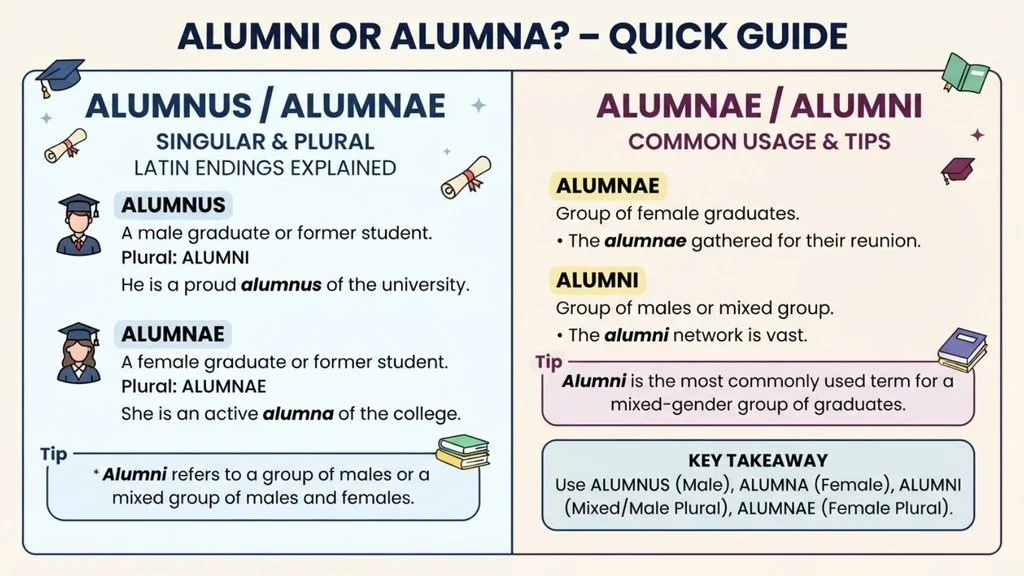
The simplest distinction is:
- Alumna = one female graduate or former student
- Alumnus = one male graduate or former student
- Alumnae = more than one female graduate or former student
Quick Examples
She is an alumna of Harvard University.
He is an alumnus of Oxford University.
They are alumni of the same university.
The alumnae attended the women’s college reunion.
In modern English, alumni is also widely used as a gender-neutral plural noun, especially in American English and university communication.
So, if you are talking about one woman, “alumna” is the traditional precise term. If you are talking about a group, “alumni” is commonly used.
The Origin of Alumni or Alumna
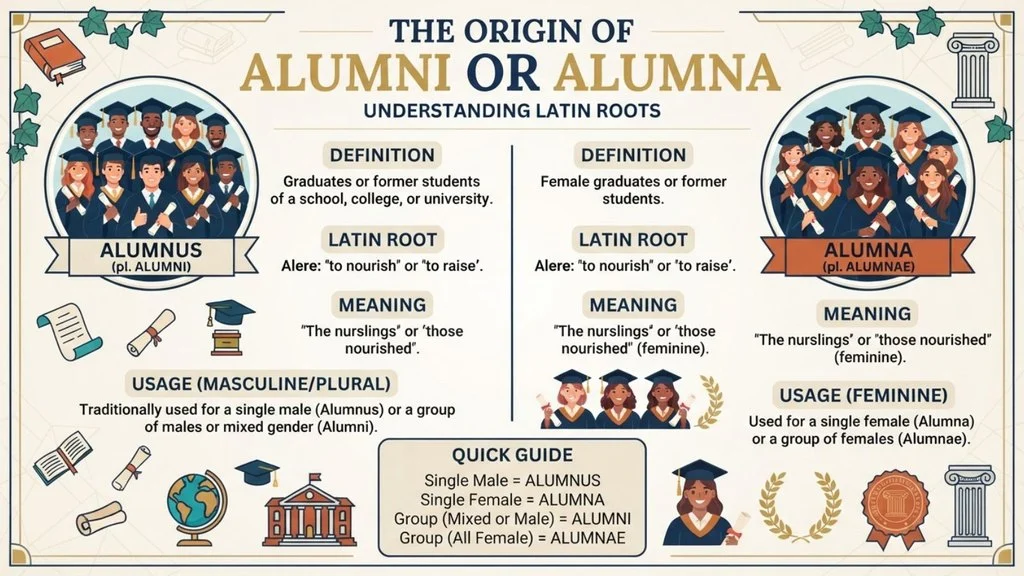
The words alumni, alumna, alumnus, and alumnae come from Latin.
The Latin word alumnus was related to the idea of a pupil, foster child, or person being nourished and raised. Over time, the words entered English as terms for graduates or former students.
The singular forms are:
- Alumnus — traditionally male
- Alumna — traditionally female
The plural forms are:
- Alumni — traditionally masculine plural or mixed group
- Alumnae — traditionally feminine plural
This explains why the words have different endings.
Why Does the Spelling Change?
The spelling reflects the original Latin system.
In traditional Latin-based usage:
-us → singular masculine
-a → singular feminine
-i → plural masculine or mixed group
-ae → plural feminine
This creates a simple pattern:
| Singular | Plural | Traditional meaning |
| Alumnus | Alumni | Male / mixed group |
| Alumna | Alumnae | Female |
English has borrowed many words from Latin, and some retain parts of their original grammatical forms.
However, everyday English does not always follow traditional Latin rules strictly. This is why alumni is now often used as a general plural term.
British English vs American English Spelling
There is no major British-versus-American spelling difference between alumni and alumna.
Both British English and American English use:
- alumnus
- alumna
- alumni
- alumnae
The bigger difference is often usage, rather than spelling.
American universities frequently use alumni as a broad term for former students. British institutions also use “alumni,” particularly in formal university communication.
Comparison Table
| Word | Traditional meaning | Number | Example |
| Alumnus | Male former student | Singular | He is an alumnus of Yale. |
| Alumna | Female former student | Singular | She is an alumna of Yale. |
| Alumni | Male or mixed group | Plural | They are alumni of Yale. |
| Alumnae | Female former students | Plural | The alumnae returned for a reunion. |
Is “Alumni” Gender-Neutral?
In modern English, alumni is often used as a gender-neutral plural.
For example:
“The university invited all alumni to the event.”
This sentence can include men, women, and people of different gender identities.
Many organizations prefer this broader use because it is simple and inclusive.
Which Spelling Should You Use Alumni or Alumna ?
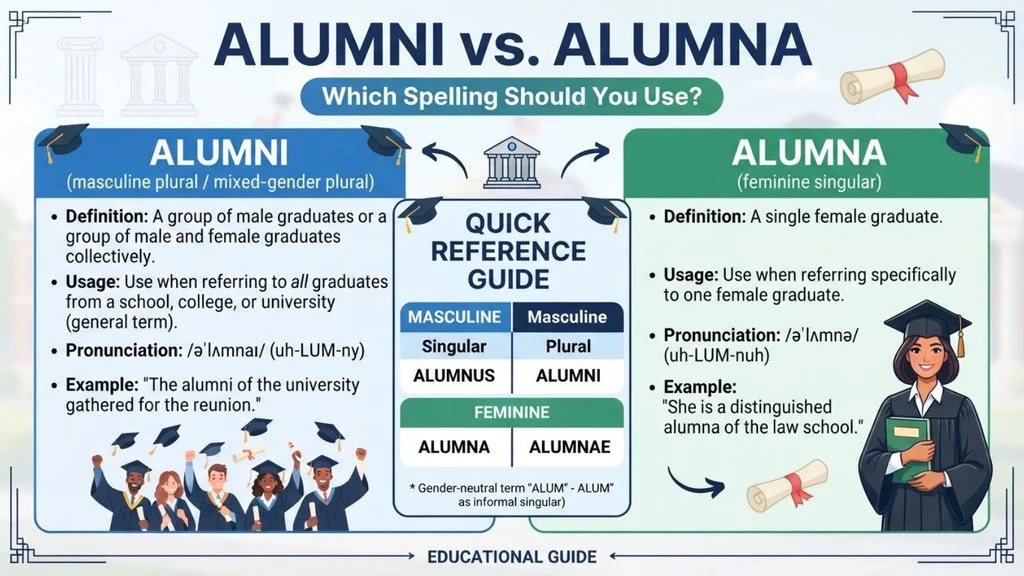
Your choice depends on what you are trying to say.
If You Mean One Woman
Use alumna.
Example:
Maria is an alumna of Stanford University.
This is the traditional and grammatically specific form.
If You Mean One Man
Use alumnus.
Example:
James is an alumnus of the university.
If You Mean Several Former Students
Use alumni.
Example:
The university invited its alumni to the annual event.
This is especially common when the group includes people of different genders.
If You Mean Several Women
You can use alumnae.
Example:
The alumnae gathered for their college reunion.
For Global or Professional Writing
If your audience may not know the Latin forms, former student, graduate, or graduates can be clearer.
For example:
“Former students are invited to the annual meeting.”
This avoids any confusion about gender or Latin terminology.
Common Mistakes with Alumni or Alumna
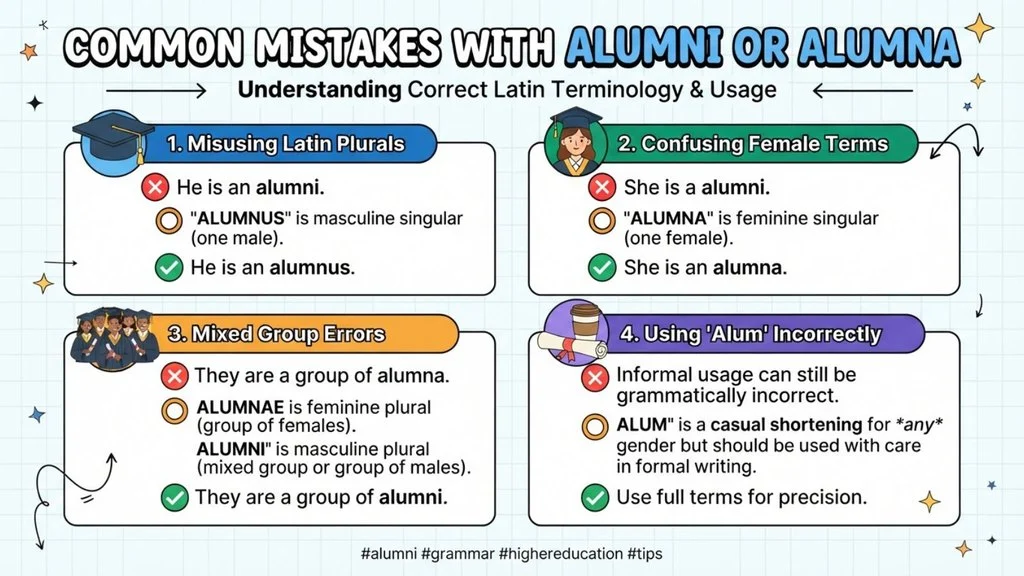
Several mistakes appear frequently in everyday writing.
Mistake 1: Using “Alumna” for a Group
Incorrect:
The university invited all alumna.
Correct:
The university invited all alumni.
Or:
The university invited all former students.
Mistake 2: Using “Alumni” for One Woman
Traditional usage:
She is an alumni of the university.
More precise:
She is an alumna of the university.
However, you may also see “alumni” used informally as a general term.
Mistake 3: Writing “Alumnis”
“Alumnis” is not the standard plural form.
Incorrect:
The alumnis attended the meeting.
Correct:
The alumni attended the meeting.
Mistake 4: Confusing Alumnae and Alumni
Remember:
Alumnae traditionally refers to a group of women.
Alumni traditionally refers to men or a mixed group and is widely used as a general plural.
Mistake 5: Assuming British English Uses a Different Spelling
British English does not normally spell these words differently from American English.
The difference is mainly about style, context, and usage preference.
Alumni or Alumna in Everyday Examples

These words appear in many types of writing.
In Emails
Formal university email:
Dear Alumni,
You are invited to attend our annual university gathering.
For one woman:
We are pleased to welcome you back as an alumna of our university.
In News Writing
A newspaper might write:
The former president is an alumnus of the university.
For a group:
Several university alumni attended the ceremony.
On Social Media
A university may post:
“Calling all alumni! Join us for Homecoming Weekend.”
This broad use of alumni is very common.
In a Resume or Biography
A person may write:
Alumna of the University of Chicago
or:
University of Chicago alumna
For a man:
University of Chicago alumnus
In Formal Writing
For a group:
The university maintains a strong relationship with its alumni.
For a woman:
She became an active alumna after graduation.
Alumni or Alumna – Google Trends & Usage Data
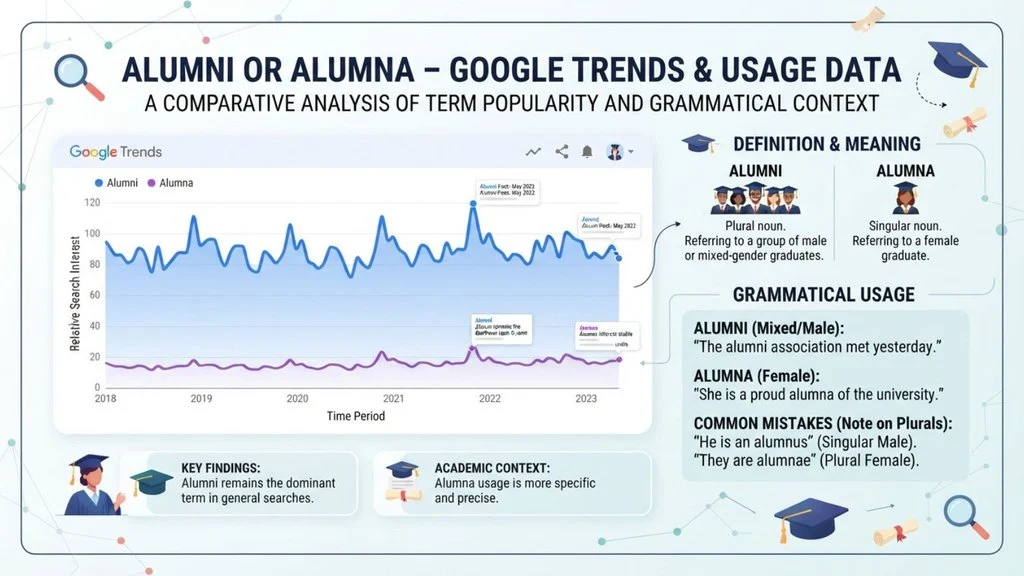
Search interest for alumni is much broader than interest in alumna because “alumni” is widely used by universities, organizations, schools, news outlets, and event pages.
Search behavior can also vary by country and context.
In the United States, “alumni” is especially common in university names, alumni associations, fundraising campaigns, reunions, and college news.
United Kingdom, “alumni” is also widely used by universities and educational institutions.
In other English-speaking countries, including Canada and Australia, both traditional Latin forms and broader terms such as “alumni” and “graduates” appear in institutional writing.
Search trends can change over time, so Google Trends data should be checked for a specific date range and country rather than treated as a permanent measure of language usage.
For SEO content, it is useful to include related terms naturally, such as:
- alumni meaning
- alumna meaning
- alumnus vs alumna
- alumni vs alumnae
- female graduate
- former student
- alumni plural
- alumna definition
- what does alumna mean
- what is the plural of alumna
Alumni Variations at a Glance
| Term | Meaning | Singular/Plural | Example |
| Alumnus | Male former student | Singular | He is an alumnus. |
| Alumna | Female former student | Singular | She is an alumna. |
| Alumni | Men or mixed group; often general plural | Plural | They are alumni. |
| Alumnae | Female former students | Plural | They are alumnae. |
| Graduate | Person who completed a degree or course | Singular | She is a graduate. |
| Graduates | People who completed degrees or courses | Plural | The graduates attended. |
| Former student | Someone who previously attended | Singular | He is a former student. |
| Former students | People who previously attended | Plural | Former students returned. |
Frequently Asked Questions
Is it “alumni” or “alumna”?
For one woman, the traditional term is alumna. Alumni is traditionally plural and is also widely used today as a general term for groups of former students.
What is the female version of alumni?
The traditional female singular form is alumna. The traditional female plural form is alumnae.
What is the plural of alumna?
The traditional plural of alumna is alumnae.
Example:
The alumnae attended the reunion.
Can a woman be called an alumnus?
In traditional usage, alumna is the feminine form of alumnus. However, some organizations use alumni as a broad, gender-neutral term for former students.
Is alumni singular or plural?
Traditionally, alumni is plural. The singular forms are alumnus and alumna. In modern informal usage, “alumni” may sometimes be treated more broadly as a collective term.
What is the difference between alumna and alumnae?
Alumna means one female former student. Alumnae means two or more female former students.
What is the difference between alumni and alumnus?
Alumnus traditionally means one male former student. Alumni traditionally means multiple former students, including a group of men or a mixed-gender group.
Conclusion
The difference between alumni or alumna becomes easy once you remember the basic pattern.
Alumna traditionally means one female former student, while alumnus means one male former student.
Alumni is traditionally plural and can refer to men or a mixed group. Alumnae traditionally refers to a group of women.
There is no major British-versus-American spelling difference. The main issue is how each word is used. In modern English, alumni is also widely used as a broad term for former students of any gender, especially by universities and organizations.
For precise writing, choose the form that matches your meaning. If you want the simplest neutral option, graduate or former student can work well. Knowing these differences helps your writing sound clear, natural, and professional.
Continue Reading:
- Resale vs. Resell: Definitions, Examples, and Usage (for 2026)
- Stopping or Stoping: Meaning, Spelling, and Usage (for 2026)
- Sherbet or Sherbert: Meaning, Spelling, and Usage (for 2026)

Mary Roach is an American science writer and bestselling author known for making unusual and complex scientific topics engaging, accessible, and humorous. Her books include Stiff, Packing for Mars, Gulp, and Fuzz.
Author at Simifind.com, sharing clear, informative content designed to help readers understand interesting topics and everyday questions.







1 thought on “Alumni vs. Alumna: Gender, Meaning, and Usage (for 2026)”