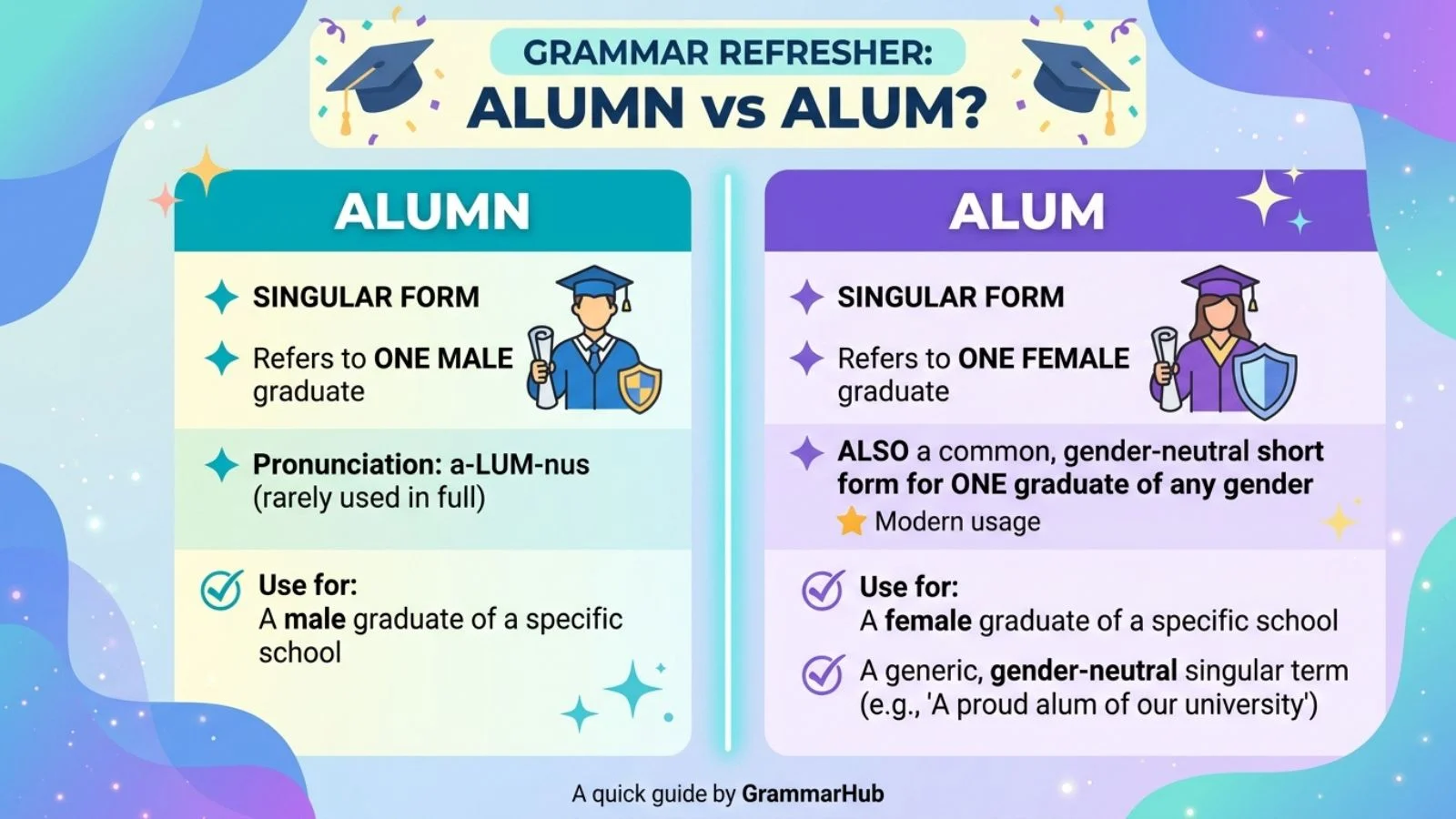
Ever wondered whether “alumn” or “alum” is the right word when talking about someone who graduated from a school or university?
Hey, I want to share something that happened to me recently about Alumn or Alum.
I was chatting with a friend when I suddenly saw this term pop up, and honestly, I had no clue what it meant at first.
I kept wondering, “Am I missing something here?” It was a bit confusing, and I didn’t want to respond the wrong way.
So, I decided to look into Alumn or Alum and figure out its meaning and context.
After understanding it, I realized how important it is to know these terms to avoid awkward situations in conversations.
I handled it by learning the proper meaning and responding confidently, and now I feel ready whenever I see Alumn or Alum again in chats or social media.
Alumn or Alum – Quick Answer
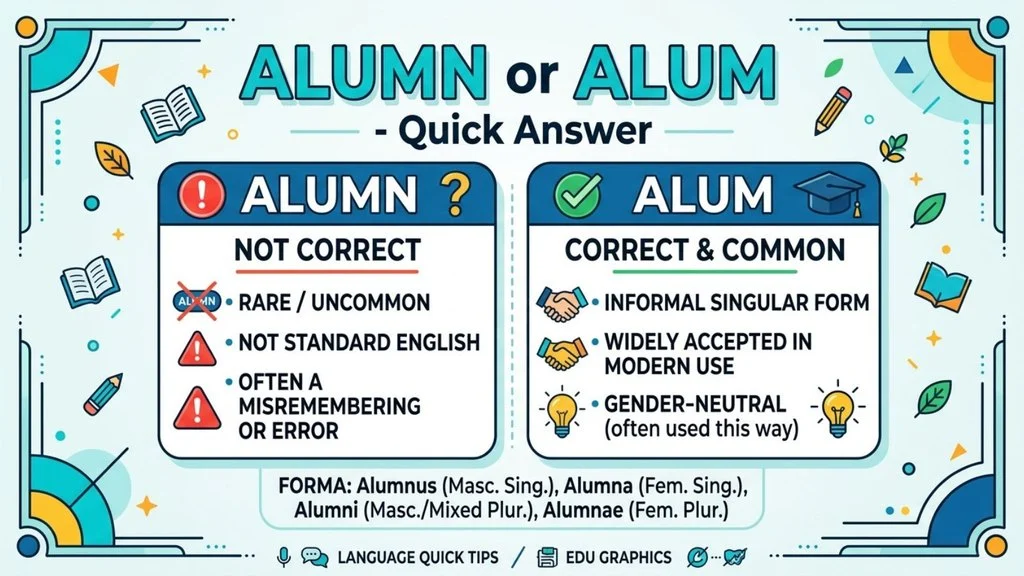
Use “alum.” It is spelled A-L-U-M. There is no “n” at the end.
An alum is a person who went to a school, college, or program. It works for any gender. The plural is alums.
Correct:
- She is an alum of Oxford.
- Three alums spoke at the event.
- I am a proud alum.
Incorrect:
- ~~She is an alumn of Oxford.~~
- ~~Three alumns spoke at the event.~~
Why do people add the “n”? Because the longer forms have one. Look:
- alumnus
- alumna
- alumni
- alumnae
The “n” belongs to those words. It does not belong to the short form.
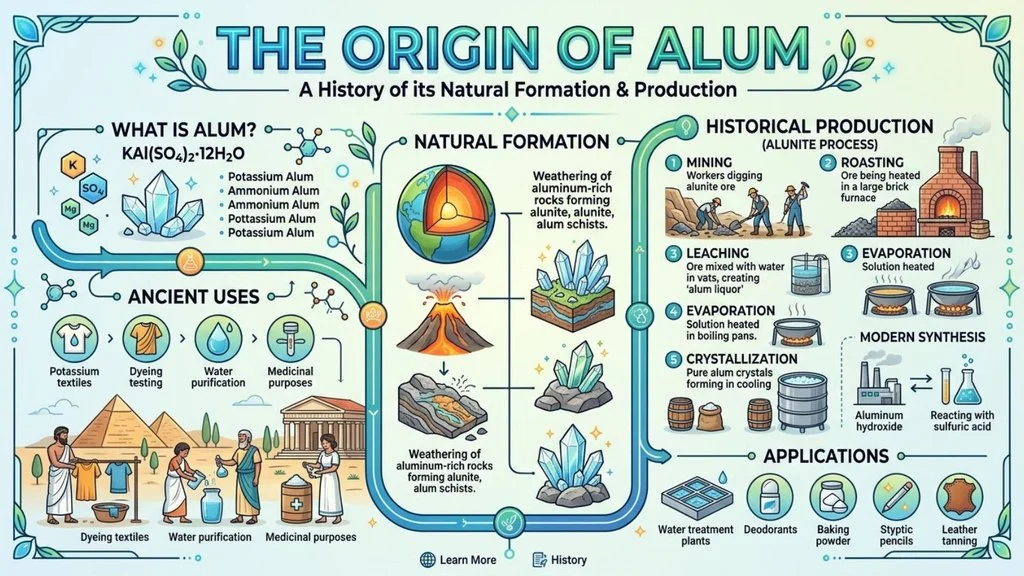
One more thing. “Alum” has a second meaning. It is also a chemical salt used in pickling, water treatment, and old-fashioned deodorant. Context makes the meaning clear. Nobody will think you pickled your degree.
The Origin of Alum
The word comes from Latin.
In Latin, alumnus meant a foster son or a pupil. It came from the verb alere, which means “to nourish.” A school nourished you. So you were its alumnus.
Latin marked gender and number in the ending. That gave us four forms:
- alumnus – one man
- alumna – one woman
- alumni – many men, or a mixed group
- alumnae – many women
English borrowed all four. That is unusual. Most borrowed words lose their foreign endings over time. These kept theirs.
The problem showed up later. English speakers wanted a word that did not force a gender choice. Writing “alumnus/alumna” in every sentence is clumsy. So “alum” appeared as a casual short form in American English in the 1800s.
It grew fast in the 1990s and 2000s. Schools wanted to include everyone. Non-binary graduates needed a word that fit. “Alum” solved both problems in four letters.
The chemical alum is a separate word. It also comes from Latin, alumen. Same root sound, different history. The two just happen to look alike.
British English vs American English Spelling
Here is the part most guides get wrong.
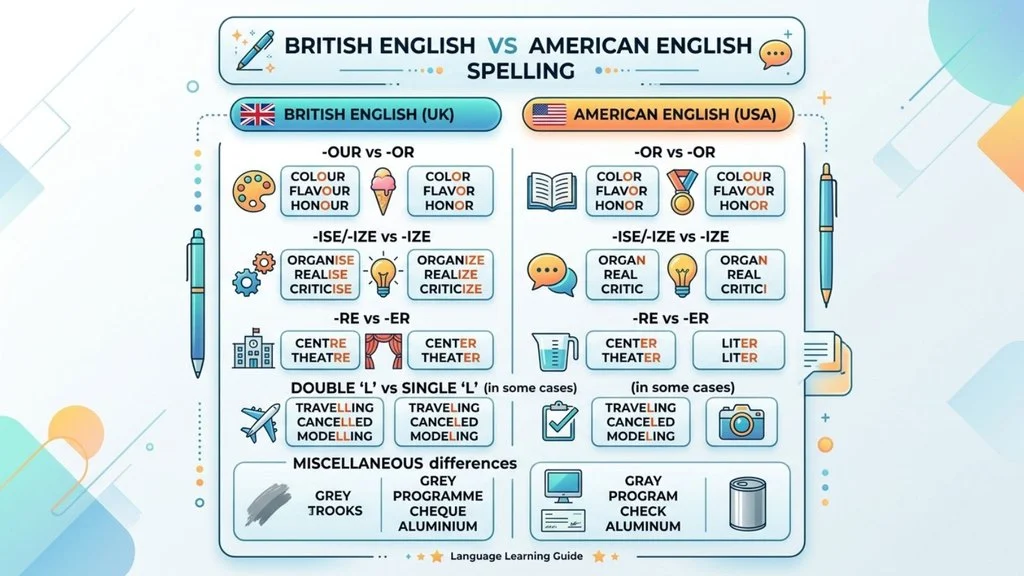
“Alum” is not a British-versus-American spelling difference. It is not like colour and color, or centre and center. There is no British spelling “alumn.” That spelling is wrong everywhere.
But there is a real difference between the two countries: how often people use the word at all.
In the United States, “alum” is common and comfortable. Universities use it in emails. News outlets use it in headlines. People use it on LinkedIn.
In the UK, Ireland, and much of the Commonwealth, “alum” sounds American. British writers more often say “graduate,” “former student,” or “old boy/old girl.” Universities there do use “alumni” for groups, especially in fundraising. The singular “alum” is rarer.
There is one true spelling split nearby, and it causes extra confusion: aluminium (British) versus aluminum (American). That is a different word entirely. It is a metal. It has nothing to do with graduates. But the letters overlap enough to muddy searches.
Spelling comparison
| Form | American English | British English | Correct? |
| alum | Common and accepted | Correct, but used less often | ✅ Yes |
| alumn | Wrong | Wrong | ❌ No |
| alumnus / alumna | Used in formal writing | Used in formal writing | ✅ Yes |
| alumni | Very common | Very common | ✅ Yes |
| alums | Common | Rare | ✅ Yes |
| alumni (as singular) | Growing, still disputed | Disputed | ⚠️ Informal |
| aluminum | Standard | Non-standard | ✅ US only |
| aluminium | Non-standard | Standard | ✅ UK only |
Which Spelling Should Use alumn or alum ?
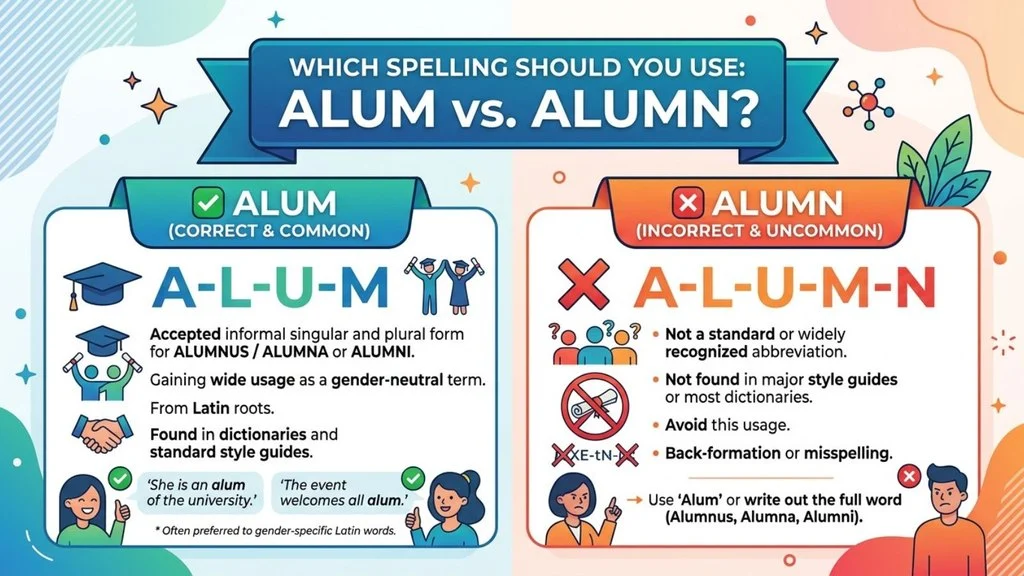
The answer depends on who is reading.
If you write for a US audience:
Use “alum” freely. It is natural in emails, bios, social posts, and most news writing. Use “alums” for the plural. For very formal documents, such as a degree citation or a legal record, use “alumnus,” “alumna,” or “alumni.”
If you write for a UK or Commonwealth audience:
“Alum” will be understood, but it may sound casual or American. Safer choices are “graduate” or “former student.” Keep “alumni” for groups and for anything tied to a university’s official language.
If you write for a global audience:
Use “graduate” when you can. Everyone understands it. It carries no gender and no Latin baggage. Use “alumni” for groups, since it travels well.
If you are unsure of someone’s gender:
Use “alum.” That is the whole point of the word. Never guess between “alumnus” and “alumna.”
If you are writing marketing or fundraising copy:
Match your institution’s style guide. Most universities have one. Many now prefer “alum” and “alums” for exactly this reason.
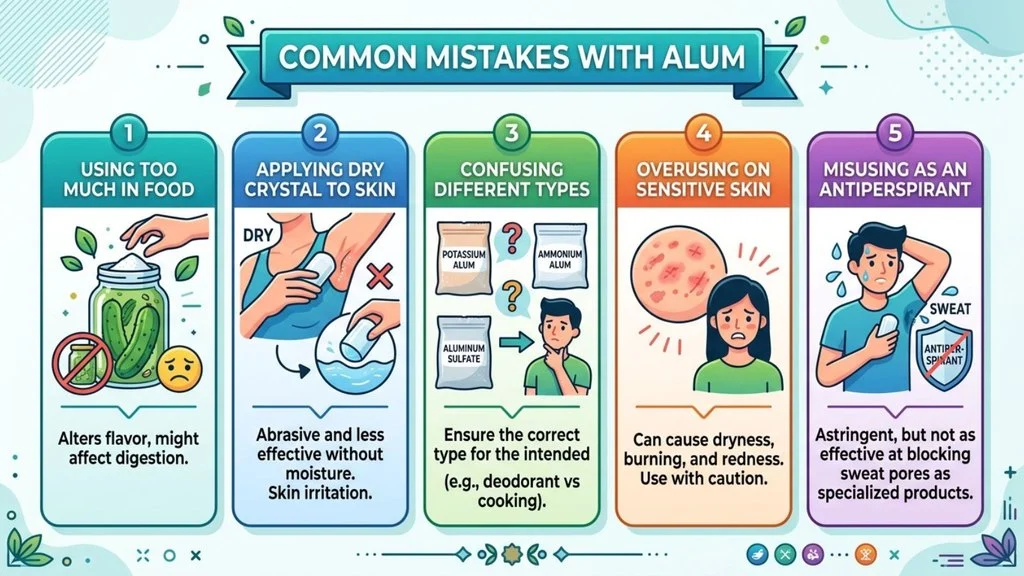
Common Mistakes with Alum
1. Adding an “n.”
Wrong: She is an alumn.
Right: She is an alum.
2. Using “alumni” for one person.
Wrong: He is an alumni of Yale.
Right: He is an alum of Yale.
This is the most common error of all. “Alumni” is plural. Many people now use it as a singular in speech. It still bothers editors.
3. Mixing up gender endings.
Wrong: She is an alumnus.
Right: She is an alumna. Or just: She is an alum.
4. Writing “alumnis” or “alumnies.”
Neither exists. The plural of “alumnus” is “alumni.” The plural of “alum” is “alums.”
5. Using “alumnae” for a mixed group.
Wrong: The alumnae, people of all genders , attended.
Right: The alumni attended.
6. Confusing it with aluminium.
Different word. Different meaning. Check your autocorrect.
7. Over-formalising a casual sentence.
I am an alumnus of the summer coding bootcamp sounds stiff. I’m an alum of the bootcamp sounds human.
Alum in Everyday Examples
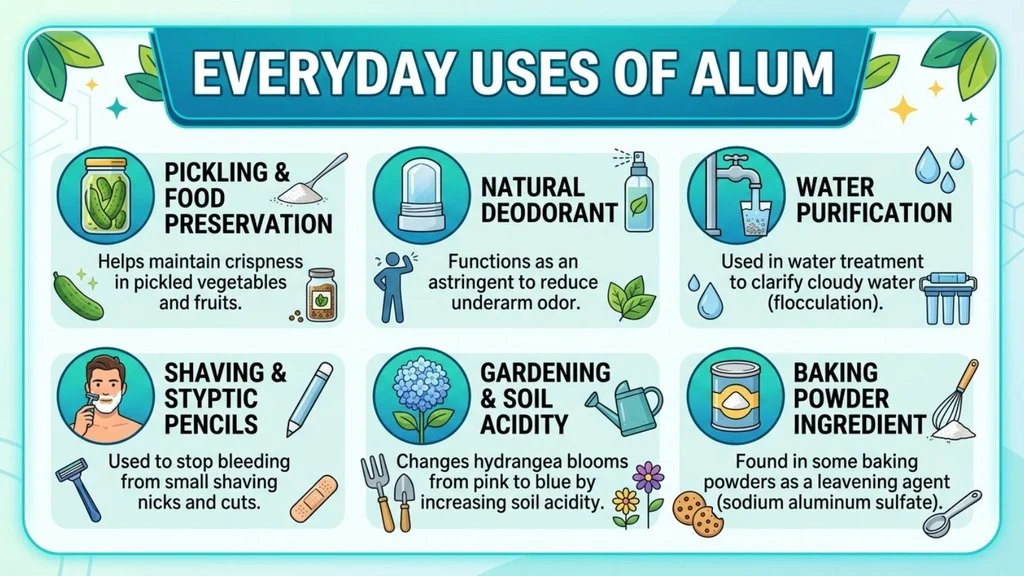
In a professional email:
Dear Ms. Rivera, I am an alum of the 2018 program and would love to reconnect.
In a LinkedIn bio:
Marketing lead. UCLA alum. Coffee first.
In a news headline:
Local Alum Donates $2 Million to Science Lab
In a social media post:
Back on campus after ten years. Once an alum, always an alum. 🎓
In formal writing:
The University invites all alumni and alumnae to the centenary dinner.
In a group setting:
Our alums now work in over thirty countries.
In a school newsletter:
Alum spotlight: meet the graduate building water systems in Kenya.
Notice the pattern. Casual writing takes “alum.” Formal and ceremonial writing takes the Latin forms. Group references almost always take “alumni.”
Alum or Alumn – Google Trends & Usage Data


Search behaviour tells a clear story.
“Alumni” is the most searched form by a wide margin. People look it up worldwide, because it appears on university websites, event invitations, and donation pages.
“Alum” searches come mostly from the United States. They also spike around graduation season, in May and June, and again in the autumn when reunion season starts. A second stream of “alum” searches comes from cooking and skincare, not education.
“Alumn” barely registers as a term on its own. When it appears, it is usually inside a longer query like “alumn or alum” or “is alumn a word.” That is the signature of a spelling check, not a real word.
Regional pattern: The US, Canada, and India show the highest interest in the alum/alumni family. The UK and Australia show steady interest in “alumni” but much less in “alum.”
Context pattern: In the US, “alum” in search results splits between education and chemistry. Outside the US, the chemistry meaning dominates more often.
The takeaway is simple. If you are searching “alumn,” you are almost certainly checking a spelling. The answer is that it is not one.
Comparison Table: Every Form Side by Side
| Word | Meaning | Number | Gender | Formality | Example |
| alum | A graduate | Singular | Any | Casual to neutral | She is an alum. |
| alums | Graduates | Plural | Any | Casual to neutral | The alums met up. |
| alumn | Nothing — a typo | — | — | — | ❌ Not a word |
| alumnus | A male graduate | Singular | Male | Formal | He is an alumnus. |
| alumna | A female graduate | Singular | Female | Formal | She is an alumna. |
| alumni | Graduates | Plural | Male or mixed | Formal to neutral | All alumni are invited. |
| alumnae | Female graduates | Plural | Female | Formal | The alumnae gathered. |
| graduate | A graduate | Singular | Any | Neutral, global | She is a graduate. |
| alum (chemical) | A mineral salt | — | — | Technical | Add alum to the brine. |
FAQs
1. Is “alumn” a word?
No. It is a misspelling of “alum.” Drop the “n.”
2. Is “alum” a real word or just slang?
It is a real word. Major dictionaries list it, including Merriam-Webster and Cambridge. It began as informal but is now widely accepted.
3. Can I say “an alumni” for one person?
Many people do in speech. In writing, it is still seen as an error. Use “alum,” “alumnus,” or “alumna” instead.
4. Is “alum” gender-neutral?
Yes. That is one of its main strengths. Use it when gender is unknown or not relevant.
5. What is the plural of “alum”?
“Alums.” Not “alumns” and not “alumni.”
6. Is “alum” British or American?
The spelling is the same in both. The usage is far more common in American English.
7. Should I write “alum” in a formal document?
It depends on the document. For diplomas, citations, and legal text, use the Latin forms. For newsletters, emails, and bios, “alum” is fine.
8. Is “alum” the same as “aluminium”?
No. Alum is a salt. Aluminium (US: aluminum) is a metal. Different words, similar letters.
9. How do I pronounce “alum”?
Uh-LUM, with the stress on the second syllable, when it means a graduate. The chemical is usually AL-um.
Conclusion
The confusion between “alumn” and “alum” has a simple ending. “Alum” is correct. “Alumn” does not exist.
Remember why the mistake happens. The longer Latin forms — alumnus, alumna, alumni, alumnae — all carry an “n” before the ending. The short form does not. Your fingers are just finishing a word your brain started.
Here is the practical advice. Use “alum” for one graduate of any gender. Use “alums” for several.
“Alumni” for a group in formal or official writing. Save “alumnus,” “alumna,” and “alumnae” for ceremonies, citations, and traditional style guides.
Know your audience too. American readers expect “alum” and find it natural. British and Commonwealth readers may prefer “graduate” or “former student.” For a worldwide audience, “graduate” is the safest choice of all.
And if you ever hesitate mid-sentence, take the escape route. “Graduate” is never wrong. But now you know the short word, and you know it has no “n.”

Here’s a concise 2-line author bio suitable for Simifind.com:
James Dashner is an American bestselling author best known for The Maze Runner series and other popular young-adult fiction.
On Simifind.com, he shares clear, engaging insights and helpful content for readers interested in books, writing, and popular literature.