Have you ever clicked the wrong option on a website and wondered whether you should deselect it or unselect it?
Both words may seem correct because they describe the same basic action: removing a selection. However, they are not used equally in standard English.
People often search for “deselect or unselect” because they see both terms in software, forms, websites, emails, and technical instructions.
The confusion usually comes from the fact that unselect sounds natural, while deselect is the more established and widely accepted word for reversing a selection.
Understanding the difference can help you choose the right word in professional writing, technical documents, user instructions, and everyday communication. In most situations, deselect is the safer choice.
This guide explains the meaning, history, spelling, usage, common mistakes, and everyday examples of deselect or unselect. It also compares the two words so you can use the right form with confidence.
Deselect or Unselect – Quick Answer
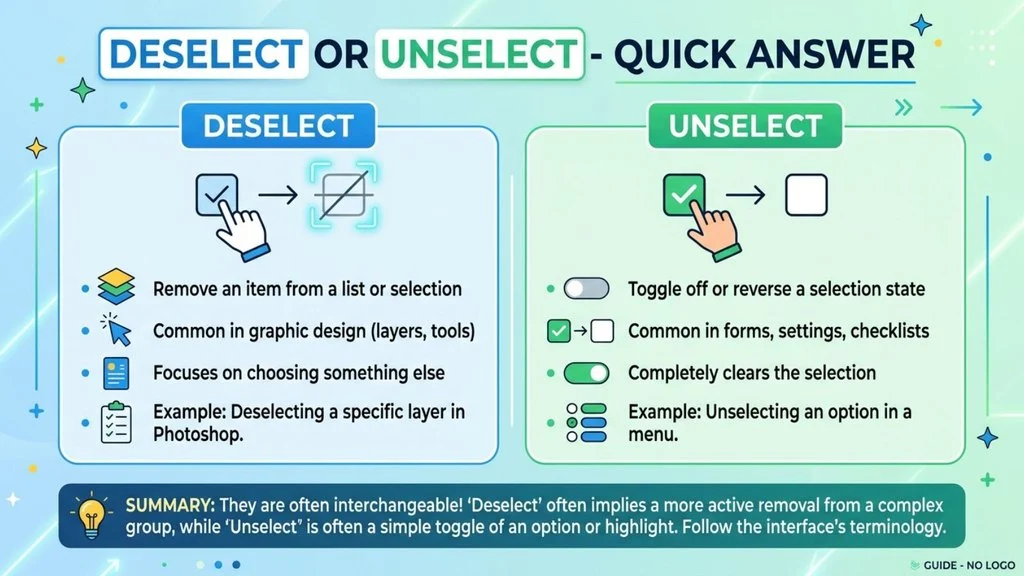
Deselect is the preferred and more standard word when you mean “remove a selection.”
Unselect is also used, especially in computing and software interfaces, but it is less common in general English.
Examples
- Deselect the option you do not want.
- Click the box again to deselect it.
- Please deselect all unnecessary items.
- The user can deselect a previously chosen file.
You may also see unselect in software instructions:
- Unselect the items you do not need.
- Click the button to unselect the option.
For professional writing, deselect is usually the better choice.
| Word | Meaning | Commonness | Best use |
| Deselect | Remove a selection | More common | General and professional English |
| Unselect | Remove a selection | Less common | Technical or software contexts |
| Select | Choose something | Very common | General use |
The prefix de- often suggests reversing or removing an action. Therefore, deselect clearly communicates the idea of reversing a selection.
The Origin of Deselect or Unselect
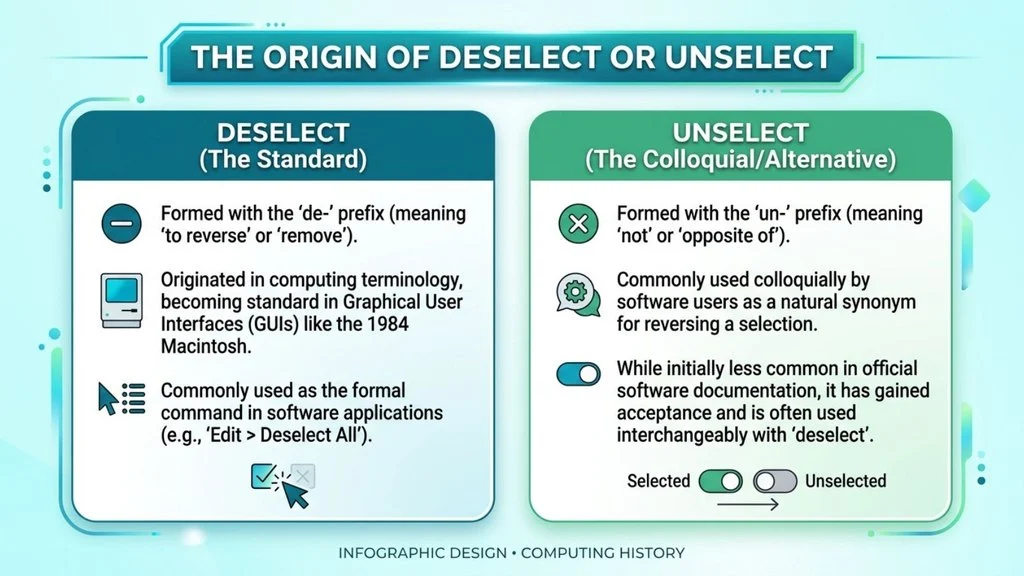
The word deselect is formed from de- and select.
The verb select comes from Latin seligere, meaning “to choose” or “to pick.” English later developed select as a verb and noun related to choosing something.
The prefix de- can indicate removal, reversal, or reduction. In deselect, it gives the word the meaning of reversing a previous selection.
So:
select → choose
deselect → remove the choice
The word unselect follows a different but familiar English pattern. The prefix un- can indicate reversal or the undoing of an action.
For example:
- lock → unlock
- tie → untie
- connect → disconnect
- select → unselect
This makes unselect easy to understand. However, being easy to understand does not always mean it is the preferred standard term.
As computers and graphical user interfaces became common, both deselect and unselect appeared in technical contexts. Software designers may use either term in instructions or interface language.
Today, deselect is generally the more established choice in standard English, while unselect remains understandable and is used in some technical contexts.
British English vs American English Spelling
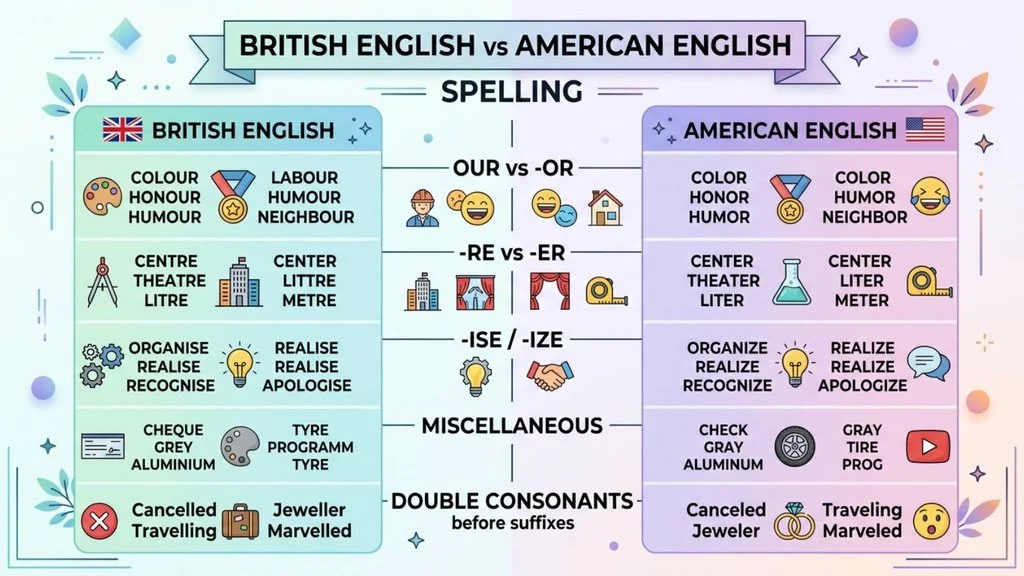
Unlike many British-American spelling differences, deselect does not normally change spelling between British and American English.
The same form is generally used in both varieties:
- British English: deselect
- American English: deselect
Likewise, unselect can appear in both varieties, although it is less established than deselect.
| Usage | British English | American English |
| Preferred term | deselect | deselect |
| Alternative term | unselect | unselect |
| Select an option | select | select |
| Remove a selection | deselect | deselect |
| Remove several selections | deselect the items | deselect the items |
This means you do not normally need to change deselect based on whether your audience uses British or American English.
For example:
British English:
“Deselect the option before continuing.”
American English:
“Deselect the option before continuing.”
The wording remains the same.
Which Spelling Should Use Deselect or Unselect ?
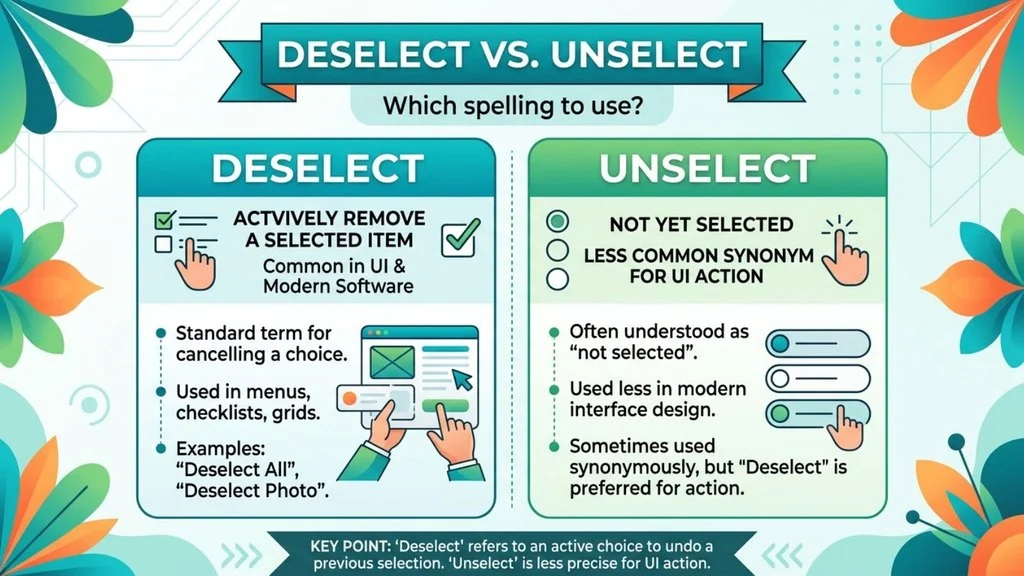
If you are writing for a general audience, deselect is the safest choice.
For American English
Use deselect in:
- professional emails
- instructions
- reports
- websites
- software documentation
- educational writing
Example:
Please deselect the checkbox before submitting the form.
For British English
The same advice applies. Deselect works naturally in formal and professional writing.
Example:
Deselect any options that do not apply to you.
For Commonwealth English
Readers in countries such as Canada, Australia, and New Zealand can also understand deselect easily.
For global audiences
Deselect is often the clearest option because it is widely recognized in computing and general usage.
If you are writing a user interface, however, the best choice can depend on the terminology already used throughout the product. Consistency is important.
If your interface says Select all, using Deselect all creates a clear pair.
Common Mistakes with Deselect or Unselect
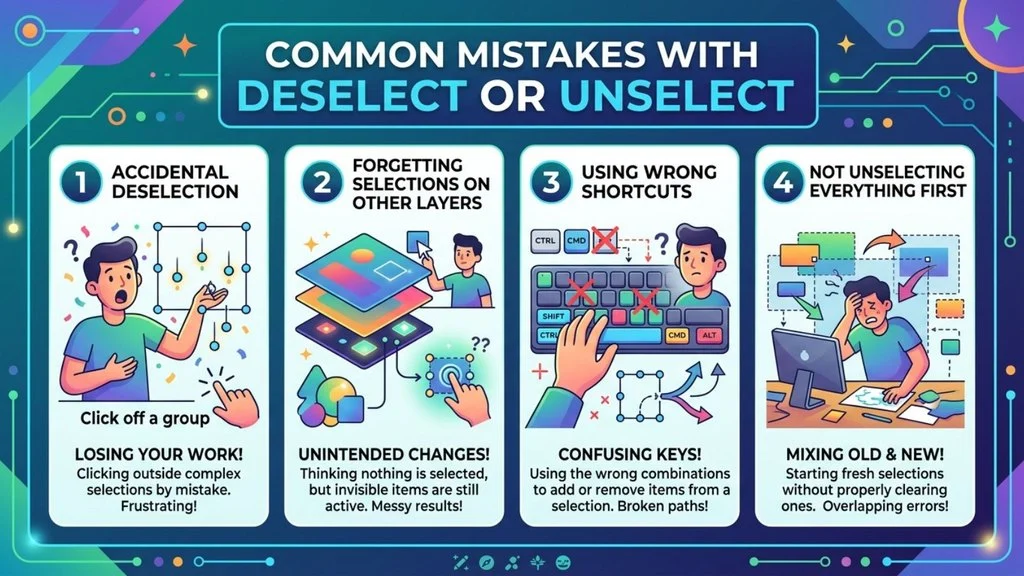
Several mistakes appear when people use these words.
Mistake 1: Assuming unselect is always wrong
Unselect is understandable and does appear in real technical usage. It is not simply meaningless.
However, deselect is generally the more established choice.
Better:
Deselect the checkbox.
Mistake 2: Using both words in the same document
Switching between deselect and unselect can make technical instructions feel inconsistent.
Inconsistent:
Select the files you need. Unselect unwanted files. Then deselect the remaining boxes.
Better:
Select the files you need. Deselect the unwanted files.
Mistake 3: Confusing deselect with delete
Deselect does not mean delete.
- Deselect = remove something from a selection.
- Delete = remove something from a system, document, or location.
Example:
Deselect the photo if you do not want to include it.
The photo still exists. It is simply no longer selected.
Mistake 4: Confusing deselect with uncheck
Uncheck is often used specifically for checkboxes.
Example:
Uncheck the box.
You can also say:
Deselect the option.
The best word depends on the interface and context.
Deselect or Unselect in Everyday Examples
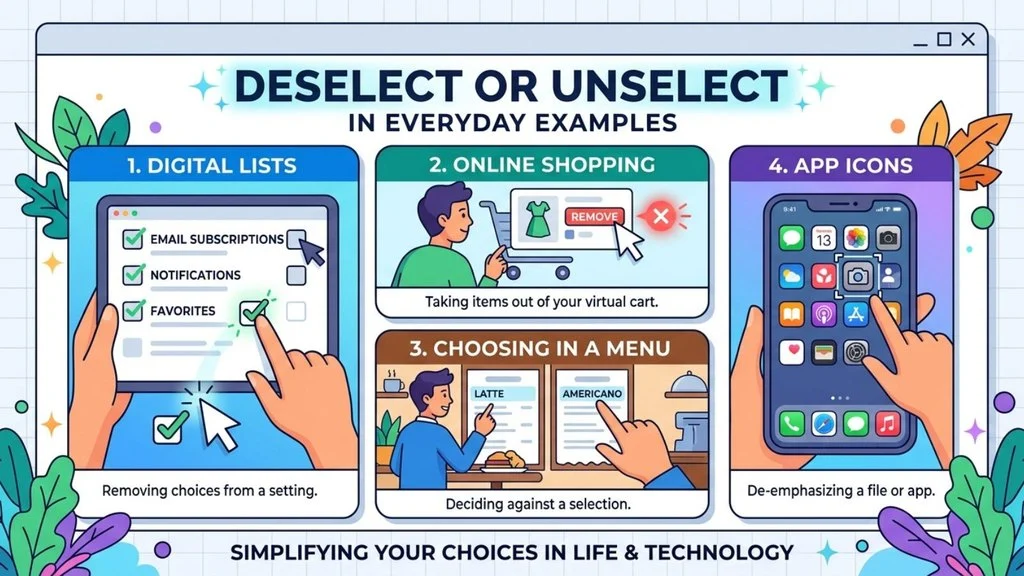
In Emails
Please deselect the incorrect attachment before sending the email.
In Software
Deselect the files you do not want to upload.
On Websites
Deselect the filters you no longer want to use.
On Social Media
Deselect the people you do not want to tag.
In Forms
Deselect “Yes” if the statement does not apply to you.
In Formal Writing
Users can deselect previously selected options before submitting the form.
In Technical Instructions
Select the required settings, then deselect any options that are not needed.
These examples show why deselect is useful. It clearly describes the reversal of an earlier selection.
Deselect or Unselect – Google Trends & Usage Data

Search interest for “deselect or unselect” is driven mainly by people trying to understand software terminology and correct English usage.
The two words can appear in different contexts.
Deselect is strongly associated with:
- software instructions
- user interfaces
- forms
- technical documentation
- programming discussions
- general English
Unselect is also associated with computing and interfaces, but it tends to be less common in polished general writing.
Search behavior can also vary by country, platform, and industry. Google Trends data changes over time and should be treated as an indicator of search interest rather than a dictionary rule.
For SEO content, it is useful to include both terms because people search for both “deselect or unselect” and related phrases such as:
- deselect meaning
- unselect meaning
- is unselect a word
- deselect vs unselect
- how to deselect an option
- deselect all meaning
The important point is that search popularity does not determine which word is grammatically preferred. Usage, context, dictionaries, and established technical conventions matter more.
Deselect vs Unselect: Comparison Table
| Feature | Deselect | Unselect |
| Basic meaning | Remove a selection | Remove a selection |
| Standard usage | More established | Less established |
| Technical usage | Very common | Also used |
| Professional writing | Recommended | Usually avoid when a clearer option exists |
| Software instructions | Common | Sometimes used |
| British English | Used | Used less often |
| American English | Used | Used less often |
| General audience | Clear | Understandable |
| Best default choice | Yes | Usually no |
The main takeaway is simple: use deselect when you want the safest and most widely accepted term.
FAQs About Deselect or Unselect
1. Is “deselect” a correct word?
Yes. Deselect is a standard English word meaning to remove something from a selection.
2. Is “unselect” a correct word?
Unselect is used in English, especially in computing and software contexts. However, deselect is generally the more established choice.
3. Should I say “deselect” or “unselect”?
In most professional and general writing, choose deselect.
4. Is “deselect” British or American?
Deselect is used in both British and American English. It does not have a major British-American spelling difference.
5. Does deselect mean delete?
No. Deselect means to remove an item from a selection. It does not mean to permanently delete the item.
6. Can I use “unselect” in software instructions?
Yes, you may see or use unselect in software contexts. However, deselect is often clearer and more conventional.
7. What is the opposite of select?
The most natural opposite in a selection context is deselect.
For example:
Select the files you want, then deselect the ones you do not need.
Conclusion
When choosing between deselect or unselect, the simplest answer is to use deselect in most situations. Both words can describe the action of removing an existing selection, but deselect is the more established and widely recognized term in standard English and professional communication.
There is no major British English versus American English spelling difference here. Both varieties commonly use deselect. The alternative unselect can appear in software and technical contexts, but it is less common in general writing.
It is also important to remember that deselect does not mean delete. When you deselect something, you simply remove it from the current selection. The item itself usually remains available.
For websites, software guides, emails, reports, forms, and technical documents, deselect is usually the clearest choice. If you are writing interface text, also consider consistency with other commands such as “Select All.”
In short, when you are unsure, choose deselect. It communicates the intended action clearly and works well for both British and American English readers.

Here’s a concise 2-line author bio suitable for Simifind.com:
James Dashner is an American bestselling author best known for The Maze Runner series and other popular young-adult fiction.
On Simifind.com, he shares clear, engaging insights and helpful content for readers interested in books, writing, and popular literature.