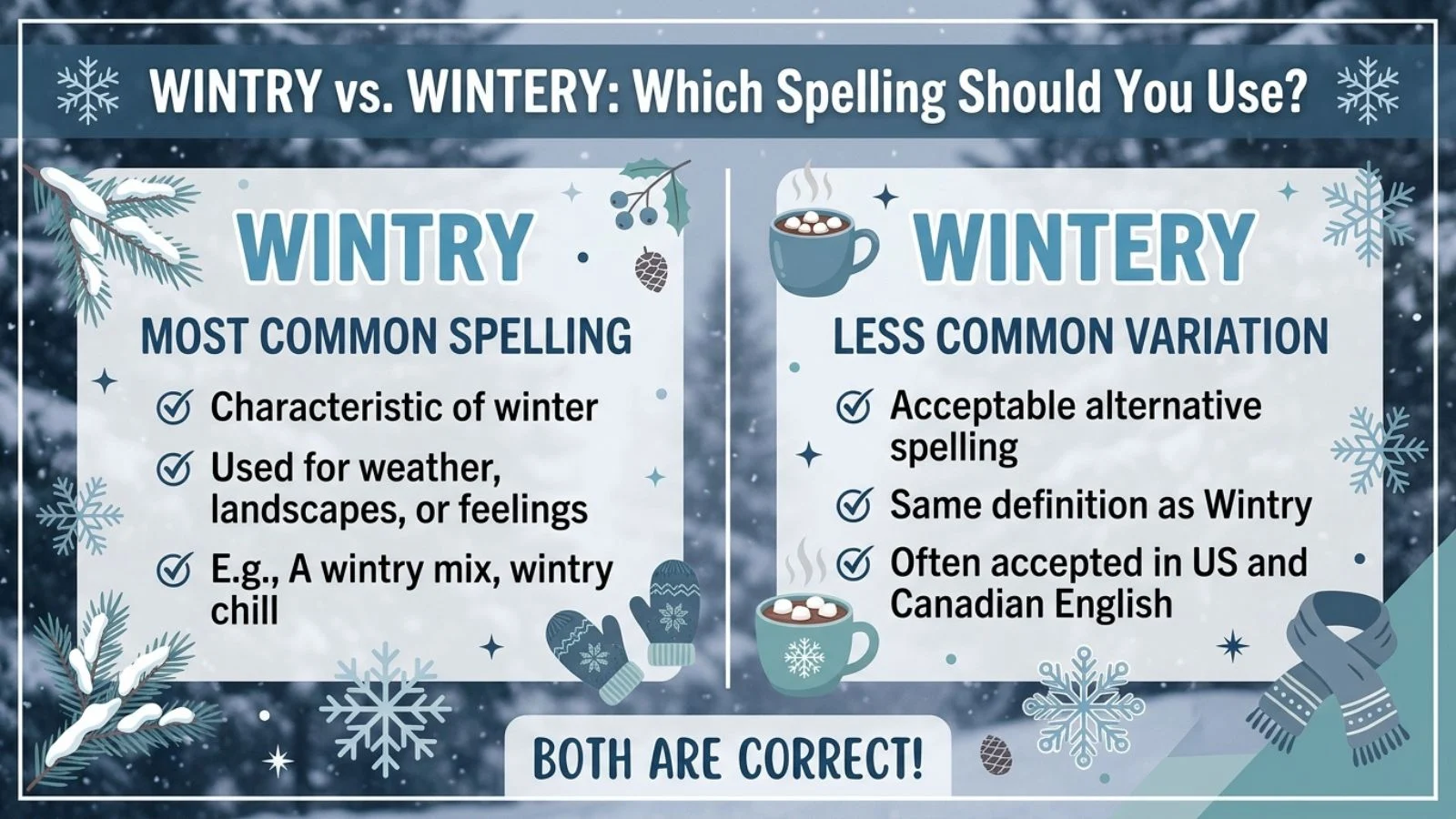
Hey, I want to share something that happened to me recently about Wintry or Wintery.
I was chatting with a friend when I suddenly saw these words pop up, and honestly, I had no clue which one was correct at first.
When two spellings look almost identical, knowing which one is right can save you from an awkward grammar mistake.
I kept wondering, “Am I missing something here?” It was a bit confusing, and I didn’t want to respond the wrong way.
So, I decided to look into Wintry or Wintery and figure out their meaning, spelling, and proper usage.
After understanding the difference, I realized how important it is to know these terms to avoid awkward situations in conversations.
I handled it by learning the correct spelling and usage, and now I feel ready whenever I see Wintry or Wintery again in chats, writing, or social media.
Wintry or Wintery – Quick Answer
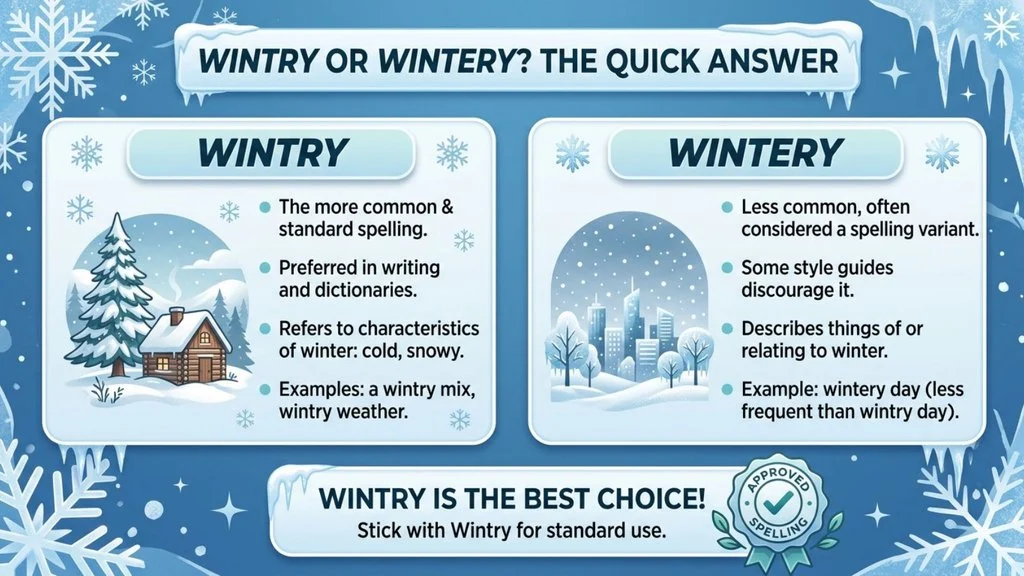
Wintry is the preferred spelling in modern English.
It means having the qualities of winter or typical of winter.
Examples
- We woke up to a wintry morning.
- The roads were dangerous in the wintry weather.
- A wintry wind swept across the town.
- The mountains looked beautiful under a wintry sky.
Wintery is not necessarily impossible or meaningless. It appears in some dictionaries and real-world writing, but it is far less common.
Quick comparison
| Spelling | Meaning | Usage |
| wintry | Like winter; typical of winter | Standard and preferred |
| wintery | Like winter; typical of winter | Less common variant |
| winter | The cold season | Standard noun |
| wintertime | The period of winter | Standard word |
Best choice: Use wintry in most situations.
The Origin of Wintry or Wintery
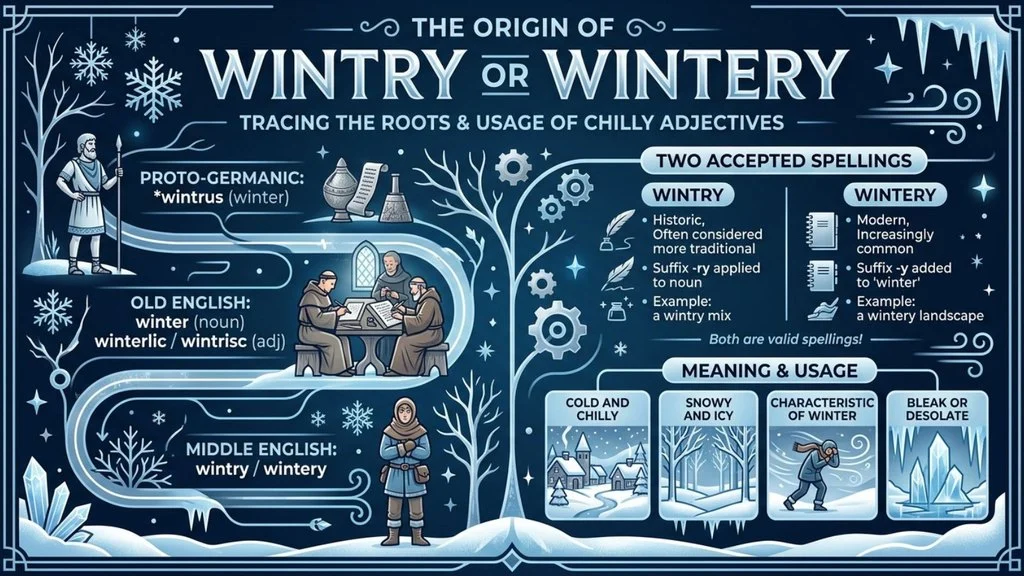
The word winter is very old. It comes from Old English winter, which referred to the cold season. Related forms appear in several Germanic languages.
Over time, English developed many adjectives by adding -y to nouns. The suffix -y often means “having the qualities of” or “characterized by.”
For example:
- cloud → cloudy
- wind → windy
- rain → rainy
- frost → frosty
- winter → wintry
The spelling wintry developed by shortening the base word before adding -y. The middle e in winter disappears, and the resulting word becomes wintry.
This type of spelling change is not unusual in English. Some words are adjusted to make pronunciation and spelling easier.
Wintery follows a more straightforward pattern: winter + y. That is why it can look perfectly reasonable to many writers.
However, wintry became the established form and is now the form most commonly preferred in standard edited English.
British English vs American English Spelling
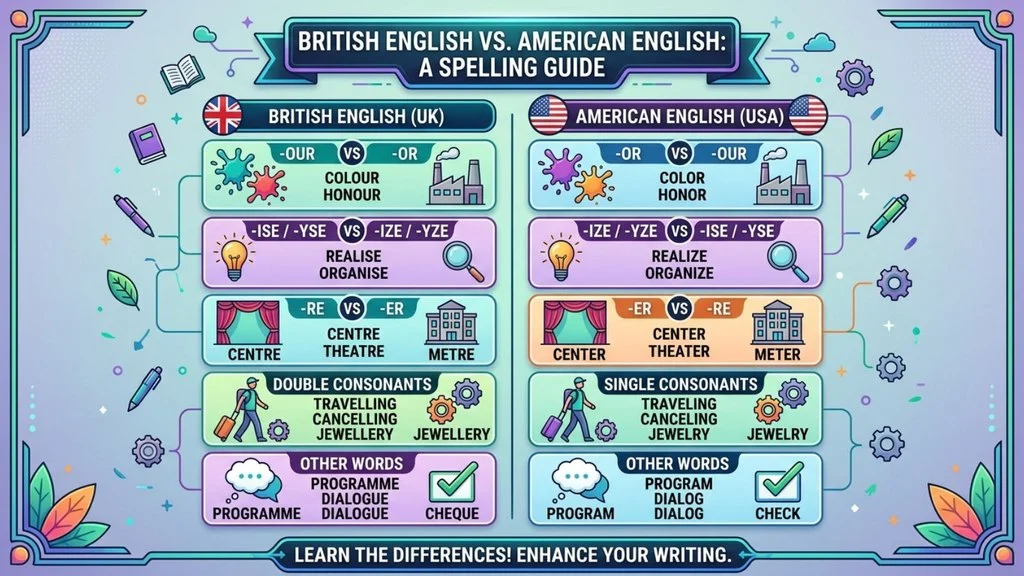
Both British and American English generally use wintry.
Unlike some spelling differences, such as colour/color or centre/center, there is no major US-versus-UK rule that changes wintry to wintery.
| Variety | Preferred spelling | Example |
| American English | wintry | The city experienced wintry conditions. |
| British English | wintry | The village had a cold, wintry morning. |
| Canadian English | wintry | Wintry weather affected travel. |
| Australian English | wintry | The region experienced wintry conditions. |
| International English | wintry | The forecast predicts wintry weather. |
Is “wintery” British or American?
Wintery should not be viewed as a standard British-versus-American spelling difference.
You may find it in writing from different English-speaking countries, but wintry is generally the stronger choice for standard writing.
If you are writing for an international audience, wintry is clear and widely recognized.
Which Spelling Should Use Wintry or Wintery ?
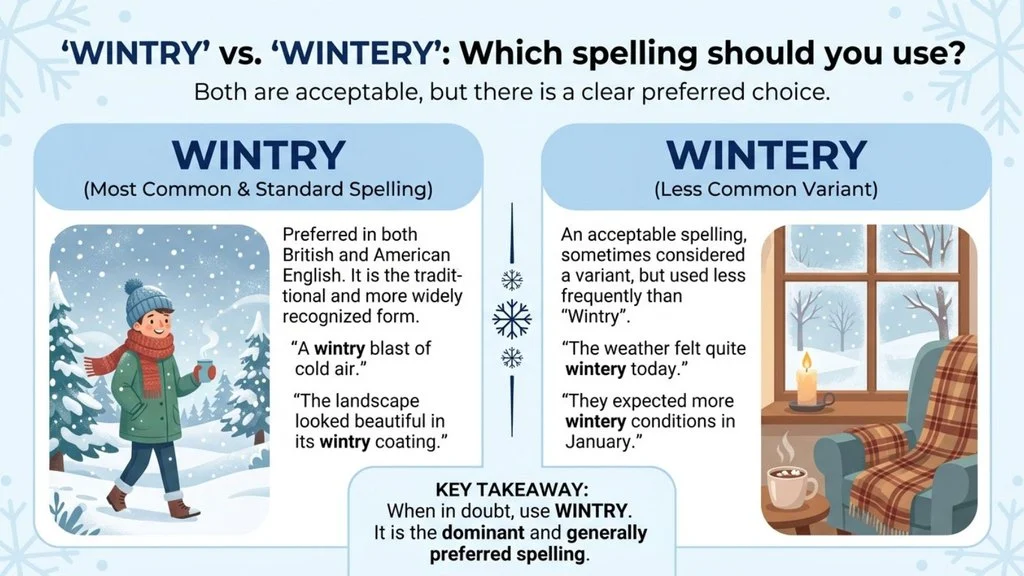
For most readers, the answer is simple:
For American English
Use wintry.
The storm brought heavy snow and wintry conditions.
For British English
Use wintry.
Cold, wintry weather is expected across the region.
For academic and professional writing
Choose wintry because it is the more established form.
For websites and SEO content
Use wintry naturally in headings and sentences. You can mention wintery when explaining the spelling difference because some users search for that version.
For casual writing
You may encounter wintery online, but wintry remains the safer choice.
Simple rule: If you are unsure, write wintry.
Common Mistakes with Wintry or Wintery
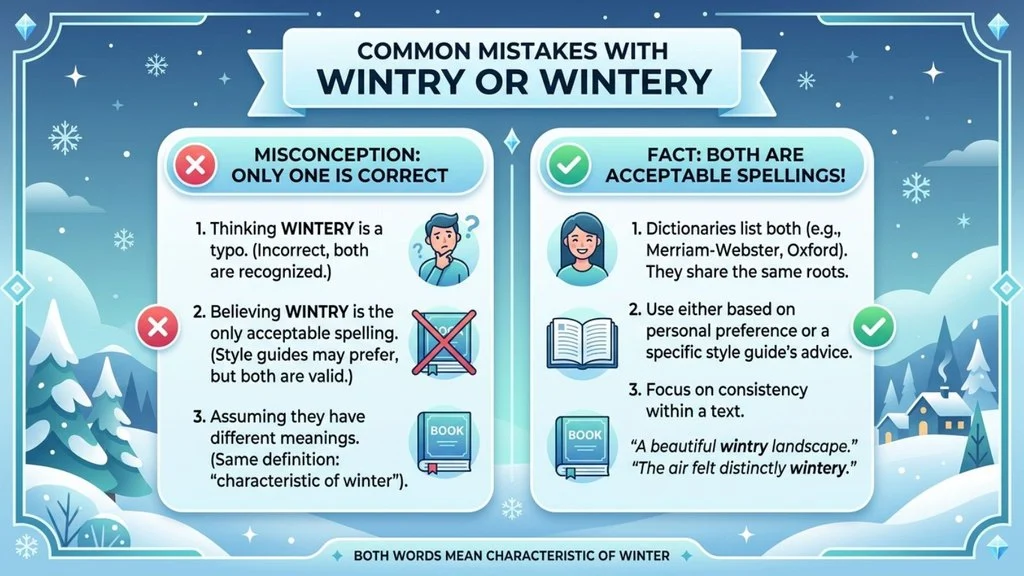
Several mistakes appear when people use these words.
1. Using “wintery” as the default spelling
Less preferred:
We had a wintery afternoon.
Preferred:
We had a wintry afternoon.
2. Confusing “wintry” with “winter”
Remember that winter is normally a noun.
Winter is my favorite season.
Wintry is an adjective.
We experienced wintry weather.
3. Using “winter” as an adjective incorrectly
Incorrect:
The winter conditions were extremely cold.
This sentence is not always grammatically wrong, because winter can sometimes act as a noun modifier. But when you mean “having the qualities of winter,” wintry is often more precise.
The wintry conditions were extremely cold.
4. Assuming “wintery” is always a spelling error
It is better to call wintery a less common variant rather than automatically treating every occurrence as a typo. Still, wintry is the preferred form in standard writing.
Wintry or Wintery in Everyday Examples
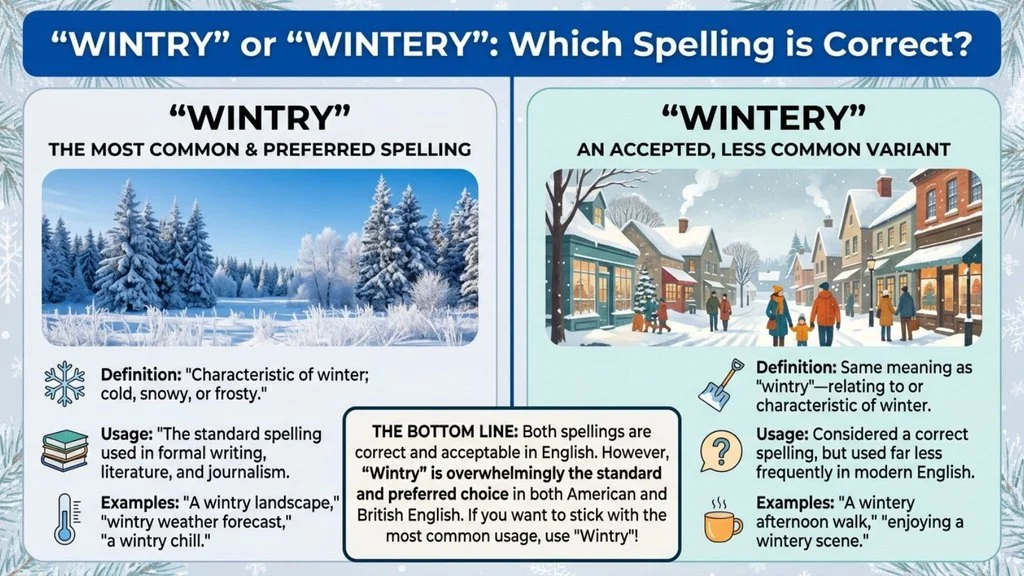
The word wintry works in many everyday contexts.
In emails
Please drive carefully because wintry weather is expected tomorrow.
In news writing
Heavy snow and wintry conditions caused delays across the region.
On social media
Nothing beats a quiet morning with this beautiful wintry view.
In formal writing
The region is known for its long winters and severe wintry conditions.
In travel writing
Visitors can enjoy beautiful mountains and dramatic wintry landscapes.
In creative writing
A wintry breeze moved through the empty streets.
With common nouns
Some natural combinations include:
- wintry weather
- wintry conditions
- wintry landscape
- wintry morning
- wintry scene
- wintry sky
- wintry wind
- wintry atmosphere
- wintry night
- wintry landscape
These combinations are much more common with wintry than with wintery.
Wintry or Wintery – Google Trends & Usage Data
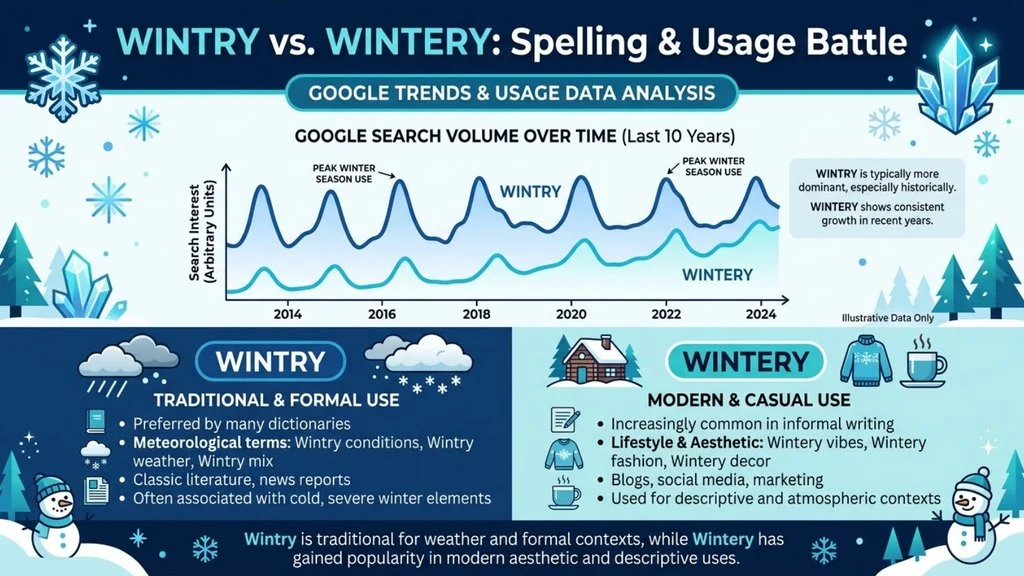
Search behavior can vary over time and by country, but the important usage pattern is clear: wintry is the established form and appears much more often in edited English than wintery.
Searches for wintry or wintery usually come from people checking spelling, grammar, or word choice. The question often appears when someone sees wintery and wonders whether it should contain the letter e.
Usage also depends on context. Wintry is common in:
- Weather reports
- News articles
- Travel writing
- Fiction
- Poetry
- Formal descriptions
- SEO content
- Everyday conversation
The word becomes especially useful during winter-related events, storms, snowfall, and seasonal travel.
For professional content, frequency should not be the only concern. Wintry is preferable because it is familiar, established, and widely accepted.
Wintry vs Wintery: Comparison Table
| Feature | Wintry | Wintery |
| Meaning | Like winter | Like winter |
| Part of speech | Adjective | Adjective/variant |
| Commonness | Very common | Much less common |
| Standard choice | Yes | Usually not preferred |
| US English | Preferred | Rare |
| UK English | Preferred | Less common |
| Formal writing | Recommended | Usually avoid |
| SEO writing | Recommended | Use when discussing the variant |
| Example | Wintry weather | Wintery weather |
FAQs About Wintry or Wintery
1. Is “wintry” or “wintery” correct?
Wintry is the standard and preferred spelling. Wintery is also found as a less common variant.
2. Is “wintery” a real word?
Yes. Wintery appears in English usage, but it is much less common than wintry.
3. Is “wintry” correct in American English?
Yes. Wintry is the preferred spelling in American English.
4. Is “wintry” correct in British English?
Yes. British English also commonly uses wintry.
5. What does “wintry” mean?
Wintry means like winter or characteristic of winter.
6. Should I write “wintry weather”?
Yes. Wintry weather is a very common and natural phrase.
7. Why is it spelled “wintry” instead of “wintery”?
The established adjective developed by shortening winter before adding the -y suffix, producing wintry.
Conclusion
When choosing between wintry or wintery, wintry is the best choice for most situations. It is the standard, familiar, and widely preferred adjective meaning “like winter” or “typical of winter.”
Wintery is also used and can be found in dictionaries and real-world writing, but it is much less common. It should not normally be your first choice when writing for school, work, websites, news, or professional audiences.
The difference is mainly about established usage rather than meaning. Both forms point to the qualities of winter, but wintry has become the dominant spelling in modern English.
If you want one simple rule to remember, use winter for the season and wintry for something that feels or looks like winter. For example, say “Winter is cold” and “We had a wintry morning.”
So, whenever you are unsure, choose wintry. It is clear, natural, and suitable for both American and British English.
Continue Reading:
- Theirs vs. Their’s: Meaning, Grammar, and Correct Usage (for 2026)
- Withdrawal or Withdraw: Meaning, Spelling, and Usage (for 2026)
- Workweek or Work Week: Examples, Rules, and Meaning (for 2026)

Here’s a concise 2-line author bio suitable for Simifind.com:
James Dashner is an American bestselling author best known for The Maze Runner series and other popular young-adult fiction.
On Simifind.com, he shares clear, engaging insights and helpful content for readers interested in books, writing, and popular literature.





1 thought on “Wintry vs. Wintery: Meaning, Spelling, and Usage (for 2026)”