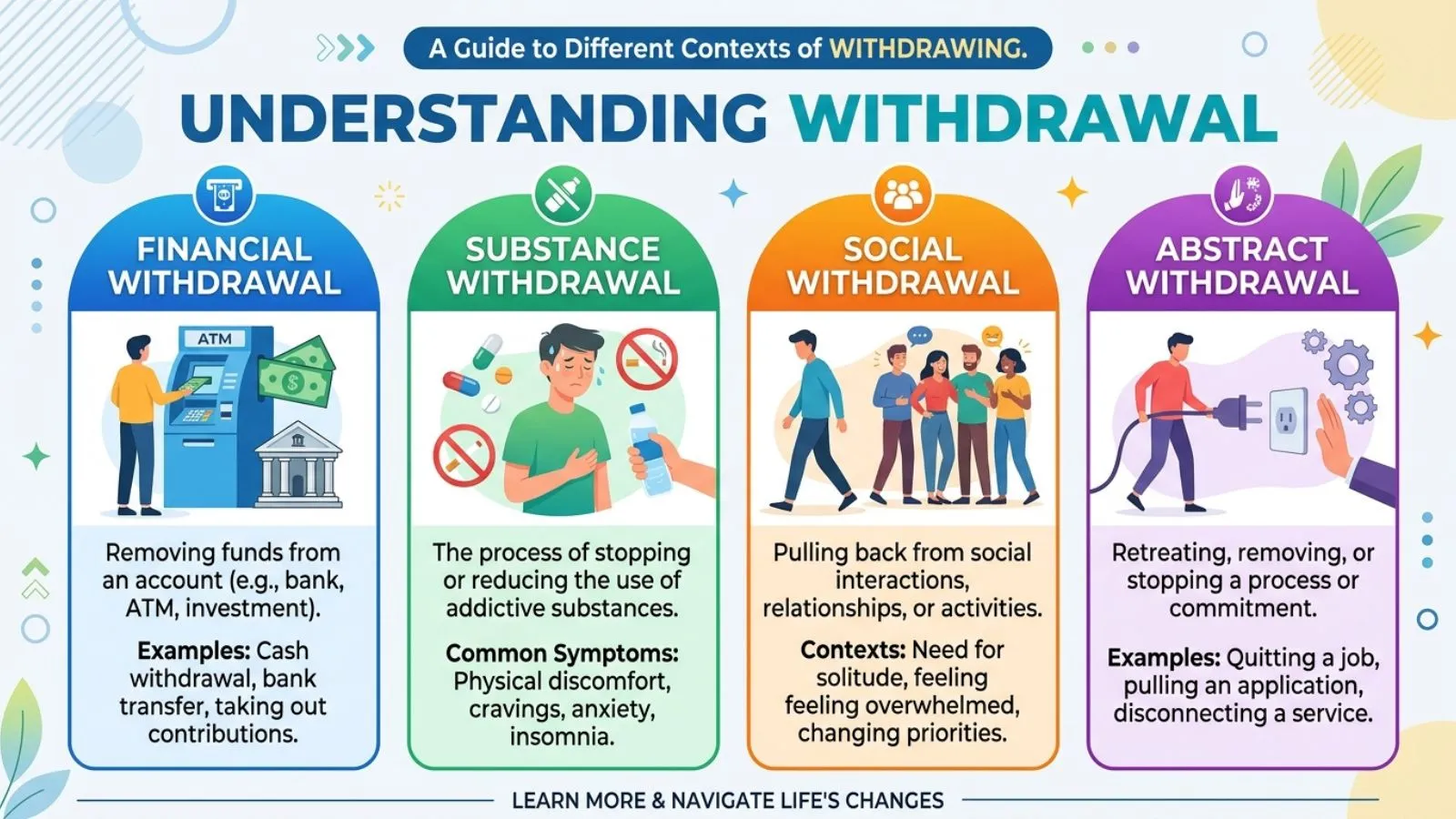
Hey, I want to share something that happened to me recently about Withdrawal or Withdraw.
I was chatting with a friend when I suddenly saw this term pop up, and honestly, I had no clue what it meant at first.
I kept wondering, “Am I missing something here?” It was a bit confusing, and I didn’t want to respond the wrong way.
When it comes to “withdrawal or withdraw,” even one small word change can completely affect how your sentence sounds and what it means.
So, I decided to look into Withdrawal or Withdraw and figure out its meaning and context.
After understanding it, I realized how important it is to know these terms to avoid awkward situations in conversations.
I handled it by learning the proper meaning and responding confidently, and now I feel ready whenever I see Withdrawal or Withdraw again in chats or social media.
Withdrawal or Withdraw – Quick Answer
Here’s the short version:
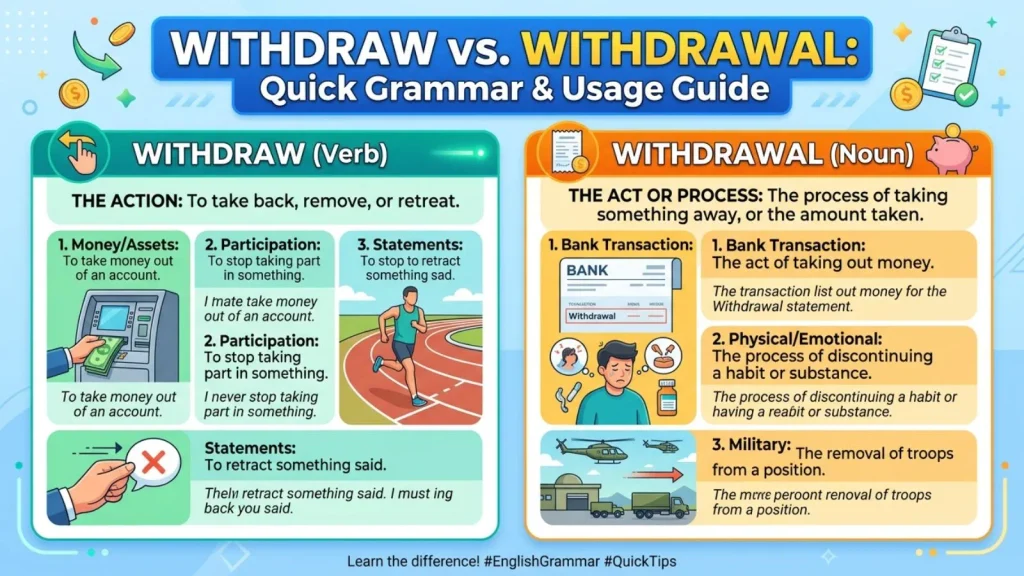
- Withdraw is a verb. It describes an action — to take out, remove, or pull back.
- Withdrawal is a noun. It names the act or process of withdrawing.
Quick examples:
- “I need to withdraw cash from the ATM.” (verb — action)
- “The withdrawal took less than a minute.” (noun — the event)
- “Please withdraw your application.” (verb)
- “We received your withdrawal request.” (noun)
A simple test: if the word follows “to,” or comes right after a subject doing something, use withdraw. If it follows “a,” “the,” or “your,” use withdrawal.
The Origin of Withdrawal or Withdraw
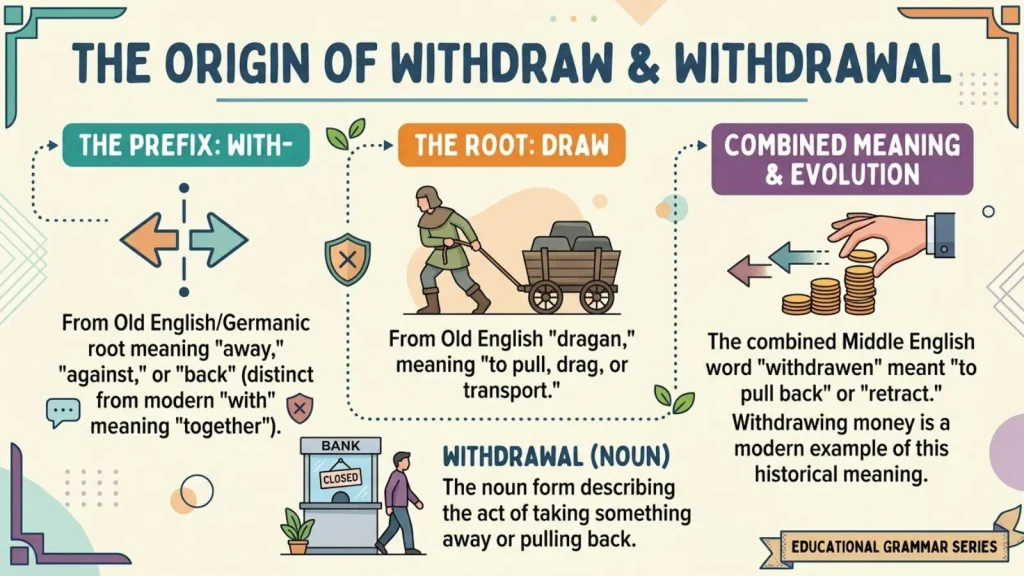
Both words trace back to Middle English. The verb “withdrawen” combined “with,” meaning “away” or “back,” and “drawen,” meaning “to draw or pull.” Together, they meant “to draw back” or “to take away.”
Over time, English speakers needed a noun form to describe the act of withdrawing. Writers added the suffix “-al,” a common pattern borrowed from Latin-influenced English. This suffix turns verbs into nouns, similar to “arrive” becoming “arrival” or “refuse” becoming “refusal.”
So “withdrawal” isn’t a random spelling variation. It’s a grammatical transformation. The “-al” ending signals that the word now names a thing or process rather than an action.
Spelling differences you might see online (like “withdrawl” without the second “a”) aren’t real alternate spellings. They’re simply common typing errors. There is only one correct spelling for the noun: withdrawal.
British English vs American English Spelling
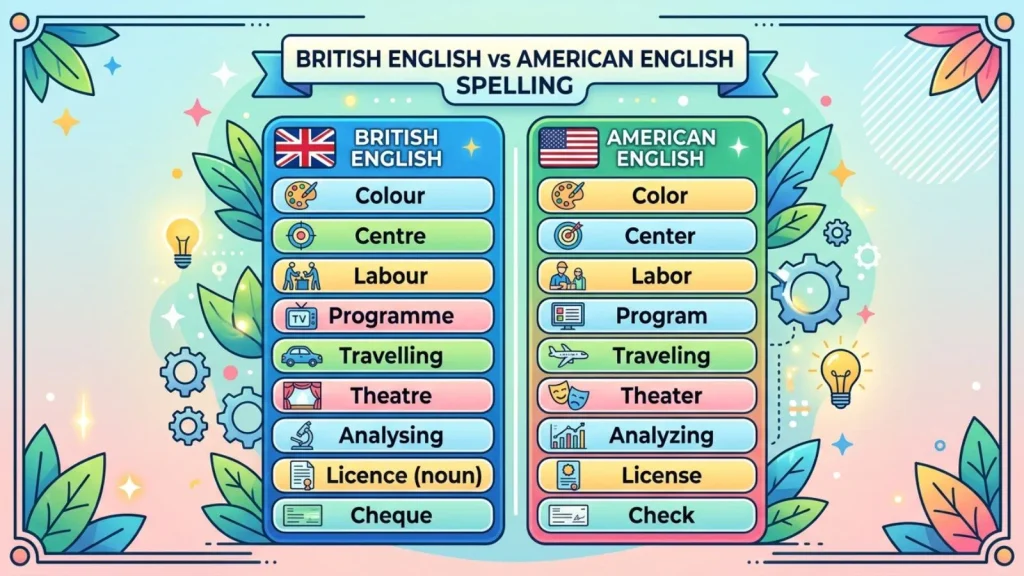
Good news here: this is one of the rare cases where British and American English fully agree. Unlike “colour” vs “color” or “organise” vs “organize,” both dialects spell these words the same way.
| Word Form | British English | American English | Notes |
| Verb | withdraw | withdraw | Identical spelling |
| Past tense | withdrew | withdrew | Identical spelling |
| Past participle | withdrawn | withdrawn | Identical spelling |
| Noun | withdrawal | withdrawal | Identical spelling |
| Pronunciation | with-DRAW / with-DRAW-uhl | with-DRAW / with-DRAW-uhl | Minor accent differences only |
The confusion people search for online usually isn’t about British vs American spelling. It’s about grammar: choosing the verb form versus the noun form. That mix-up happens equally in both dialects.
Which Spelling Should Use Withdrawal or Withdraw ?
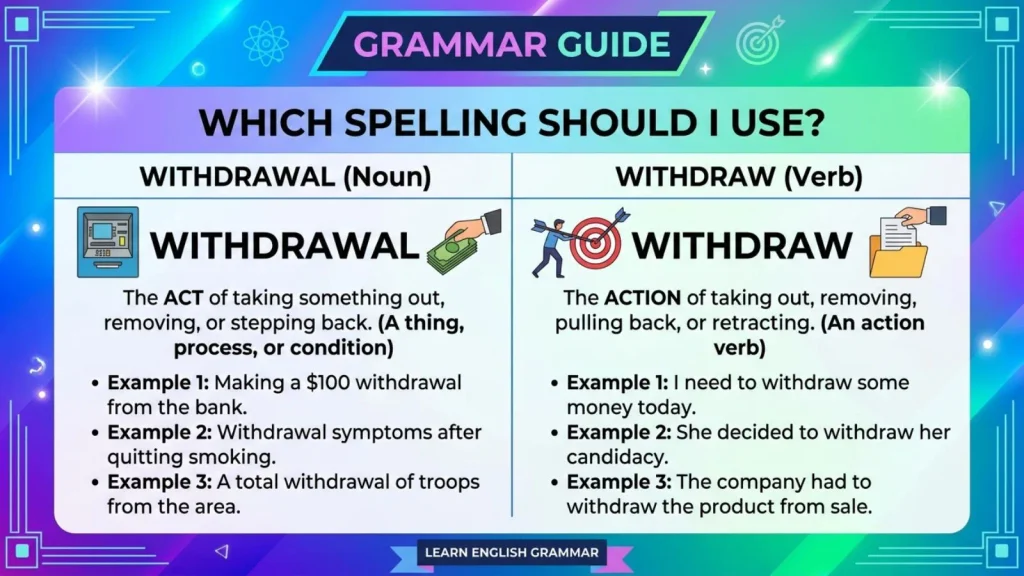
Since spelling doesn’t change by region, your choice depends entirely on grammar and context, not geography. Still, here’s guidance by audience:
US writers and businesses: Use “withdraw” for actions (banking, applications, statements) and “withdrawal” for the resulting noun or event. Common in financial and legal documents.
UK and Commonwealth writers (Canada, Australia, India, etc.): Same rules apply. No regional spelling shift to worry about.
Global and non-native English speakers: Focus on the grammar rule, not the region. Ask yourself: “Am I describing an action, or naming a thing?” That answer decides your word choice every time.
Academic and formal writing: Always double-check the sentence structure. Formal documents like legal contracts and academic papers are where this error gets noticed most.
Common Mistakes with Withdrawal or Withdraw
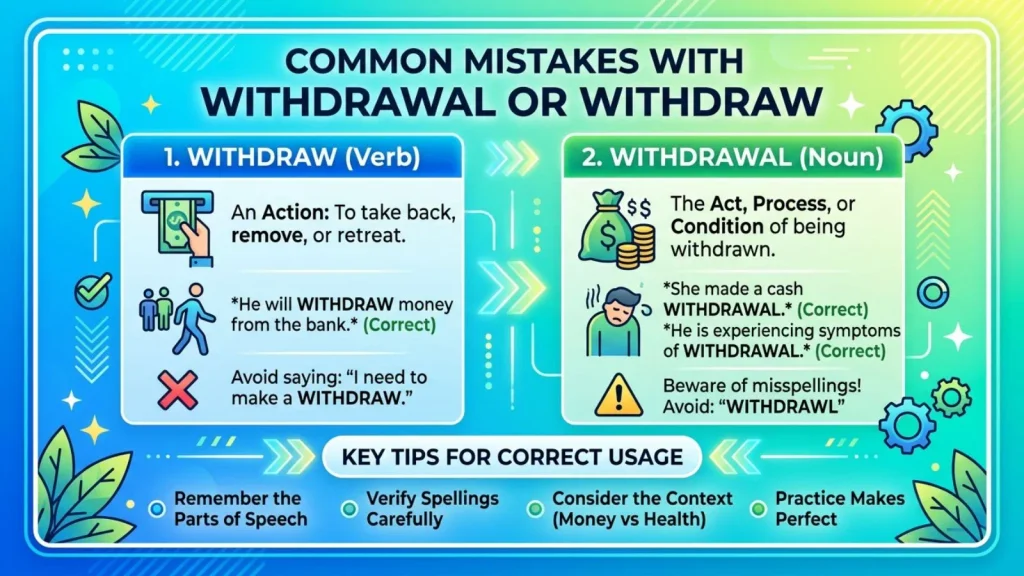
Here are the errors people make most often, along with corrections.
Mistake 1: “I want to withdrawal money.” Correction: “I want to withdraw money.” (Action needs the verb.)
Mistake 2: “Please process my withdraw.” Correction: “Please process my withdrawal.” (Naming the request needs the noun.)
Mistake 3: “withdrawl” (missing the second “a”) Correction: “withdrawal” — this is simply a spelling error, not a variant.
Mistake 4: Confusing past tense forms — “I have withdrawed the funds.” Correction: “I have withdrawn the funds.” (“Withdraw” is irregular: withdraw, withdrew, withdrawn.)
Mistake 5: Using “withdrawal” as a verb in casual speech — “I’m going to withdrawal later.” Correction: “I’m going to withdraw later.”
A helpful trick: replace the word mentally with “remove” or “removal.” If “remove” fits, use “withdraw.” If “removal” fits, use “withdrawal.”
Withdrawal or Withdraw in Everyday Examples
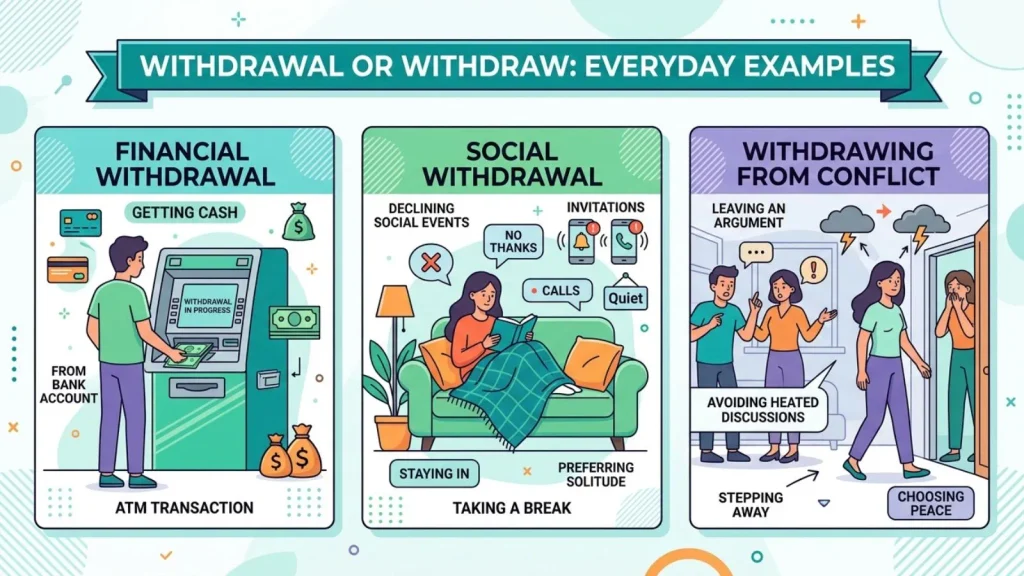
In emails: “Hi team, I’d like to formally withdraw my proposal for the March budget.” (verb, action taken)
In news headlines: “Troop withdrawal begins as ceasefire talks continue.” (noun, describing an event)
In social media posts: “Just had to withdraw from the marathon due to an injury. So bummed.” (verb) “The withdrawal symptoms from quitting caffeine are real.” (noun)
In formal or legal writing: “The applicant may withdraw consent at any time. Withdrawal of consent must be submitted in writing.” (Notice how the same sentence pair uses both forms correctly — action first, then the resulting process.)
In banking contexts: “You can withdraw up to $500 per day. Each withdrawal is subject to a small fee.”
Withdrawal or Withdraw – Google Trends & Usage Data
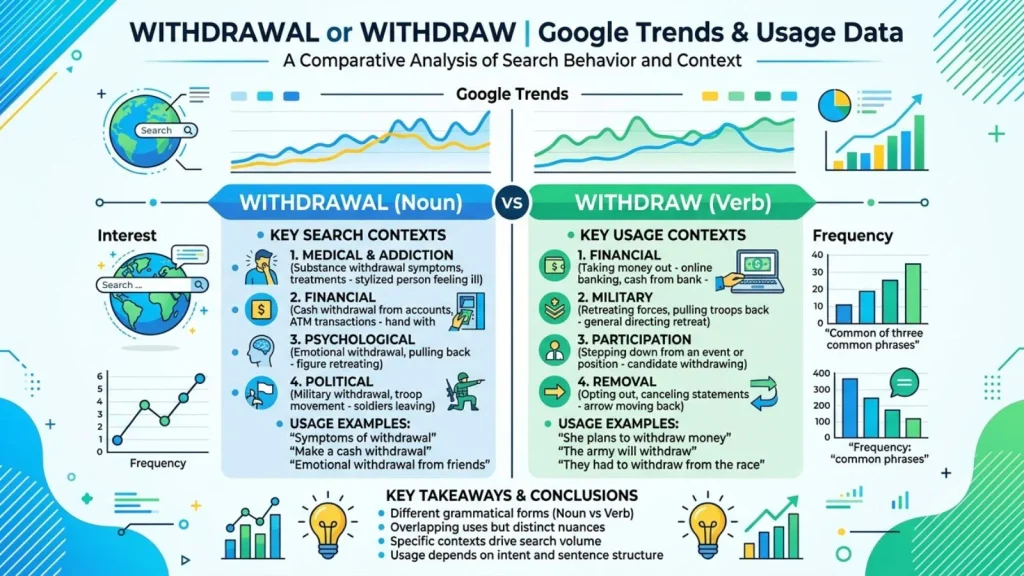
Search interest in this keyword pair stays fairly consistent year-round, with small spikes tied to tax season, university application deadlines, and financial news cycles (interest rate changes, bank policy updates).
By country, search volume is highest in the United States, United Kingdom, India, Canada, and Australia — all major English-speaking markets. This matches expectations, since the confusion is grammatical rather than regional.
By context, the most common search intent falls into three groups: banking and finance (ATM withdrawals, account closures), academic or legal use (withdrawing from a course, contract withdrawal), and general grammar help (students and ESL learners checking correct usage).
Interestingly, “withdrawal symptoms” is a frequently searched variation, tied to health and wellness topics like quitting smoking, alcohol, or medication.
Keyword Variations Comparison Table
| Variation | Part of Speech | Example Use |
| withdraw | Verb (base form) | “I will withdraw the funds.” |
| withdraws | Verb (present, 3rd person) | “He withdraws money weekly.” |
| withdrew | Verb (past tense) | “She withdrew her statement.” |
| withdrawn | Verb (past participle) | “The offer has been withdrawn.” |
| withdrawing | Verb (present participle) | “They are withdrawing support.” |
| withdrawal | Noun (singular) | “The withdrawal was approved.” |
| withdrawals | Noun (plural) | “Multiple withdrawals were flagged.” |
FAQs
1. Is “withdrawl” a correct spelling?
No. “Withdrawl” is a common misspelling. The correct noun spelling is “withdrawal,” with the second “a” included.
2. What is the past tense of “withdraw”?
The past tense is “withdrew.” The past participle (used with “have” or “has”) is “withdrawn.”
3. Can “withdrawal” ever be used as a verb?
No. “Withdrawal” is always a noun. Using it as a verb is a grammatical error.
4. Is there a difference between British and American spelling for this word?
No. Both dialects spell “withdraw” and “withdrawal” identically. This is one of the few word pairs where spelling doesn’t change across regions.
5. How do I remember which form to use?
Try substituting “remove” (verb) or “removal” (noun) into your sentence. Whichever fits naturally tells you the correct word.
6. What does “withdrawal symptoms” mean?
It refers to physical or mental effects experienced when stopping a substance, habit, or medication, such as caffeine, nicotine, or alcohol.
7. Is “withdrawal” one word or two?
It’s one word: w-i-t-h-d-r-a-w-a-l. It should never be written as “with drawal” or hyphenated.
Conclusion
The confusion between “withdrawal” and “withdraw” comes down to one simple grammar rule: “withdraw” is a verb for actions, and “withdrawal” is a noun for things or events.
Once you internalize this difference, the mistake disappears from your writing for good.
Unlike many British vs American English debates, this word pair spells the same way everywhere.
So whether you’re writing from London, New York, Toronto, or Mumbai, the rules don’t change. Your only job is choosing the right part of speech for your sentence.
Watch out for the common misspelling “withdrawl,” remember the irregular past tense forms (withdrew, withdrawn), and use the “remove vs removal” substitution trick whenever you’re unsure.
Whether you’re writing a banking email, a legal document, a news headline, or a casual social media post, getting this word pair right makes your writing look polished and professional.
Bookmark this guide, and you’ll never have to pause mid-sentence over “withdrawal or withdraw” again.

Mary Roach is an American science writer and bestselling author known for making unusual and complex scientific topics engaging, accessible, and humorous. Her books include Stiff, Packing for Mars, Gulp, and Fuzz.
Author at Simifind.com, sharing clear, informative content designed to help readers understand interesting topics and everyday questions.




1 thought on “Withdrawal or Withdraw: Meaning, Spelling, and Usage (for 2026)”