Hey, I want to share something that happened to me recently about Spiraled or Spiralled.
One small spelling difference can make you stop and wonder which word is actually correct.
I was chatting with a friend when I suddenly saw this term pop up, and honestly, I had no clue what it meant at first.
I kept wondering, “Am I missing something here?” It was a bit confusing, and I didn’t want to respond the wrong way.
So, I decided to look into Spiraled or Spiralled and figure out its meaning, spelling, and context.
After understanding it, I realized how important it is to know these terms to avoid awkward situations in conversations.
I handled it by learning the proper spelling and usage, and now I feel ready whenever I see Spiraled or Spiralled again in chats, writing, or social media.
Spiraled or Spiralled – Quick Answer
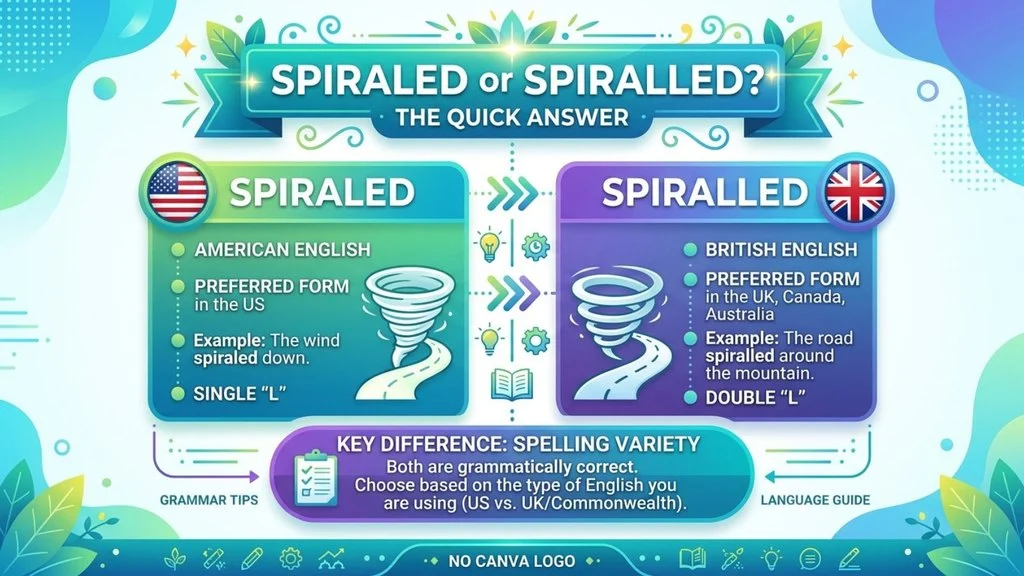
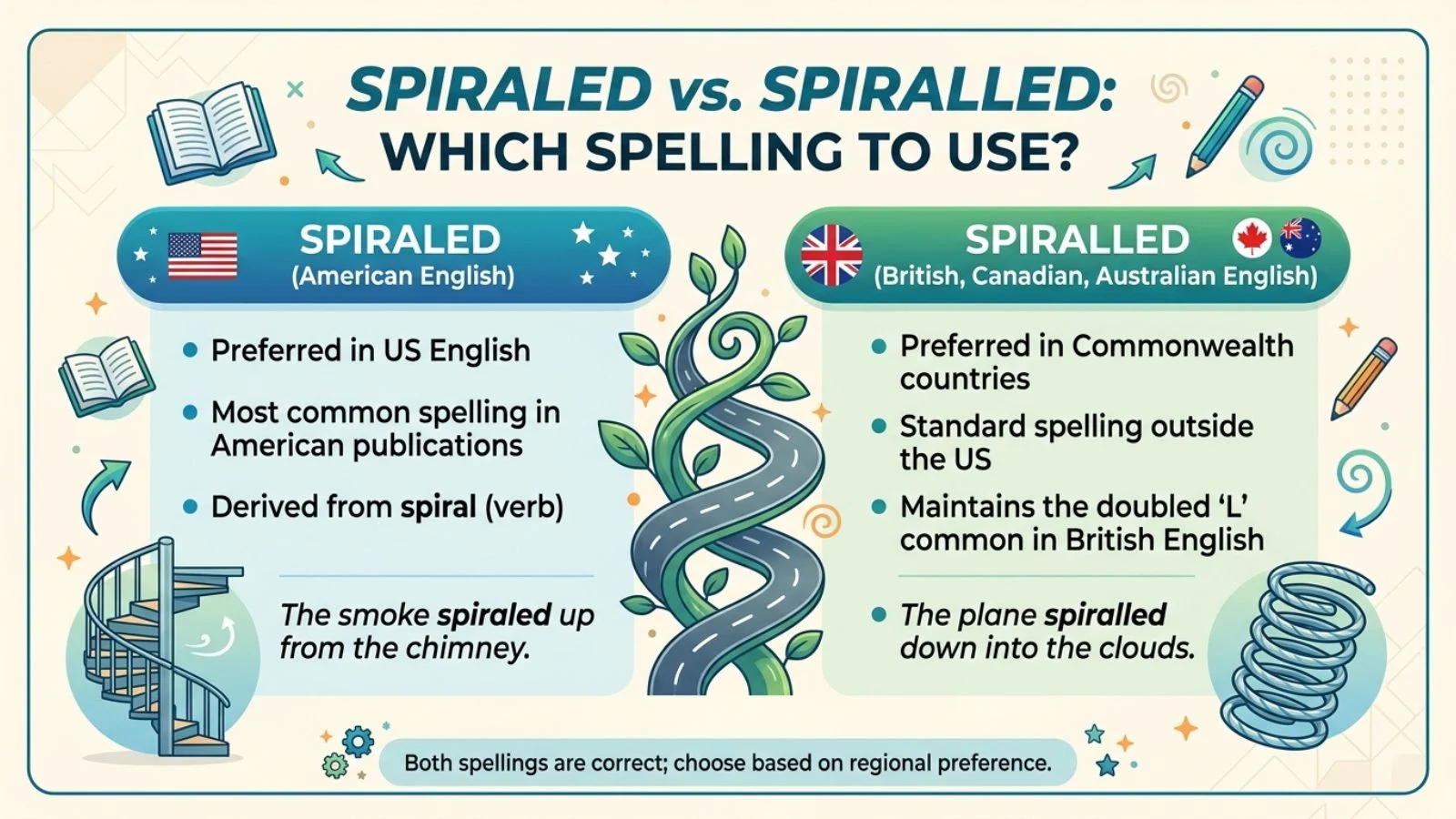
Spiraled is American English. One L.
Spiralled is British English. Two Ls.
Both mean the same thing. Both are correct. Pick the one that matches your audience.
Here are examples:
- American: The costs spiraled out of control.
- British: The costs spiralled out of control.
- American: Smoke spiraled up from the chimney.
- British: Smoke spiralled up from the chimney.
The same rule applies to other forms of the word:
- Spiraling (US) / Spiralling (UK)
- Spiraled (US) / Spiralled (UK)
The base word never changes. It is always spiral with one L.
The Origin of Spiraled and Spiralled
The word comes from a long path through several languages.
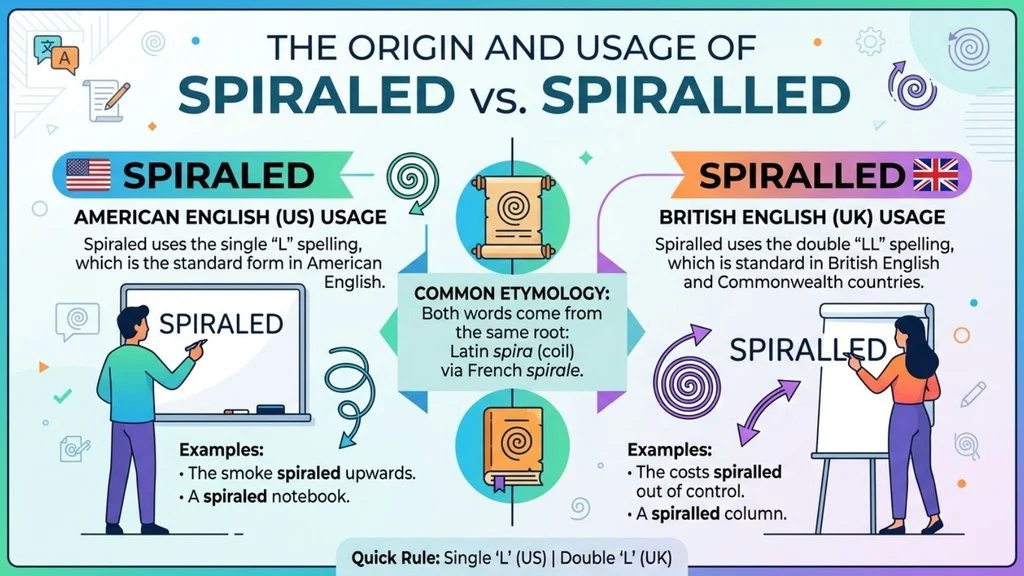
It starts with the Greek word speira. That meant a coil or a twist. Latin borrowed it and made spira. Medieval Latin then built spiralis, which meant winding or coiling.
French picked it up as spirale. English took it from French in the 1500s. At first, spiral was only a noun and an adjective. People talked about a spiral staircase or a spiral shell.
The verb came later. By the 1800s, writers used spiral to mean moving in a curve. Soon after, they used it to mean rising or falling fast. Prices could spiral. Debt could spiral. A life could spiral.
So where did the two spellings come from?
In the early 1800s, English spelling was messy. Noah Webster wanted to fix that in America. He published his dictionary in 1828. He cut letters he thought were useless. Colour became color. Traveller became traveler. Spiralled became spiraled.
Britain kept the older forms. That split never closed.
British English vs American English Spelling
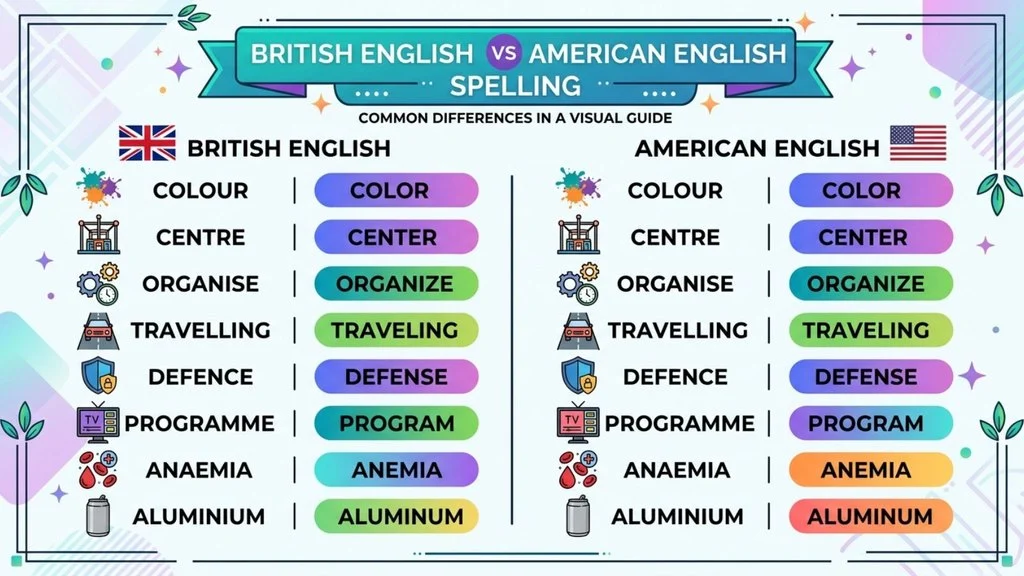
There is a real rule behind this. It is simple once you see it.
American rule: Double the final L only when the stress falls on the last syllable.
British rule: Double the final L whenever the word ends in a single vowel plus L.
Say “spiral” out loud. The stress lands on SPI-ral. The first syllable. So American English keeps one L. British English doubles it anyway.
This is why the same pattern shows up in many other words.
| Base Word | American English | British English |
| spiral | spiraled, spiraling | spiralled, spiralling |
| travel | traveled, traveling | travelled, travelling |
| cancel | canceled, canceling | cancelled, cancelling |
| label | labeled, labeling | labelled, labelling |
| model | modeled, modeling | modelled, modelling |
| signal | signaled, signaling | signalled, signalling |
| fuel | fueled, fueling | fuelled, fuelling |
Now look at a word with stress on the last syllable:
| Base Word | American English | British English |
| control | controlled | controlled |
| propel | propelled | propelled |
| rebel | rebelled | rebelled |
Both sides double the L there. The stress is on the final syllable. So the rule matches.
That is the whole system. Learn it once and it covers dozens of words.
Which Spelling Should Use Spiraled or Spiralled ?
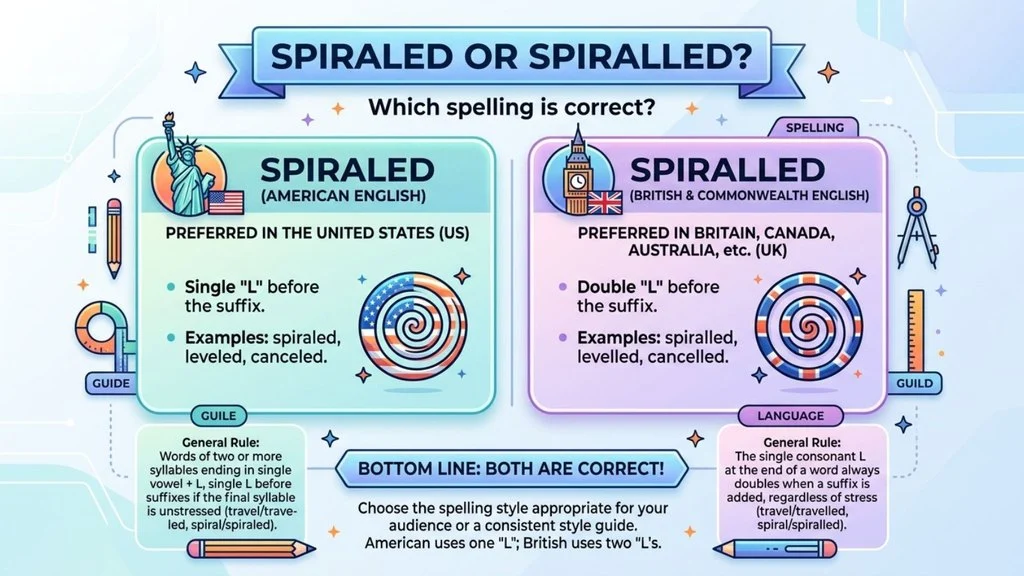
The right choice depends on who reads your writing.
If you write for the United States: Use spiraled. American readers expect one L. Style guides like AP and Chicago use it. Most US spell-checkers flag the double L.
If you write for the UK, Ireland, Australia, New Zealand, South Africa, or India: Use spiralled. Commonwealth countries follow British spelling. Oxford and Cambridge dictionaries list it first.
If you write for Canada: Use spiralled. Canadian English leans British on this one. Canadian Press style keeps the double L.
If you write for a global audience: Pick one and stay with it. Mixing looks careless. Most of your traffic comes from the US, choose spiraled. If it comes from the UK or Australia, choose spiralled.
If you write for school or work: Follow the style guide you were given. A teacher, editor, or employer has already made this choice. Ask if you are not sure.
Quick tip for writers: Set your word processor’s language to match your audience. Then trust the squiggly line.
Common Mistakes with Spiraled and Spiralled
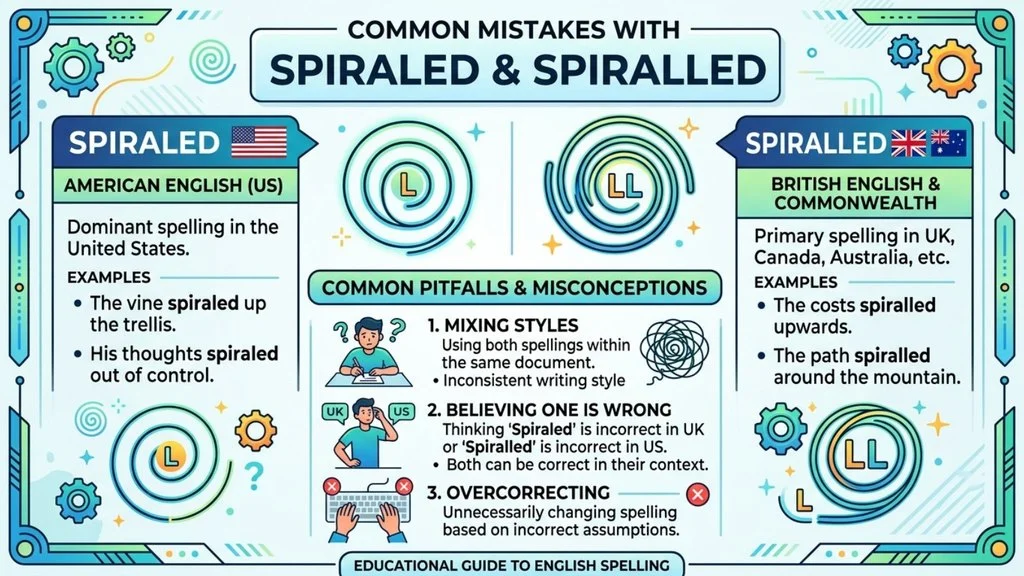
Here are the errors people make most.
Mistake 1: Doubling the L in the base word
- Wrong: The staircase had a spirall shape.
- Right: The staircase had a spiral shape.
The base word always has one L. The doubling only happens when you add -ed or -ing.
Mistake 2: Mixing both spellings in one piece
- Wrong: Prices spiraled in March and kept spiralling in April.
- Right: Prices spiraled in March and kept spiraling in April.
Pick one style. Use it everywhere.
Mistake 3: Thinking one spelling is wrong
Neither is wrong. Both appear in major dictionaries. If someone tells you spiralled is a typo, they are only thinking about American English.
Mistake 4: Forgetting the noun form
- Wrong: The economy entered a death spirall.
- Right: The economy entered a death spiral.
Wrong 5: Adding a third L
- Wrong: Spiralled becomes spiralling with three Ls.
- Right: Spiralling has exactly two Ls.
Mistake 6: Confusing spiral with similar words
Spiral is not the same as spire or swirl. A spire is a pointed tower. A swirl is a loose twist. A spiral is a curve that winds around a center.
Spiraled or Spiralled in Everyday Examples
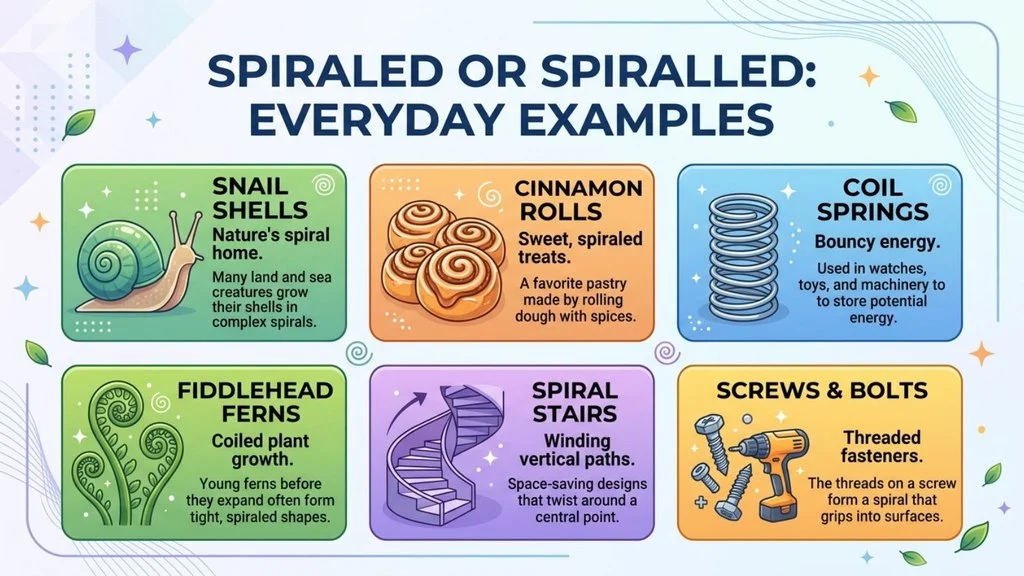
Here is how the word shows up in real writing.
In business emails:
- US: “Our shipping costs spiraled after the fuel price hike.”
- UK: “Our shipping costs spiralled after the fuel price hike.”
In news headlines:
- US: “Housing prices spiraled to record highs this quarter.”
- UK: “Housing prices spiralled to record highs this quarter.”
On social media:
- “My to-do list spiraled into chaos today.”
- “That argument spiralled so fast.”
Social posts follow the writer’s own habits. Nobody edits a tweet for style.
In formal and academic writing:
- US: “Inflation spiraled throughout the 1970s.”
- UK: “Inflation spiralled throughout the 1970s.”
In everyday speech and casual writing:
- “The conversation spiraled into an argument.”
- “Her anxiety spiraled before the interview.”
- “The bird spiraled down toward the water.”
Notice something. The meaning never shifts. Only the letters change.
Spiraled or Spiralled – Google Trends and Usage Data
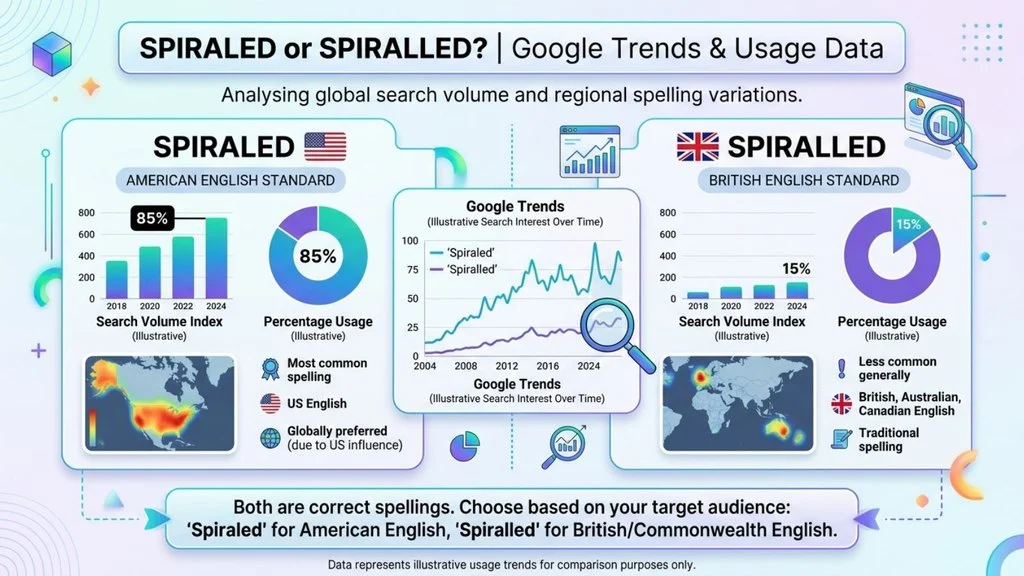
Search patterns follow country lines almost exactly.
Where “spiraled” leads: The United States drives most searches for the single-L form. American writers, students, and businesses use it by default. Because the US produces a large share of English content online, spiraled appears more often across the web overall.
Where “spiralled” leads: The United Kingdom, Australia, New Zealand, Ireland, and South Africa favor the double L. India and Canada also lean this way. In these countries, the single-L version often gets flagged as an error.
What drives the searches: Interest tends to spike when the word appears in major news coverage. Stories about rising costs, debt, or conflict use phrases like “spiraling prices” or “spiralling violence.” Readers see the unfamiliar spelling and look it up.
What this means for your content: If you write for a US audience, spiraled matches how your readers search. If you target the UK or Australia, spiralled matches theirs. Search engines understand both. They usually show results for either spelling. Still, matching your reader’s habit builds trust.
One practical note: If you run a global site, your analytics will show you which spelling your visitors use. Let the data decide.
Comparison Table: All Spiral Word Forms
| Form | American English | British English | Example |
| Base verb | spiral | spiral | Prices spiral fast. |
| Past tense | spiraled | spiralled | Prices spiraled last year. |
| Past participle | spiraled | spiralled | Costs have spiraled. |
| Present participle | spiraling | spiralling | Costs are spiraling. |
| Noun | spiral | spiral | A death spiral. |
| Plural noun | spirals | spirals | The shell has tight spirals. |
| Adjective | spiral | spiral | A spiral staircase. |
| Related adverb | spirally | spirally | The vine grew spirally. |
Frequently Asked Questions
1. Is “spiralled” a real word?
Yes. It is the standard British English spelling. Oxford, Cambridge, and Collins all list it. It is not a typo.
2. Is “spiraled” wrong in the UK?
It is not wrong in a strict sense. But it looks American. British editors will usually change it to spiralled.
3. Why does British English double the L?
British English doubles the final L in most verbs that end in a single vowel plus L. The rule ignores which syllable gets the stress. American English only doubles when the stress falls on the last syllable.
4. Which spelling do Canadians use?
Canadians use spiralled. Canadian English follows British spelling for this word.
5. Does the double L change the meaning?
No. The meaning is exactly the same. Only the spelling differs.
6. What about “spiraling” and “spiralling”?
Same rule. Spiraling is American with one L. Spiralling is British with two.
7. Which spelling is better for SEO?
Neither is better on its own. Match your target country. Search engines treat both as the same word. If your readers are in the US, use spiraled. If they are in the UK or Australia, use spiralled.
8. Can I use both in one article?
No. Pick one and stay consistent. Mixing them looks sloppy to readers and editors.
Conclusion
The confusion ends here.
Spiraled has one L. It is American English. Spiralled has two Ls. It is British English. Both are correct. Both mean the same thing. Neither is a mistake.
The rule behind it is simple. American English doubles a final L only when the stress falls on the last syllable. Spiral is stressed on the first syllable, so Americans keep one L. British English doubles the L no matter where the stress falls.
That same rule covers dozens of other words. Traveled and travelled. Canceled and cancelled. Modeled and modelled. Learn it once and you solve them all.
Your practical takeaway is short.US, use spiraled.UK, Australia, Canada, India, or Ireland, use spiralled. Write for a global audience, pick one and never mix.
Set your spell-checker to the right language. Check your style guide if you have one. Then write with confidence.
The word itself means a curve that winds tighter and tighter. Your spelling choice does not have to.

Mary Roach is an American science writer and bestselling author known for making unusual and complex scientific topics engaging, accessible, and humorous. Her books include Stiff, Packing for Mars, Gulp, and Fuzz.
Author at Simifind.com, sharing clear, informative content designed to help readers understand interesting topics and everyday questions.