Hey, I want to share something that happened to me recently about nobodies or nobody’s.
I was chatting with a friend when I suddenly saw this term pop up, and honestly, I had no clue what it meant at first.
I kept wondering, “Am I missing something here?” It was a bit confusing, and I didn’t want to respond the wrong way.
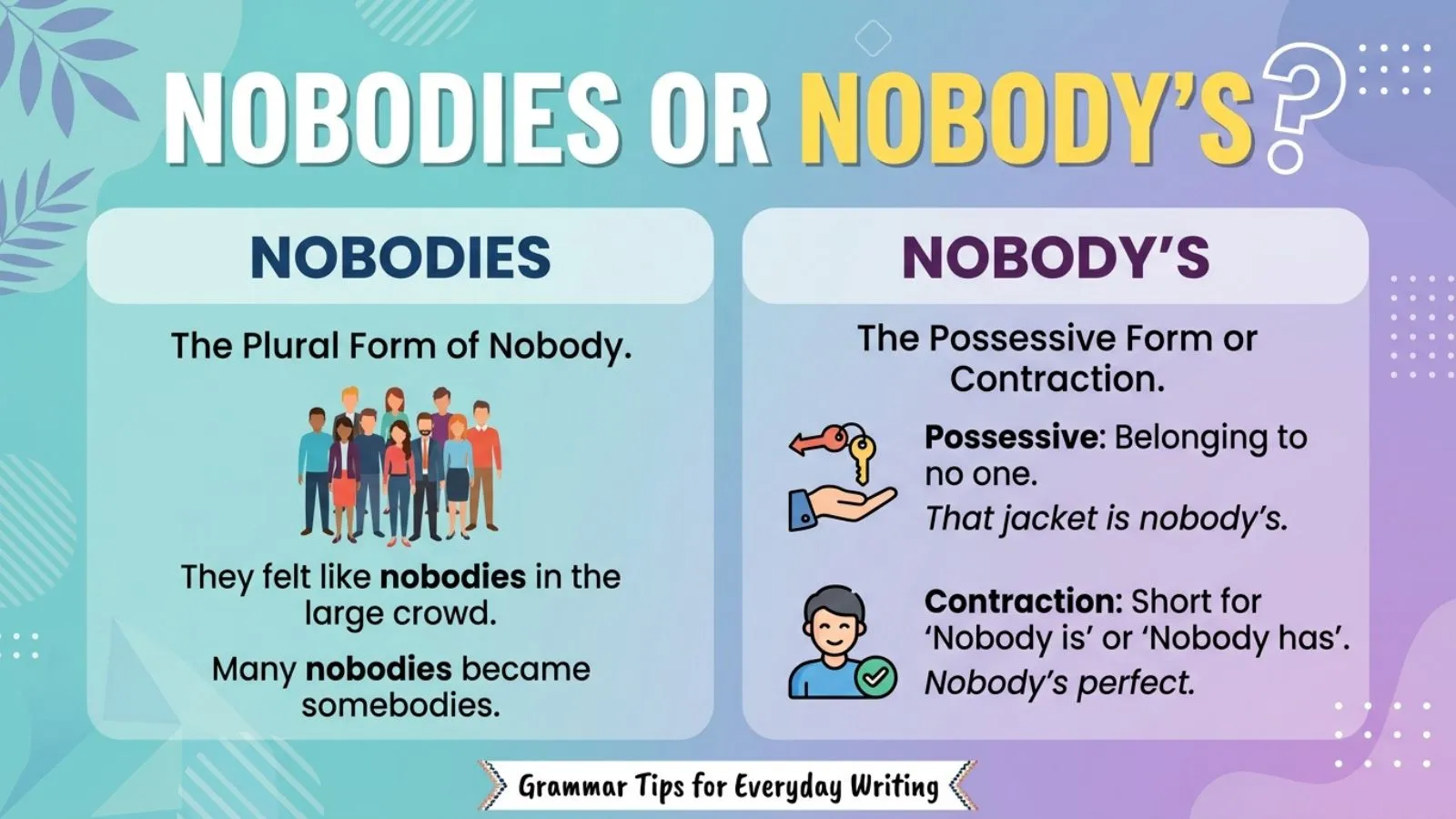
The difference between “nobodies” and “nobody’s” may look tiny, but that little apostrophe can completely change the meaning of a sentence.
So, I decided to look into nobodies or nobody’s and figure out its meaning and context.
After understanding it, I realized how important it is to know these terms to avoid awkward situations in conversations.
I handled it by learning the proper meaning and responding confidently, and now I feel ready whenever I see nobodies or nobody’s again in chats or social media.
Nobodies or Nobody’s – Quick Answer
Here is the short version.
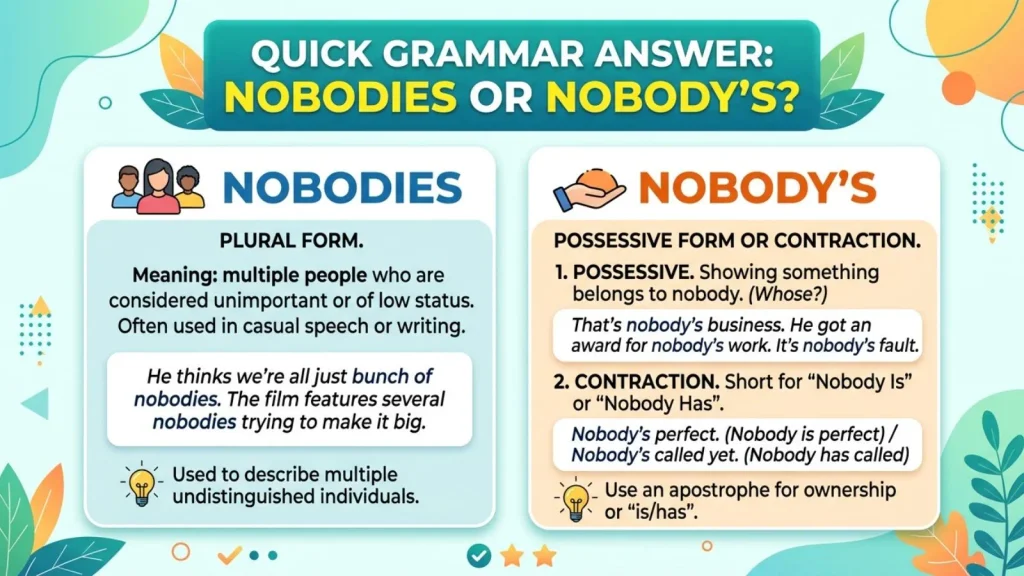
- Nobodies is a plural noun. It means people who are unimportant or unknown. Example: “The room was full of nobodies pretending to be famous.”
- Nobody’s is a contraction of “nobody is” or “nobody has.” It can also show possession. Example: “Nobody’s coming to the party” (nobody is coming). Example: “It’s nobody’s fault” (possession).
The apostrophe is the key. No apostrophe means plural. An apostrophe means a shortened phrase or ownership.
The Origin of Nobodies and Nobody’s
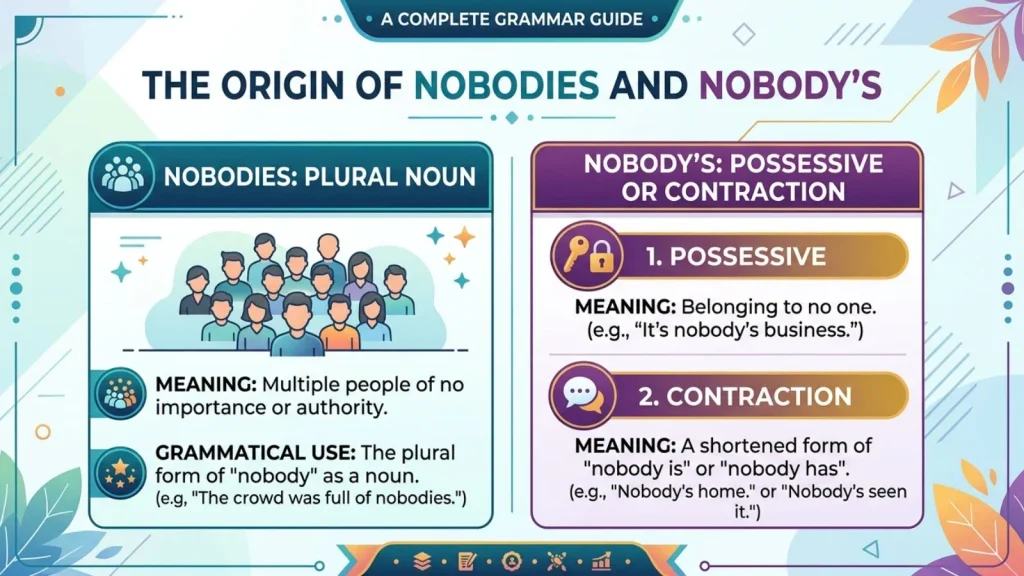
The word “nobody” comes from Old English roots. It combines “no” and “body,” where “body” once meant “person,” not just a physical form. This usage dates back to Middle English, when writers needed a simple word for “not one person.”
Over time, English speakers needed a plural form for cases where more than one unimportant person was being described. Adding an “s” created “nobodies,” following the normal rule for turning nouns into plurals.
The possessive and contracted form, “nobody’s,” developed alongside standard English possession rules. English typically adds an apostrophe and an “s” to show ownership (“the dog’s bone”) or to shorten two words into one (“nobody is” becomes “nobody’s”). Since “nobody” already ends in a consonant sound, this pattern applied naturally.
Spelling differences you may notice online usually come from typing habits, not from real historical rules. Autocorrect, quick typing, and confusion between homophone-like patterns often cause people to drop or add an apostrophe by mistake.
British English vs American English Spelling
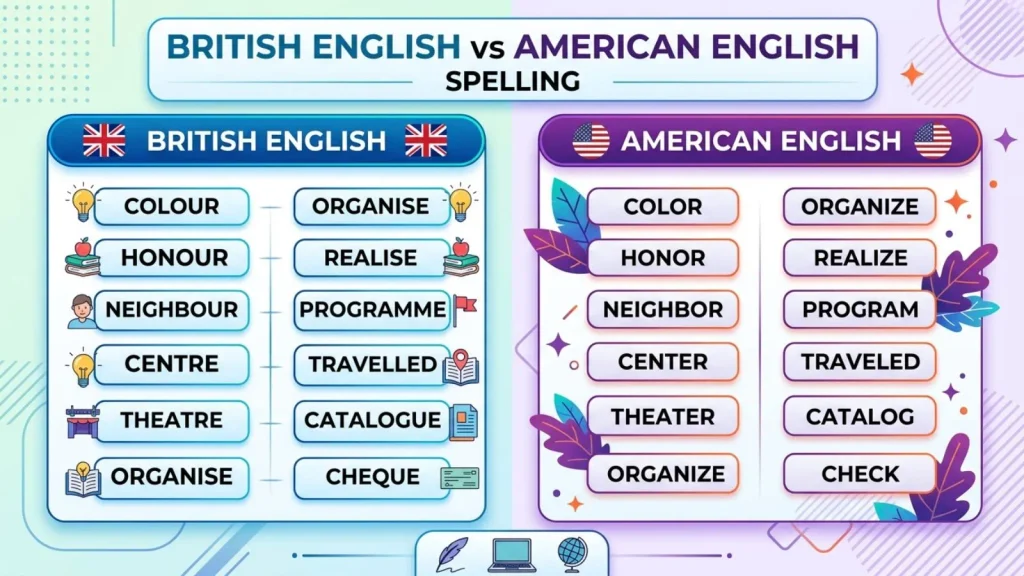
Good news here: this is not a true British versus American spelling split, like “colour” versus “color.” Both “nobodies” and “nobody’s” are spelled the same way in the UK, the US, Canada, Australia, and other English-speaking regions.
What differs slightly is usage style and formality. British English tends to favor slightly more formal writing in professional contexts, so “nobody’s” as a contraction appears less often in formal UK business writing. American English is generally more relaxed with contractions across contexts, including business emails.
| Feature | American English | British English |
| Spelling of “nobodies” | Same | Same |
| Spelling of “nobody’s” | Same | Same |
| Contraction use in formal writing | More common | Less common |
| Preferred in academic writing | Avoided (both forms) | Avoided (both forms) |
| Everyday speech and casual writing | Very common | Very common |
The real difference is not spelling. It is when and how often each form gets used.
Which Spelling Should Use nobodies or nobody’s ?
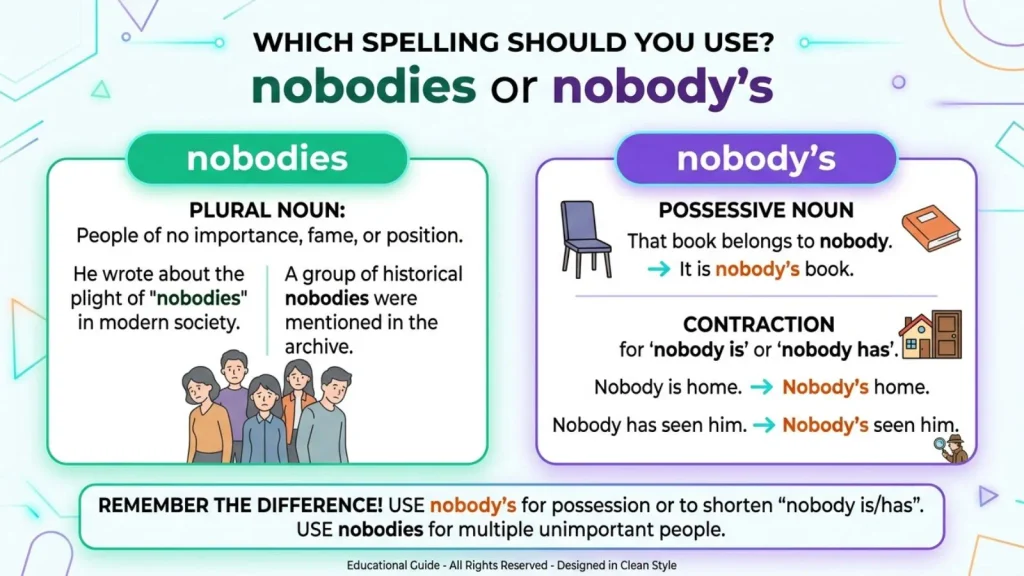
Your choice depends on meaning, not region.
If you mean multiple unimportant or unknown people: Use “nobodies.” This applies everywhere English is spoken.
If you mean “nobody is,” “nobody has,” or ownership by nobody: Use “nobody’s.” This also applies everywhere English is spoken.
For formal or academic writing (US, UK, or global): Avoid contractions altogether. Instead of “nobody’s coming,” write “nobody is coming.” This keeps your writing clear and professional in any English-speaking country.
For casual writing, social media, or friendly emails: Both forms work fine, as long as you pick the correct one for your meaning.
For global or international audiences: Stick with full phrases like “nobody is” or “no one has” when writing for readers who may be non-native English speakers. This avoids confusion entirely.
Common Mistakes with Nobodies and Nobody’s
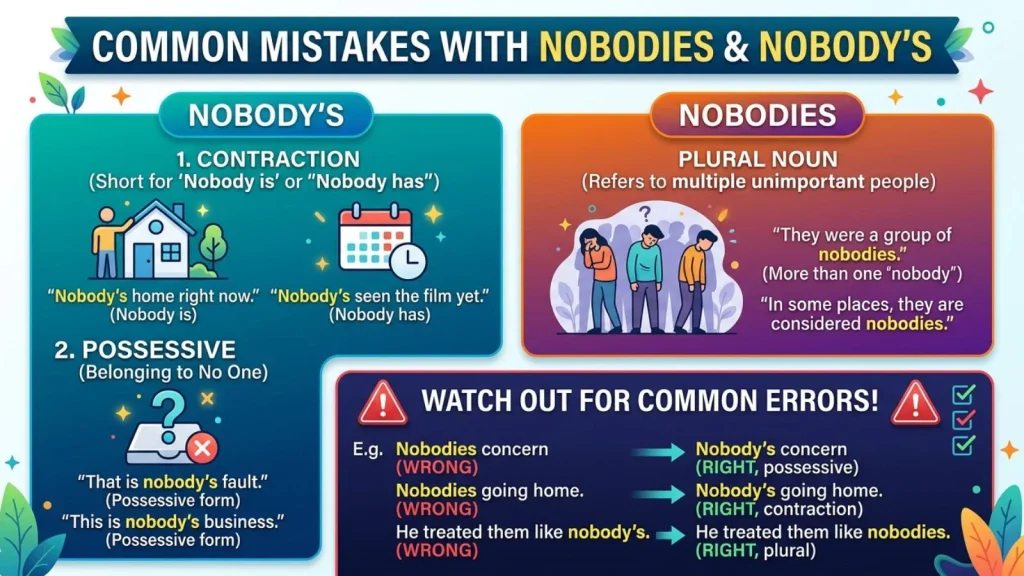
Here are the errors people make most often, along with the fix.
Mistake 1: “We were treated like nobody’s.” Fix: “We were treated like nobodies.” (Plural noun, no apostrophe needed.)
Mistake 2: “Nobodies going to the meeting today.” Fix: “Nobody’s going to the meeting today.” (Contraction of “nobody is.”)
Mistake 3: “This is nobodies business.” Fix: “This is nobody’s business.” (Possessive form.)
Mistake 4: Using “nobody’s” when you mean more than one unimportant person. Fix: Use “nobodies” for plural people.
Mistake 5: Adding an apostrophe out of habit, even for the plural form. Fix: Ask yourself: am I shortening “nobody is/has,” or showing ownership? If not, skip the apostrophe.
A simple test: try replacing the word with “nobody is” or “nobody has” in the sentence. If it still makes sense, use “nobody’s.” If it does not, and you mean more than one person, use “nobodies.”
Nobodies and Nobody’s in Everyday Examples
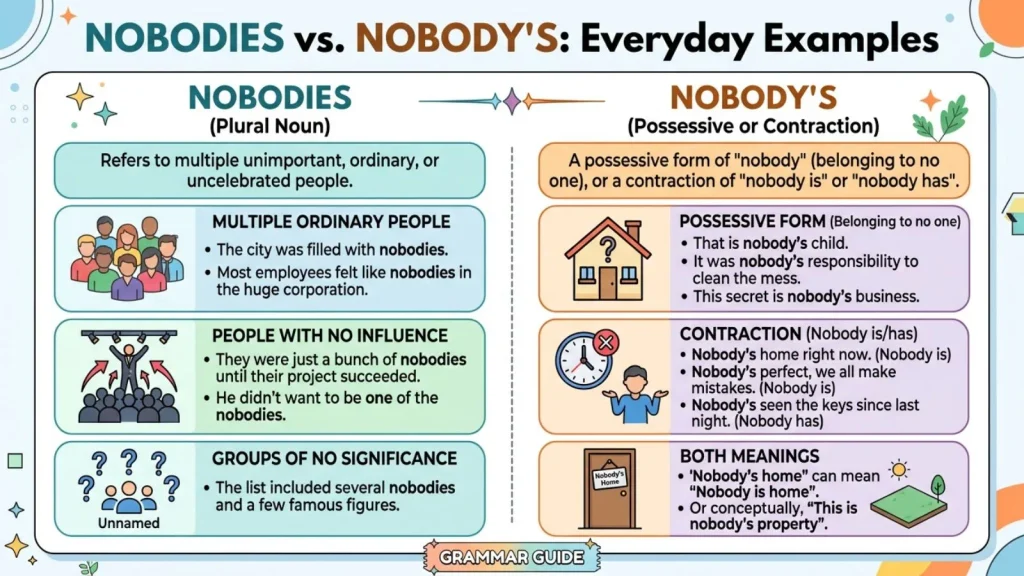
In emails: “Nobody’s replied to my last message yet. Could you please follow up?”
In news writing: “The scandal turned respected politicians into public nobodies overnight.”
Social media posts: “Nobody’s perfect, but we can still try our best today. 💪”
In formal business writing: “To date, nobody has confirmed attendance for the quarterly review.” (Formal writing avoids the contraction entirely.)
In casual conversation: “Don’t worry about them, they’re just a bunch of nobodies trying to get attention.”
In legal or ownership contexts: “This land is nobody’s property; it remains unclaimed.”
These examples show how context shapes word choice, and how formality level often decides whether a contraction is used at all.
Nobodies or Nobody’s – Google Trends & Usage Data
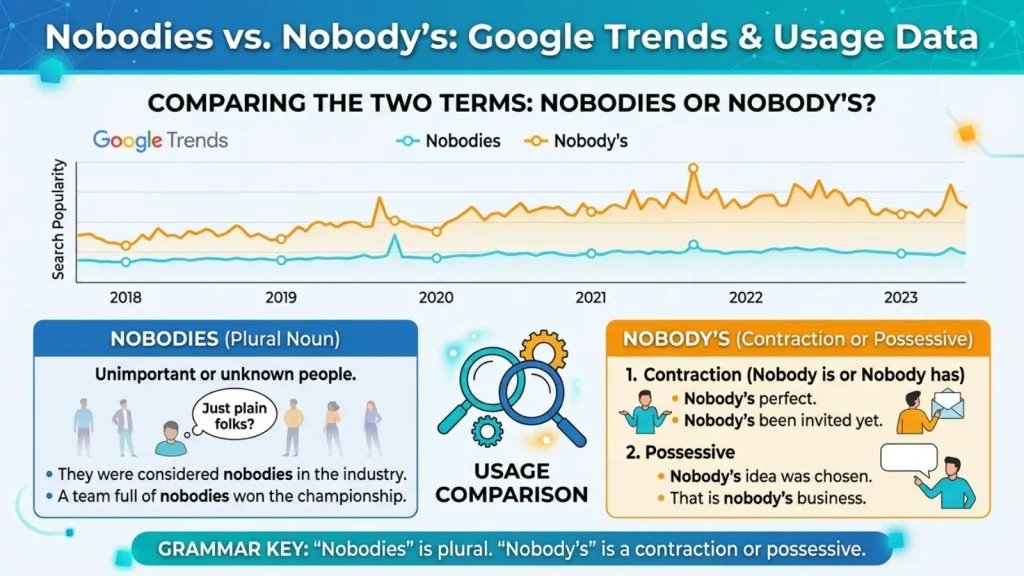
Search interest in this topic tends to spike among students, writers, editors, and content creators looking for a fast grammar check. Search volume is generally higher in the United States, United Kingdom, Canada, Australia, and India, reflecting large English-speaking and English-learning populations.
Usage patterns show that “nobody’s” appears far more often in searches and everyday writing than “nobodies,” mainly because contractions like “nobody’s coming” or “nobody’s fault” show up constantly in speech, texting, and casual writing. “Nobodies” appears less often but shows spikes around discussions of fame, social status, or plots involving anonymous or forgotten people.
Interest in this keyword tends to hold steady over time rather than spike seasonally, since it reflects an ongoing grammar question rather than a trending topic.
Keyword Variation Comparison
| Variation | Meaning | Example | Common Context |
| Nobodies | Plural noun for unimportant people | “They felt like nobodies.” | Storytelling, casual speech |
| Nobody’s | Contraction of “nobody is/has” | “Nobody’s home right now.” | Speech, texting, casual writing |
| Nobody’s (possessive) | Shows ownership by nobody | “It’s nobody’s fault.” | Everyday speech, writing |
| Nobody is | Full, formal version | “Nobody is available today.” | Formal writing, business |
| No one’s | Alternative contraction | “No one’s answering the phone.” | Casual speech |
FAQs
1. Is “nobodies” a real word?
Yes. “Nobodies” is the correct plural form of “nobody” when used as a noun meaning unimportant or unknown people.
2. Is “nobody’s” always a contraction?
No. It can be a contraction of “nobody is” or “nobody has,” or it can show possession, as in “nobody’s fault.”
3. Which one should I use in formal writing?
Avoid both. Use the full phrase “nobody is” or “nobody has” for a more professional tone.
4. Do British and American English spell these words differently?
No. Both words are spelled the same way in British and American English. The difference lies in how often contractions are used in formal writing.
5. What is a quick trick to remember the difference?
Check for an apostrophe. No apostrophe means plural people. An apostrophe means a shortened phrase or ownership.
6. Can “nobodies” be used as a possessive?
No. “Nobodies” is only a plural noun. It does not show ownership.
7. Is “no one’s” the same as “nobody’s”?
Yes, “no one’s” works the same way as “nobody’s” and can replace it in most sentences without changing the meaning.
Conclusion
The difference between “nobodies” and “nobody’s” comes down to one small mark: the apostrophe. “Nobodies” is a plural noun for unimportant or unknown people. “Nobody’s” is a contraction of “nobody is” or “nobody has,” or it shows possession.
This is not a British versus American spelling issue. Both words are spelled the same everywhere English is spoken. The real difference is in meaning and formality. Formal writing tends to avoid both forms, favoring full phrases like “nobody is” instead.
To choose correctly, ask yourself what you mean. If you are talking about more than one unimportant person, use “nobodies.” If you are shortening “nobody is” or “nobody has,” or showing ownership, use “nobody’s.”
Keep this simple rule in mind, check for the apostrophe, and think about your audience. Whether you are writing a casual text, a news article, or a formal report, you now have everything you need to use these words with confidence.

Here’s a concise 2-line author bio suitable for Simifind.com:
James Dashner is an American bestselling author best known for The Maze Runner series and other popular young-adult fiction.
On Simifind.com, he shares clear, engaging insights and helpful content for readers interested in books, writing, and popular literature.