Leaves or leafs—which one is correct? A tiny spelling choice can make a big difference when you are talking about plants, books, or someone leaving a place.
Hey, I want to share something that happened to me recently about “leaves or leafs.”
I was chatting with a friend when I suddenly saw this term pop up, and honestly, I had no clue which form was correct at first.
I kept wondering, “Am I missing something here?” It was a bit confusing, and I didn’t want to respond the wrong way.
So, I decided to look into leaves or leafs and figure out their meaning, spelling, and proper context.
After understanding the difference, I realized how important it is to know which word to use in everyday conversations and writing.
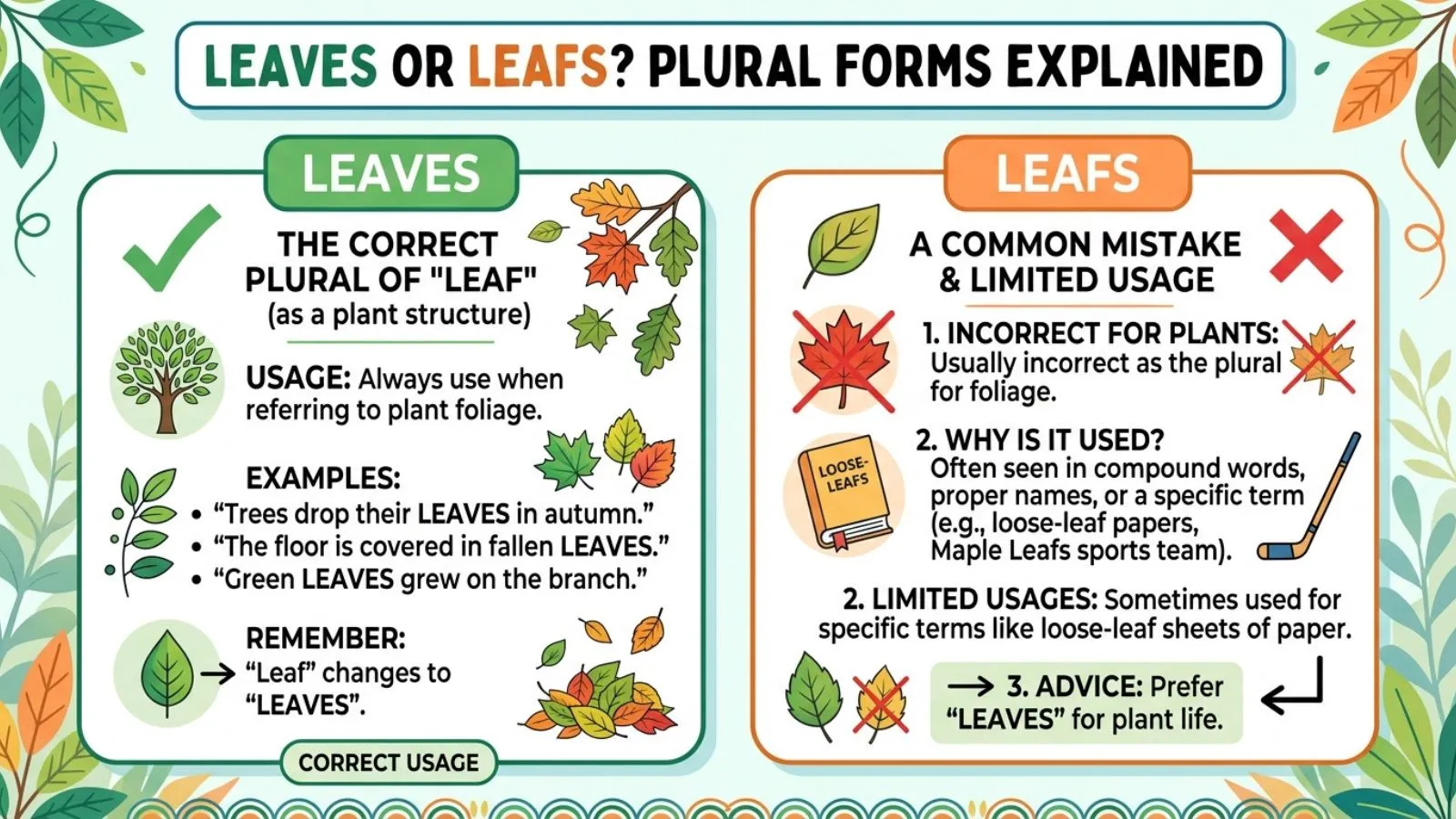
“Leaves” is the standard plural of “leaf,” while “leafs” is rarely used and mainly appears in specific contexts, such as referring to someone moving through pages or the Toronto Maple Leafs.
Once I understood the rule, the confusion disappeared. Now I feel confident whenever I see leaves or leafs in chats, social media, schoolwork, or everyday writing.
Leaves or Leafs – Quick Answer
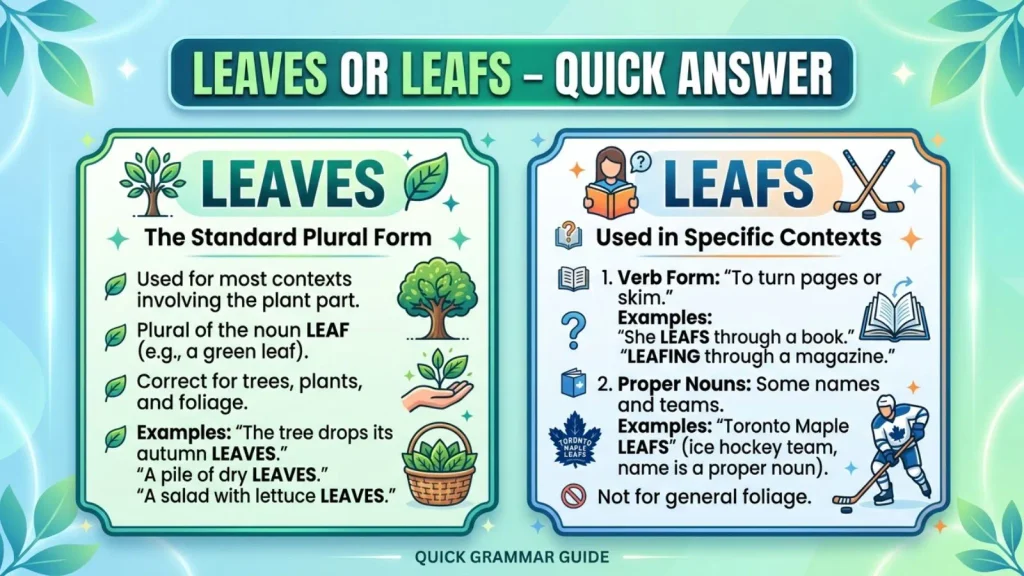
The correct plural of “leaf” is leaves.
Use “leaves” when you talk about:
- Tree leaves (“The leaves fell in October.”)
- Pages of a book (“She turned the leaves slowly.”)
- Parts of a table (“The table has extra leaves.”)
“Leafs” is rarely correct. It appears in two cases only:
- As a verb: “He leafs through the magazine.”
- As a proper noun: “The Toronto Maple Leafs won last night.”
Outside of these two cases, always use “leaves.”
The Origin of Leaves or Leafs
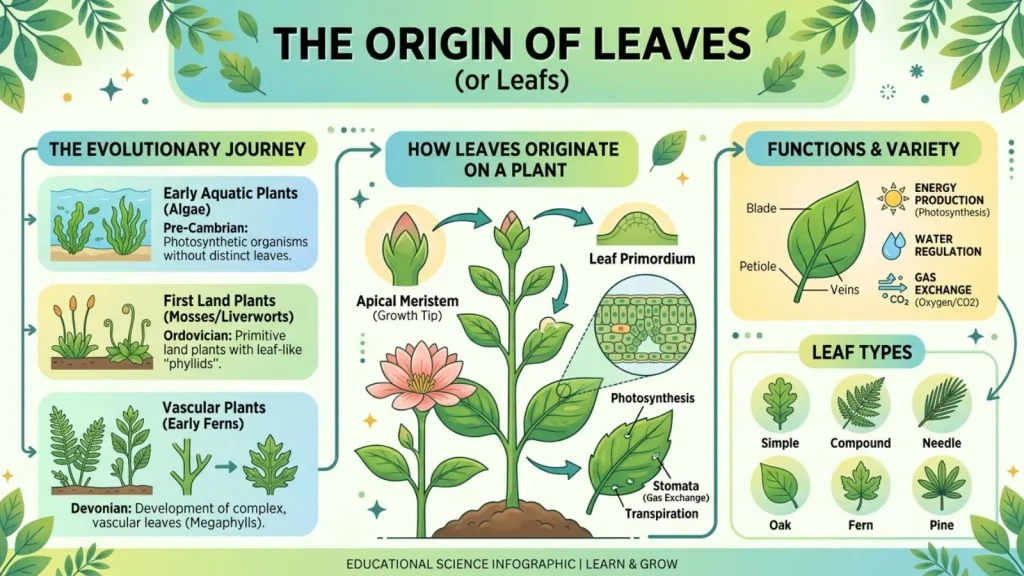
English plurals often follow simple rules. Add an “-s” or “-es” to the end of a word. But some old English words follow a different pattern.
“Leaf” comes from Old English “lēaf.” Many old English words ending in “f” or “fe” changed their spelling in the plural form. The “f” sound shifted to a “v” sound over time. This is called the “f to v” pattern.
Other words follow this same old pattern:
- Knife → Knives
- Wife → Wives
- Half → Halves
- Wolf → Wolves
This pattern is a leftover from Old English grammar rules. Modern English kept it for common words like “leaf.” That is why “leaves” feels normal, even though it breaks the usual “-s” rule.
Proper nouns work differently. Team names, brand names, and titles do not follow standard grammar rules. This is why the “Toronto Maple Leafs” keeps the “-s” ending instead of becoming “Maple Leaves.”
British English vs American English leaves or leafs
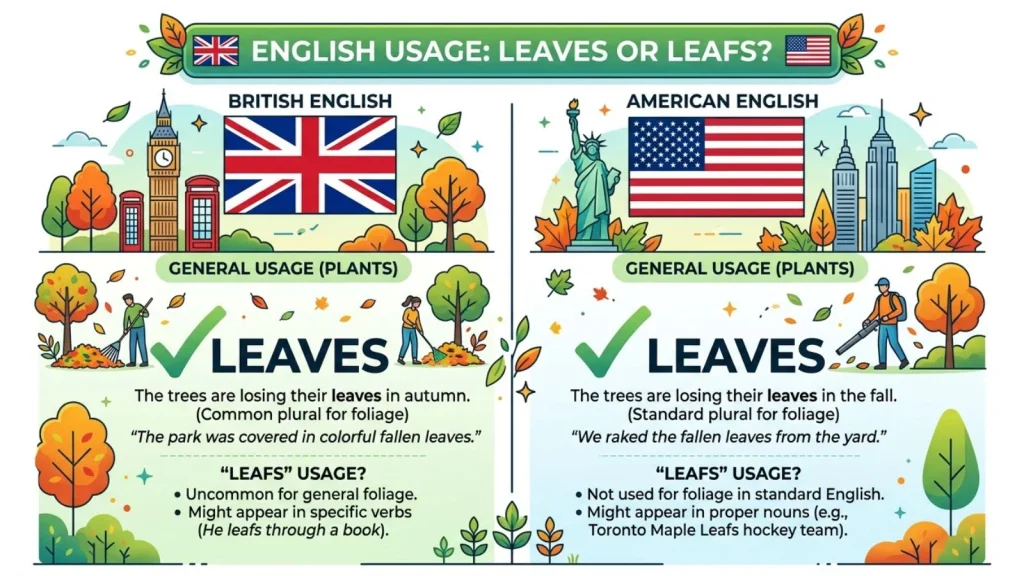
Good news: this is not a British versus American spelling issue. Both British English and American English use “leaves” as the plural of “leaf.” There is no regional difference here.
This surprises many people. English often has spelling splits between the US and UK, like “color” versus “colour.” But “leaves” stays the same everywhere.
The only difference comes from proper nouns, like team names. These stay fixed no matter the region.
| Word Form | British English | American English |
| Plural of “leaf” | Leaves | Leaves |
| Verb form | Leafs (he leafs through) | Leafs (he leafs through) |
| Hockey team | Toronto Maple Leafs | Toronto Maple Leafs |
| Spelling rule | f → v pattern | f → v pattern |
Which Spelling Should Use leaves or leafs ?
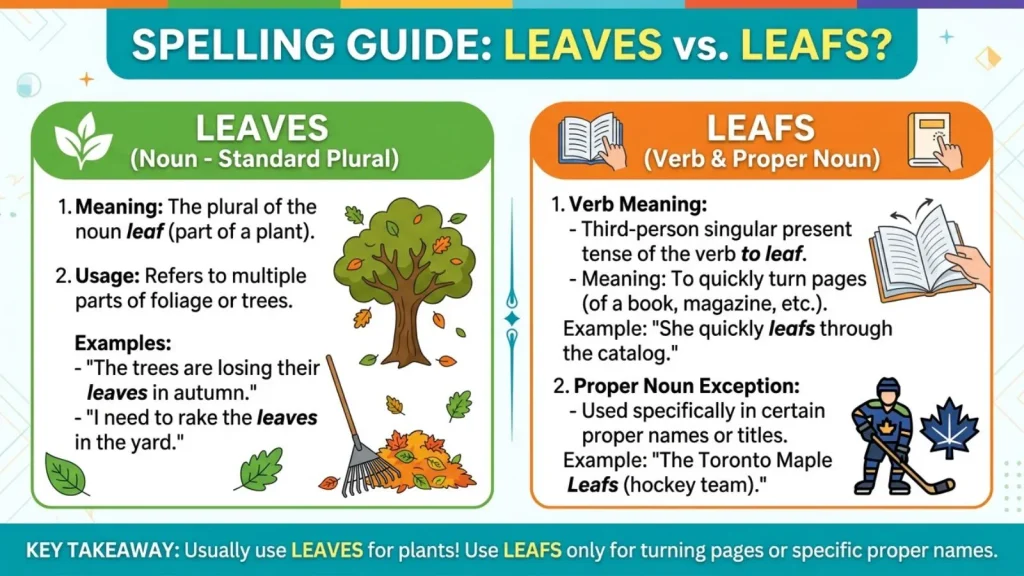
Your choice depends on your audience and context.
For general writing (US, UK, or global readers): Use “leaves” for the plural of “leaf.” This works everywhere. No exceptions apply for country or region.
For sports writing or fan content: Use “Leafs” only when referring to the Toronto Maple Leafs hockey team. Never change the team name to “Leaves.”
For business and formal writing: Always use “leaves.” This is the grammatically correct form. Using “leafs” in a report or email looks like a spelling mistake.
For casual or social media writing: Stick with “leaves” for trees, pages, or tables. Save “leafs” only for the hockey team or the verb form.
Common Mistakes with Leaves or Leafs
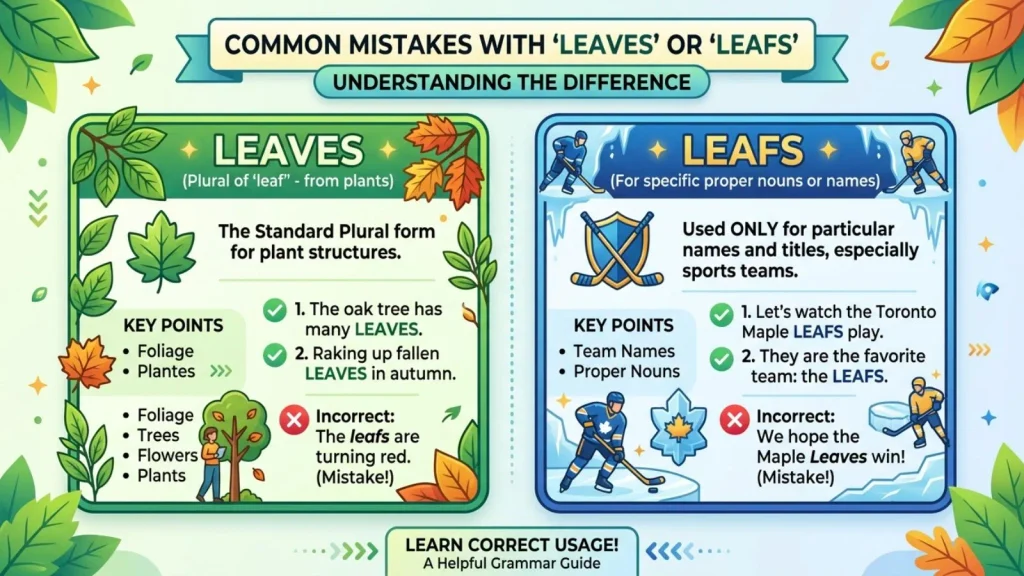
Many writers make small errors with this word. Here are the most common ones.
Mistake 1: Writing “leafs” for tree leaves Wrong: “The leafs are turning orange.” Correct: “The leaves are turning orange.”
Mistake 2: Writing “leaves” for the hockey team Wrong: “The Toronto Maple Leaves lost the game.” Correct: “The Toronto Maple Leafs lost the game.”
Mistake 3: Confusing the verb form Wrong: “She leaves through old photos.” Correct: “She leafs through old photos.” (This means flipping through pages.)
Mistake 4: Mixing up “leaves” as a verb Note: “Leaves” can also mean “departs.” Example: “He leaves at noon.” This is a different meaning from the plural noun.
Mistake 5: Adding an apostrophe Wrong: “The tree lost its leaf’s.” Correct: “The tree lost its leaves.”
Leaves or Leafs in Everyday Examples
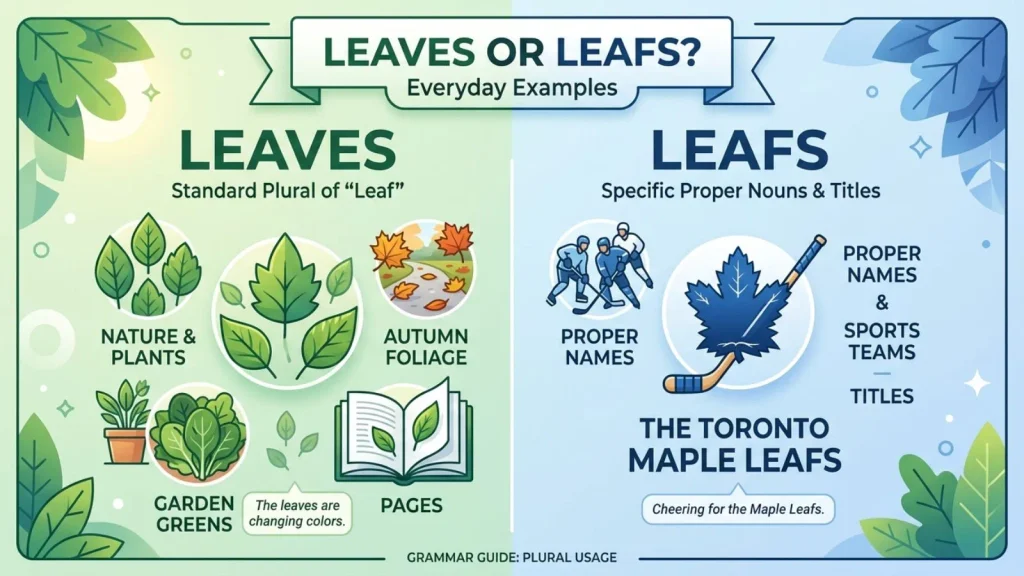
In emails: “Please rake the leaves before Friday’s inspection.”
In news headlines: “City crews begin fall leaf pickup this week.”
Social media posts: “Nothing beats the smell of fresh leaves in October 🍁 #FallVibes”
In formal writing: “The report analyzed leaf decay rates across three forest regions.”
Sports content: “The Maple Leafs face the Bruins in tonight’s matchup.”
In casual conversation: “He leafs through cookbooks every Sunday morning.”
Leaves or Leafs – Google Trends & Usage Data
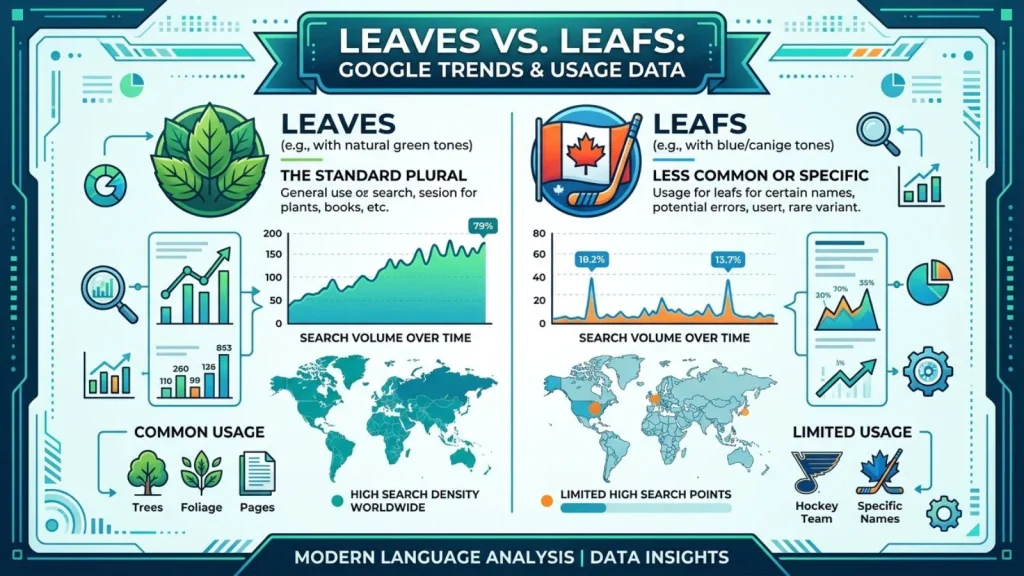
Search interest for “leaves or leafs” rises every autumn. People search this term most in September, October, and November. This matches the fall season, when tree leaves change color and fall.
Search data also shows spikes during hockey season. Fans search “Maple Leafs” often between October and June, during the NHL season.
Searches come from both the US and Canada at high rates. Canadian searches often link to hockey. US searches often link to gardening, yard work, or general grammar questions.
Globally, “leaves” dominates as the correct grammar term. “Leafs” ranks lower in raw search volume but spikes hard during hockey games and playoffs.
Comparison Table: Keyword Variations
| Term | Meaning | Correct Usage |
| Leaves | Plural of “leaf” | “The leaves fell from the tree.” |
| Leafs | Verb (flips pages) | “He leafs through the book.” |
| Leafs | Proper noun (hockey team) | “The Maple Leafs scored first.” |
| Leaved | Past tense (rare, informal) | Not standard English; avoid using |
| Leafing | Present participle of “leaf” (verb) | “She is leafing through the file.” |
FAQs
1. Is “leafs” ever correct for trees?
No. “Leafs” is never correct for tree leaves. Always use “leaves.”
2. Why do the Toronto Maple Leafs spell it “Leafs”?
Team names do not follow standard grammar rules. The team chose “Leafs” as a stylistic and branding choice.
3. Is “leaves” both a noun and a verb?
Yes. “Leaves” is the plural of “leaf” (noun). It also means “departs,” as in “She leaves at 5 PM” (verb).
4. What is the plural of “leaf” in British English?
It is “leaves,” the same as American English. There is no spelling difference.
5. Can “leafs” be used as a plural noun in any context?
Only for proper nouns, like team names. It cannot replace “leaves” in general writing.
6. Why does “leaf” change to “leaves” instead of adding “-s”?
This follows an old English pattern where “f” sounds shift to “v” sounds in plural forms, like “knife” to “knives.”
7. Is “leafs” a spelling mistake in Word or Grammarly?
Yes, most grammar tools will flag “leafs” as incorrect unless it refers to a proper noun or the verb form.
Conclusion
The plural of “leaf” is “leaves.” This rule applies in both British and American English, with no regional differences. The only exceptions are proper nouns, like the Toronto Maple Leafs, and the verb form, as in “he leafs through a magazine.”
This word follows an old English pattern. Many words ending in “f” shift to “v” in their plural form. “Knife” becomes “knives.” “Wolf” becomes “wolves.” “Leaf” becomes “leaves.” Knowing this pattern helps you remember the rule for good.
For everyday writing, business emails, and formal documents, always use “leaves.” Save “leafs” only for hockey fans talking about their favorite team, or when using the verb form about flipping through pages.
Now you have a clear answer. You know the correct spelling , exceptions and why the rule exists. Use “leaves” with confidence in your next email, post, or report.

Mary Roach is an American science writer and bestselling author known for making unusual and complex scientific topics engaging, accessible, and humorous. Her books include Stiff, Packing for Mars, Gulp, and Fuzz.
Author at Simifind.com, sharing clear, informative content designed to help readers understand interesting topics and everyday questions.