
Both honoured and honored are correct. Honoured is British English, honored is American English. Both mean the same thing — shown respect.
Have you ever written honoured in an email and then seen honored in an article?
You may have wondered which spelling is right. The good news is that both honoured and honored are correct. The main difference is the type of English you use.
People often search for “honoured or honored” when writing school work, job applications, business emails, essays, or social media posts.
They want to choose the right spelling and avoid mistakes. This is important when you write for readers in different countries.
The word honored means that someone feels respect for a person, has received respect, or feels proud to receive a special role or award.
For example, you may feel honored to meet a great teacher. You may also say that a leader was honored for their service.
In British English, people usually write honoured. In American English, they usually write honored. The meaning stays the same, even though the spelling changes.
In this guide, you will learn the difference, explore the word’s history, compare examples, and find out which spelling works best for your audience.
Honoured or Honored – Quick Answer
Both honoured and honored are correct spellings of the same word. The right choice depends on your audience and the type of English you follow.
- Honoured: British English, commonly used in the UK, Pakistan, and other countries that follow British spelling.
- Honored: American English, commonly used in the United States.
Examples:
- British English: I am honoured to receive this award.
- American English: I am honored to receive this award.
Both sentences mean the same thing. The only difference is the letter u.
The same spelling rule applies to related words:
- Honour / Honor
- Honouring / Honoring
- Honourable / Honorable
The Origin of Honoured and Honored
The word honour comes from the Old French word honor, which came from the Latin word honor, meaning respect, esteem, or public recognition.
Over time, English spelling changed in different ways. British English kept the u in words such as honour, favour, and colour. American English often dropped the u in these words.
The American spelling reforms of the 18th and 19th centuries helped make shorter spellings more common in the United States. Noah Webster, an American lexicographer, supported several spelling changes that shaped modern American English.
As a result, both forms became accepted in their own regions:
- Honoured follows the traditional British spelling pattern.
- Honored follows the standard American spelling pattern.
Neither form is wrong. The choice reflects a regional spelling style rather than a difference in meaning.
What Does Honoured Mean?
Honoured is the British English spelling of honored in American English. It means showing respect, admiration, or appreciation for someone or something.
It can also mean feeling proud because someone has given you respect, recognition, or a special opportunity.
People use the word honoured in everyday conversations, formal writing, professional emails, speeches, and special occasions.
For example, someone might say, “I am honoured to receive this award” when expressing gratitude for recognition.
Similarly, “We honoured our teacher for her dedication” means that people showed respect and appreciation for their teacher.
The word can also describe keeping a promise or fulfilling an obligation. For instance, “The company honoured its agreement” means that the company followed the terms it had promised to follow.
Examples of Honoured in Sentences
- I am honoured to be invited to this important event.
- She was honoured for her outstanding contribution to education.
- The school honoured its former principal during the ceremony.
- He honoured his promise to help his friend.
- We feel honoured to work with such a talented team.
British English vs American English Spelling
British and American English use different spelling rules for many words. One common difference is the use of -our in British English and -or in American English.
| British English | American English | Example |
| Honoured | Honored | She was honoured for her work. |
| Honour | Honor | It is an honour to meet you. |
| Honouring | Honoring | We are honouring our teachers. |
| Honourable | Honorable | He is an honourable man. |
| Colour | Color | My favourite colour is blue. |
| Favour | Favor | Please do me a favour. |
| Neighbour | Neighbor | Our neighbour is friendly. |
| Labour | Labor | Labour laws protect workers. |
Why Does British English Keep the Letter U?
British English generally retains the letter u in words such as honour, colour, and favour. American English usually removes it.
For example:
- British: The school honoured its best students.
- American: The school honored its best students.
Both sentences are grammatically correct. The spelling changes, but the meaning does not.
Is Honoured More Formal Than Honored?
No. Neither spelling is more formal or more respectful than the other. Both are suitable for formal letters, academic essays, news articles, and professional documents.
The key is to follow the spelling style expected by your readers.
Which Spelling Should You Use?
Choosing between honoured and honored is simple when you know your audience.
1. Use Honoured for British English
Choose honoured when writing for readers in the United Kingdom and many countries that use British English, including Pakistan.
Examples:
- I feel honoured to receive this award.
- The university honoured the visiting scholar.
- We are honoured by your presence.
For CSS essays, Pakistani academic writing, and other work that follows British English conventions, honoured is generally the preferred choice.
2. Use Honored for American English
Choose honored when writing for readers in the United States or following an American style guide.
Examples:
- I am honored to join your team.
- The president honored the brave soldiers.
- She felt honored to receive the prize.
3. What About Global Websites?
If your website targets readers around the world, choose a main spelling style and use it consistently. If your primary audience is American, use honored.
For a British or Pakistani audience, use honoured.
For SEO, you can mention both variants naturally when the article discusses their difference. Avoid repeating both forms unnecessarily just to target search engines.
Common Mistakes with Honoured or Honored
Here are some mistakes to avoid when using these words.
Mistake 1: Treating One Spelling as Wrong
Incorrect claim: “Honoured is always wrong.”
Correction: Both spellings are correct. The preferred form depends on the regional variety of English.
Mistake 2: Mixing Spelling Styles
Example:
- Inconsistent: The school honoured its students and honored their teachers.
- Consistent British English: The school honoured its students and honoured their teachers.
- Consistent American English: The school honored its students and honored their teachers.
Mixing forms may be appropriate when reproducing official names or direct quotations, but it is best to follow one style in your own writing.
Mistake 3: Adding an Extra Letter
The standard spellings are honoured and honored. Avoid forms such as honourred or honorred.
Mistake 4: Confusing Honoured with Honorary
These words have different uses:
- Honoured: She was honoured for her service.
- Honorary: He received an honorary degree.
Honoured describes receiving respect or recognition. Honorary describes a title, position, or award granted as an honour, often without the usual duties.
Mistake 5: Using the Wrong Form in a Formal Document
If your university, employer, or publication requires American English, use honored. If it requires British English, use honoured. Follow the required style guide even if you personally prefer the other spelling.
Honoured or Honored in Everyday Examples
The best way to learn a spelling difference is to see it in everyday writing.
In Emails
British English:
Dear Professor, I feel honoured to be invited to speak at your event.
American English:
Dear Professor, I feel honored to be invited to speak at your event.
In News Articles
British English:
The charity honoured volunteers who helped their local communities.
American English:
The charity honored volunteers who helped their local communities.
On Social Media
British English:
Feeling truly honoured to receive this recognition!
American English:
Feeling truly honored to receive this recognition!
In Academic Writing
British English:
The researcher was honoured for her contribution to public health.
American English:
The researcher was honored for her contribution to public health.
In Formal Speeches
British English:
It is an honour to welcome our distinguished guests.
American English:
It is an honor to welcome our distinguished guests.
These examples show that the difference is regional, not grammatical. Both versions communicate respect, gratitude, and recognition.
Honoured or Honored – Google Trends and Usage Data
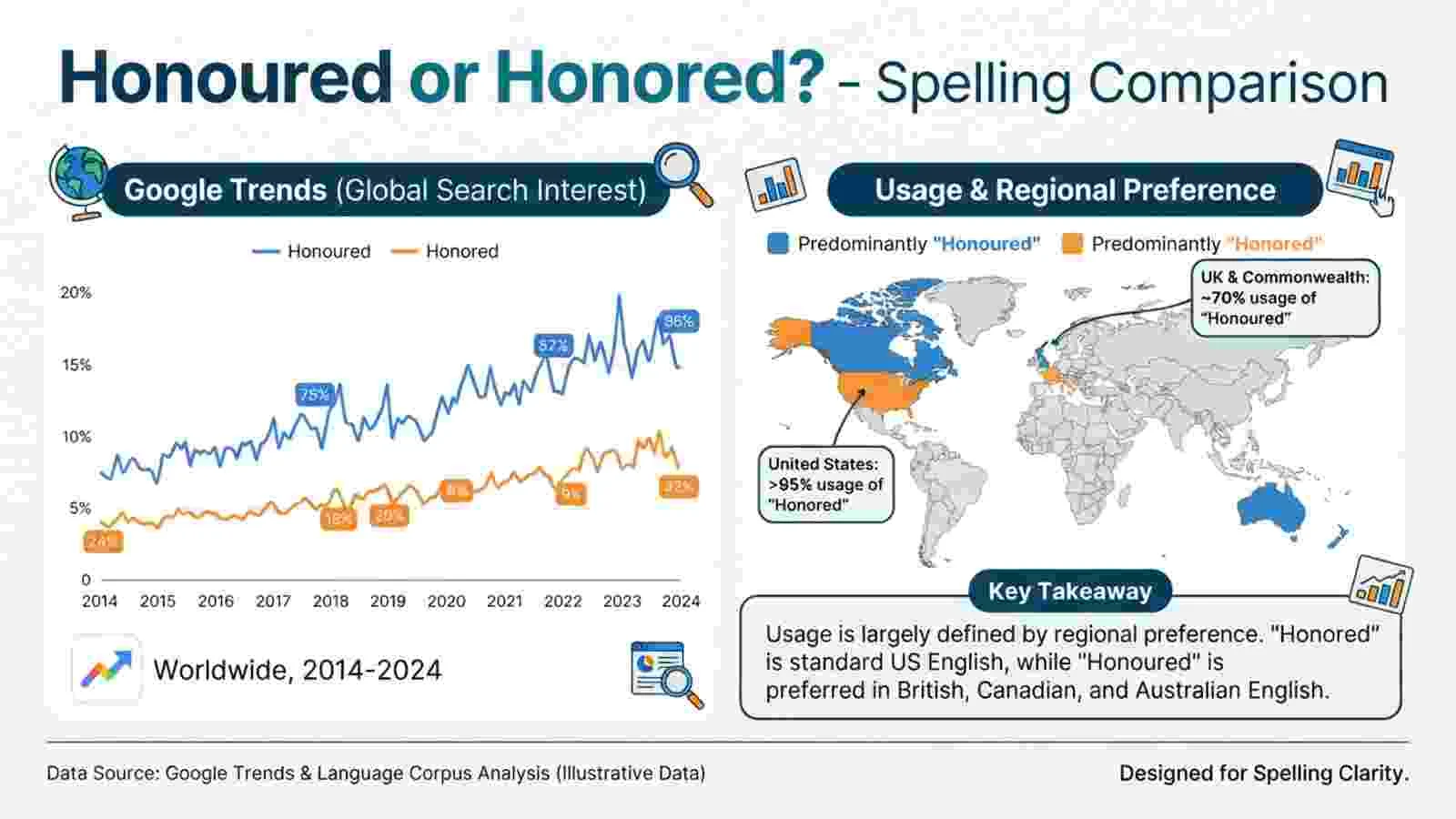
People search for both spellings because English has different regional standards. The spelling they use often depends on their country, school, workplace, or preferred writing guide.
In general, honored is associated with American English, while honoured is associated with British English. Similar regional patterns appear in words such as color/colour and favor/favour.
Spelling Preferences by Country
| Country or region | Common preference |
| United States | Honored |
| United Kingdom | Honoured |
| Pakistan | Honoured |
| India | Honoured |
| Australia | Honoured |
| New Zealand | Honoured |
| Canada | Both forms are used |
These are general spelling conventions, not exact measurements of every writer’s habits. Canadian English, in particular, includes variation.
How to Check Google Trends
Google Trends lets you compare search interest by country and over time. However, it does not directly provide exact monthly search volumes, and its scores are relative rather than absolute search counts.
To research this keyword for SEO:
- Open Google Trends.
- Compare the search terms honoured and honored.
- Select your target country, such as the United States, United Kingdom, or Pakistan.
- Choose a time range, such as the past 12 months.
- Review interest by region and related queries.
SEO tip: Use honoured or honored in your article title if you want to address both spellings. Include the preferred variant in your headings and examples, based on your target audience. Do not claim a specific search-volume figure unless you have verified it with a keyword research tool.
Honoured vs Honored – Comparison Table
| Feature | Honoured | Honored |
| English variety | British English | American English |
| Meaning | Shown respect or given recognition | Same |
| Extra letter | Contains u | No u |
| Common base word | Honour | Honor |
| Past tense | Honoured | Honored |
| Present participle | Honouring | Honoring |
| Common audience | UK and many Commonwealth readers | US readers |
| Formal writing | Correct | Correct |
| SEO use | Useful for British-oriented content | Useful for American-oriented content |
FAQs About Honoured or Honored
1. Is honoured or honored correct?
Both are correct. Honoured is the standard British English spelling, while honored is the standard American English spelling.
2. Is honoured British English?
Yes. British English generally uses honoured, with the letter u. For example: “I am honoured to receive this award.”
3. Is honored American English?
Yes. American English generally uses honored, without the letter u. For example: “I am honored to receive this award.”
4. Which spelling should I use in Pakistan?
Use honoured in most formal writing in Pakistan because British English spelling conventions are widely followed. However, follow any specific American English style guide if your institution requires it.
5. Do honoured and honored have different meanings?
No. Both words express respect, recognition, or pride in receiving an honour. The difference is spelling, not meaning.
6. Can I use honoured and honored in the same article?
It is better to choose one spelling style and use it throughout the article. You may include the alternative spelling when explaining the difference or quoting an official name.
7. Which spelling is better for SEO?
Neither spelling is universally better. Use honored when targeting American readers and honoured when targeting British or other audiences that prefer British English. Including both naturally can help readers understand the distinction.
8. What does honoured mean?
Honoured means shown respect or recognition, or feeling proud to receive a special role or award.
9. What does honored mean?
Honored means the same as honoured: shown respect or recognition. It is the American English spelling.
10. Is honoured a word?
Yes, honoured is a real English word. It is the British English spelling of honored.
11. How do you spell honoured?
Spell it H-O-N-O-U-R-E-D: honoured, with a u after the o — honour plus ed.
Conclusion
The difference between honoured and honored is easy to understand once you know the rules of British and American English.
Both spellings are correct, and both express the same idea: showing respect, receiving recognition, or feeling proud of a special opportunity.
Use honoured when writing in British English, including most formal writing in Pakistan.
Choose honored when writing for an American audience or following an American style guide. Neither spelling is more professional, polite, or meaningful than the other.
Remember to keep your spelling consistent throughout your articles, emails, academic essays, and business documents.
This simple habit makes your writing clear and professional. If you manage a website, consider your readers’ location before choosing your main spelling style.
You can also explain both forms in a comparison article to help readers find the answer they need.
In short, there is no need to worry about choosing between these two words. Think about your audience, follow the right regional spelling convention, and use the word with confidence.
Continue Reading:
- Moral vs. Morale: Definitions, Differences, and Examples ( for 2026)
- Governor vs. Garner: Meaning, Spelling, and Usage ( for 2026)
- Calendar vs. Calender: Meaning, Spelling, and Usage ( for 2026)
- Cuter or Cutier: Correct Spelling, Meaning, and Usage ( for 2026)
- Selfs or Selves: Meaning, Grammar, and Examples (for 2026)

Here’s a concise 2-line author bio suitable for Simifind.com:
James Dashner is an American bestselling author best known for The Maze Runner series and other popular young-adult fiction.
On Simifind.com, he shares clear, engaging insights and helpful content for readers interested in books, writing, and popular literature.








4 thoughts on “Honoured vs Honored: Meaning, Spelling, and Usage ( for 2026)”