
Calendar is correct. Calender is incorrect (it is a surname / proper name, or a machine for pressing cloth — not the thing that shows days and months). Calendar = the system of days, weeks and months, or the chart that shows them.
Have you ever typed calendar or calender and wondered which spelling is correct?
You are not alone. Many people make this mistake when writing emails, school notes, blog posts, or work plans.
The two words look almost the same, but they do not have the same meaning or use.
A calendar is a chart, page, or digital tool that shows days, weeks, and months. People use it to plan meetings, track holidays, mark birthdays, and remember important dates.
A calender, on the other hand, is a machine used to press, smooth, or shape materials such as paper, cloth, and rubber.
The confusion often happens because both words sound alike in everyday speech. Their spelling differs by only one letter, which makes it easy to choose the wrong word while typing.
In this guide, you will learn the correct spelling, the origin of both words, and how to use them in American and British English.
You will also find practical examples, common mistakes, and answers to frequently asked questions. By the end, you will know which word to use in your writing.
Calendar or Calender – Quick Answer
Calendar is the correct word when you mean a system for organizing days, weeks, months, and dates. It is the spelling most people need in everyday writing.
Calender is also a real English word, but it has a different meaning. It refers to a machine or process used to press and smooth materials.
Examples:
- Correct: I added the meeting to my calendar.
- Correct: Our school calendar shows the exam dates.
- Correct: The factory uses a calender to smooth the paper.
- Incorrect: I checked my calender to find my next appointment.
If you are talking about dates, events, birthdays, holidays, or schedules, use calendar.
The Origin of Calendar and Calender
The word calendar comes from the Latin word kalendarium, which referred to an account book or record of debts. It is linked to Kalendae, the Latin name for the first day of a month in the Roman calendar.
Over time, the word developed into the English term we use today. A calendar now helps people organize time, plan events, and keep track of important dates.
The word calender has a different history. It is linked to words from French and Latin that refer to pressing or rolling materials. A calender machine uses rollers to make surfaces smooth, thin, or even.
Although these words look and sound similar, their meanings developed in different ways. The spelling difference is not a rule that separates American English from British English. Both words exist in standard English, but they serve different purposes.
Remember this simple tip: a calendar helps you manage time, while a calender helps process materials.
British English vs American English Spelling
There is no spelling difference between American and British English when referring to a schedule of dates. Both use calendar.
Likewise, calender is used in both varieties of English when referring to the machine or process that presses materials.
| Context | American English | British English | Correct usage |
| Monthly date planner | Calendar | Calendar | Calendar |
| Work schedule | Calendar | Calendar | Calendar |
| School term dates | Calendar | Calendar | Calendar |
| Paper-smoothing machine | Calender | Calender | Calender |
| Fabric-pressing process | Calender | Calender | Calender |
Examples in American English
- I saved the appointment on my calendar.
- The 2027 calendar is available online.
- The factory uses a calender to process the material.
Examples in British English
- Please check the school calendar for the holiday dates.
- I marked the meeting on my calendar.
- The paper passes through a calender during production.
The key point is simple: calendar and calender have different meanings, not different regional spellings.
Which Spelling Should You Use?
Choosing between calendar and calender depends on what you want to say. Your country does not change the basic spelling rule.
For American Readers
Use calendar when discussing appointments, events, holidays, or dates. This is the standard spelling in American English.
Example: “I added the conference to my calendar.”
For British and Commonwealth Readers
Use calendar for schedules and dates in the United Kingdom, Pakistan, Australia, Canada, and other English-speaking regions.
Example: “The school calendar lists the examination dates.”
For Global and Professional Writing
If you write blog posts, emails, reports, or website content for an international audience, use calendar whenever you mean a date planner.
Use calender only in technical or industrial writing about machines that press or smooth materials.
For SEO content, the correct spelling also helps match search intent. Someone searching for a monthly calendar usually wants a date planner, not industrial equipment.
Common Mistakes with Calendar and Calender
Many spelling errors happen because the two words look almost identical. Here are some common mistakes and how to fix them.
1. Writing Calender for a Date Planner
Incorrect: I need a new calender for next year.
Correct: I need a new calendar for next year.
Use calendar when talking about dates and months.
2. Using Calendar for an Industrial Machine
Incorrect: The factory uses a calendar to smooth the paper.
Correct: The factory uses a calender to smooth the paper.
In this technical context, calender refers to equipment used to press materials.
3. Assuming British English Uses Calender
Incorrect: Calender is the British spelling of calendar.
Correct: Calendar is the standard spelling in both British and American English.
There is no regional spelling change for this meaning.
4. Misspelling Calendar in Professional Emails
Incorrect: Please check your calender before the meeting.
Correct: Please check your calendar before the meeting.
A quick spelling check can help you avoid this error in work messages.
5. Confusing Similar-Sounding Words
Because calendar and calender sound alike, spell-check tools may not always identify the intended word. Read the whole sentence to make sure the word matches its meaning.
Calendar or Calender in Everyday Examples
Here are practical examples showing how each word works in daily life.
In Emails
- “Please check your calendar before choosing a meeting time.”
- “I have added the deadline to my work calendar.”
- “The factory team will inspect the calender next week.”
In News and Reports
- “The school calendar includes the dates for the annual examinations.”
- “The company announced its calendar of public events.”
- “The manufacturer installed a new calender to improve paper quality.”
On Social Media
- “My new calendar helps me stay organized.”
- “Add this event to your calendar so you do not forget!”
- “Our production team is testing a new calender machine.”
In Formal Writing
- “The academic calendar outlines the start and end dates of each term.”
- “The project calendar identifies key deadlines and milestones.”
- “The calender process improves the surface finish of the material.”
These examples show that the correct word depends on the subject. Use calendar for time management and calender for industrial processing.
Calendar or Calender – Google Trends and Usage Data
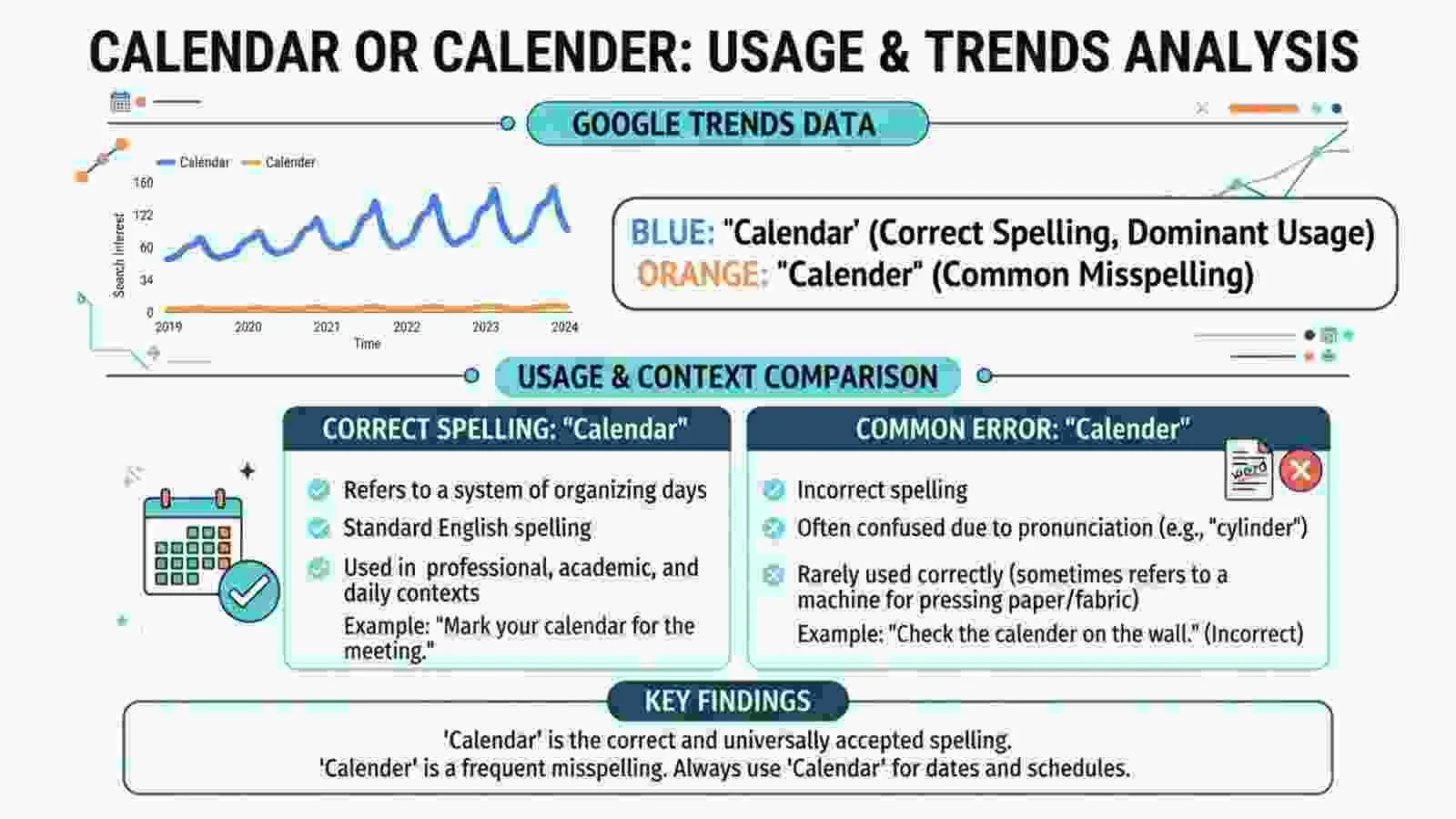
People commonly search for “calendar or calender” because they want to confirm the correct spelling before writing. The search may come from students, office workers, teachers, bloggers, or people planning events.
The word calendar has broad everyday uses. It appears in searches about monthly calendars, yearly calendars, school schedules, work meetings, holidays, and digital planning tools.
The word calender is more specialized. It usually appears in technical searches about paper production, textile manufacturing, rubber processing, and industrial rollers.
Search interest can vary by country and by the topic being searched. However, an exact country-by-country ranking or search-volume comparison requires current Google Trends or keyword research data. Without checking that data, it would not be accurate to claim specific percentages or rankings.
For SEO writers, the best approach is to match the word to the reader’s intent. Use calendar for general information about dates and schedules. Use calender for manufacturing and technical subjects.
Calendar and Calender: Comparison Table
| Feature | Calendar | Calender |
| Main meaning | A system for organizing dates | A machine or process for pressing materials |
| Common use | Planning events and tracking dates | Industrial production |
| Everyday frequency | Very common | Specialized |
| American spelling | Calendar | Calender |
| British spelling | Calendar | Calender |
| Example | Check your calendar. | The calender smooths the paper. |
| Suitable for general SEO | Yes, for date-related topics | Only for relevant technical topics |
Frequently Asked Questions
1. Is it calendar or calender?
Calendar is correct when referring to dates, days, weeks, months, and schedules. Calender is a separate word for a machine or process used to press materials.
2. Is calender a real word?
Yes. Calender is a real English word used mainly in industrial and manufacturing contexts. It describes equipment or a process that presses and smooths materials.
3. Is calendar the American or British spelling?
Calendar is the standard spelling in both American and British English. Neither variety uses calender as the alternative spelling for a date planner.
4. Why do people spell calendar as calender?
The words sound similar and differ by only one letter. This makes calender a common spelling mistake when people mean calendar.
5. How do you spell calendar correctly?
The correct spelling is C-A-L-E-N-D-A-R. A helpful way to remember it is to connect calendar with dates, months, and appointments.
6. What is the plural of calendar?
The plural of calendar is calendars.
Example: “The shop sells wall calendars and desk calendars.”
The plural of calender is calenders when referring to more than one machine or item of that type.
7. Which word should I use in an SEO article?
Use calendar for articles about schedules, dates, holidays, planners, and time management. Use calender only when the article discusses industrial machines or material-processing methods.
8. What does calendar mean?
Calendar means a system for organizing days, weeks and months, or a chart, page or digital tool that shows them. For example, “I marked the date on my calendar.”
9. What is the difference between calendar and calender?
Calendar is the chart or system for organizing dates and months; calender is a machine that presses paper, cloth or plastic to make it smooth. They sound alike but mean completely different things.
Conclusion
The difference between calendar or calender is easy to understand once you know what each word means. Calendar is the correct spelling when you are talking about dates, months, holidays, appointments, or schedules. It is used in both American and British English.
Calender is also a valid English word, but it belongs to a different context. It refers to a machine or process that presses, smooths, or shapes materials such as paper and fabric. It is not the British spelling of calendar.
When writing emails, school assignments, business reports, or SEO articles, think about the meaning before choosing the word. If you want to organize your time or mark an important event, choose calendar. If you are describing industrial equipment, calender may be the right choice.
A simple rule can prevent most mistakes: calendar is for dates, and calender is for pressing materials. Keep this distinction in mind, and you will be able to use both words correctly in everyday and professional writing.
Continue Reading:
- Ate vs Eaten: Meaning, Grammar Rules, and Examples ( for 2026)
- Jess’s vs Jess’: Meaning, Rules, and Examples ( for 2026)
- Mum vs Mom: Meaning, Differences, and Usage ( for 2026)
- Cuter or Cutier: Correct Spelling, Meaning, and Usage ( for 2026)
- Selfs or Selves: Meaning, Grammar, and Examples (for 2026)

Mary Roach is an American science writer and bestselling author known for making unusual and complex scientific topics engaging, accessible, and humorous. Her books include Stiff, Packing for Mars, Gulp, and Fuzz.
Author at Simifind.com, sharing clear, informative content designed to help readers understand interesting topics and everyday questions.








5 thoughts on “Calendar vs. Calender: Meaning, Spelling, and Usage ( for 2026)”