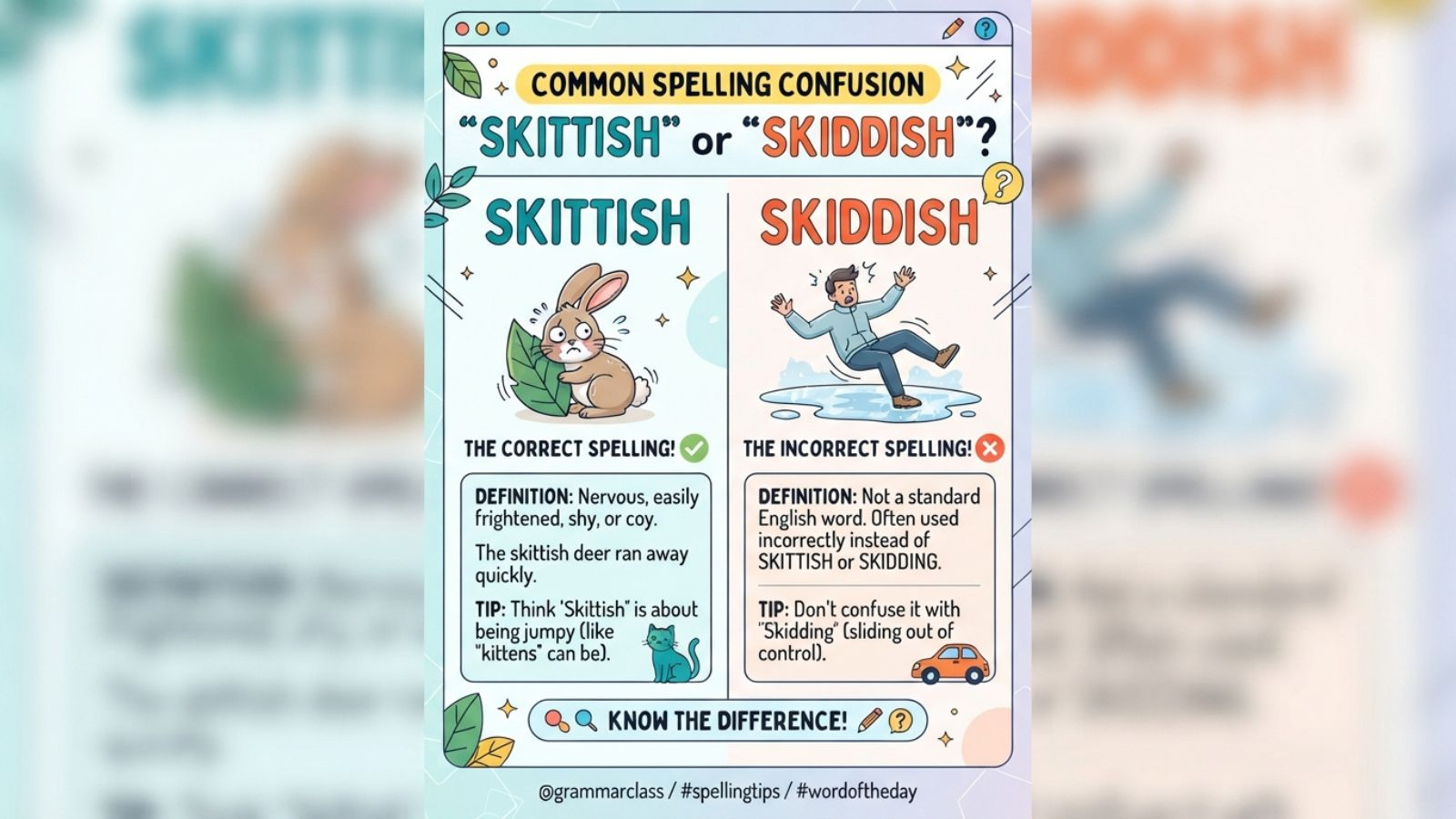
Have you ever wondered whether someone is “skittish” or “skiddish” when you want to describe a person who seems nervous, easily frightened, or uneasy?
Hey, I want to share something that happened to me recently about Skittish or Skiddish.
I was chatting with a friend when I suddenly saw this term pop up, and honestly, I had no clue what it meant at first.
I kept wondering, “Am I missing something here?” It was a bit confusing, and I didn’t want to respond the wrong way.
So, I decided to look into Skittish or Skiddish and figure out its meaning and context.
After understanding it, I realized how important it is to know these terms to avoid awkward situations in conversations.
I handled it by learning the proper meaning and responding confidently, and now I feel ready whenever I see Skittish or Skiddish again in chats or on social media.
Skittish or Skiddish – Quick Answer
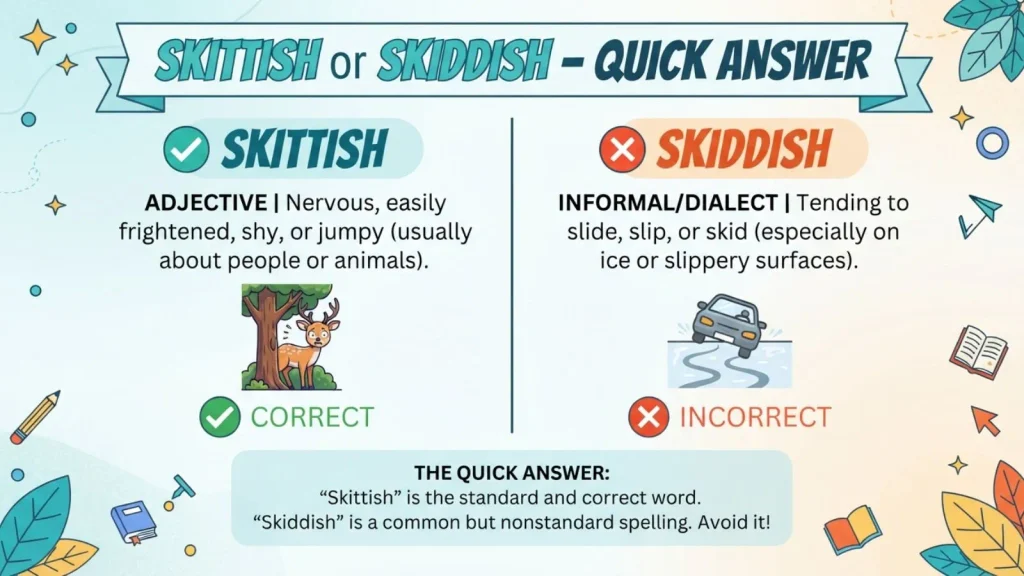
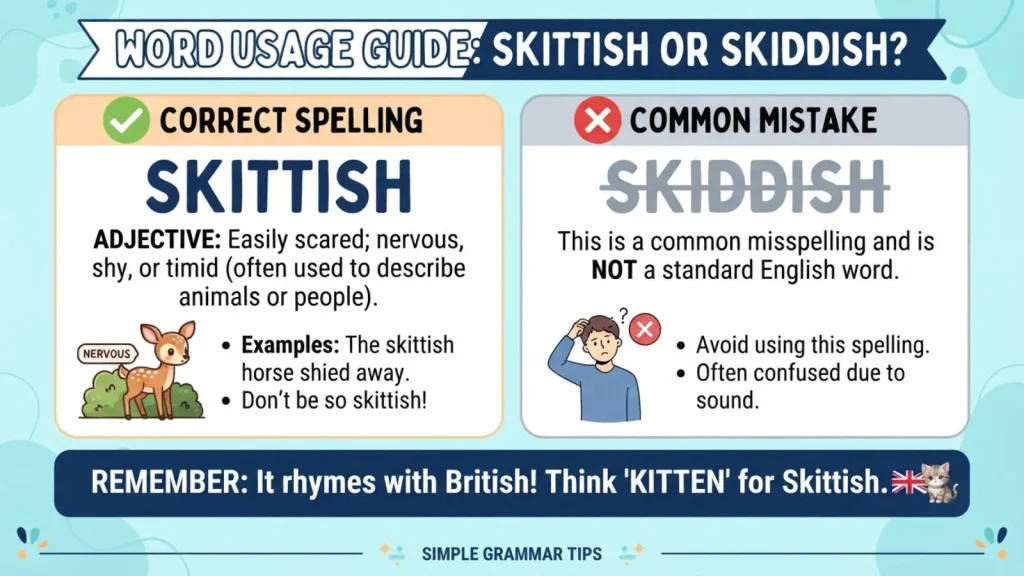
“Skittish” is correct. “Skiddish” is a misspelling.
There is no dictionary — American, British, or otherwise — that lists “skiddish” as a proper word. It does not appear in Merriam-Webster, Oxford, Cambridge, or Collins. It is a phonetic error, not an alternate spelling.
“Skittish” means easily frightened, nervous, or unpredictable. It is most often used to describe:
- Animals: “The horse grew skittish near the loud machinery.”
- People: “She felt skittish before her first job interview.”
- Markets or situations: “Investors turned skittish after the earnings report.”
If you remember one rule from this article, remember this: it is spelled with two T’s, not a D. Say it slowly — “skit-ish” — and the correct spelling becomes easier to picture.
Skittish Meaning
Skittish means nervous, easily frightened, or quick to react to something unexpected. It is often used to describe a person or animal that feels uneasy and may suddenly move away or avoid a situation. For example, a skittish horse may become frightened by a loud noise and quickly run away.
The word can also describe someone who is restless, uncertain, or uncomfortable, especially in a new or stressful situation.
Examples:
- The skittish cat hid when the visitors arrived.
- She felt skittish before giving her presentation.
- The horse became skittish when it heard the thunder.
Synonyms: nervous, timid, fearful, jumpy, uneasy, apprehensive.
In simple words: Skittish = easily scared or nervous and quick to react.
The Origin of Skittish
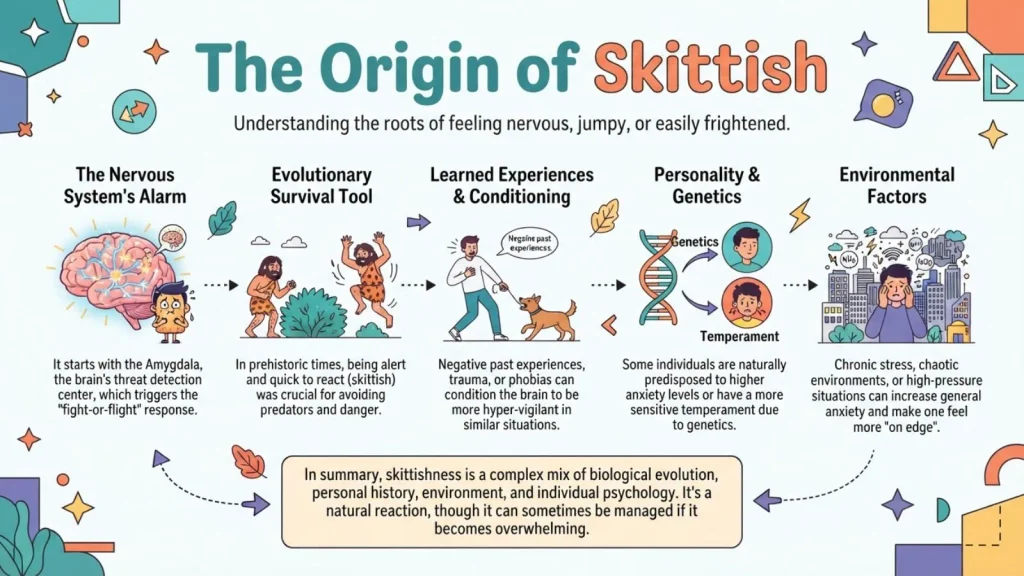
“Skittish” has been part of English since the late 1300s. Language historians trace it to Middle English, likely connected to Scandinavian roots related to words for “shy” or “shy movement.” Over time, it settled into the form we use today: skit + ish.
The “-ish” ending is a common English suffix that means “somewhat like” or “having the quality of.” You see it in words like “childish,” “selfish,” and “sluggish.” So “skittish” literally carries the sense of “having a skittering, darting quality” — the same instinct you see in a startled animal.
So why does “skiddish” show up at all? It comes down to sound, not history. English speakers often say the double-T sound quickly, and it can come out closer to a “d” sound in casual speech. This is called a flapped consonant, and it happens in many everyday words — “butter” and “ladder” often sound alike in fast American speech, for example. The ear picks up “skid,” and some writers spell the word the way it sounds rather than the way it is written.
There is no historical version of “skiddish” in old texts, dictionaries, or formal writing. It is purely a modern spelling error born from pronunciation.
British English vs American English Spelling
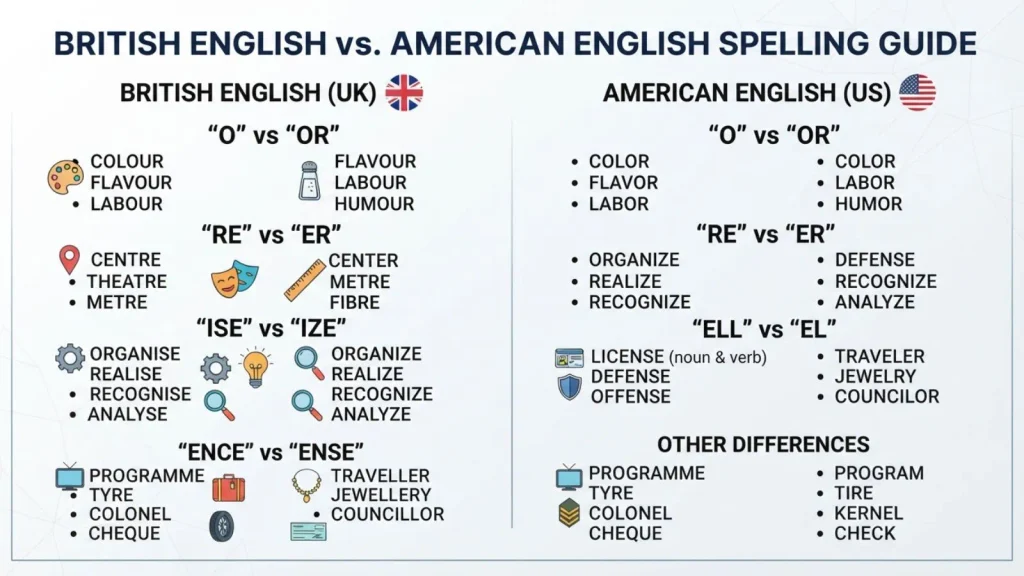
Spelling differences between British and American English are common — think “colour” versus “color,” or “organise” versus “organize.” Naturally, some people assume “skittish” might have a regional variant too.
It does not. This is one of the rare cases where British and American English fully agree. “Skittish” is spelled the same way in both traditions. There is no British “skiddish” and no American “skiddish” either.
Here is a simple comparison table to make this clear:
| Spelling | British English | American English | Valid Word? |
| Skittish | Correct | Correct | Yes |
| Skiddish | Not used | Not used | No |
| Skittishly | Correct | Correct | Yes |
| Skittishness | Correct | Correct | Yes |
Unlike many word pairs that split by region, “skittish” is a rare point of full agreement. This makes the rule easy to remember: no matter where your reader is from, “skittish” is always the safe choice.
Which Spelling Should Use Skittish or Skiddish ?
Since there is only one correct spelling, the real question is not “which version,” but “how do I make sure I always use the right one.”
- US writers: Use “skittish.” It is standard in American dictionaries, style guides, and publications.
- UK and Commonwealth writers (Australia, Canada, India, etc.): Use “skittish.” The spelling does not change across English-speaking countries.
- Global and ESL writers: Use “skittish” and treat “skiddish” as a pronunciation trap, not a formatting choice. If your first language flattens double consonants or blends “t” and “d” sounds, this word deserves extra attention.
- Business and professional writing: Always use “skittish.” Misspellings like “skiddish” can look careless in formal documents, resumes, or client communication.
There is no audience, region, or context where “skiddish” is the accepted or preferred form.
Common Mistakes with Skittish
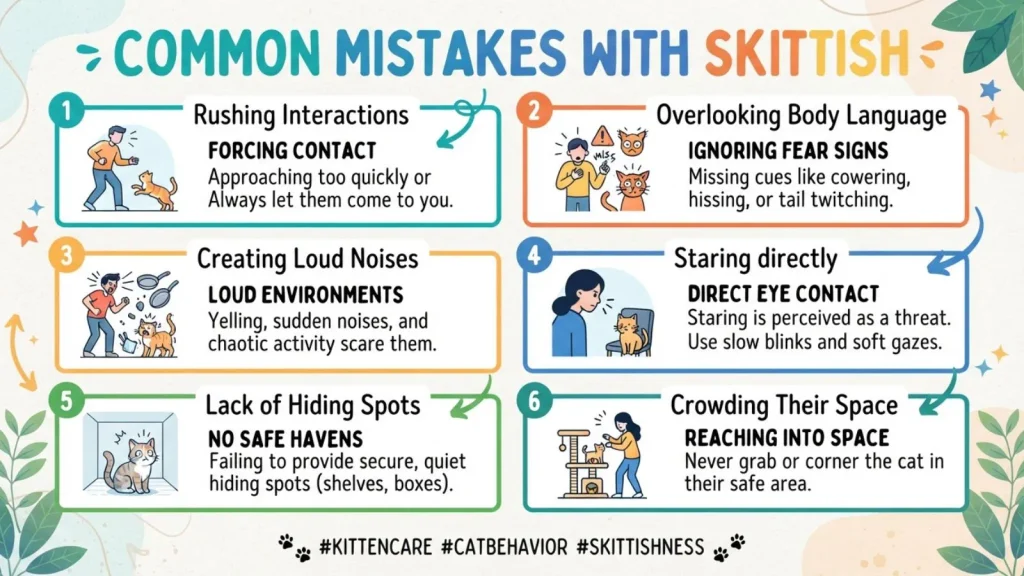
Most errors with this word fall into a few repeating patterns.
- Mistake: “The skiddish cat ran under the bed.” Correction: “The skittish cat ran under the bed.”
- Mistake: Adding an extra syllable, like “skitterish.” Correction: The correct word has only two syllables: skit-tish.
- Mistake: Confusing it with “skit,” as in a short comedy performance. Correction: “Skit” and “skittish” are related in origin but mean different things today. A skit is a scene; skittish describes nervous behavior.
- Mistake: Writing “skittesh” or “skitish” with only one T. Correction: The double T is required: s-k-i-t-t-i-s-h.
- Mistake: Using “skittish” to describe physical illness or dizziness. Correction: “Skittish” refers to nervousness or unpredictability, not sickness. Use “queasy” or “dizzy” for physical discomfort instead.
A simple memory trick: pair it with “kitten.” Both words share a double-T sound, and kittens themselves are a classic example of skittish behavior.
Skittish in Everyday Examples
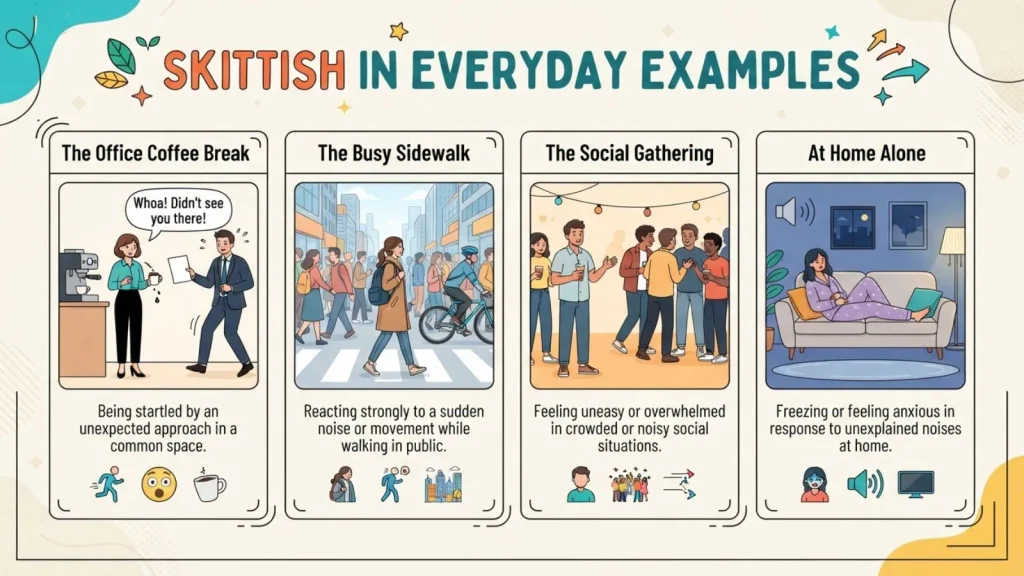
Seeing the word in context makes the spelling easier to remember.
Emails: “Please handle this client carefully — they’ve been a bit skittish since the delay last month.”
In news writing: “Markets turned skittish Tuesday after new inflation data spooked traders.”
In social media posts: “my dog is SO skittish around fireworks, anyone else deal with this? 😅”
In formal or academic writing: “The study observed skittish behavior in the test subjects following exposure to sudden noise stimuli.”
Across every setting — casual, professional, or academic — the spelling stays exactly the same: skittish.
Skittish – Google Trends & Usage Data
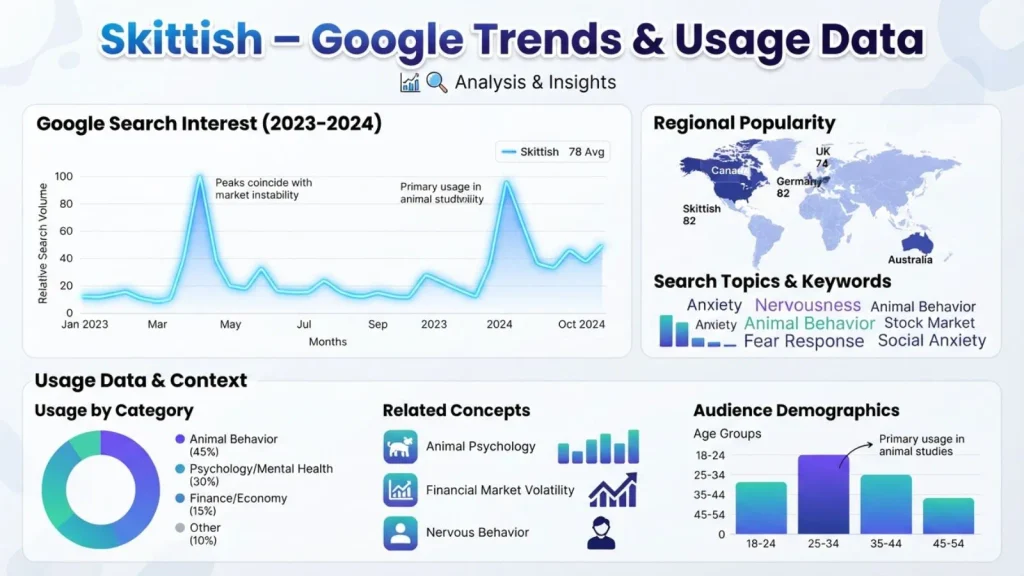
Search interest in this word tends to rise during two situations: financial news cycles and everyday conversations about pets or nervous behavior. Terms like “skittish market” and “skittish investors” spike whenever stock volatility makes headlines, since financial writers reach for this word often.
Search data also shows a consistent pattern of people typing “skiddish” instead of “skittish,” which reflects the pronunciation confusion covered earlier rather than a real spelling debate. This pattern appears across English-speaking countries, including the US, UK, Canada, and Australia, suggesting the mistake is driven by sound, not regional spelling habits.
Usage remains steady across writing styles — it appears in casual social posts, pet and animal content, financial journalism, and formal reports alike, making it one of the more versatile “nervous” or “jumpy” synonyms in English.
Keyword Variation Comparison Table
| Term | Correct? | Common Use Case |
| Skittish | Yes | Standard, correct spelling |
| Skiddish | No | Common misspelling based on pronunciation |
| Skittishly | Yes | Adverb form (“she reacted skittishly”) |
| Skittishness | Yes | Noun form (“a sense of skittishness”) |
| Skitish | No | Missing double T |
| Skittesh | No | Incorrect vowel ending |
FAQs
1. Is “skiddish” ever acceptable in casual writing?
No. Even in casual texts or social media, “skiddish” is considered a spelling mistake, not an informal variant.
2. Why does “skittish” sound like it has a “d” in it?
Fast speech often blends double-T sounds into something closer to a “d,” a common feature of spoken English called consonant flapping.
3. What part of speech is “skittish”?
It is an adjective, used to describe animals, people, or situations that are nervous or easily startled.
4. Does British English spell it differently from American English?
No. “Skittish” is spelled identically in both British and American English.
5. What is a simple synonym for “skittish”?
Common synonyms include jumpy, nervous, jittery, and easily spooked.
6. Can “skittish” describe things that aren’t alive, like markets?
Yes. It is widely used to describe unpredictable or volatile situations, especially in financial writing.
7. How can I remember the correct spelling long-term?
Break it into parts: “skit” + “t” + “ish.” Picture a nervous animal darting around in a comedy skit — it keeps both the meaning and the spelling in mind together.
Conclusion
The confusion between “skittish” and “skiddish” comes down to one simple fact: only “skittish” is correct. “Skiddish” is not a recognized word in any English-speaking country, region, or dictionary. The mix-up happens because of how the word sounds in fast, casual speech, not because of any real spelling rule or regional difference.
Whether you are writing a business email, a news article, a social media caption, or a school assignment, the rule stays the same. Use “skittish,” spelled with a double T, everywhere and every time. There is no American version, no British version, and no acceptable shortcut.
If you keep forgetting, lean on a simple memory trick: connect “skittish” to “kitten.” Both carry that same double-T sound, and a skittish kitten is an easy image to picture. Once the spelling clicks, it tends to stick for good.
Now you have the quick answer, the deeper explanation, and the confidence to use this word correctly in any setting — professional, casual, or academic.

Here’s a concise 2-line author bio suitable for Simifind.com:
James Dashner is an American bestselling author best known for The Maze Runner series and other popular young-adult fiction.
On Simifind.com, he shares clear, engaging insights and helpful content for readers interested in books, writing, and popular literature.