Have you ever wondered whether “Gardener” or “Gardner” is the correct spelling when you’re talking about someone who cares for plants?
Hey, I want to share something that happened to me recently about Gardener or Gardner.
I was chatting with a friend when I suddenly saw this term pop up, and honestly, I had no clue which spelling was correct at first.
I kept wondering, “Am I missing something here?” It was a bit confusing, and I didn’t want to respond the wrong way.
So, I decided to look into Gardener or Gardner and figure out its meaning, spelling, and proper context.
After understanding the difference, I realized how important it is to know the correct word, especially when writing or chatting online.
A small spelling mistake can sometimes change the meaning or make your message look unclear.
I handled it by learning the proper spelling and usage, and now I feel ready whenever I see Gardener or Gardner again in chats, social media, or everyday writing.
If you have also wondered which one is correct, this simple guide will help clear up the confusion.
Gardener or Gardner – Quick Answer
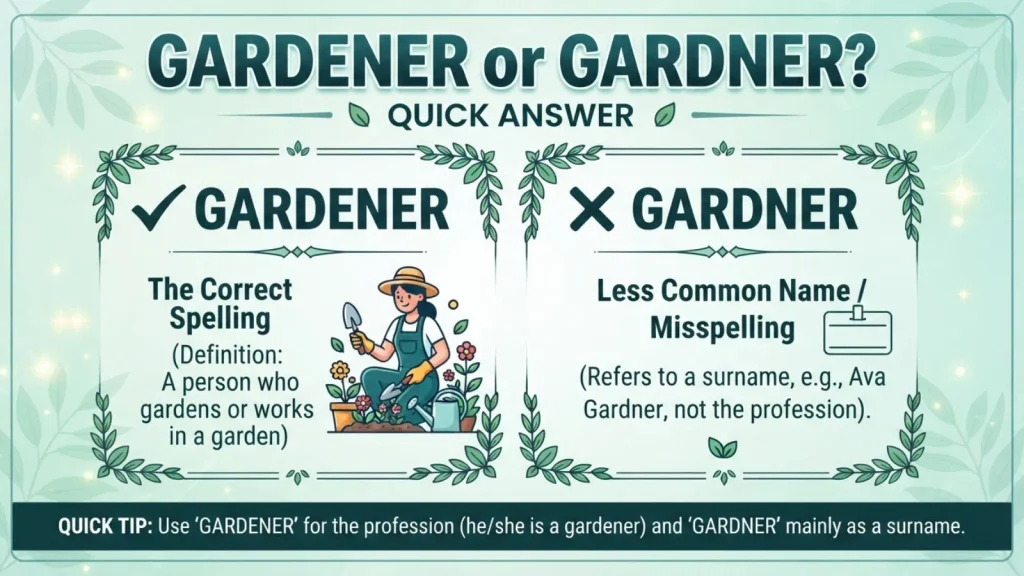
Use “gardener” when you mean a person who grows or tends plants.
- Correct: My gardener trims the hedges every spring.
- Correct: She hired a professional gardener for the estate.
- Incorrect: My gardner trims the hedges every spring.
Use “Gardner” only as a proper noun — a last name.
- Correct: Ava Gardner starred in classic Hollywood films.
- Correct: Mr. Gardner lives next door.
There is no British or American version of “gardener.” Both dialects spell it the same way.
The Origin of “Gardener”
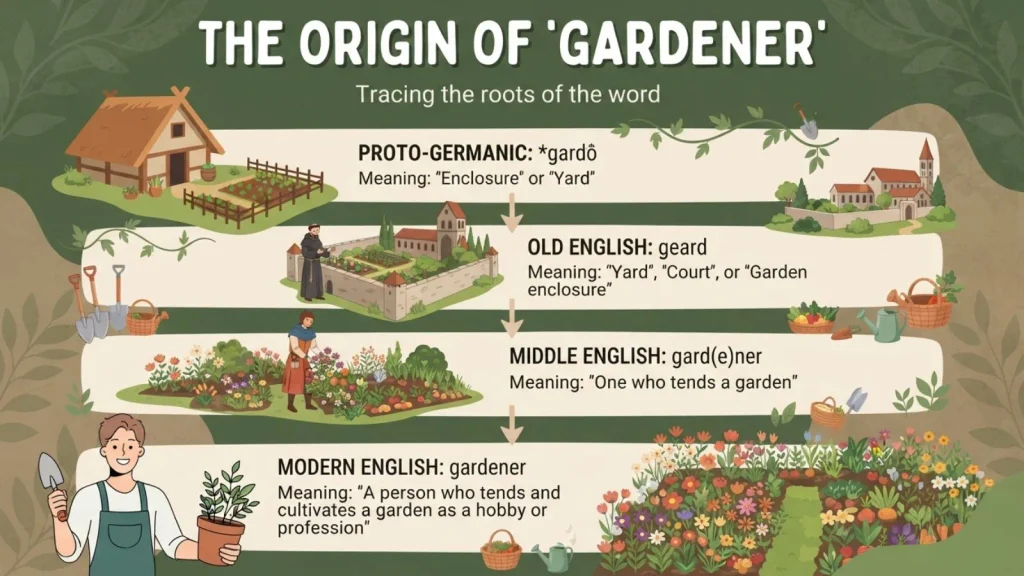
The word “gardener” comes from Middle English “gardin” or “gardyn,” which came from Old French “gardin,” related to the word “garden” itself. Add the suffix “-er,” which turns a noun or verb into “a person who does this,” and you get “gardener” — a person who gardens.
This pattern is common in English. Compare:
- Teach + er = teacher
- Bake + er = baker
- Garden + er = gardener
The confusion with “Gardner” likely happens for two reasons. First, “Gardner” sounds almost identical when spoken quickly, since the middle “e” often gets dropped in casual speech. Second, “Gardner” is a well-known surname, so people see it often and assume it is an alternate spelling.
It is not. “Gardener” describes a job or activity. “Gardner” identifies a person’s family name.
British English vs American English Spelling
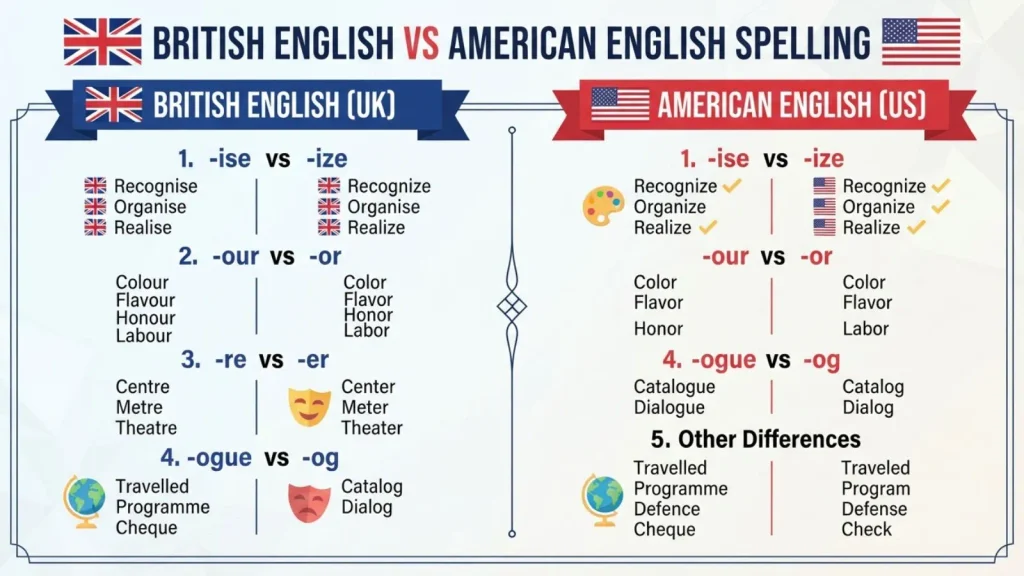
Many English words do split by region. Think of “colour” versus “color,” or “organise” versus “organize.” People naturally expect the same pattern here. But “gardener” breaks that pattern.
Both British English and American English spell it exactly the same way: gardener.
| Word | British English | American English | Notes |
| Gardener | gardener | gardener | Identical in both |
| Colour/Color | colour | color | True regional split |
| Organise/Organize | organise | organize | True regional split |
| Gardner | Gardner | Gardner | Surname only, not a spelling variant |
The table above shows why the confusion happens. “Gardener” sits next to real spelling splits in people’s minds, so it gets treated like one, even though it isn’t.
Which Spelling Should Use Gardener or Gardner ?
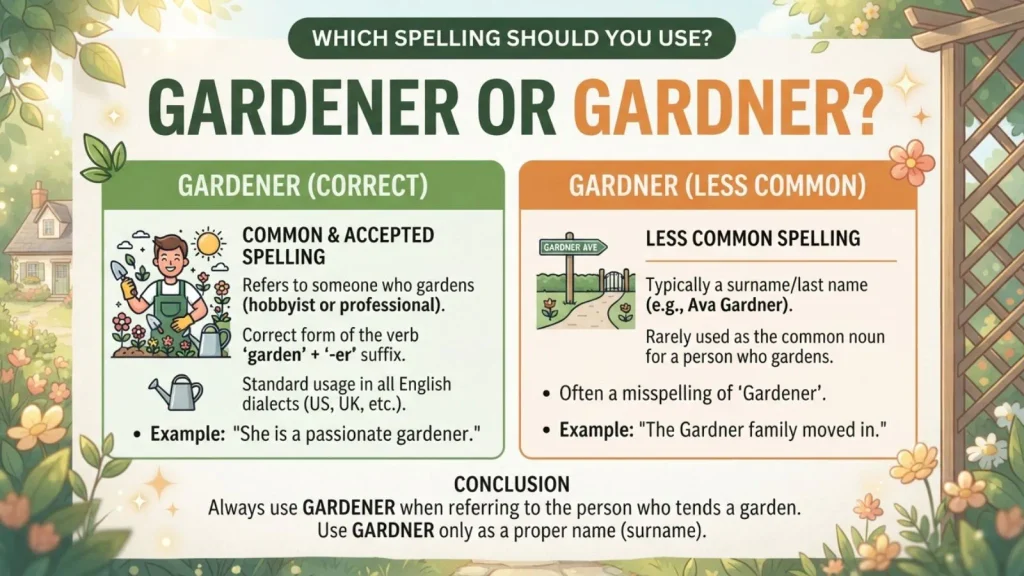
The answer depends on what you mean, not where you live.
- If you mean the person who tends a garden: Always write “gardener,” whether you are in the US, the UK, Canada, Australia, or anywhere else.
- If you are referring to someone’s last name: Write “Gardner,” matching exactly how that person spells their own name.
- If you are writing for a global audience: “Gardener” is safe everywhere. No regional adjustment is needed.
- If you are unsure which a person’s name is: Check spelling directly. Surnames vary between “Gardner” and “Gardiner” as well, so confirm before publishing.
Common Mistakes with Gardener
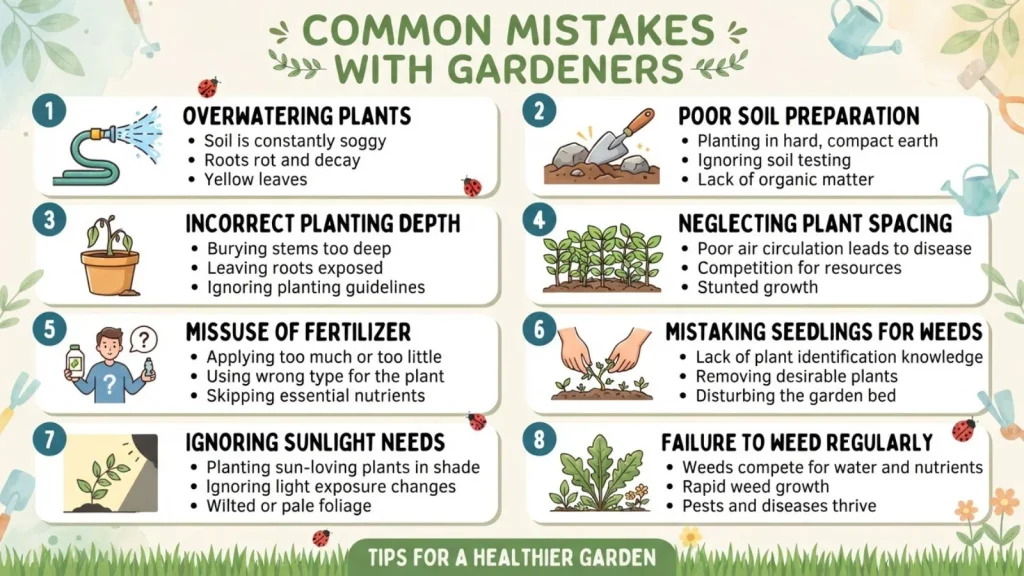
Mistake 1: Dropping the middle “e.” Wrong: gardner Right: gardener
Mistake 2: Assuming it changes by country. Wrong: “gardner” in American English, “gardener” in British English Right: “gardener” everywhere
Mistake 3: Using “Gardner” for the profession. Wrong: I need a Gardner to mow my lawn. Right: I need a gardener to mow my lawn.
Mistake 4: Mixing it up with “guardian.” “Gardener” and “guardian” look similar but mean very different things. A guardian protects or has legal responsibility for someone. A gardener tends plants.
Mistake 5: Capitalizing “gardener” unnecessarily. “Gardener” is a common noun. Only capitalize it at the start of a sentence or in a title.
Gardener in Everyday Examples
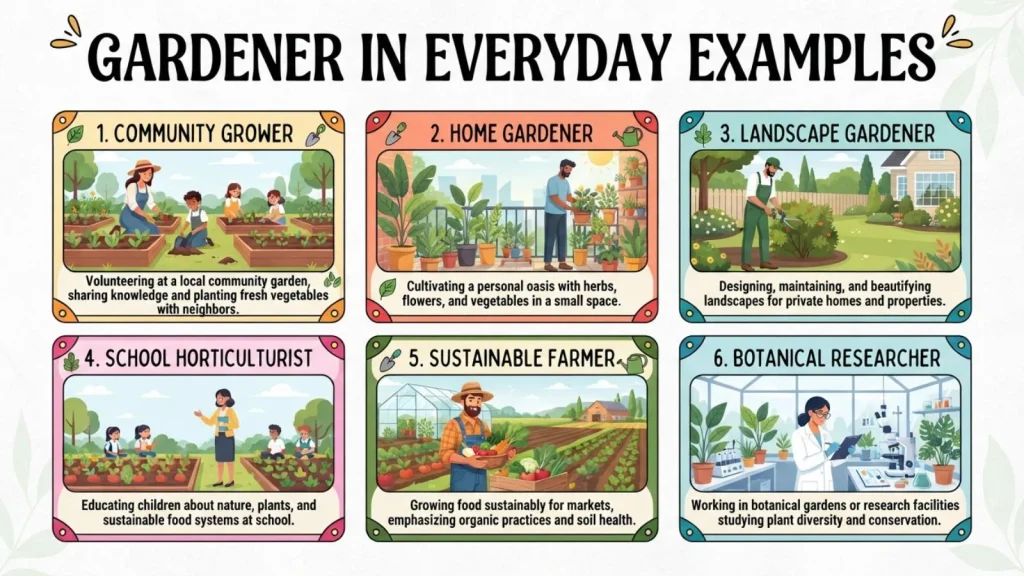
In emails: “Hi Sam, our gardener is coming Thursday to trim the trees. Let me know if you need him to look at the fence too.”
News writing: “The award-winning gardener transformed the abandoned lot into a community garden over three years.”
In social media posts: “Shoutout to my gardener for making our backyard look incredible this summer 🌿 #gardening #landscaping”
In formal writing: “The estate employed a full-time gardener responsible for maintaining the grounds, orchard, and greenhouse.”
Notice that every example uses “gardener,” regardless of tone or format.
Gardener – Google Trends & Usage Data
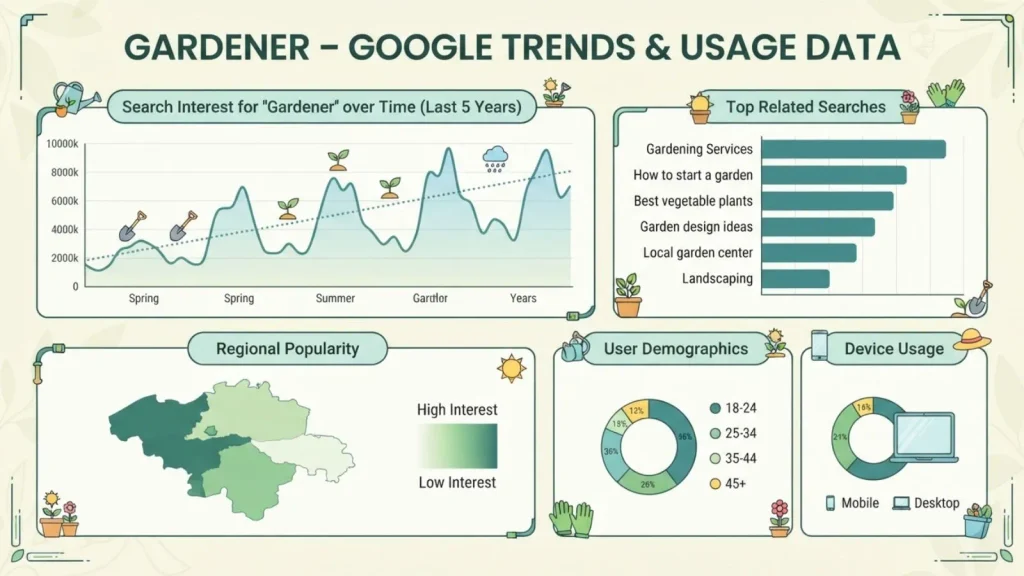
Search interest for “gardener” stays fairly steady year-round, with predictable spikes in spring and early summer across the US, UK, Canada, and Australia, when people hire help for yard work and planting season.
Searches for “gardener vs gardner” or “gardner spelling” spike separately. These searches usually come from people writing emails, job listings, or content and pausing to double check the word. This pattern shows the confusion is about spelling accuracy, not regional dialect, which matches everything explained above.
“Gardner” as a search term mostly reflects people looking up the surname — actors, authors, athletes, or someone they know — not the gardening profession.
Keyword Variations Compared
| Term | Meaning | Correct Usage |
| Gardener | Person who tends a garden | She is a skilled gardener. |
| Gardner | Surname (last name) | Have you met Mr. Gardner? |
| Gardening | The activity itself | Gardening relaxes me. |
| Gardiner | Alternate surname spelling | Gardiner is a common Irish surname. |
| Garden | The plot of land or plants | The garden is full of roses. |
FAQs
1. Is “gardner” ever correct?
No, not as a standalone word. “Gardner” only works as a surname. As the job title, “gardener” is always correct.
2. Do British and American English spell “gardener” differently?
No. Both use “gardener.” This word does not follow the same regional spelling pattern as words like “colour/color.”
3. Why do so many people misspell “gardener” as “gardner”?
Mostly because the word is often pronounced quickly, dropping the middle “e” sound, and because “Gardner” is a familiar surname that visually looks similar.
4. Is “Gardner” a common last name?
Yes. It ranks among common English-language surnames, especially in the US and UK.
5. What is the plural of “gardener”?
“Gardeners.” Example: The estate employs three gardeners.
6. Is “landscaper” the same as “gardener”?
Not exactly. A gardener typically focuses on planting, growing, and maintaining plants. A landscaper often handles broader outdoor design, hardscaping, and construction. There is overlap, but the terms aren’t fully interchangeable.
7. How do I know if someone’s last name is spelled “Gardner” or “Gardiner”?
Always check directly with the person or a reliable source. Both surnames exist and are not interchangeable, even though they sound alike.
Conclusion
The keyword “gardener or gardner” leads to one clear answer: use “gardener” when talking about a person who tends a garden. “Gardner” is not a spelling option for that meaning — it is a surname, nothing more.
Unlike true British versus American spelling splits, such as “colour” and “color,” this word does not change by region. Whether you are writing for a reader in London, New York, Toronto, or Sydney, “gardener” is the correct and only spelling for the profession.
Remember the core points: keep the middle “e,” don’t capitalize it unless starting a sentence or title, and reserve “Gardner” strictly for names. Double-check any surname before publishing, since “Gardner” and “Gardiner” are both real but distinct names.
Getting this right matters for professional writing, job postings, emails, and content that readers trust. A small spelling slip can look careless. Now you have the quick answer, the reasoning behind it, and real examples to apply immediately.

Mary Roach is an American science writer and bestselling author known for making unusual and complex scientific topics engaging, accessible, and humorous. Her books include Stiff, Packing for Mars, Gulp, and Fuzz.
Author at Simifind.com, sharing clear, informative content designed to help readers understand interesting topics and everyday questions.