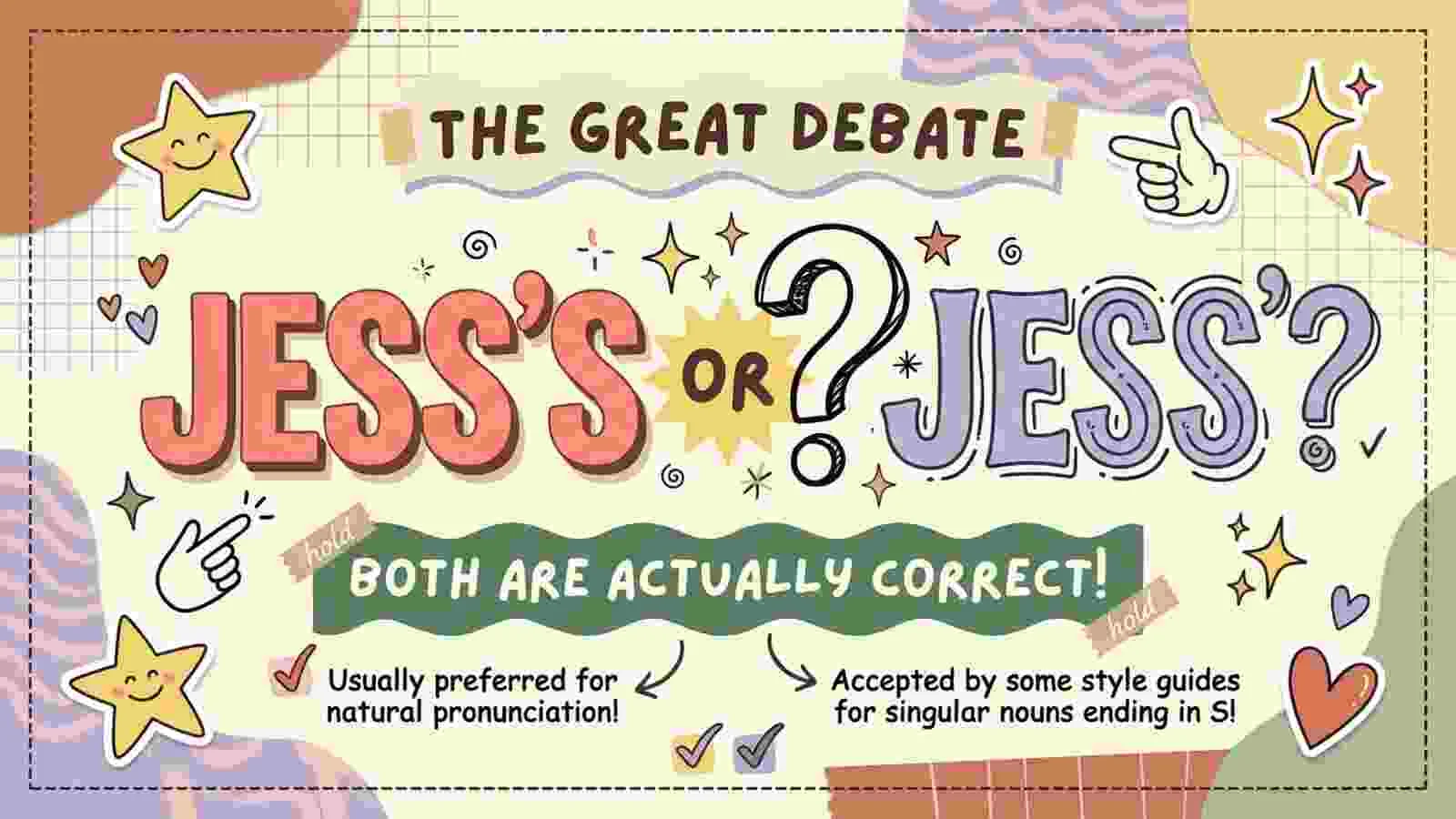
Jess is correct. Jesss is incorrect. Jess is the short form of Jessica/Jesse; the possessive is Jess’s (or Jess’ by some style guides).
Have you ever wanted to write about something that belongs to Jess but felt unsure how to show ownership?
You may have seen both Jess’s and Jess’ in books, websites, emails, and social media posts. This can make it hard to know which form is correct.
The good news is that both forms can show possession. The choice depends on the style guide you follow and the writing rules you need to use.
Jess’s is common in American English and many modern writing styles. Jess’ is also accepted by some style guides, especially when a name ends in s.
People often search for “Jess’s or Jess’” because they want to write a sentence that looks clear and correct.
They may need to describe Jess’s bag, Jess’s car, or Jess’ new job. The main challenge is knowing whether to add an apostrophe and another s or use only an apostrophe.
This guide explains both forms in simple words. You will learn their meanings, spelling rules, differences between British and American English, common mistakes, and everyday examples.
By the end, you will know which form to use in schoolwork, emails, articles, and professional writing.
Jess’s or Jess’: Quick Answer
Both Jess’s and Jess’ can show possession when a name ends in s. However, Jess’s is the safest general choice for most modern writing unless your style guide prefers Jess’.
Use Jess’s when you follow the common rule of adding apostrophe + s to a singular name.
- This is Jess’s book.
- Jess’s phone is on the table.
- I borrowed Jess’s jacket.
Use Jess’ when your chosen style guide allows a possessive apostrophe without another s after a name ending in s.
- This is Jess’ book.
- Jess’ phone is on the table.
- I borrowed Jess’ jacket.
Both forms express the same basic idea. The important point is to follow one style consistently. If you are writing for a school, newspaper, website, or employer, check its preferred spelling rules.
Remember that Jess’s and Jess’ are possessive forms. They show that something belongs to Jess. Neither form is a plural.
What Is the Possessive Form of Jess?
The possessive form of Jess is usually Jess’s or Jess’, depending on the style guide. Both forms show that something belongs to Jess, such as Jess’s book or Jess’ car.
Jess’s vs. Jess’: Which Form Is Correct?
Both forms are accepted in different writing styles. Most modern style guides prefer Jess’s, while some styles, including AP style, use Jess’ for names ending in s.
Examples of Jess in Possessive Sentences
Understanding possessive forms becomes easier with everyday examples. You can write “Jess’s phone is new,” “Jess’s house is beautiful,” or “Jess’ bag is missing” to show ownership.
Common Mistakes When Writing the Possessive of Jess
A common mistake is writing Jesss or Jess’s’. Use one apostrophe-based form consistently and avoid confusing the possessive Jess’s with the plural form Jesses.
Jess’s or Jess’? Which Should You Use?
Choose Jess’s for general American English and most academic writing. Use Jess’ if your preferred style guide specifically recommends it, and maintain consistency throughout your content.
The Origin of Jess’s or Jess’
The difference between Jess’s and Jess’ comes from the history of English possessive spelling.
In English, an apostrophe often shows ownership. For example, the girl’s bag means the bag belongs to one girl. For most singular nouns, English adds an apostrophe and s to form the possessive.
The name Jess follows this rule in many modern style guides:
- Jess becomes Jess’s.
- James becomes James’s.
- Chris becomes Chris’s.
However, English writing has also developed a shorter form for names that already end in s. Some writers add only an apostrophe. This creates forms such as Jess’, James’, and Chris’.
Over time, different publishers and style guides have adopted different rules. Some prefer the full possessive ending, while others allow or recommend the shorter form for names ending in s.
These differences do not usually change the meaning. They reflect different editorial choices rather than different definitions.
The name Jess is commonly used as a short form of Jessica and can also be a name in its own right. Its possessive spelling follows the same general conventions used for other singular names ending in s.
Jess’ or Jess’s: Which Is Correct?
The words Jess’ and Jess’s are both used to show possession, meaning that something belongs to a person named Jess.
The main difference is the style of writing you follow. Jess’s is widely used in modern English, while Jess’ is also accepted by some style guides, especially when a singular name ends in s. Both forms can be correct, depending on the writing style and the context.
For example, if you want to talk about a bag that belongs to Jess, you can write “Jess’s bag” or “Jess’ bag.” Both forms communicate the same meaning.
However, it is important to choose one style and use it consistently throughout your writing.
When to Use Jess’s
Use Jess’s when following the common rule of adding an apostrophe and s (‘s) to a singular name to show ownership, even if the name already ends in s.
Examples:
- Jess’s book is on the table.
- I borrowed Jess’s laptop yesterday.
- Jess’s car is parked outside.
- We attended Jess’s birthday party.
- I really like Jess’s new hairstyle.
In each example, the apostrophe and s show that the book, laptop, car, birthday party, or hairstyle is associated with Jess.
This form is common in everyday writing, school assignments, blogs, and many formal documents. If you are unsure which form to choose, Jess’s is a good default choice.
When to Use Jess’
Use Jess’ when following a style guide that allows a singular proper name ending in s to take only an apostrophe. This approach avoids adding another s after the name.
Examples:
- Jess’ book is on the table.
- I borrowed Jess’ laptop yesterday.
- Jess’ car is parked outside.
- We attended Jess’ birthday party.
- I really like Jess’ new hairstyle.
These examples have the same meanings as the examples using Jess’s. The difference is spelling and punctuation, not meaning.
Possessive of Jess: Jess’s or Jess’?
The possessive of Jess is usually Jess’s in modern English, as in “Jess’s book.” Some style guides also accept Jess’, especially when following particular punctuation conventions.
What Is the Correct Possessive Form of Jess?
Jess’s is the standard choice in many writing styles because it clearly shows ownership. For example, “Jess’s phone is on the table” means the phone belongs to Jess.
When Should You Use Jess’?
Jess’ is an alternative form accepted by some style guides, particularly for names ending in s. For example, “Jess’ car is new” expresses the same ownership as “Jess’s car is new.”
Examples of Jess’s in Everyday Sentences
Use Jess’s to show that something belongs to Jess, such as Jess’s house, Jess’s bag, or Jess’s favorite book. This form works naturally in everyday writing, emails, and most general English contexts.
Is Jess’s or Jess’ Better?
For general articles and SEO content, Jess’s is a reliable choice because it follows common modern possessive rules. However, follow your chosen style guide consistently, especially in academic or formal writing.
Difference Between Jess and Jess’s?
Jess is the name itself, while Jess’s indicates possession. For example, “Jess is reading” identifies the person, whereas “Jess’s book is interesting” shows that the book belongs to Jess.
British English vs American English Spelling
British and American English both use apostrophes to show possession. However, individual style guides may differ on whether to add another s after a name that already ends in s.
In American English, Jess’s is widely used and follows the common rule for singular possessives. Many American style guides recommend adding apostrophe + s even when the name ends in s.
In British English, both forms appear in published writing. Some British style guides prefer Jess’s, while others accept or prefer Jess’. Therefore, it is not accurate to say that British English always uses Jess’ or that American English always rejects it.
Comparison Table: Jess’s vs Jess’
| Feature | Jess’s | Jess’ |
| Meaning | Something belongs to Jess | Something belongs to Jess |
| Spelling | Apostrophe + s | Apostrophe only |
| American English | Widely used | Accepted by some style guides |
| British English | Common in many styles | Also used in some styles |
| Grammar | Singular possessive | Singular possessive |
| Example | Jess’s desk | Jess’ desk |
| Best use | General modern writing | When the chosen style guide prefers it |
The key difference is the spelling convention, not the meaning. Always check the rules required by your publisher, teacher, or organization.
Which Spelling Should You Use?
Choosing between Jess’s and Jess’ is simple when you know your audience and writing purpose.
For American English
Use Jess’s as your default choice. It follows the common rule for singular possessives, even when a name ends in s.
Example: Jess’s presentation was excellent.
This form works well for school assignments, blog posts, business emails, and general writing.
For British English and Commonwealth Readers
Both forms can be found in British and Commonwealth writing. Follow the style guide used by your school, employer, or publisher.
If no specific rule applies, Jess’s is a clear and widely understood choice.
For Global and Online Writing
For websites, international readers, and general online content, choose one form and use it consistently. Jess’s is a practical default because it makes the possessive ending clear and follows a widely used modern rule.
For formal publications, consistency matters more than personal preference. Do not switch between Jess’s and Jess’ in the same article without a clear reason.
Common Mistakes with Jess’s or Jess’
Writers often confuse possessive forms because the name already ends in s. Here are the mistakes to avoid.
1. Using Jesss Without an Apostrophe
Incorrect: This is Jesss book.
Correct: This is Jess’s book.
The apostrophe is needed to show possession.
2. Treating Jess’ as a Plural
The form Jess’ does not usually mean several people named Jess. It is a possessive form under styles that use an apostrophe alone.
If you mean more than one person named Jess, the plural depends on the naming context. For example, the Jesses may refer to several people with that name.
3. Mixing Both Forms in One Article
Using Jess’s in one paragraph and Jess’ in another can make your writing look inconsistent.
Choose one form according to your style guide and keep using it throughout the text.
4. Confusing Possessives with Contractions
An apostrophe can show possession or replace missing letters in a contraction. These are different uses.
- Possessive: Jess’s coat is blue.
- Contraction: Jess’s coming home.
In the second example, Jess’s means Jess is. Context tells the reader which meaning is intended.
5. Forgetting the Apostrophe in Formal Writing
Incorrect: I reviewed Jesss report.
Correct: I reviewed Jess’s report.
A missing apostrophe can make writing look careless. Check names carefully when editing reports, letters, and professional documents.
Jess’s or Jess’ in Everyday Examples
Both forms can appear in everyday writing. The examples below use Jess’s as the default spelling.
In Emails
“Hi Mark, I have attached Jess’s report for your review.”
This sentence shows that the report belongs to Jess or was prepared by Jess.
In News Writing
“Jess’s interview drew attention from local readers.”
The possessive form connects the interview with Jess.
On Social Media
“Jess’s birthday party was so much fun!”
This casual sentence uses the full possessive form to show whose party it was.
In Formal Writing
“The committee reviewed Jess’s application before making its decision.”
This example suits professional documents and reports.
In Everyday Conversation
“Where is Jess’s bag?”
The question asks about a bag that belongs to Jess.
Using Jess’
Some publications may write these sentences with Jess’ instead:
- “Jess’ report is ready.”
- “We attended Jess’ birthday party.”
- “The team reviewed Jess’ application.”
These examples have the same intended meanings. The spelling choice depends on the style being followed.
Jess’s or Jess’: Google Trends and Usage Data
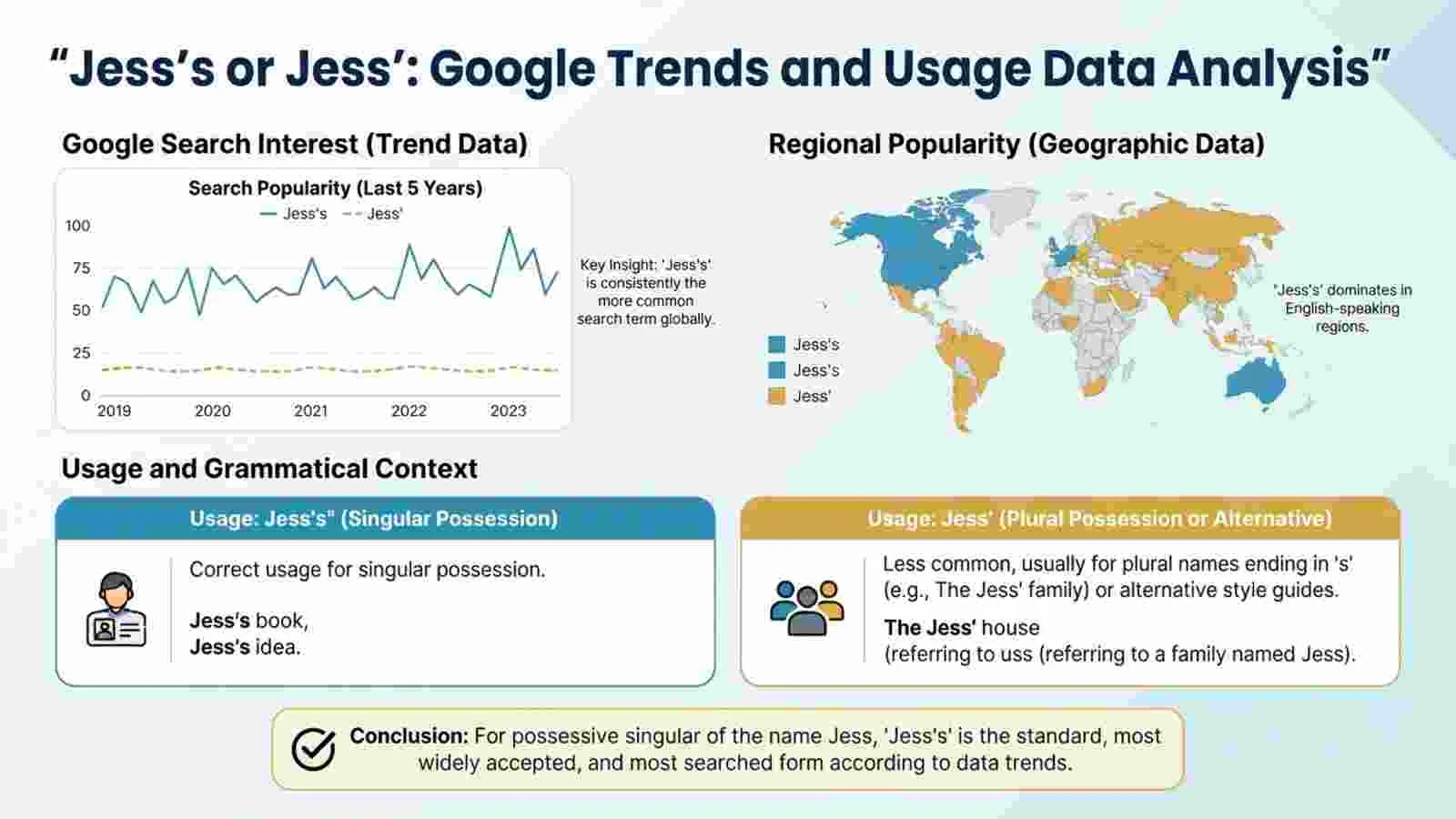
People searching for “Jess’s or Jess’” usually want a quick grammar answer. They may be writing a school assignment, checking a name in a document, or editing content for a website.
Search interest in possessive forms can vary by country, publication style, and context. However, exact popularity rankings for Jess’s and Jess’ should not be claimed without checking current Google Trends data.
Google Trends can help compare the relative search interest of these terms over a selected period and in selected regions. Its figures represent relative search interest, not the total number of searches.
To compare the forms fairly:
- Open Google Trends.
- Enter “Jess’s” and “Jess’” as separate search terms.
- Select the country or region you want to study.
- Choose a time range, such as the past 12 months.
- Compare the interest graph and related queries, if available.
Be careful when interpreting the results. Apostrophes may affect how search terms are processed, and a low trend score does not mean a spelling is incorrect.
For SEO articles, answer the spelling question directly near the beginning. Then explain the grammar rule, show examples, and include regional guidance. This approach helps readers who want a quick answer and those who need a detailed explanation.
Frequently Asked Questions
1. Is Jess’s or Jess’ correct?
Both forms can be correct. Jess’s follows the common rule of adding apostrophe + s to a singular name. Jess’ is accepted by some style guides.
2. Is Jess’s more common in American English?
Jess’s is widely used in American English because many American style guides recommend adding s after the apostrophe for singular possessives ending in s.
3. Do British people use Jess’?
Yes. Jess’ appears in some British writing, but Jess’s is also widely used. The preferred form depends on the publisher or style guide.
4. Does Jess’s mean Jess is?
Sometimes. In a sentence such as “Jess’s happy,” the form may mean “Jess is happy.” In “Jess’s bag,” it shows possession. The context determines the meaning.
5. Should I use Jess’ in a formal essay?
Use Jess’ only if your required style guide allows or prefers it. Otherwise, Jess’s is a practical choice for most formal writing.
6. Is Jess’ a plural form?
No. Jess’ is generally a possessive form when referring to one person named Jess. A plural form for several people with that name would be written differently.
7. How can I remember the correct spelling?
Remember this simple rule: for a singular name ending in s, add apostrophe + s unless your style guide says otherwise. For most general writing, choose Jess’s.
8. Is jesss a word?
No, jesss is not a word. The correct spelling is Jess, and the possessive is Jess’s (or Jess’ by some style guides).
9. What does Jess mean?
Jess is a name, usually the short form of Jessica or Jesse.
10. Jesss or Jess — which is correct?
Jess is correct. Jesss is a misspelling — do not add an extra s to Jess.
11. What is the possessive of Jess?
The possessive of Jess is usually Jess’s — for example, “Jess’s book.” Jess’ is also accepted by some style guides.
12. How do you spell Jess?
Spell it J-E-S-S: Jess, with two s’s — do not write Jesss with three s’s.
Conclusion
The choice between Jess’s and Jess’ can seem confusing, but the rule is easy to understand once you know why the two forms exist. Both can show that something belongs to a person named Jess. The difference comes from the spelling rules followed by different writers, editors, and publishers.
Jess’s is a strong default for modern English writing. It follows the common singular possessive rule and is widely used in American English and many other contexts. Jess’ is also accepted by some style guides, including certain British publishing styles.
When writing for school, work, a website, or a formal publication, check whether a specific style guide is required. If there is no special rule, use Jess’s and keep the spelling consistent throughout your text.
Remember that an apostrophe is important because it marks possession. Do not leave it out or confuse a possessive form with a plural. Also, pay attention to context because Jess’s can sometimes mean “Jess is” or “Jess has” in a contraction.
In short, use Jess’s as your general choice, follow your required style guide, and write with confidence.
Continue Reading:
- Mum vs Mom: Meaning, Differences, and Usage ( for 2026)
- Metre vs Meter: Meaning, Spelling, and Usage Explained ( for 2026)
- Liter vs Litre: Meaning, Difference, and Usage ( for 2026)
- Cuter or Cutier: Correct Spelling, Meaning, and Usage ( for 2026)
- Selfs or Selves: Meaning, Grammar, and Examples (for 2026)

Here’s a concise 2-line author bio suitable for Simifind.com:
James Dashner is an American bestselling author best known for The Maze Runner series and other popular young-adult fiction.
On Simifind.com, he shares clear, engaging insights and helpful content for readers interested in books, writing, and popular literature.


5 thoughts on “Jess’s vs Jess’: Meaning, Rules, and Examples ( for 2026)”