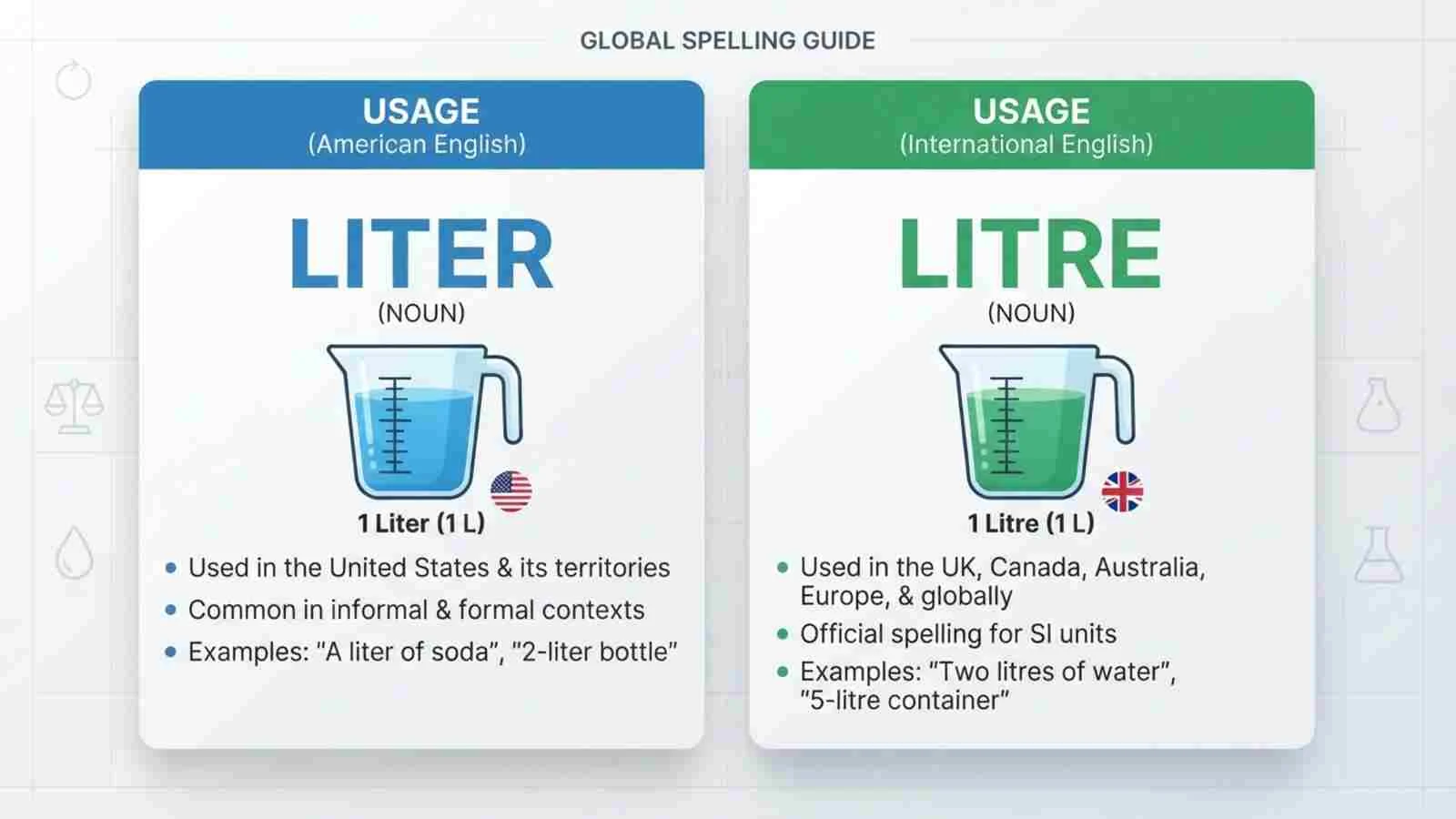
Both liter and litre are correct. Liter is American English, litre is British English. Both mean the same unit of volume (1 litre = 1,000 millilitres).
Have you ever wondered whether to write liter or litre?
Both spellings are correct. They mean the same thing and refer to a unit used to measure liquid volume. The only difference is where each spelling is common.
People often search for “liter or litre” when writing school assignments, shopping lists, product labels, news articles, or formal documents.
The two spellings can seem confusing, especially when English changes from one country to another.
In American English, liter is the standard spelling. In British English, litre is the usual form.
The same regional pattern appears in many countries that follow British English, such as the United Kingdom, Australia, and New Zealand.
For example, an American may write “a two-liter bottle of water,” while a British writer may use “a two-litre bottle of water.” Both sentences are correct.
This guide explains the meaning, origin, spelling rules, and everyday use of both words.
You will also learn which spelling to choose for your audience, how to avoid common mistakes, and how regional spelling affects professional writing.
By the end, you will know when to use liter and when to use litre.
Liter or Litre – Quick Answer
Liter is the American English spelling, while litre is the British English spelling. Both words have the same meaning.
A liter or litre is a metric unit used to measure volume, especially liquids. One liter equals 1,000 milliliters.
Examples:
- American English: I bought one liter of milk.
- British English: I bought one litre of milk.
- American English: This car has a 50-liter fuel tank.
- British English: This car has a 50-litre fuel tank.
Neither spelling is wrong. The best choice depends on your audience and the style of English you are using.
The Origin of Liter and Litre
The word liter comes from the French word litre. The French term is linked to the older Greek word litra, which referred to a unit of weight or measure.
The liter became part of the metric system in France during the late eighteenth century. The metric system was created to make measurements easier and more consistent.
As the metric system spread, the word entered English. Over time, different English-speaking countries adopted different spelling styles.
American English often favors simpler spellings. This is why Americans write liter, meter, and center.
British English generally keeps the spellings litre, metre, and centre. These differences became common through regional language conventions and spelling reforms.
Today, both forms are accepted. The difference is not about meaning, measurement, or accuracy. It is simply a difference in regional spelling.
British English vs American English Spelling
The main difference between liter and litre is regional usage.
American English uses liter. British English uses litre. Many countries that follow British spelling also use litre, although local writing standards may vary.
Comparison Table: Liter vs Litre
| Feature | Liter | Litre |
| English variety | American English | British English |
| Meaning | Unit of volume | Unit of volume |
| Symbol | L | L |
| Milliliters in one unit | 1,000 | 1,000 |
| Common usage | United States | UK, Australia, New Zealand |
| Example | A one-liter bottle | A one-litre bottle |
| Correct spelling? | Yes | Yes |
Examples of Regional Spelling
American English:
- The recipe needs two liters of water.
- My car has a 1.5-liter engine.
- The store sells three-liter bottles of soda.
British English:
- The recipe needs two litres of water.
- My car has a 1.5-litre engine.
- The shop sells three-litre bottles of fizzy drink.
Both groups of examples are correct. The key is to follow one spelling style throughout your writing.
Why Do the Spellings Differ?
American and British English developed different spelling habits over time. American spelling often favors forms such as liter, while British spelling commonly retains litre.
These differences also appear in other words:
| American English | British English |
| Liter | Litre |
| Meter | Metre |
| Center | Centre |
| Theater | Theatre |
| Fiber | Fibre |
| Kilometer | Kilometre |
These pairs show that spelling can change by region without changing a word’s meaning.
Which Spelling Should You Use?
The right spelling depends on who will read your content.
For American Readers
Use liter when writing for an American audience. This applies to blog posts, schoolwork, product descriptions, recipes, and business documents.
Example: “Add one liter of water to the mixture.”
For British and Commonwealth Readers
Use litre when following British English conventions. This is common in the United Kingdom, Australia, and New Zealand.
Example: “Add one litre of water to the mixture.”
In Pakistan, both forms may be understood, but litre is common in British-influenced educational and formal writing. Follow the style guide required by your school, workplace, publisher, or client.
For International Websites
If your website targets readers around the world, choose the spelling that matches your main audience. You can also explain both spellings when discussing language differences.
For SEO articles, the keyword may use either form. If your focus keyword is “liter or litre,” include both naturally in the article.
Avoid switching between American and British spellings without a clear reason. Consistency makes your writing easier to read and more professional.
Common Mistakes with Liter and Litre
Although both spellings are correct, writers often make a few mistakes.
1. Thinking One Spelling Is Always Wrong
Incorrect idea: “Litre is a spelling mistake.”
Correction: Both liter and litre are correct. Their use depends on the regional style of English.
2. Mixing Spelling Styles
Example: “The car has a 2-litre engine, and the tank holds 50 liters.”
This sentence mixes British and American forms. It may be understood, but consistent writing is better.
Better American version: “The car has a 2-liter engine, and the tank holds 50 liters.”
Better British version: “The car has a 2-litre engine, and the tank holds 50 litres.”
3. Confusing Liters with Milliliters
A liter is larger than a milliliter. One liter equals 1,000 milliliters.
For example, 500 milliliters is half a liter.
4. Using the Wrong Unit Symbol
The standard symbol for the liter is L. The symbol does not change between American and British English.
Examples:
- 1 L
- 2 L
- 750 mL
Unit symbols are not normally pluralized. Write “5 L,” not “5 Ls.”
5. Forgetting the Regional Audience
A British customer may expect litre on a product description, while an American reader expects liter. Check your audience before publishing.
Liter or Litre in Everyday Examples
Both words appear in daily communication. The spelling you choose should match your audience and writing style.
In Emails
American English: “Please order ten liters of drinking water for the office.”
British English: “Please order ten litres of drinking water for the office.”
In News Articles
American English: “The company announced a new one-liter bottle.”
British English: “The company announced a new one-litre bottle.”
On Social Media
American English: “I drink about two liters of water each day.”
British English: “I drink about two litres of water each day.”
In Recipes
American English: “Pour one liter of milk into the pan.”
British English: “Pour one litre of milk into the pan.”
In Formal and Academic Writing
American English: “The experiment used three liters of distilled water.”
British English: “The experiment used three litres of distilled water.”
In Product Descriptions
American English: “Reusable 1-liter water bottle.”
British English: “Reusable 1-litre water bottle.”
These examples show that the meaning stays the same. Only the spelling changes.
Liter or Litre – Google Trends and Usage Data
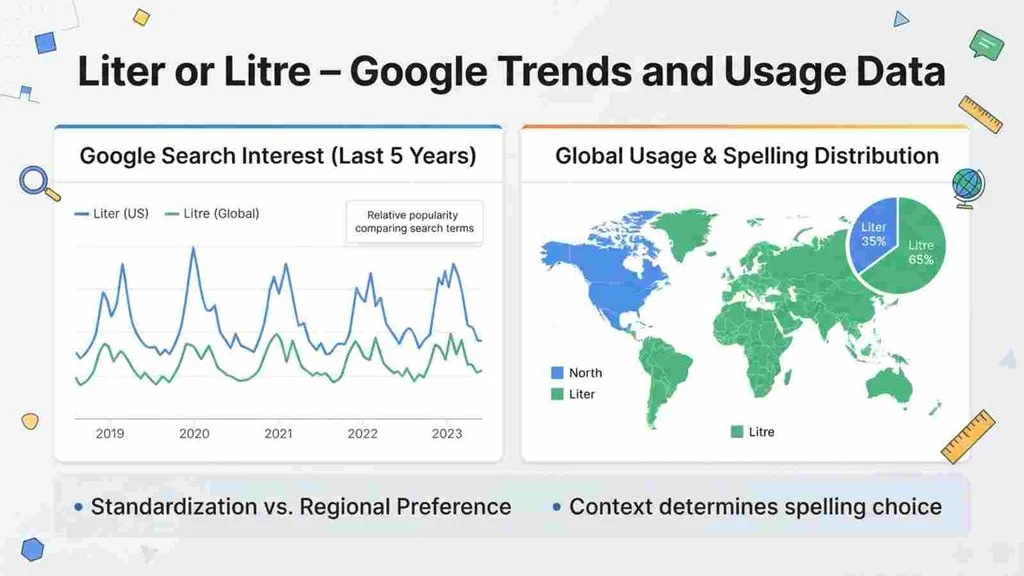
Search interest in “liter or litre” can vary by country, audience, and context. People may search for the difference when studying English, writing product descriptions, preparing assignments, or checking spelling.
American users are generally more likely to use liter in everyday writing. Users in the United Kingdom and other British-English markets commonly use litre.
However, exact search volumes and country-by-country popularity can change over time. Without current Google Trends data, it would be misleading to provide exact rankings or percentages.
You can compare the terms yourself using Google Trends by entering “liter” and “litre,” choosing a time range, and comparing countries such as the United States, United Kingdom, Australia, and Pakistan.
For SEO purposes, consider these related keywords:
| Keyword variation | Search intent |
| Liter or litre | Compare spellings |
| Liter vs litre | Understand the difference |
| Is it liter or litre? | Check correct spelling |
| One liter or one litre | Find the correct form |
| Liter meaning | Learn the definition |
| Litre meaning | Learn the definition |
| Liter to milliliters | Convert volume |
| How many milliliters in a litre? | Find a measurement |
Use these phrases naturally. Helpful explanations, clear examples, and answers to common questions are more valuable than repeating keywords too often.
Frequently Asked Questions
1. Is it liter or litre?
Both are correct. Liter is the standard American English spelling, while litre is the standard British English spelling.
2. Which spelling is used in the USA?
The United States uses liter. For example, Americans usually write “a two-liter bottle.”
3. Which spelling is used in the UK?
The United Kingdom uses litre. For example, British writers usually write “a two-litre bottle.”
4. Is litre British English?
Yes. Litre is the standard British English spelling and is also common in other countries that use British spelling conventions.
5. Do liter and litre mean the same thing?
Yes. Both refer to the same metric unit of volume. One liter or litre equals 1,000 milliliters.
6. What is the symbol for liter or litre?
The standard symbol is L. For example, 1 L means one liter or one litre. The symbol stays the same in both spelling systems.
7. Which spelling should I use in Pakistan?
In Pakistan, litre is common in British-influenced formal and educational writing. However, follow the spelling rules requested by your school, employer, or target publication.
8. What does liter mean?
Liter means a metric unit of volume used to measure liquids — for example, “a liter of milk.”
9. What does litre mean?
Litre means the same as liter: a metric unit of volume, equal to 1,000 millilitres — for example, “a litre of water.”
10. What is the difference between liter and litre?
The only difference is spelling: liter is American English, litre is British English. The meaning and measurement are the same.
11. Is litre a word?
Yes, litre is a real English word. It is the British English spelling of liter.
12. How do you spell litre?
Spell it L-I-T-R-E: litre, with -re at the end, not -er.
Conclusion
The choice between liter or litre is simple once you understand the difference between American and British English. Both words have the same meaning, and neither spelling is incorrect.
Use liter when writing for readers in the United States. Choose litre when writing in British English or following a style guide that uses British spelling.
In countries such as Pakistan, the United Kingdom’s spelling conventions often influence formal writing, so litre is a useful default when no other style is specified.
Remember that one liter or litre equals 1,000 milliliters. The unit’s meaning and measurement remain the same regardless of spelling. The symbol L is also the same in both varieties of English.
For websites, blogs, emails, school assignments, and professional documents, consistency matters most. Choose the spelling that suits your audience and use it throughout your text.
If you are writing an SEO article, explain both forms so readers can find the answer they need. With these simple rules, you can use liter and litre with confidence in everyday and formal writing.
Continue Reading:
- Analysis or Analyses: Definition, Pronunciation, and Usage( for 2026)
- Yourself vs Your Self: Grammar, and Sentence Examples ( for 2026)
- Bearer vs. Barer: Meaning, Differences, and Usage ( for 2026)
- Cuter or Cutier: Correct Spelling, Meaning, and Usage ( for 2026)
- Selfs or Selves: Meaning, Grammar, and Examples (for 2026)

Mary Roach is an American science writer and bestselling author known for making unusual and complex scientific topics engaging, accessible, and humorous. Her books include Stiff, Packing for Mars, Gulp, and Fuzz.
Author at Simifind.com, sharing clear, informative content designed to help readers understand interesting topics and everyday questions.





3 thoughts on “Liter vs Litre: Meaning, Difference, and Usage ( for 2026)”